BlueRun Ventures Leads Galaxy Universal's First Round, Pioneering On-Site Real-Robot Interaction as the World's First — BlueRun Ventures Family Headlines

The first-generation embodied large-model robot G1 demonstrates the generalization capabilities of embodied intelligence large models.

Barely a year after its founding, it has raised over 700 million RMB in angel funding, with a valuation reaching several billion RMB.
Recently, Beijing Galaxy Universal Robot Co., Ltd. (Galbot) has gradually entered the public eye.
Despite amassing a considerable fanbase, the outside world knows surprisingly little about this "low-key" company. Public disclosures have been scarce, so we paid them a visit to dig up firsthand information about Galbot.
Galbot, short for Galaxy Bot, carries profound symbolism in its name — looking toward the future and the vast ocean of stars, delivering intelligent robots to distant galaxies to explore boundless possibilities for humanity.
The company's investors include:
In what has been dubbed a "capital winter," why has this company garnered such unanimous favor from heavyweight investors spanning top venture capital firms, industry players, and research institutions?
A recently viral demo video of Galaxy Universal's first-generation embodied large-model robot — Galbot — gives us the answer.
In the video, powered by multimodal large models and generalized embodied skills, Galbot engages in intelligent human-robot interaction and autonomously completes a series of generalized operations, painting a picture of the future for household robots.
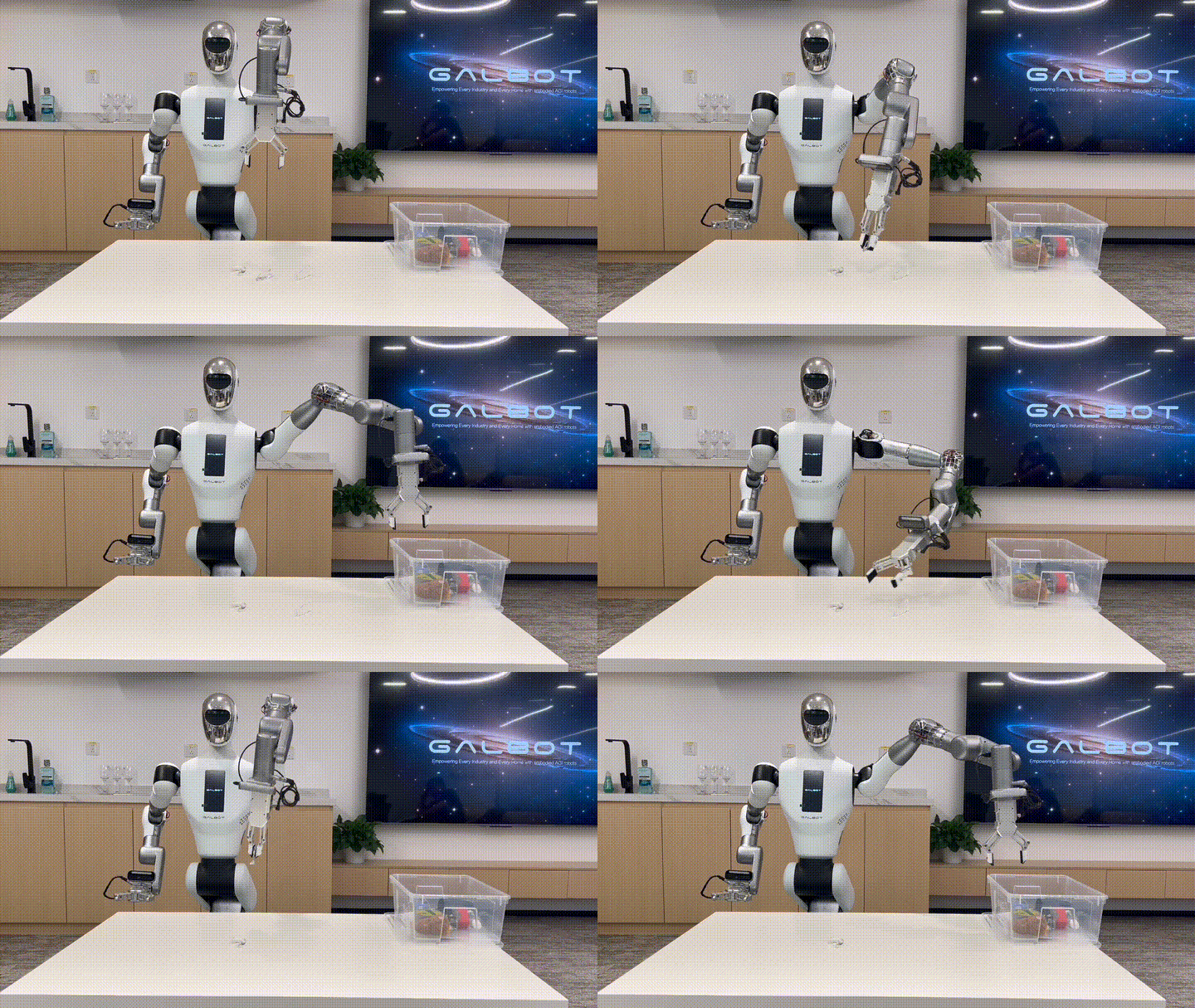
Galbot features a wheeled base, dual arms, and a folding telescopic design that dramatically expands its operational workspace.
Unlike bipedal robots that cannot bend or kneel, Galbot merges its two legs into one with a folding design, combined with a 360° omnidirectional wheeled chassis. This allows the 1.73-meter-tall robot to not only stably manipulate objects on the ground in a "squatting" posture, but even flatten its entire body to reach below ground level.
Moreover, the telescopic structure paired with seven-degree-of-freedom arms enables it to reach up to 2.4 meters when standing, easily working above 2 meters. It is the world's first known humanoid robot with a larger workspace than humans.
Beyond Galbot's elegant, agile, and exquisitely practical exterior design, what is even rarer is its extremely intelligent perceptual decision-making "brain" and its "cerebellum" for precisely controlling its body to perform generalized operations.
At the beginning of the video, Galbot effortlessly handles its owner's requests to "fetch items" and "pour water" in an open kitchen.
When the owner asks it to pour a drink, Galbot leverages multimodal large model capabilities to "see" and understand the scene, then autonomously asks the owner what type of drink they want. After the owner selects orange juice, it uses both hands to pour the juice into a cup on the table.
After a glass is accidentally broken, and faced with the owner's request to clean up the shards, Galbot demonstrates astonishing generalized perception and manipulation skills — directly identifying and grasping transparent, randomly shaped glass fragments, and disposing of them in a trash bin.
This completely breaks through the limitation of traditional robots requiring pre-programmed specifications for object material, shape, and lighting conditions, demonstrating unprecedented generalization capability.
It's not just rigid materials like glass. Even more challenging are soft objects like sweaters. Regardless of clothing style, sleeve length, or neckline shape, Galbot can generalize to hang them on clothes hangers.
To say this without exaggeration: this capability is a world-first demonstration.
However, could this silky-smooth operation and jaw-dropping generalization ability be just another staged stunt for clicks?
We can responsibly tell you: this is absolutely not staged. Galbot's real capabilities are genuinely this strong. Don't believe it? Let's walk into the scene and verify for ourselves!

A few days ago, at the 2024 BAAI Conference — known as the "AI Spring Festival Gala" — Galbot's debut instantly drew a massive crowd that surrounded the booth.
Within a ten-square-meter exhibition space featuring shelves and a coffee table, it fetched items while showing off its skills, earning gasps of amazement from the audience.
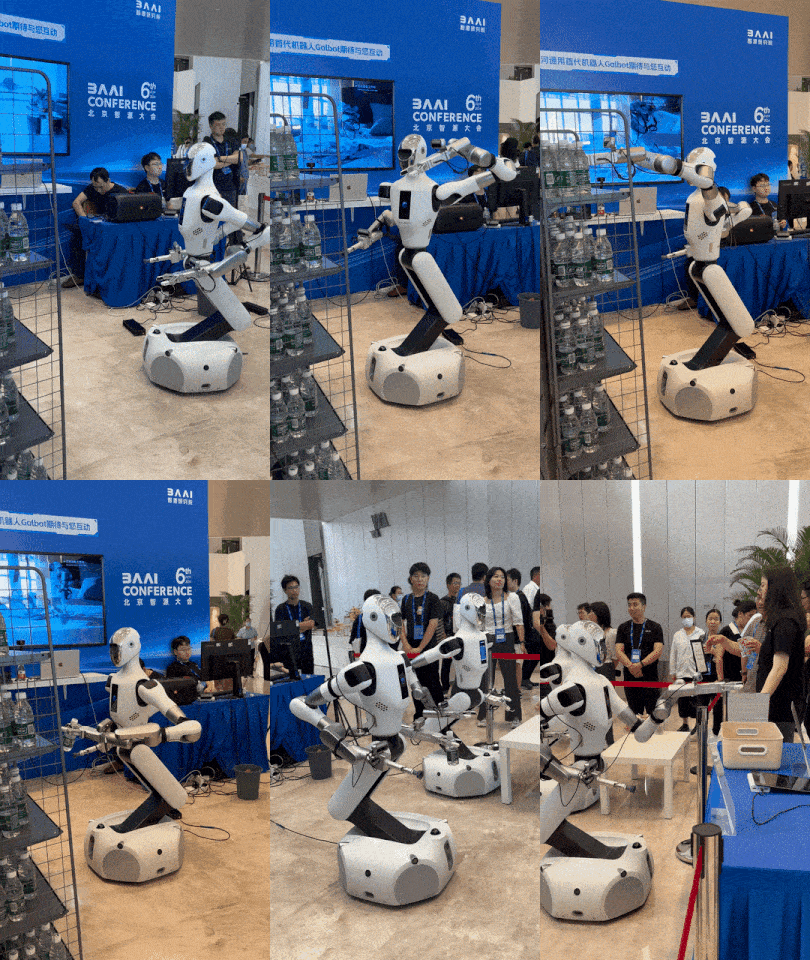
(GIF has been accelerated)
At the exhibition, we observed that there were no path markers on the ground, and no QR codes or positioning tags on the shelves. So how did Galbot achieve precise navigation and recognition in this temporarily constructed, unfamiliar environment?
Through interviews with staff, we learned this stems from Galaxy Universal's "out-of-the-box" product philosophy and its underlying robot auto-deployment technology — based on 3DGS robot automatic 3D scene semantic reconstruction. After scanning and mapping, the robot completes geometric reconstruction, semantic segmentation, and recognition of all objects in the scene, including transparent ones. This allows the robot to know the approximate location of items like an employee, navigate nearby, and then perform generalized grasping.
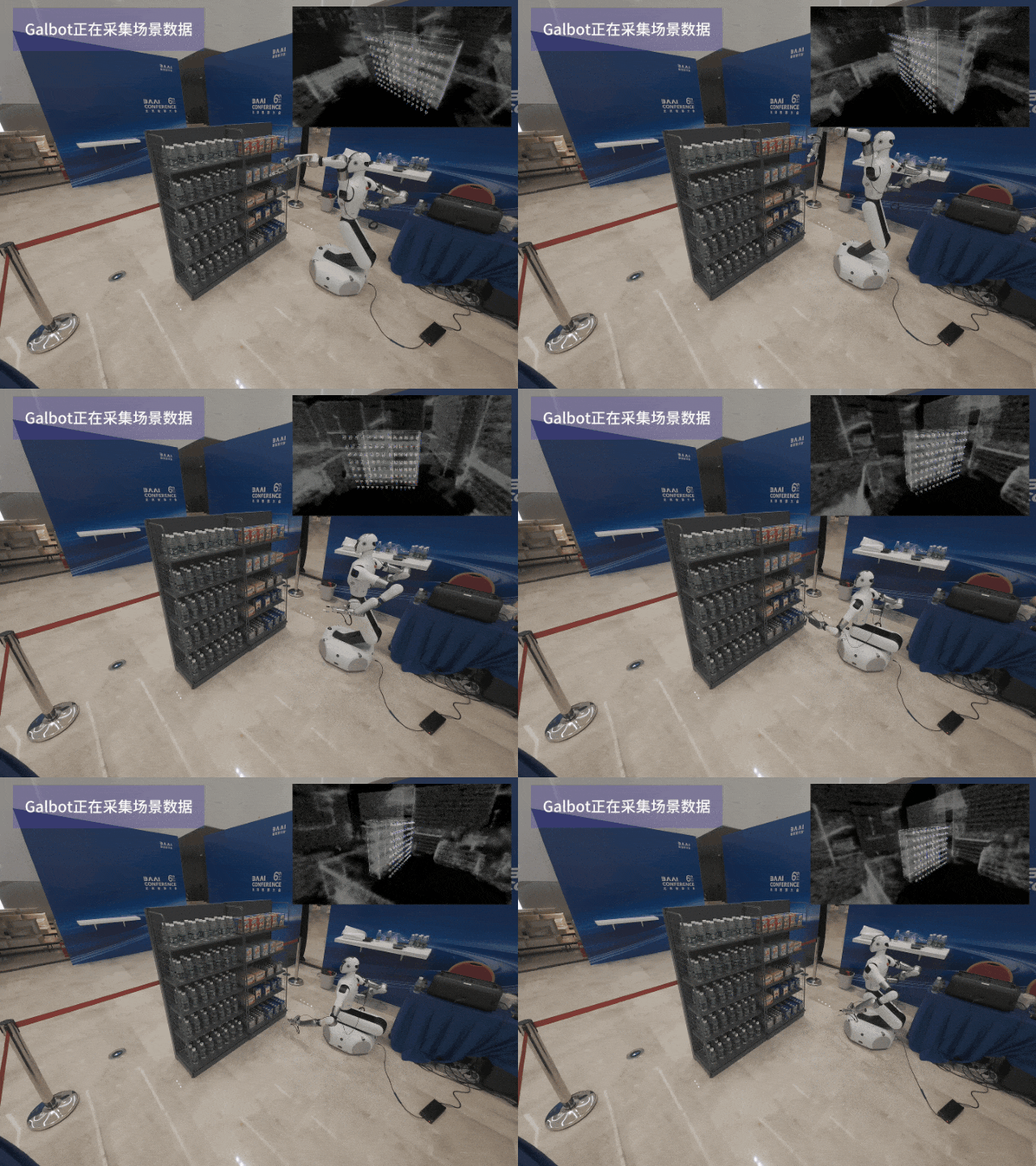
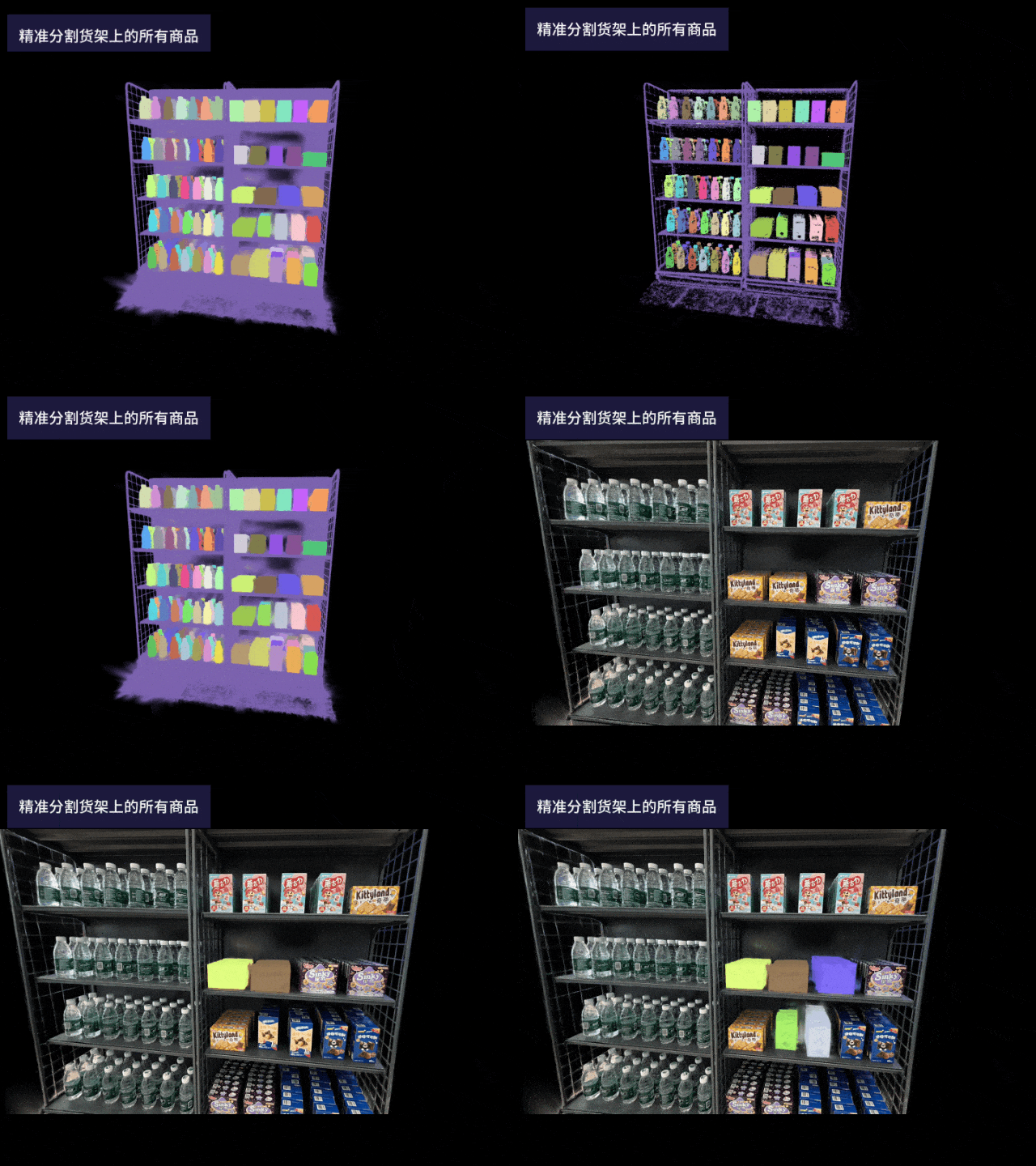
So can it really accurately identify and grasp products on the shelves? Well, this audience member put it to the test on the spot, ordering a box of cookies.
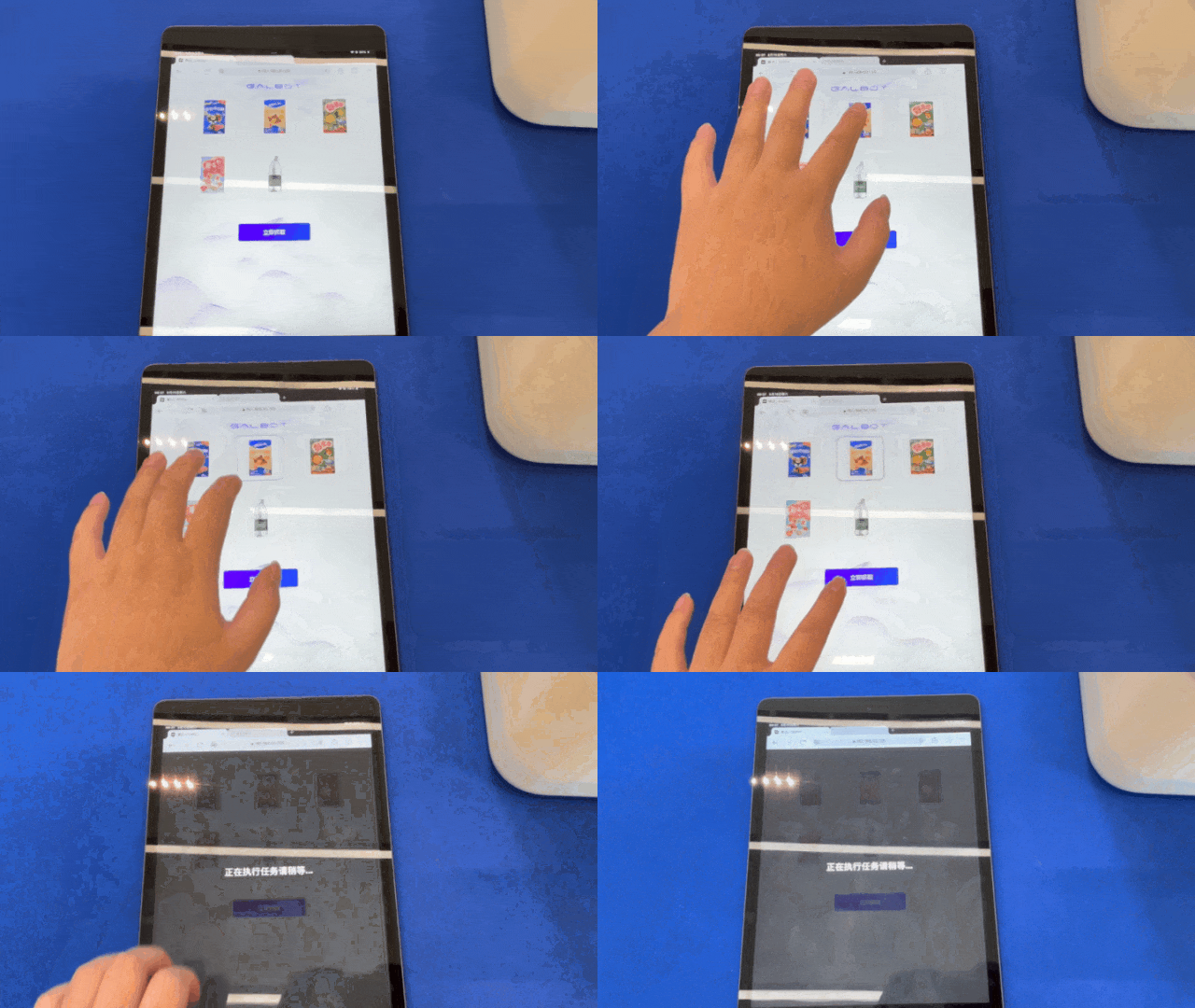
After receiving the task, Galbot began moving and adjusting its body height. After carefully observing the shelves, it spotted the target and extended its arm to accurately grab the cookies ordered by the audience member.
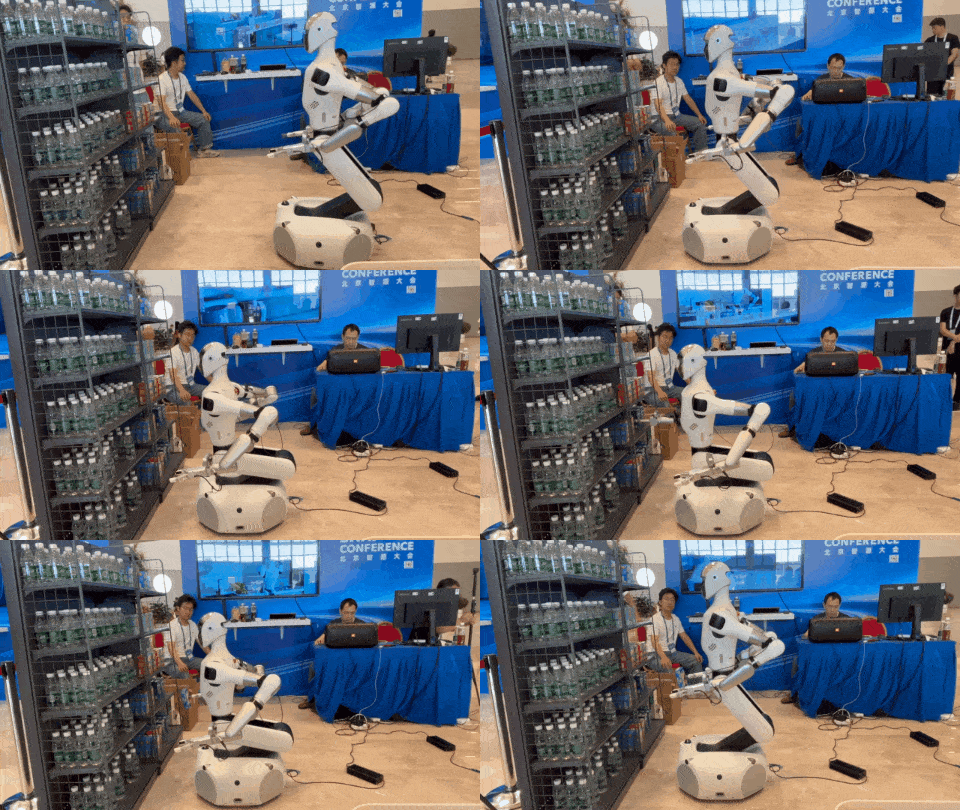
It then turned and moved to the counter, gracefully placing the cookies into the pickup basket in front of the staff member.
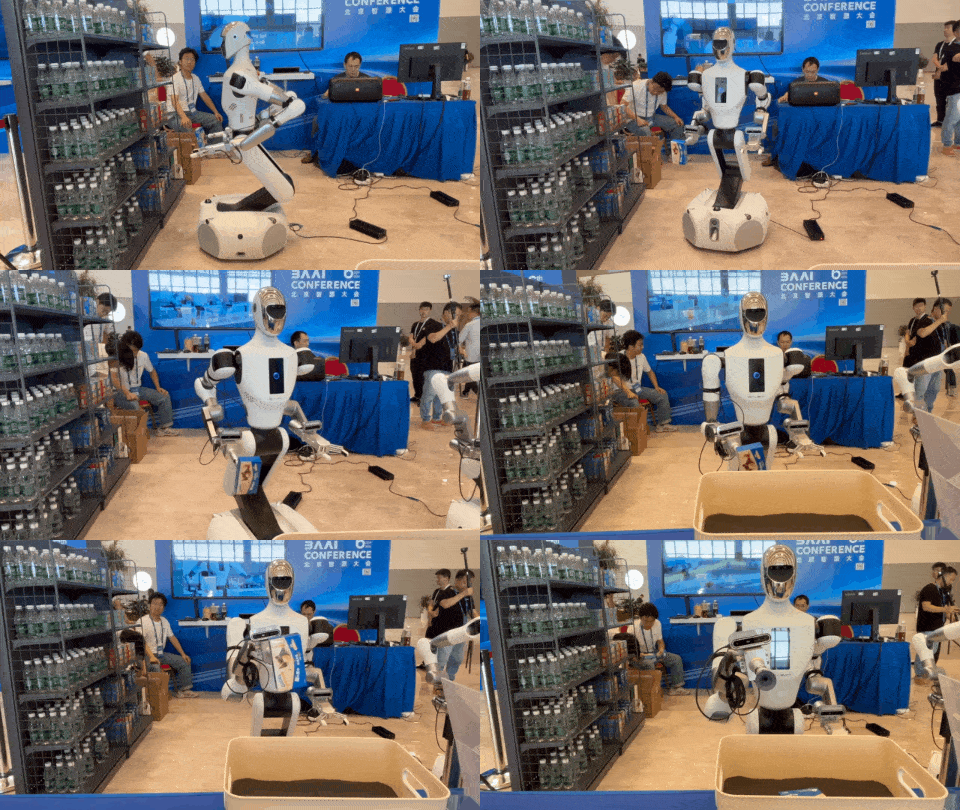
Over the two-day exhibition, Galbot worked continuously for 18 hours, serving over 800 customers and completing more than 1,000 tasks with a success rate exceeding 97%. This outstanding performance earned it round after round of applause.
On the other side of the booth, Galbot further demonstrated the generalization capabilities of its embodied intelligence large model: faced with a pile of randomly placed objects, it could understand human instructions and perform grasping and placement.
One audience member gave Galbot a command: "Galbot, grab me a plush toy." Galbot immediately accepted the instruction, precisely identifying and grasping the plush toy among multiple items.
Galbot then received many personal items randomly placed by audience members on the spot — lipstick, car keys, room cards, and other objects it had never seen before.
Regardless of variations in the grasped objects' materials, shapes, or placement positions, it successfully completed the tasks, drawing continuous exclamations from the live audience.
Beyond the BAAI Conference, Galbot has also completed live demonstrations at multiple public events including CCTV-2's Dialogue program and the 2024 China Humanoid Robot Developers Conference.

CCTV-2 Dialogue: Intelligent understanding and execution of voice commands
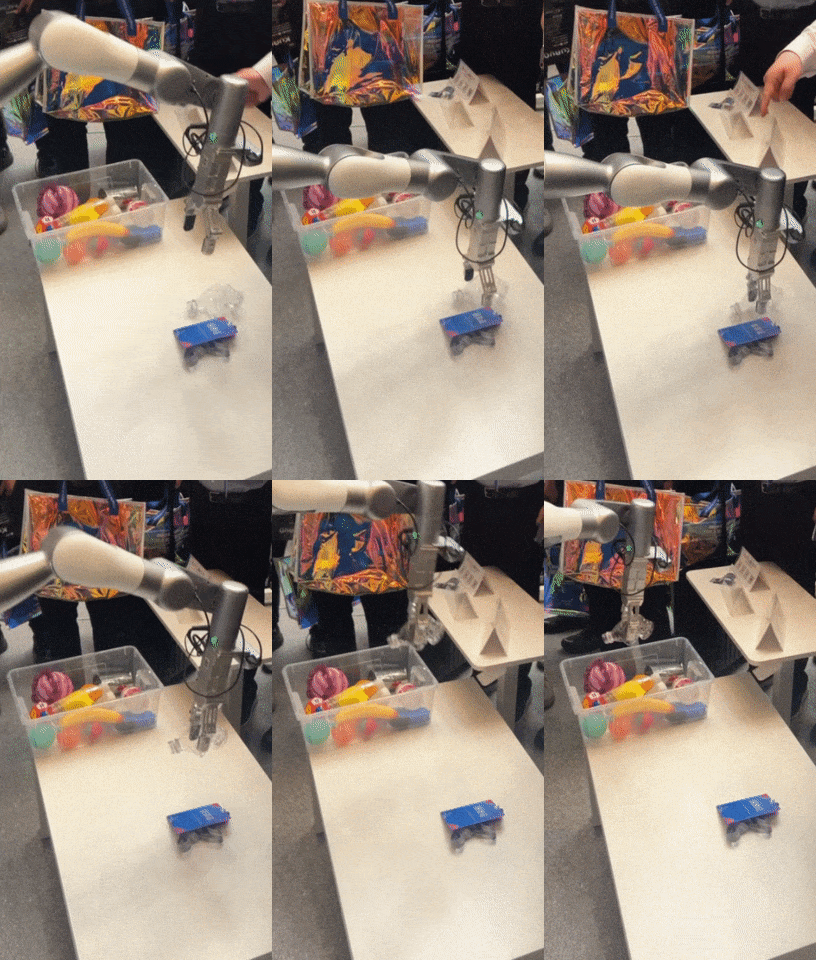
2024 China Humanoid Robot Developers Conference: Audience-provided random object grasping
Across the entire humanoid robot track, companies bold enough to conduct live on-site generalized operation demonstrations with open audience interaction are extremely rare. Galaxy Universal's move fully demonstrates the confidence of a leading enterprise in the embodied intelligent robotics field.
After large language models (LLMs) exploded in popularity, many people said: "We want robots to help us sweep floors, wash dishes, and do housework — not to write poetry, paint, or compose novels for us!" The generalized working capabilities demonstrated by Galbot may well make our dreams come true.
All the impressive generalized skill demonstrations we've seen above stem from powerful technical support behind the scenes. Today, we'll take you on a deep dive to uncover the mysterious technology behind Galbot.

To train robots in generalized manipulation skills, they must be trained across various scenes, objects, and actions — creating enormous data demands.
Take Tesla's FSD autonomous driving system as reference: it is built on data from various roads, one million vehicles, and hundreds of millions of hours of user driving actions. However, for robot manipulation data, there are currently neither enough robots nor volunteers willing to "drive" robots to collect data.
This difficult real-world data collection path has already been explored by Google's RT series and Tesla:
- Google spent 17 months collecting 130,000 data points, yet only covered one room. Once the robot stepped outside, performance dropped dramatically;
- Though Tesla assembled a 40-person team for teleoperation data collection, taking battery insertion and removal as an example: after completing teleoperation data collection, the robot still couldn't handle batteries of different models.
We can see that due to the high cost of real-world data collection and its susceptibility to scene and object limitations, data scale is severely constrained, making it difficult to achieve a high degree of generalization in embodied skills.
In fact, the lack of data has become the biggest bottleneck for embodied intelligence to achieve a "zero-to-one" breakthrough.
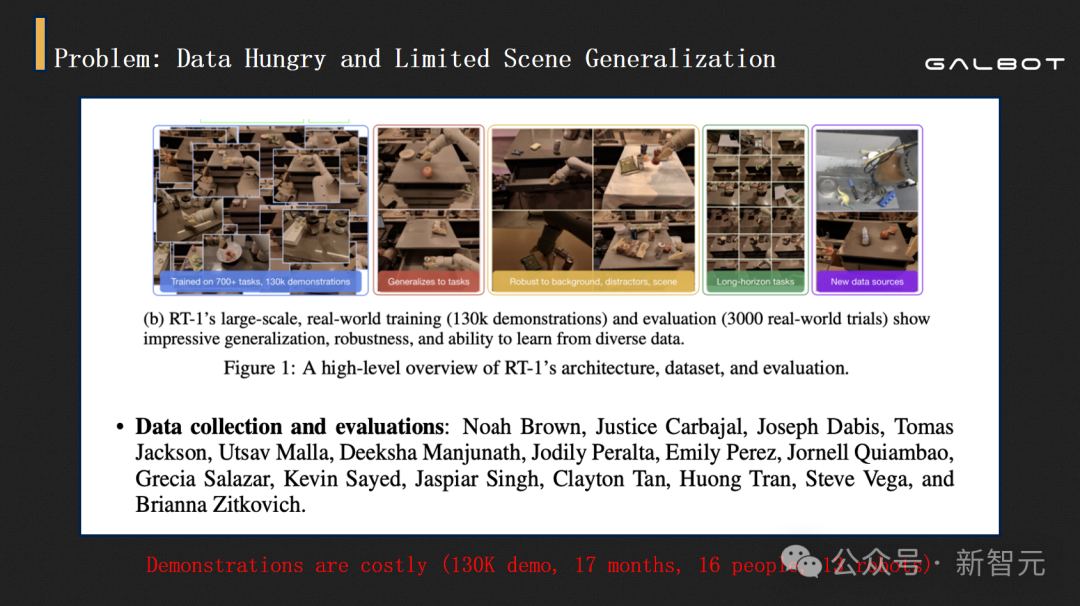
Faced with this world-class challenge, Galaxy Universal has adopted an exclusive technical path — using massive amounts of simulated synthetic data for training, then performing sim-to-real transfer (Sim2Real).
To this end, the team has developed extensive related synthetic datasets, including millions of scene-level data points and billions of manipulation data points.
Compared to real data, the advantage of synthetic data lies in its ability to break free from real-world constraints, depicting arbitrary scenes and objects, endowing robots with stronger generalization capabilities, and enabling large-scale order-of-magnitude expansion through computer graphics (CG) techniques.
The "quantity" of simulated synthetic data can be guaranteed — but what about "quality"? Compared to robots trained on real data, could this cause performance degradation? This question must be answered, otherwise Sim2Real would merely be a false proposition, degrading data to "Sim2Sim."
On this question, Galaxy Universal gives us full confidence: completely based on synthetic data and Sim2Real, without using any real-world data, the joint research team of Galaxy Universal, Peking University, and BAAI has acquired diverse, high-success-rate generalized skills.
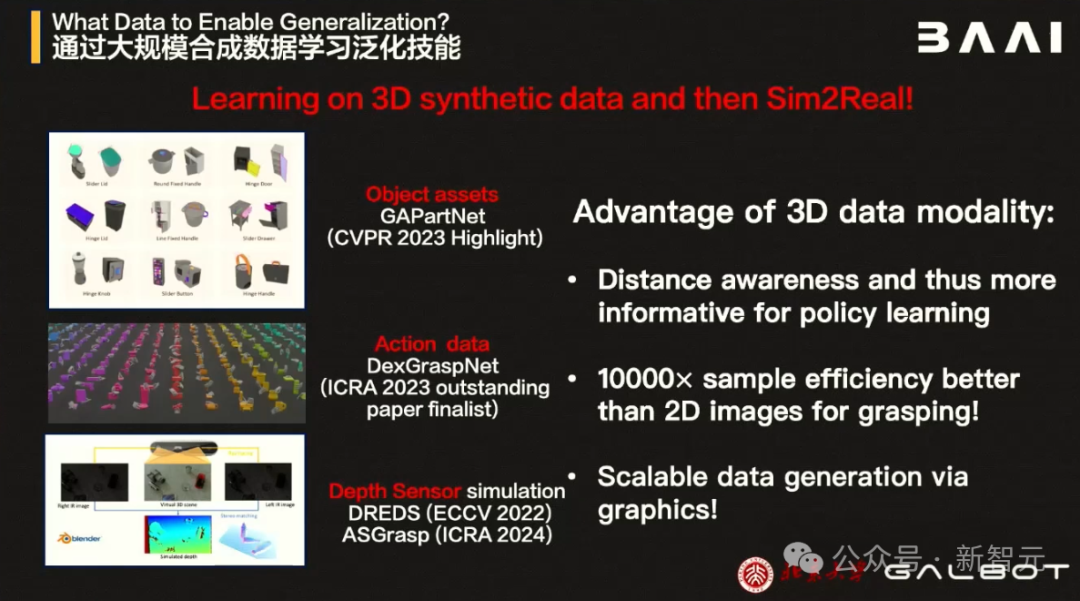
Generalized Manipulation Skill Learning: From Two-Finger Grasping to Dexterous Manipulation
Faced with the reality that Google and Tesla spent massive amounts of real data yet failed to sufficiently generalize grasping and placement, the Galaxy Universal team leveraged years of accumulated expertise to率先 achieve grasping technology with over 95% success rate for objects of arbitrary material, geometric form, and stacking configurations.
Faced with world-class challenges like generalized grasping of transparent objects, Galaxy Universal successfully obtained geometric depth that sensors cannot accurately measure through three generations of technical iteration using synthetic data, and based on this, acquired point-cloud-based grasp prediction.
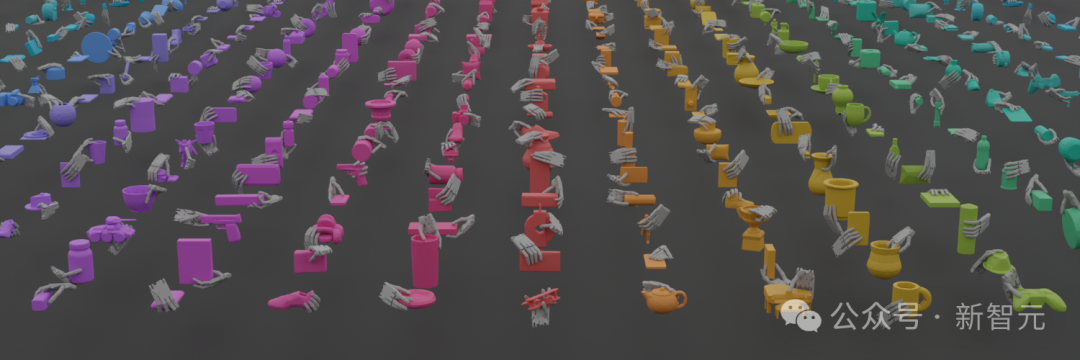
Building on two-finger grasping, Galaxy Universal is laying out the endgame for humanoid robot manipulation: dexterous hands, proposing DexGraspNet — the world's largest dexterous hand dataset.
Using a depth-accelerated differentiable force-closure estimator, Galaxy Universal achieves efficient, robust large-scale synthesis of stable and diverse dexterous grasp instances. The dataset covers 5,355 objects across 133+ categories, generating 200+ different grasp instances for each object, totaling 1.32 million.
Beyond grasping, faced with diverse manipulation tasks, the team proposed GAPartNet.
This is a "part"-centric interactive dataset containing 8,489 parts across 9 categories including lids and handles, distributed over 1,166 object instances, with rich semantic and pose annotations. This allows robots to learn object manipulation from parts, where the learned heuristics can better generalize to manipulation of unfamiliar objects.
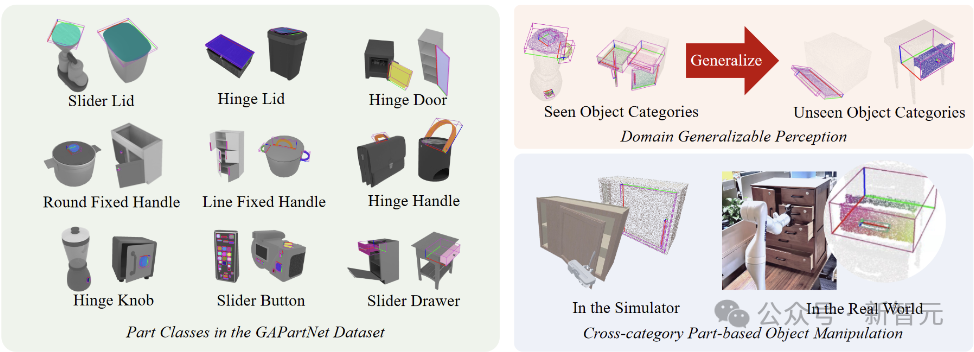
Notably, the papers for these datasets were all accepted by top-tier conferences including ECCV, CVPR, and ICRA, with GAPartNet selected as a CVPR 2023 full-score highlight paper, and DexGraspNet shortlisted for ICRA 2023 Outstanding Manipulation Paper.
This recognition from world-leading academic conferences further demonstrates the cutting-edge nature and breakthrough significance of Galaxy Universal's achievements.
Endgame-Oriented Technology: End-to-End Action Large Model Solution
Beyond numerous discrete skills, Galaxy Universal is simultaneously laying out the ultimate technology for embodied intelligence: end-to-end multimodal large models that directly output actions.
Specifically, Galaxy Universal chose to begin exploring end-to-end action large models from the lower-body navigation task.
Recently accepted by the top robotics conference RSS 2024, NaVid is the world's first video-based embodied navigation multimodal large model. Its training data encompasses 510,000 purely simulated synthetic indoor environment video navigation samples (including action planning and instruction reasoning) and 763,000 real-world video data points (without navigation tasks or action information).
Unlike existing robot navigation technologies, NaVid's most outstanding feature is its full utilization of multimodal large model advantages, and its ability to perform pure visual navigation in a human-like manner.
It relies solely on RGB video streams captured by a single-view camera, no longer requiring mapping or other sensor signals such as 3D point clouds, odometry, or depth maps as traditional navigation technologies do — avoiding the sim-to-real gap these introduce in real robot deployment.
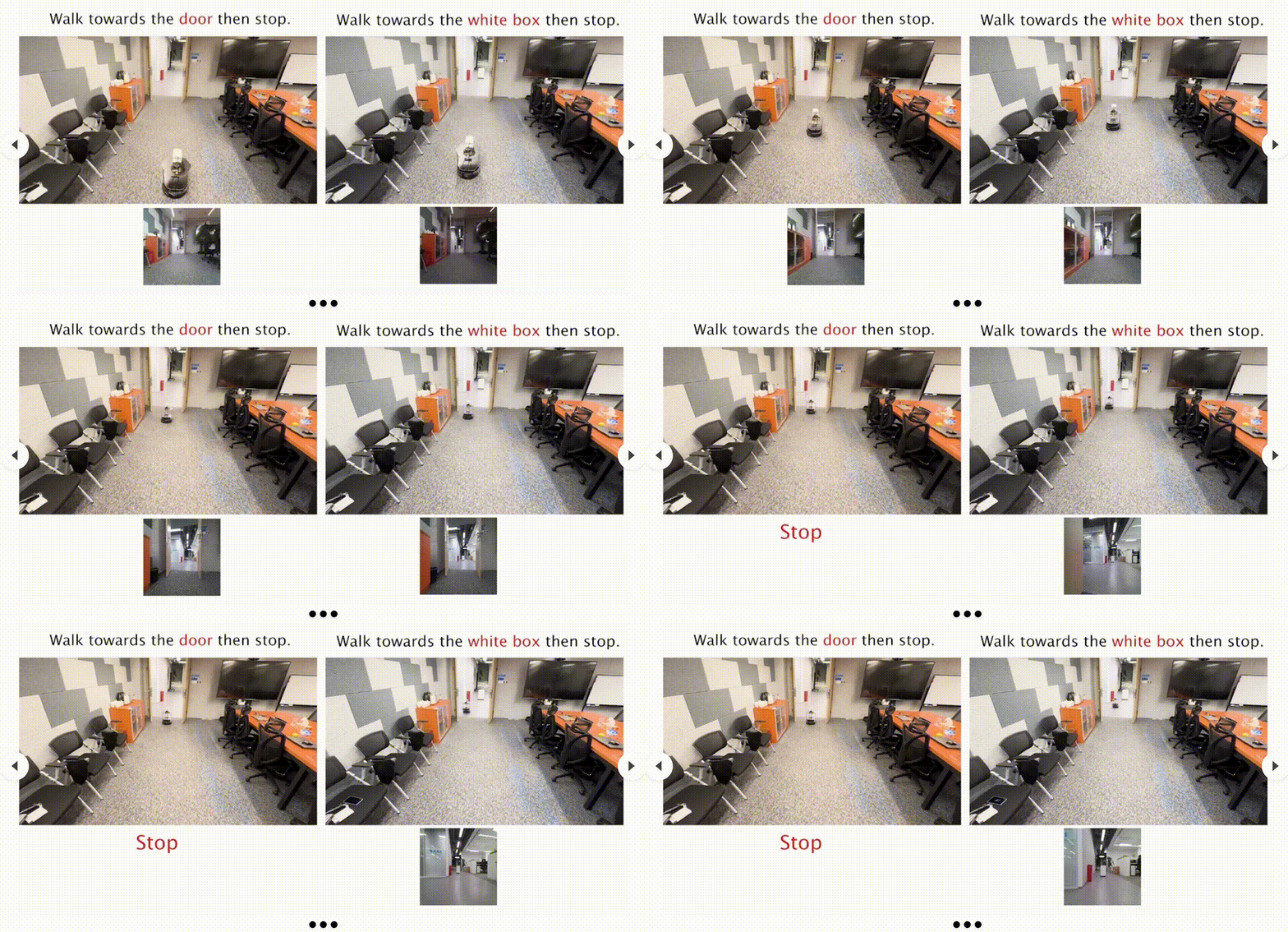
Experiments show that NaVid achieves SOTA performance in both simulated and real environments, whether cross-dataset, from indoor to outdoor, or transitioning from simulated to real environments — demonstrating exceptional generalization capability and becoming the field's first milestone research achievement using video multimodal large models for generalized navigation.
In the near future, Galaxy Universal will further extend embodied multimodal action large models to manipulation, forming a whole-body navigation-manipulation integrated robot foundation model.
In summary, Galaxy Universal's innovations and explorations in data have truly realized a simulation-to-reality (Sim2Real) data-driven path, overcoming the "zero-to-one" data bottleneck in embodied intelligence, achieving both modular generalized skills and end-to-end large model solutions, leading the development of world embodied intelligence.

What kind of team stands behind this world-leading technology startup?
In fact, despite having secured 700 million RMB in angel investment from top institutions and achieved breakthroughs in core embodied intelligent robotics technology, this company maintains its consistently mysterious and low-profile style, with the outside world knowing little about it.
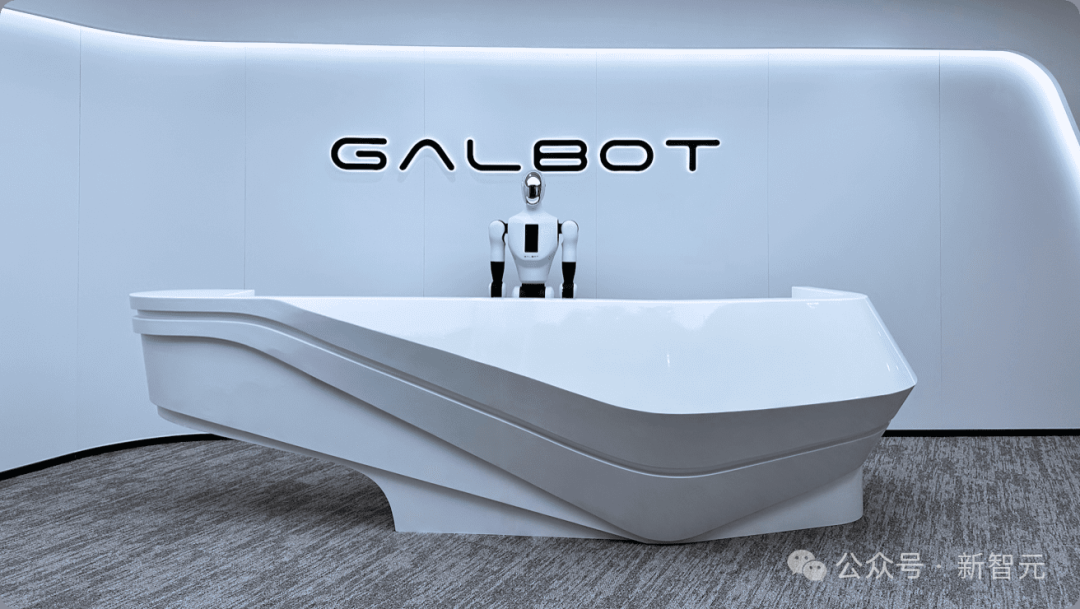
We gained first-time deep access to the internal team of this highly-watched star company — and their ability to achieve live robot generalization demonstrations within just one year comes as no surprise.
A Leading Figure in Embodied Intelligence
Speaking of embodied intelligence, we must mention Dr. He Wang, an internationally top scholar in the field. He received his PhD from Stanford University in 2021, advised by American "three-academy" academician Leonidas J. Guibas. Prior to that, he earned his bachelor's degree from Tsinghua University.
Currently, besides serving as an assistant professor at Peking University's Frontiers Computing Research Center, where he founded and leads the Embodied Perception and Interaction Computing Lab (EPIC Lab), Dr. He Wang is also director of the Embodied Intelligence Research Center at BAAI.
Regarding personal achievements, Dr. He Wang has published over 50 papers in top international conferences and journals, and received ICCV 2023 Best Paper Honorable Mention, ICRA 2023 Best Manipulation Paper, Eurographics 2019 Best Paper Nomination, and the World Artificial Intelligence Conference Youth Outstanding Paper Award, among others.
Galaxy Universal's Beijing R&D center is located in "China's Silicon Valley" — Zhongguancun, surrounded not only by numerous well-known enterprises but also within walking distance of prestigious universities such as Peking University and Tsinghua University.
Benefiting from this unique academic research advantage, Galaxy Universal has partnered with Peking University and BAAI to establish joint laboratories and research centers for embodied intelligence.
As an enterprise co-incubated by Peking University and BAAI, Dr. He Wang also serves as director of the PKU-Galaxy Universal Joint Laboratory on Embodied Intelligence, bringing dual technical accumulations from Peking University and BAAI to inject continuous innovative momentum into Galbot, pushing it to ever new heights.
A Pioneer in the Intelligent Robotics Industry
Mr. Tengzhou Yao brings profound professional expertise. He earned his master's degree from Beihang University's Robotics Institute, advised by Professor Tianmiao Wang, a titan of China's robotics industry and president of Zhongguancun Zhiyou Research Institute.
Mr. Yao previously worked at ABB Group's Shanghai Robotics R&D Center, accumulating years of experience in industrial and service robot R&D, with mass production experience for smart hardware products with sales in the tens of millions. He possesses rich industry experience in hardware product design, manufacturing, and sales.
Having assembled a cohort of top research talent from home and abroad, combined with rich commercialization experience, Galaxy Universal collaborates closely with Peking University and BAAI, gathering forces from industry, academia, and research. Not only has it successfully overcome multiple challenges in embodied intelligence technology, but it has also provided strong support for fundamental scientific research, further laying a solid foundation for cultivating future elite talent in the robotics industry.
Based on existing achievements, what layout will Galaxy Universal unfold next?

In He Wang's view, "being able to work" is the ultimate technical goal of humanoid robot R&D.
At this year's GTC conference, NVIDIA launched its humanoid robot project GR00T, aimed at creating a "Generalist Robot."
Generalist, in essence, means hoping robots can do all kinds of things.
Moreover, "generalist" has two layers of meaning: first, task generality — robots can handle various tasks and understand human instructions. Second, environment generality — robots can not only walk on flat ground but also navigate and work across challenging terrains.
The various demonstrations at the beginning of this article already show us that future employees may no longer be human beings.
In complex environments like factories and automotive plants, robots can independently complete multiple tasks, improving production efficiency while providing better collaborative environments for humans.
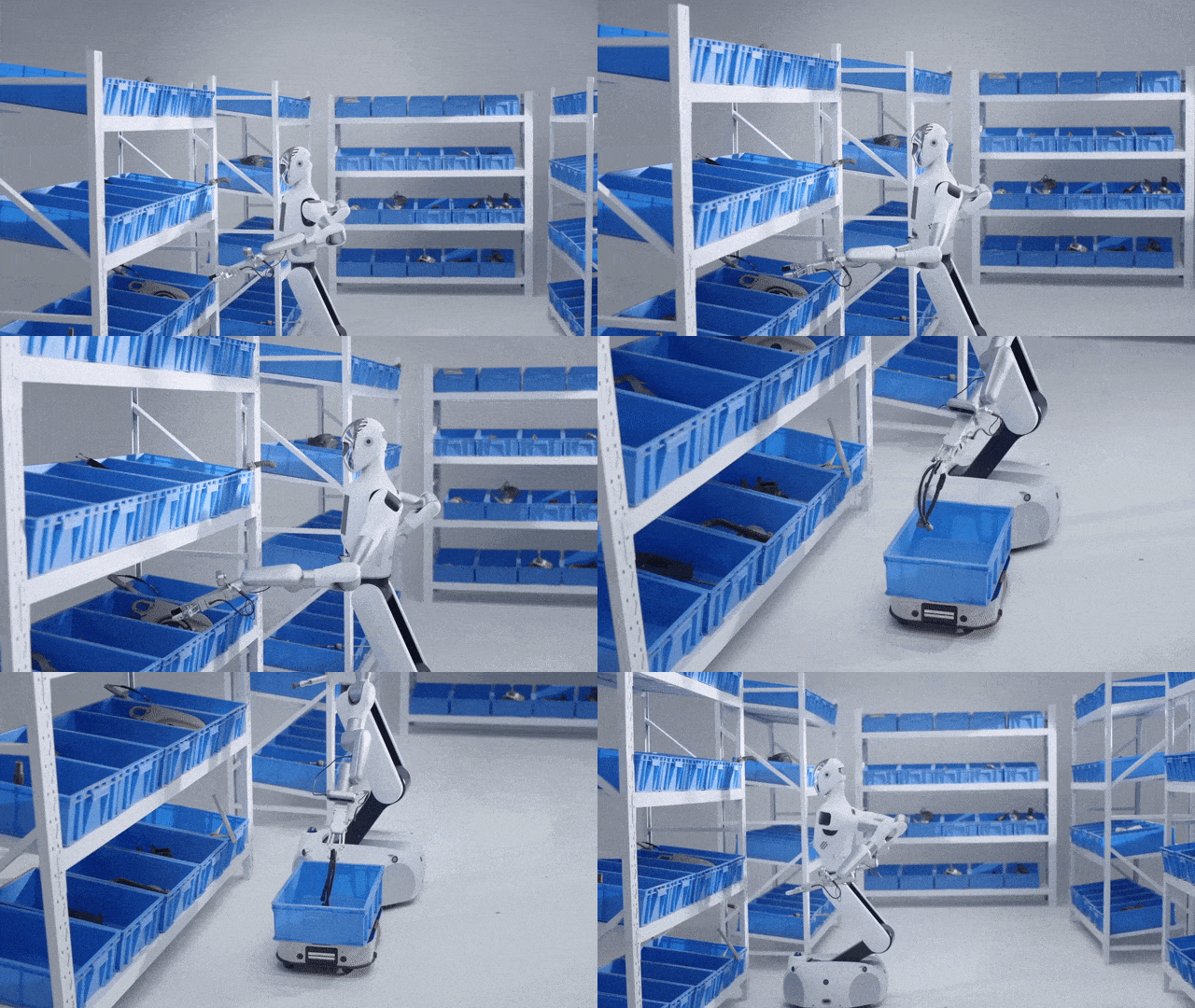
Robots can also fully handle 24-hour unmanned scenarios, completing tasks like packaging goods.
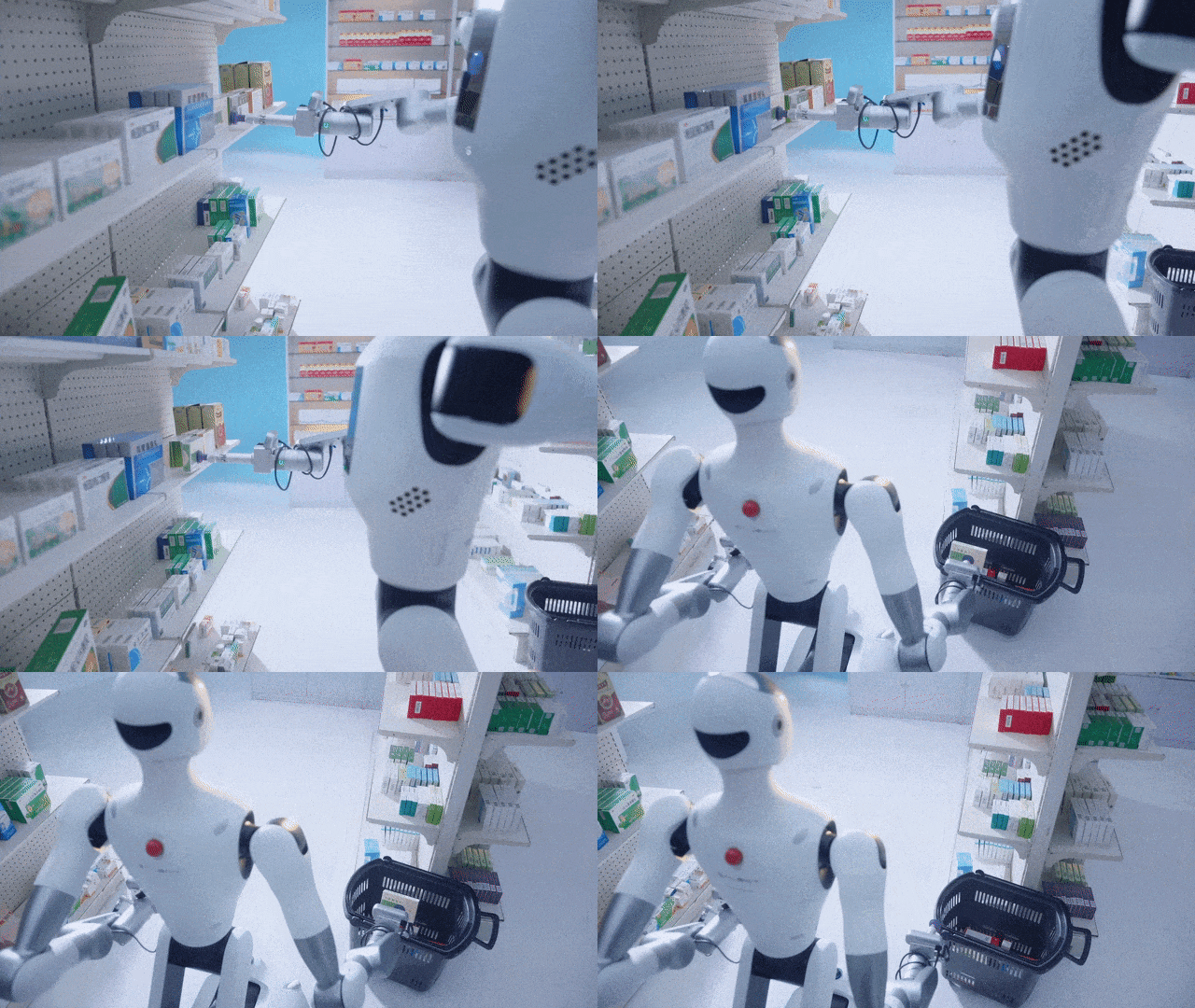
He Wang stated, "We hope robots can genuinely help humans in the most basic yet extremely tedious and complex tasks such as goods delivery in supermarkets and automotive plants, like 'line-side material fetching,' truly bringing new quality productive forces to society and endowing enterprises with new momentum."
Beyond deep deployment in retail scenarios, Galaxy Universal has also conducted in-depth scenario exchanges and landing validations in industrial, logistics, and university sectors, reaching strategic cooperation with multiple enterprises and institutions. In the future, it will further explore more application scenarios including community elderly care and household services.
That embodied intelligent robots will penetrate real-world scenarios to become human city managers, life assistants, and even work partners has long become industry consensus.
Goldman Sachs' latest research report has adjusted its market expectations for humanoid robots in 2035 — with projected scale reaching $38 billion.
Elon Musk announced at a recent shareholder meeting that the humanoid robot track will create a $35 trillion market space.
Today, both domestically and internationally, from software platforms to hardware development, from startups to tech giants, all have entered the arena.
We hope to see Chinese enterprises represented by Galaxy Universal make their mark on the world stage.
We believe that day will not be far away.


First Step in a Grand Project: miHoYo-Backed Fusion Energy Company Ignites Plasma | BlueRun Ventures Family Headlines

Sorry, BlueRun Ventures Doesn't Want That Kind of Startup Camp | Buming 2024 Now Recruiting

BlueRun Ventures and Portfolio Companies Win 36Kr China Equity Investment Industry Early-Stage Investment Institution TOP 3 and Other Awards