Can Drug Discovery Move Beyond "Finding a Needle in a Haystack"? | BlueRun Ventures Biotech Salon Highlights

We spoke with DeepWise, Xinyue Biotech, Ketu Medicine, and Leadart Medtech about innovations in drug R&D models.

Drug discovery is an experimental science. Finding a single molecule that can treat a human disease from countless candidates is like searching for a needle in a haystack.
Beyond traditional target discovery and molecular screening techniques, recent years have brought new tools and platforms — from AlphaFold 2 to chemical proteomics and single-cell screening — as underlying technologies have matured from discovery to application, alongside growing datasets and algorithmic breakthroughs.
Are there new opportunities to change this status quo? Can we move beyond the simple models of traditional drug development and use new technologies to simulate drug-molecule and protein interactions in ways that more closely resemble in vivo environments? China's new generation of biotech companies is emerging like bamboo shoots after rain — do we have advantages in developing new drugs? Has the industry reached a systemic inflection point?
Recently, BlueRun Ventures hosted an online Bio2X salon titled "Beyond 'Simple Models': A New Transformation in Drug R&D," bringing together BlueRun Ventures, DeepWise, Xinyue Biotech, Ketu Medicine, and Leadal Therapeutics to discuss R&D model innovation across AI for Science, live-cell drug screening, phenotypic screening, and chemical proteomics.
AI for Science and Its New Paradigm
Sun Weijie, Founder and CEO of DeepWise
AI for Science means using AI to first solve the underlying scientific problems of how things work, then addressing the industrial problems that these scientific problems map onto.
The most direct difference from the past AI for Industry model is that the latter relied on accumulated industry data to train AI models, extract high-value patterns, and then make predictions to solve practical problems. The Human Genome Project in life sciences followed a similar research paradigm.
A critical challenge in drug and materials R&D is that what appears to be massive data is actually trivial compared to the high-dimensional problems being solved — there's a significant asymmetry between data and the problem at hand.
In such scenarios, we can apply the AI for Science logic: although data in drug design is scarce, scientists can abstract the underlying physical, chemical, and biological principles of how drugs and materials operate, forming a series of scientific questions or established principles. We use AI to learn these scientific principles or directly solve these scientific problems, then further address practical challenges like drug and materials R&D.
The AI for Science paradigm mainly employs two methods. One: when the underlying scientific principles are relatively clear — for instance, when they can be abstracted into well-defined physics problems — we can use AI to learn physical models and solve physical equations.
Two: when we have accumulated some scientific data, but very little. In protein structure prediction, for example, there are roughly 200,000 data points, yet over 5 billion protein sequences have been identified. The severe mismatch between this data volume and the real problem it maps onto calls for solutions in few-shot learning and data generation.
DEL Live-Cell Screening Technology Combined with AI
Jin Feng, Deputy General Manager of Xinyue Biotech
DNA-Encoded Library (DEL) technology draws inspiration from monoclonal antibody discovery, using PCR sequencing to create a one-to-one correspondence between DNA tags and small-molecule structures, enabling rapid, low-cost identification of small molecules with high protein affinity. It consists of two main parts: library construction and screening. However, some membrane proteins are difficult to purify, making them inaccessible to traditional DEL screening for binding small molecules.
DEL live-cell screening can be applied to cell-based assays without requiring target protein expression and purification. Compared to previous biochemical models, cell-based screening more closely approximates real in vivo environments, leading to higher screening success rates.
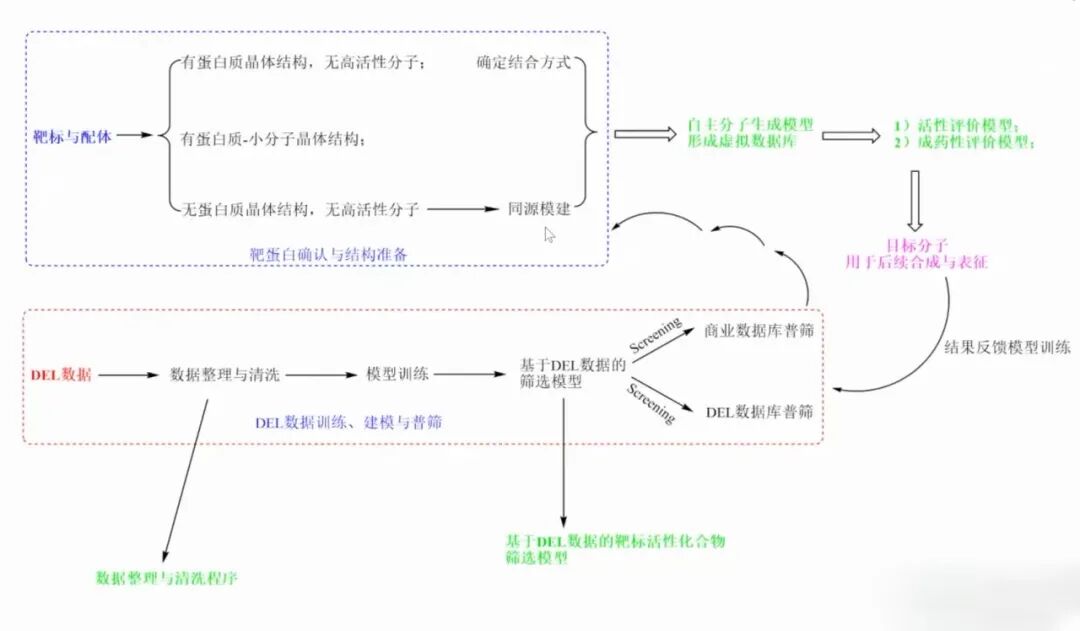
Overview of Xinyue Biotech's AI+DEL Technology
Phenotypic Screening and Drug Discovery Based on Innovative Disease Models
Sun Zhijian, Founder of Ketu Medicine
The disease model field has seen significant technological advances in recent years. Developments like organoid technology have enabled effective modeling of many diseases that previously couldn't be modeled.
Looking at model technology itself, many diseases still severely lack models or have no cell models at all. We're also increasingly focused on developing drugs for "undruggable" targets, rare mutation models, and various resistance models that emerge after targeted therapies.
These disease models apply not just to front-end Discovery, but also to Transition, Development, and Preclinical stages.
For example, in Discovery, targets are extremely precious. Statistics show roughly 600–1,500 human targets exist, with truly good ones being exceedingly rare. About 85% of companies focus on highly overlapping targets, which are often undruggable — approximately 75% of targets concentrate on kinases, GPCRs, and proteases.
Organoids can be combined with the latest CRISPR technology for genetic modification, leveraging the background characteristics of disease models themselves to efficiently enable target screening and discovery.
There are also many cases where patients are rarely seen and cell models haven't been established, including mechanisms of resistance that emerge after current targeted therapies hit the market — all worth developing through this approach. Expanding population diversity analysis through organoid biobanks also enables deeper understanding of disease.
Technical Evolution in New Drug R&D: Beyond "Simple Models"
Ni Feng, Founder and CEO of Leadal Therapeutics
The evolution of technology from bench to clinic is about transcending "simple models" — gathering as much accurate and comprehensive information as possible to inform early-stage decision-making. From large-scale computational simulation to live-cell protein DEL to organoid models, each step advances further into complex biological systems.
New drug discovery is an extremely cumbersome process of matching all chemical molecular space with biological target space. The biggest pain point is low success rate. Chemical molecular space is relatively rich — at least 10^60 molecules exist, including natural products, synthetic compounds, combinatorial libraries, and virtual libraries. Unfortunately, biological target space is relatively limited, currently comprising only protein and nucleic acid targets.
One major response is continuously improving matching efficiency. From high-throughput screening to virtual screening to today's DEL library screening, we've been constantly improving the "one research object vs. multiple research objects" process. Achieving "many-to-many" matching is our primary future direction. The most important — and most difficult — part is the very beginning: spending more time on target validation early on makes everything easier downstream.
A second strategy is expanding druggable target space. The current domestic industry remains stuck in a stock-target mindset. Shifting to an incremental-target mindset would enable greater investment in disease understanding and biological insight, bringing us closer to first-in-class drugs. There's enormous space worth exploring.
Q&A Part 1
Q: How do you view the development of drugs for difficult and novel targets? How do you see technological development and future prospects in this space?
Sun Weijie (DeepWise): The defining characteristic of difficult targets is that they're difficult. The critical point is understanding exactly why. One challenge is microscopic mechanism; another is that for difficult targets, biological pathway understanding remains insufficient, and their relationship with disease hasn't been fully established. To systematically address target problems, we need to analyze biological mechanisms more thoroughly on a target-by-target basis, then select the most appropriate model to tackle each one.
Sun Zhijian (Ketu Medicine): From my perspective, two points: 1. We need to understand the biological environment these targets inhabit. We're not treating a target — we're treating a disease, so deepening our understanding of disease and biology is essential to finding solutions. 2. What tools can we actually deploy? We now have more means to convert undruggable targets into druggable ones, based on improved biological understanding and tools that expand our capabilities.
Ni Feng (Leadal Therapeutics): Making a target druggable involves three aspects: physiology, pathology, and pharmacology. Most "undruggable" or "difficult" targets are currently infeasible during drug development, but emerging tools and technologies are gradually making previously infeasible approaches viable. Two trends: 1. Breakthroughs in rare diseases — subdividing the problem can first resolve some difficult target challenges. 2. From the chemical space perspective. Natural products co-evolved with humans and Earth's environment, making them more likely to interact with biological targets. If we can discover activity or therapeutic effects from molecular chemistry and elucidate the targets involved, we may find keys to unlock some previously undruggable targets.
Q&A Part 2
Q: How can we obtain quality data in experiments, and how can frontier biotechnologies effectively combine with AI to make fuller use of our high-quality, scarce data?
Ni Feng (Leadal Therapeutics): For practitioners from experimental backgrounds like myself, we want to surpass the efficiency and stability of manual data acquisition, so we need to build platforms that rapidly implement automation using frontier technologies. New technologies are held by a small number of early developers and are difficult to quickly disseminate, commercialize, and share data with industry partners. Therefore, I believe forming such a platform — using automation to supply data so everyone can develop scenarios on top of that data foundation — will help the biopharma industry rapidly cross its current inflection point.
Sun Zhijian (Ketu Medicine): The key to data is "correlation." Clinical settings and disease are extremely complex. How do we establish such correlations? For example, when a person takes a drug and produces a certain clinical outcome, that's a correlation. But such correlations severely limit the scale of clinical trial data. To further expand data volume, we need model-based analysis. Another dimension is establishing other functional data — the logic being that within the same biological individual or cell model, after establishing this correlation, data quality becomes an issue. We need to select for pharmacological or functional characteristics while maximizing throughput. Combined with AI, this can generate enormous value for future therapeutics and development. We can establish correlations between molecular-level changes and database information to predict clinical efficacy, or predict similar drug effectiveness at the molecular level during clinical drug development.
Jin Feng (Xinyue Biotech): What data is missing now? It's not data about substances themselves — it's data bridging chemistry and biology. What's actually needed is data establishing relationships between small-molecule structures, target proteins, and the entire biological system. Why is this missing? First, limitations in bioscience development; second, human subjectivity.
Interested friends are welcome to contact the event organizer:

Further Reading
- AI制药的新范式:从量变到质变|蓝驰生物科技沙龙精华回顾
- 蓝驰6月报 | 希望是一种甜蜜的等待
- 蓝驰创投季度投融资速览|2022 Q2
- 我们与硅谷创业者聊了什么:蓝驰举办「Web3 & SaaS Explorer Day」
BlueRun Ventures was established in Silicon Valley in 1998. BlueRun Ventures China was founded in 2005 and focuses on early-stage venture investments.
Currently, BlueRun Ventures manages multiple USD and RMB dual-currency funds in China with over RMB 15 billion in assets under management, making it one of the largest early-stage funds domestically. The firm invests primarily at Pre-A and Series A stages across hard tech and innovative interaction, enterprise technology, new consumer, and healthcare sectors, with over 150 portfolio companies including Li Auto, Waterdrop, QingCloud, Guazi.com, Qudian, Songguo Mobility, Ganji.com, Energy Monster, Yuntu Semiconductor, Machenike, CloudShen Intelligence, Anxin Network Shield, and BioMap.
BlueRun Ventures has been ranked #1 on Zero2IPO's "China Early-Stage Investment Institutions Top 30" and ChinaVenture's "China Best Early-Stage Venture Capital Institutions Top 30," and was named among Preqin's Top 10 Global Venture Capital Fund Managers for Sustained High Returns.
The firm has also received consecutive recognition from Forbes China, 36Kr, Cyzone, Caixin Media, CBNweekly, Jiemian, and other media as "China Early-Stage Firm of the Year," "China Top Venture Capital Firm," "Most Entrepreneur-Friendly Early-Stage Firm of the Year," and "Most Influential Early-Stage Firm of the Year."