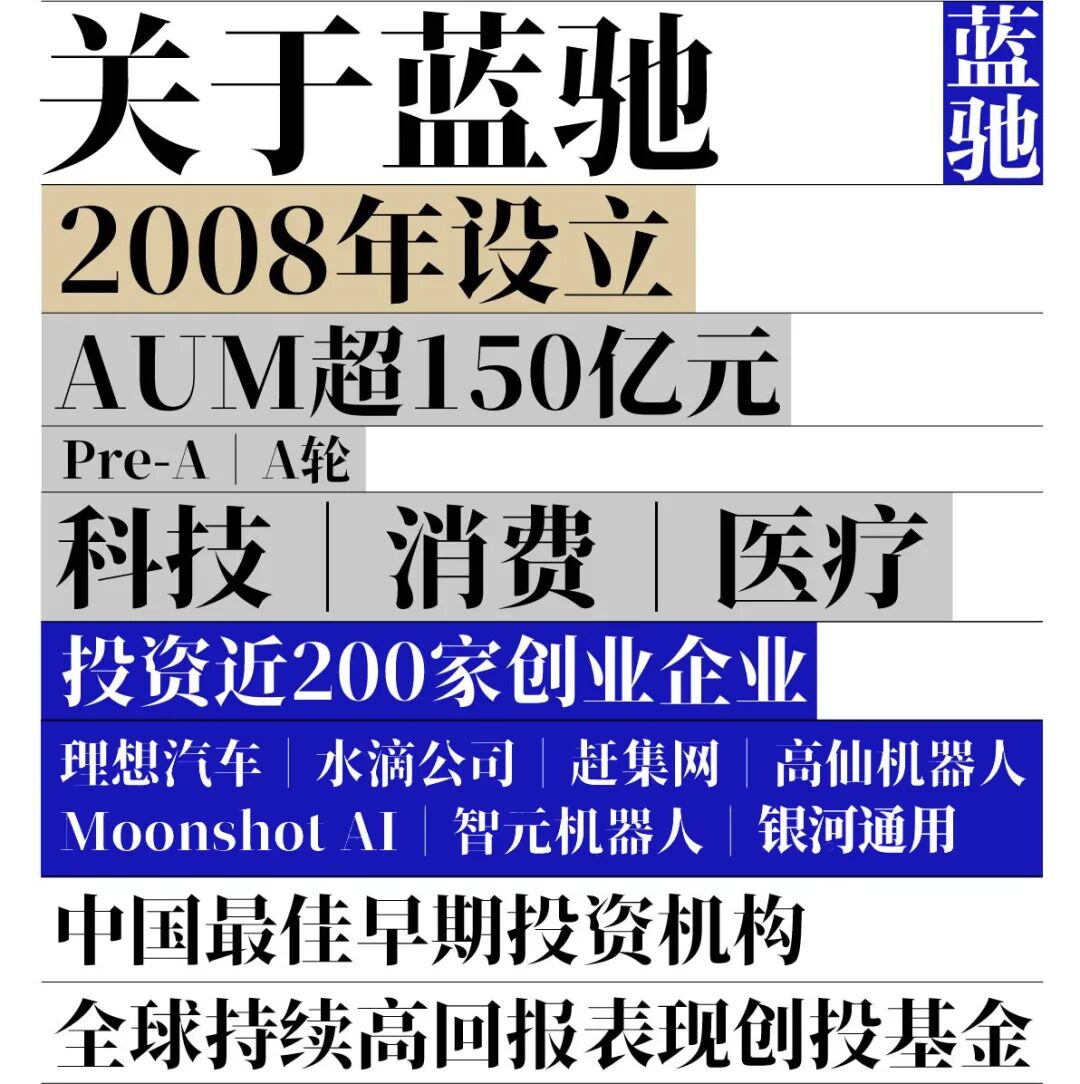
A Conversation with Lingchu AI CEO Qibin Wang: On Robotics Technology Roadmap Choices, and the Key Breakthroughs for VLA Capabilities | BlueRun Ventures Family Headlines

Peng! Play Mahjong with a robot!
第三,硬件如何与软件协同?本体设计是否适配算法需求,能否支撑长期稳定运行?
这三者之间的匹配与迭代,才是当前机器人系统构建的真正难点。
腾讯科技:你提到VLA是软件能力的核心,能否具体解释什么是VLA,以及为什么它如此关键?
王启斌: VLA是Vision-Language-Action的缩写,即视觉-语言-动作端到端系统。它的核心思想是将感知、理解和执行融为一体,而非像传统机器人那样分模块串联。
传统范式通常是:视觉模块识别物体 → 语言模块理解指令 → 规划模块生成路径 → 控制模块执行动作。每个模块独立优化,信息在传递过程中层层损耗,误差累积,最终导致"看得清却做不到"或"听得懂却抓不稳"。
VLA则试图用一个统一的模型,直接从视觉输入和语言指令映射到动作输出。这类似于自动驾驶的端到端思路,但机器人操作远比驾驶复杂——环境是非结构化的,物体是多样化的,动作要求是灵巧且接触丰富的。
判断VLA做得好不好的核心标准,我认为有两个:
一是长程任务能力。不是单一动作,而是能在复杂环境中连续完成多步骤任务,比如"从冰箱里拿出牛奶,倒入杯子,再放进微波炉加热"。这要求模型具备记忆、推理和错误恢复能力。
二是灵巧操作能力。类人手的精细控制,比如捏起一根针、拧开瓶盖、折叠纸张。这需要对接触力学、物体属性和空间关系有深度理解。
目前行业在这两点上都还有很大提升空间。
腾讯科技:既然VLA如此重要,目前行业在VLA研发上处于什么阶段?主要瓶颈在哪里?
王启斌: 坦率说,VLA领域现在还处于早期探索阶段,远未标准化。主要面临三个挑战:
第一,缺乏统一评估指标。 不同团队用不同任务、不同场景测试,结果难以横向比较。有人报告在仿真环境中成功率90%,但真机部署可能只有30%。这种"仿真到现实的鸿沟"让评估变得复杂。
第二,高质量数据稀缺且昂贵。 VLA训练需要大量"视觉-语言-动作"对齐的数据。与自动驾驶有海量路测数据不同,机器人操作数据需要真机采集,成本高、速度慢。一条高质量的"抓取-放置"轨迹,可能需要数十分钟的人工示教或远程操作。我们估算,目前全行业公开的机器人操作数据集,加起来可能还不如自动驾驶一个月的采集量。
第三,技术路线尚未收敛。 是用大规模预训练+微调,还是强化学习为主?是多模态大模型直接输出动作,还是分层架构?是用仿真数据为主,还是真机数据为主?各家路径差异很大,没有形成像NLP领域Transformer那样的共识架构。
这也是灵初智能重点投入的方向。我们提出了"Chain of Action Thought(CoAT)"框架,试图在推理透明度和动作执行之间找到平衡——让机器人不仅能做,还能"想明白"为什么这样做。
腾讯科技:能否具体介绍CoAT框架的设计思路?它与传统的思维链(Chain of Thought)有何不同?
王启斌: 传统的大模型思维链(CoT)主要解决语言推理问题,比如数学证明、逻辑分析,输出的是文本形式的中间步骤。但机器人需要的是动作思维链——每一步推理都要对应可执行的动作,且要考虑物理约束和时效性。
CoAT的核心设计有三层:
第一层是感知推理。 机器人观察环境,识别物体位置、状态和关系,形成"物理场景理解"。这不是简单的目标检测,而是要理解"这个杯子是倒扣的,所以抓取方式需要调整"。
第二层是任务规划。 将高层指令分解为可执行的子任务序列,并能根据环境变化动态调整。比如打麻将时,要根据对手出牌实时更新策略,而不是僵化执行预设计划。
第三层是动作生成。 将规划转化为具体的关节运动或末端执行器轨迹,同时保证安全性和灵巧性。这一层需要与硬件特性深度耦合——同样的"抓取"意图,二指夹爪和五指灵巧手的实现方式完全不同。
三层之间是双向交互的,而非单向流水线。动作执行中的触觉反馈,可以反过来修正感知推理;任务失败时,规划层需要回溯并重新生成策略。
这种设计让机器人在开放环境中具备更强的适应性和可解释性。比如打麻将时,我们可以追溯它"为什么杠"的完整推理过程,而不是黑箱决策。
腾讯科技:数据瓶颈如此突出,灵初智能采取了什么策略来解决?
王启斌: 我们采取的是"仿真+真机"双轮驱动,但侧重点与行业常见做法有所不同。
第一阶段,用仿真快速验证算法架构。 我们构建了高保真的物理仿真环境,可以大规模生成多样化场景和任务变体。比如在麻将场景中,我们可以随机改变牌桌布局、光照条件、牌张磨损程度,测试模型的鲁棒性。仿真阶段的核心目标是找到可迁移的学习范式,而非追求仿真中的绝对性能。
第二阶段,用真机采集关键数据。 我们开发了高效的遥操作系统,让人类操作员通过VR设备远程控制机器人执行任务,同时记录视觉、力觉和动作数据。这种方式比纯自主采集效率更高,且能保证数据质量。我们特别注重采集"困难案例"——失败尝试、边缘情况、人类纠错过程,这些对模型学习至关重要。
第三阶段,部署后的持续学习。 机器人进入真实场景后,会记录执行日志,定期回传至数据中心。我们筛选高价值样本,加入训练集,形成"数据飞轮"。当然,这涉及隐私和安全问题,我们在客户授权和脱敏处理上有严格流程。
长期来看,我们认为仿真数据的占比会越来越高,但前提是物理仿真精度要达到"临界质量"——即仿真中学会的技能,真机部署后无需大量微调即可工作。这需要仿真引擎、物体建模和接触物理的持续进步。
腾讯科技:除了软件,硬件本体也是关键一环。你如何看待当前人形机器人的形态争议?双足是否是必要选择?
王启斌: 这是一个需要理性看待的问题。人形机器人确实天然承载了很高的公众期待——科幻作品几十年塑造的想象,让大家觉得"机器人就该像人"。但从工程角度,我们必须区分形态拟人和功能适配。
双足的优势在于通用性:能适配人类设计的楼梯、门槛、操作台高度。但代价也很明显——控制复杂度高、能耗大、负载能力受限、成本高昂。目前双足动态平衡的可靠性,在复杂真实环境中仍面临挑战。
我们认为,"双足"并非当前阶段的最优解。灵初智能的Psi R1采用轮式底盘+双臂+灵巧手的配置,在大多数服务场景中,这种设计在稳定性、续航和成本上更有优势。轮式移动足以覆盖平整地面,遇到台阶时可借助辅助机构或环境改造,而非强行让机器人"像人一样走"。
当然,这取决于应用场景。如果是家庭环境,楼梯不可避免,双足或四足更有必要;如果是酒店、商场、工厂,轮式+升降机构往往更实用。我们判断,未来会出现形态分层:不同场景选择最适合的移动方式,而非统一追求人形。
更重要的是,当前技术能力与公众期待之间存在显著差距。过度营销"像人一样"可能导致行业信任危机。我们更愿意诚实展示能力边界,在可控场景中先做到可靠、有用,再逐步扩展。
腾讯科技:灵初智能目前的商业化进展如何?Psi R1已经在哪些场景落地?
王启斌: 我们采取"场景聚焦、逐步扩展"的策略。当前重点打磨三个场景:
一是棋牌娱乐,也就是大家看到的打麻将。这看似是展示场景,实则是极佳的技术验证平台——麻将涉及随机性、策略推理、精细操作和人际交互,对VLA的综合能力要求很高。我们与多家文旅场所合作,将机器人作为科技体验项目部署。
二是商业服务,包括酒店客房服务、商场导览和物品递送。这些场景任务相对结构化,但对可靠性和安全性要求高,适合积累真实运营数据。
三是工业质检与装配,与制造企业合作,在产线上执行零部件抓取、检测和简单装配。这类场景对精度要求高,但环境相对可控,是验证灵巧操作能力的良好起点。
目前Psi R1已完成数百台的小批量交付,主要集中在前两类场景。我们预计2026年能实现千台级别的规模化部署,届时成本结构会有显著优化。
腾讯科技:融资环境对机器人创业公司的影响如何?灵初智能接下来的重点是什么?
王启斌: 2025年人形机器人融资确实非常活跃,IT桔子的数据也反映了这一点。但需要冷静看到,资金正在向头部集中,且有"重本体、轻智能"的倾向——很多投资人更关注机器人能不能跑、能不能跳,而非能不能真正完成任务闭环。
我们两轮融资都来自对技术有深度理解的机构,Hillhouse和BlueRun Ventures在硬科技和AI领域有长期布局,这让我们能更专注地推进VLA研发,而非被迫追逐短期热点。
接下来的核心工作:
技术上,推动CoAT框架从"单任务熟练"向"多任务泛化"演进,目标是在陌生环境中,机器人能基于少量示例快速适应新任务。
产品上,完成Psi R2的迭代,优化硬件可靠性和成本结构,探索更轻量化的灵巧手设计。
商业上,在已验证场景中扩大部署规模,同时与合作伙伴共建数据联盟,解决行业性的数据稀缺问题。
腾讯科技:最后一个问题,你对机器人行业未来三到五年的判断是什么?
王启斌: 我有三个判断:
第一,VLA将从"技术概念"进入"工程竞赛"阶段。 2025-2026年,各家的技术路线会逐步清晰,评估标准会初步建立,领先者和跟随者的差距会拉开。没有扎实VLA能力、仅靠本体硬件的公司,会面临越来越大的压力。
第二,数据将成为最核心的竞争壁垒。 算法架构会趋同,算力可以购买,但高质量、场景覆盖广、持续更新的操作数据,需要长期投入和生态积累才能形成。未来可能出现专业的机器人数据服务商,类似自动驾驶领域的标注和仿真公司。
第三,形态多元化将取代"人形崇拜"。 市场会逐渐理性,根据不同场景选择最优形态。人形机器人会在特定场景(如家庭、展览)有价值,但绝不会是唯一答案。轮式、履带式、固定基座+机械臂等形态,会在各自优势领域占据主流。
归根结底,机器人行业的终极衡量标准不是"像不像人",而是"能不能用、好不好用、贵不贵"。回归这个本质,行业才能健康发展。
关于灵初智能
灵初智能(Lingchu AI)成立于2024年,专注于具身智能操作能力的研发与商业化。公司核心产品Psi系列机器人搭载自研VLA模型,具备基于CoAT框架的自主推理与灵巧操作能力,已在棋牌娱乐、商业服务和工业场景实现落地。公司已完成两轮数亿元融资,投资方包括Hillhouse、BlueRun Ventures等。
Third, on the hardware side, the essence of embodied intelligence lies in "embody" — it's not purely a language or vision model, but must be tightly integrated with the physical world.
Finally, and most importantly: how to translate these technical capabilities into products that actually meet real needs.
On data, we currently rely mainly on simulation data for cold-start training, gradually introducing real-world data later. We particularly emphasize a "hybrid data" strategy, which parallels the large-model training pipeline — the data distributions needed for pre-training, post-training, and inference stages aren't identical, and relying solely on simulation or real-robot data is suboptimal. We currently train manipulation skills in simulation environments, and will adopt methods like data gloves to collect high-quality real manipulation data in the future, reducing real-robot collection costs while improving generalization.
As for hardware, we've chosen a dual-wheel, dual-arm structure. This configuration offers high reliability and low cost at the current stage, and already satisfies our primary application scenarios, so we're not considering humanoid robots for now.
(1) Hierarchical end-to-end architecture: introducing the "action" modality on top of language and vision
Tencent Technology: What VLA models has Lingchu released so far?
Wang Qibin: We've released three versions to date. At the end of December 2024, Lingchu released its first version, Psi R0, with an intermediate Psi R0.5 version following. The latest version is Psi R1, released this April, which demonstrates our mahjong-playing capabilities. This version represents our newest achievement under the hierarchical end-to-end architecture, and is a system with self-learning capabilities.
Tencent Technology: From an industry perspective, most funding projects previously concentrated on hardware development, but from last year to this year, startups working on embodied models and end-to-end approaches have clearly increased. How do you view the actual development stage of the end-to-end route in the industry right now?
Wang Qibin: The essence of end-to-end is achieving lossless propagation throughout the entire model during training, ultimately enabling direct deployment and execution. We explicitly proposed building a "hierarchical end-to-end" architecture starting last year. From the current landscape, whether it's Figure or Pi, everyone is talking about end-to-end.
But Pi started with a pure end-to-end architecture before adding hierarchy later, which shows that at the execution stage, you still need to distinguish between fast-brain and slow-brain capability structures. Environmental perception, understanding, and reasoning rely more on large models; while end-effector execution, such as hand manipulation, typically requires high-frequency, complex, low-latency control. Therefore, we believe hierarchical end-to-end is more efficient, allowing each module to operate independently at appropriate frequencies and improving overall performance.
By early this year, whether looking at Figure's updated versions, or models from Pi, NVIDIA, and others, a consensus around hierarchical end-to-end had basically formed. But even so, the industry still faces challenges in training manipulation capabilities.
Tencent Technology: So what are the main technical approaches to end-to-end architecture in the industry currently? If Lingchu has chosen hierarchical architecture combined with reinforcement learning, what directions do other major players tend toward?
Wang Qibin: There are several main technical paths right now: one uses Diffusion Policy generative models combined with imitation learning for manipulation; another is our approach using hierarchical end-to-end architecture.
Currently, hierarchical end-to-end has become the mainstream path globally. From Figure to Pi, to Google's Gina, to NVIDIA's Project GR00T, basically all have adopted hierarchical designs.
But this architecture still faces two major challenges.
The first is how to train truly dexterous manipulation capabilities between the cerebellum and fast brain. Most companies still rely primarily on imitation learning, while we use simulation cold-start reinforcement learning to train hand movements. If you look at our demonstrations on social media, you'll see our robots completing complex dexterous operations like LEGO assembly, piano playing, and ball bouncing.
The second is organic coordination between the fast brain and slow brain. Our approach encodes entire actions as encoders or tokens, integrating them into the system's brain input to build a multimodal input system fusing language, vision, and manipulation modalities, upon which unified planning and training are conducted.
Tencent Technology: How does the latest Psi R1 model's architecture address these two challenges?
Wang Qibin: We've proposed a new architecture — CoAT (Chain of Action and Thought). It builds upon traditional COT (Chain of Thought) by adding an "action" module, forming a more complete closed loop.
Tencent Technology: So it could be understood that while many VLA companies currently center on language and vision, Lingchu has introduced "action" as a modality on top of that foundation.
Wang Qibin: Yes, currently most VLA systems in the industry only cover language and vision inputs. We've added the manipulation modality on this basis, enabling the entire system to handle more complex tasks.
Tencent Technology: Are these manipulation action inputs trained through a combination of simulation and real data?
Wang Qibin: Yes, we've encoded manipulation actions and input them as tokens into the autoregressive brain model, achieving end-to-end fusion training.
Tencent Technology: How does this design affect coordination efficiency between the fast brain and slow brain?
Wang Qibin: There are differences between language and manipulation modalities. For example, in our LEGO assembly scenario, the language instruction is "put the red LEGO on top of the yellow one," but during execution, the hand needs to complete numerous subtle positioning, rotation, and insertion movements. Finding the correct module from a pile of LEGOs and completing the insertion at the precise angle — this is where the manipulation system's key challenge lies. We use reinforcement learning combined with imitation learning to achieve this high-precision manipulation.
Tencent Technology: From a commercialization perspective, if one were to evaluate whether a company's VLA is well-executed, are there quantifiable, relatively authoritative dimensions for judgment?
Wang Qibin: I think evaluation can be done along two dimensions.
The first is whether the system can complete long-horizon tasks in open scenarios with the ability to respond to variable changes. For example, our released mahjong feature involves not only long task duration but also dynamic game-playing and uncertainty. If the model can stably complete a task requiring adaptation to opponent behavior, it demonstrates strong capabilities in environmental modeling, reasoning, and strategy adjustment.
The second is whether manipulation capabilities are dexterous and precise, capable of human-like operations. For instance, in our supermarket packing application, the robot must not only pick up objects but also ensure visual unobstructedness during scanning while coordinating with the other hand to complete other actions. Such scenarios demand extremely high manipulation precision and action coordination.
What we emphasize isn't "can grasp" but "can manipulate." Manipulation isn't transportation — it's the ability to use tools and complete difficult, fine tasks like humans do, such as threading a needle, assembling components, multi-tool coordination, and so on. These demonstrate whether robots possess sufficient intelligence and control in real tasks.
Tencent Technology: When the industry discusses VLA, the data scarcity problem is unavoidable. You've chosen simulation cold-start combined with real data. Does this approach bring training data closer to reality?
Wang Qibin: The "real data" mentioned here isn't "real-robot data" in the traditional sense. Currently, a relatively mainstream industry practice is using teleoperation systems for data collection, with each cluster (a complete set of collection equipment for gathering real-robot data) costing approximately 200,000 to 300,000 RMB.
The "real data" we refer to means decoupling from teleoperation systems and collecting human manipulation behavior through data gloves. This approach costs less, roughly only about 10% of real-robot data investment. While data quality may degrade slightly, it still satisfies model training needs.
Tencent Technology: Regarding embodied intelligence data, we've indeed heard many different approaches. Some companies use pure simulation data, others use real-robot data. Why did Lingchu choose this current combination of simulation and real data? Is there clear validation or evidence behind this decision?
Wang Qibin: I think we first need to understand the nature of data. There's actually broad consensus in the industry: data has a "pyramid structure." The base is internet data, above that is synthetic data and simulation data, and the top tier is real data and real-robot data.
The core of data strategy lies in dynamically adjusting data ratios according to industry development stage and commercialization path. For example, in large model training, early pre-training stages use massive internet data; in later post-training stages, such as RLHF, human-annotated or guided-generated data is used.
In other words, data structure must closely align with model iteration stages. For us, embodied intelligence data strategy is about finding balance between quality and cost. The goal is ensuring data ratios are both training-effective and cost-controllable.
We oppose training robots on single data sources. Synthetic data has inherent gaps — many physical behaviors cannot be precisely modeled through synthesis; but we also don't advocate complete reliance on real-robot data, primarily because it's not realistically feasible for early-stage startups.
Take Tesla as an example. It had real vehicles on roads collecting data starting from the 2012 Model S launch. After the 2017 Model 3 release, vehicles deployed at scale, and by 2022 annual sales exceeded one million — only then did it truly have the conditions to build a large-scale real-machine data system.
But Lingchu currently lacks such an installed base. If we had to deploy 300,000 robots daily to exchange for data today, that would be an enormous burden. Therefore, we cannot rely on real-robot data as a primary source.
Additionally, differences between robot hardware platforms affect real-robot data transferability, further increasing collection costs and complexity. Thus our choice is to use reinforcement learning as the core, training high-degree-of-freedom manipulation skills through simulation, and using real data for further optimization, ensuring both model performance and cost control.
In the next stage, we'll continue using data gloves to supplement training data. This solution has already validated its cost-effectiveness — through data gloves costing a few thousand RMB per pair, millions of data samples can be collected across various environments to train efficient models.
From a long-term perspective, as installed volume gradually expands, the proportion of real-robot data will naturally rise. According to some financial institution projections, such as Bank of America's forecast that over one million humanoid or embodied robots will be deployed globally by 2030. While this timeline may fluctuate, as commercialization progresses, we'll eventually enter a more mature "data closed-loop" stage where real-robot data becomes the primary source.
What we aim to build is a data flywheel model like Tesla's — more product deployment leads to faster data accumulation, which drives faster model performance improvement. But until then, reasonable data ratios and cost control are key.
Tencent Technology: We've previously spoken with other embodied intelligence companies in the industry, and some strongly advocate for synthetic data. From your perspective, why does this divergence in judgment exist in the industry?
Wang Qibin: I believe this mainly stems from different understandings of the cost-quality relationship. Synthetic data does have advantages, such as low cost, large-scale generation, and rapid iteration. But the problem is that truly high-quality synthetic data isn't actually cheap.
To generate synthetic data usable for robot training, you need to simulate complex physical properties including geometry, materials, center of gravity, and transparency. Producing assets at this level is actually high-investment. If you can't achieve high fidelity, this data introduces errors that ultimately weaken training effectiveness.
Meanwhile, the industry's frequent discussion of "sim2real" or "real2sim" also illustrates that the core issue isn't how to generate realistic "sim," but how to make simulation data transferable to the real world. This process often implies additional modeling and tuning costs, sometimes even exceeding those of collecting real data.
So I believe there's no cheap, perfect, low-cost solution in the digital world that fully matches physical reality. That's just the reality.
This also reflects the complexity of manipulation tasks. Manipulation itself is a dynamic, nonlinear, high-difficulty problem — especially when the state of the manipulated object keeps changing. To adapt to these changes, the model's training data can't be too homogeneous.
So ultimately, most companies return to a "hybrid path" approach, using multimodal, multi-source data strategies to address the complex challenges of the real world.
Tencent Technology: What's the distinction between "real-robot data" and "real-world data"?
Wang Qibin: "Real-robot data" typically refers to data collected when the robot itself performs real tasks, often through teleoperation. The operator directly controls the robot to execute tasks, while the system simultaneously records trajectories, states, actions, and so on. This is currently the highest-quality data format.
But it has several problems: first, high cost; second, limited applicability. For high-dynamic tasks like catching and throwing balls, teleoperation is nearly impossible — even devices like Vision Pro or exoskeletons can't achieve stable control.
More importantly, current teleoperation systems themselves have ceilings. Whether in bandwidth, response time, or control precision, they struggle to cover complex dynamic tasks. So in practical deployment, these systems are difficult to scale and remain expensive.
Tencent Technology: But "real-world data" doesn't sound standardized — there must be many issues to resolve before feeding it into robots.
Wang Qibin: Exactly. Real-world data quality is generally slightly lower than real-robot data, with accuracy around 85%–90% of the latter. But drawing on our team's past capabilities in reinforcement learning and sim-to-real transfer, we can effectively compensate for this degradation.
For example, we now use data gloves to collect high-dimensional manipulation data. While the precision doesn't match real-robot data, the policy transfer after training is quite stable. Many teams can't complete dexterous manipulation in simulation, let alone transfer results to real robots.
This involves extensive engineering details — from data collection to annotation, preprocessing, to model transfer — every stage requires precise control.
(2) Robot Hardware Thinking: Why Choose a Wheeled Structure?
Tencent Technology: Finally, let's talk about the hardware you mentioned. The robotics field has been extremely hot these past few years. Almost every company is discussing "whether to build humanoids," and most have chosen "must build humanoids." But from what you just said, you chose wheeled — what's the thinking behind that?
Wang Qibin: I think this reflects different understandings of market and technology evolution. For example, iRobot once gave a talk at Stanford. As a long-term incremental innovator, they proposed a principle: a robot's appearance shapes market expectations of it. In other words, humanoid robots naturally set very high public expectations, while current technical capabilities have a significant gap with those expectations.
This is the classic "high expectations, low reality" development pattern, exactly as the Gartner hype curve describes: initially surging expectations, then rapid decline. I believe different companies' choices in technical investment often reflect cognitive differences. Lingchu's core has always been data-driven algorithm iteration. We focus on problems that can truly be deployed today, so in hardware we don't deliberately pursue bipedal forms — instead choosing wheeled structures closer to application scenarios.
Tencent Technology: We noticed your team has an interesting age distribution — not just post-70s and post-80s, but also post-00s from Fei-Fei Li's student team. How did you assemble such a team?
Wang Qibin: In 2023, when I first had the idea to start a company, I began seeking collaborations with top global scientists. I talked with many Silicon Valley scientists and had in-depth communications with domestic scholars. Later, Professor Yang Yaodong and I hit it off immediately, and after multiple exchanges decided to build the team and advance the company.
Professor Yang Yaodong helped us build the scientist and algorithm core team. For example, among the four scientists on our algorithm team, several are Fei-Fei Li's students. Professor Yang Yaodong himself graduated from University College London (UCL), with long-term research in reinforcement learning, accumulating deep expertise from large model post-training to dexterous manipulation. Our co-founder Chen Yuanpei is his student, specializing in robotic dexterous manipulation.
Tencent Technology: Your investors include AgiBot?
Wang Qibin: Yes, AgiBot invested in us early on, and our cooperation is very close. They've also provided certain hardware resource support.
Tencent Technology: I noticed your robot's appearance differs from AgiBot's mainstream form — did you make modifications?
Wang Qibin: Yes, we did make some structural adjustments.

Tencent Technology: One final question about the industry as a whole. How do you view the current stage of the embodied intelligence track? We previously spoke with an investor who said the second half of 2025 will "see a wave of companies die off." What's your view on this?
Wang Qibin: I think this is a typical long-cycle track. When I started working on robots in 2018, I already saw certain trends. From 2015, many companies were doing indoor delivery; around 2018, robotic arms began spreading. JD.com's last-mile autonomous delivery vehicle was also an L4 project launched in 2018, and indeed some companies broke through last year.
So my judgment is that this track's cycle is roughly 7 to 10 years. In such a cycle, ups and downs are inevitable — this also follows Gartner curve logic. From the second half of 2023 to now could be considered an industry peak. As the market enters the next phase, cooling down is a natural phenomenon.
The key question is: who can survive this trough? Those who do will live on and go further.
Companies that can cross the valley need several core capabilities: first, financial capacity — a financing moat; second, talent density — only excellent talent can drive continuous iteration of algorithms, data, and hardware; third, clear scenario targets and verifiable commercialization paths. Companies must accumulate results through the process, continuously approaching visible commercial milestones.
This track is wide enough and long enough. It's like a "long slope with thick snow." Each company has different positioning in the ecosystem: some excel at hardware, some focus on algorithms, some may become core component suppliers in the future. Lingchu's positioning is as an algorithm-driven company, focusing on improving manipulation capabilities. Our hardware strategy is: build reliable, cost-controllable structures that serve practical scenarios in the B2B market.
Tencent Technology: Many people are only now becoming aware of this track through consumer-side buzz, like Unitree going viral during Spring Festival. But on the B2B side, this track already heated up one or two years ago. Could we say that consumer-side buzz is just superficial momentum, while the real peak already happened on the B2B side?
Wang Qibin: Exactly. Consumer-side breakthrough moments mostly come from concentrated media exposure. But real industry momentum started much earlier. Like Figure's demo released last March — the robot handing someone an apple, communicating with people — looked dazzling, but much of it was demonstrative filming with staged elements.
Tencent Technology: Yes, quite a few people mistakenly thought that level of application was already technically achievable.
Wang Qibin: Right, but fortunately public judgment is more rational now. Look at Figure's recent logistics demo — still a demo, but the content is starting to approach practical applications. This reflects that industry cognition has shifted from "showing off" to "landing."
Tencent Technology: Looking at these demos now, it's hard to "fool" consumer users anymore. People care more about whether things truly land and are reproducible.
Wang Qibin: This divergence trend will become increasingly clear. I completely agree with Rodney Brooks' (iRobot founder) statement: "A robot's appearance determines users' expectations of it." And current humanoid robot capabilities genuinely can't meet these expectations. We choose to focus on real scenarios for leading customers, like 3C manufacturing and logistics, concentrating our energy on solving practical problems. These are more pragmatic, deployable directions for the present.
Tencent Technology: If benchmarking against global peers, which company do you think is most similar to Lingchu?
Wang Qibin: I'd say Figure is relatively similar. Though they do full humanoids, we particularly emphasize "both hands" manipulation capability.
From day one, we decided not to do simple grippers but to build true dexterous hands. For example, our "dexterous hand" is a typical hardware-software integrated product, extremely flexible.
Our understanding of dexterous hands is that they're a hardware-software coupled system. We've tried dexterous hand components from various companies like Shadow, but ultimately found many adaptation issues between them and deep control algorithms.
For instance, reinforcement learning algorithms require very high control precision for the hand — from position, velocity down to current level. The deeper the control, the better the performance. But many off-the-shelf hardware components don't support this level of control.
So we propose a view: dexterous hand iteration isn't just competition over hardware metrics (like degrees of freedom, response speed), but should be redefined from the perspective of "data trainability." In different task scenarios, what kind of hand is suitable to work with our algorithm system?
This is why we emphasize hardware-software integration and deep control, using data gloves to train dexterous manipulation, letting data drive hardware design in reverse, ultimately forming a truly compatible operating system.
This article was written by Zhou Xiaoyan of Tencent Technology, first published on the WeChat public account "Tencent Technology" (ID: qqtech).

 Lingchu Intelligence's Psi R1 Becomes First Embodied Intelligence Model to Achieve Vision-Language-Action Multimodal Coordination | BlueRun Ventures Family Headlines
  Multimodal DeepSeek Arrives! Yang Yaodong's Team Collaborates with HKUST to Release Align-DS-V, Supporting Lingchu's DS-VLA Alignment Extension | BlueRun Ventures Family Headlines
  BlueRun Ventures Family Headlines | Lingchu Intelligence's Psi R0, the First End-to-End Reinforcement Learning Embodied Model, Makes Its Debut!