Zhenzhong Lan Issues a "Hero's Call": The Chinese ChatGPT Seeks a CEO | BlueRun Ventures Headline
Scientists Search for Ultraman
How does a company founded less than two years ago find the audacity to declare its mission of "building China's OpenAI"? In fact, when OpenAI chose its current path, it too was dismissed as a "small company" that wouldn't amount to much. BlueRun Ventures led Xinchen AI's angel round, and we have always stood alongside a new generation of tech heroes.
BlueRun's Perspective:
Danny is the most focused AI large-model entrepreneur in China, with uniquely consistent accumulation from academia to industry, and one of the few Chinese leaders who can rapidly mobilize overseas AI large-model talent.
Outliers notes that timing determines much. Like the previous generation of digital heroes — Bill Gates, Steve Jobs — all born in close succession; or the founders of China's three major portals and BAT, similarly clustered in age. After all, timing determines whether a person's early-career focused "10,000 hours" of accumulation happens to align with the great cycles of technology. AGI — this era belongs to the Dannys of the world!
— Terry Zhu, Managing Partner, BlueRun Ventures
Regardless of how much recent discussion has ridden the ChatGPT hype wave, one objective industry fact remains: in the final race to catch up with OpenAI and build a "Chinese ChatGPT," only a handful of teams will ultimately reach the summit.
Broadly speaking, domestic teams chasing ChatGPT currently fall into three categories: first, internet giants with talent and capital, such as Baidu, JD.com, and ByteDance; second, industry-academia-research startups with strong scientific research capabilities (particularly in developing language large models), such as Xinchen AI and Zhipu AI; and third, internet veterans who entered after ChatGPT went viral, such as Huiwen Wang and Chuan Wang.
These three types of teams each have their strengths and weaknesses, but the fundamental requirements they must meet are universal: first, sufficient capital, because large-model R&D demands massive compute investment; second, capable R&D talent, proficient in algorithms and engineering, able to train high-performance language large models; and finally, a professional management team skilled in commercial execution, capable of integrating resources, capturing markets, and winning customers... a point often overlooked.
Why could OpenAI develop products like DALL·E and ChatGPT?
OpenAI was founded to achieve artificial general intelligence (AGI), a technical term not widely familiar to the general public. But through ChatGPT, all internet users can now directly experience, in their interactions with it, what a cross-domain AI system looks like — understanding that AI is no longer a machine like AlphaGo that can only play Go.
Overall, it starts with excellent product design and innovation, which reflects the OpenAI team's outstanding execution in realizing ambitious goals: able to reach for the stars while keeping feet on the ground.
OpenAI did three things right: first, actively securing external resources, bringing in giants like Microsoft; second, maintaining the R&D team's innovative independence, daring to pursue radical research; and third, possessing a "laying eggs along the way" commercial mindset, developing innovative products on the path to AGI that both attract users and collect large volumes of high-quality data through reinforcement learning, feeding back into research.
In other words, all three types of domestic teams chasing ChatGPT need these three elements. The potential of large companies need not be discussed for now, but for research-leaning AIGC startups and business-leaning second-time/serial entrepreneurs, their disadvantages at the starting line are obvious — the former lack commercial resources and capabilities, while the latter lack talent and technical accumulation.
Zhenzhong Lan, founder of Xinchen AI, recognized this risk early. As a startup incubated by Westlake University, Xinchen AI is actively seeking a CEO like OpenAI's Sam Altman — someone both fanatical about technology and possessing exceptional resource integration capabilities.
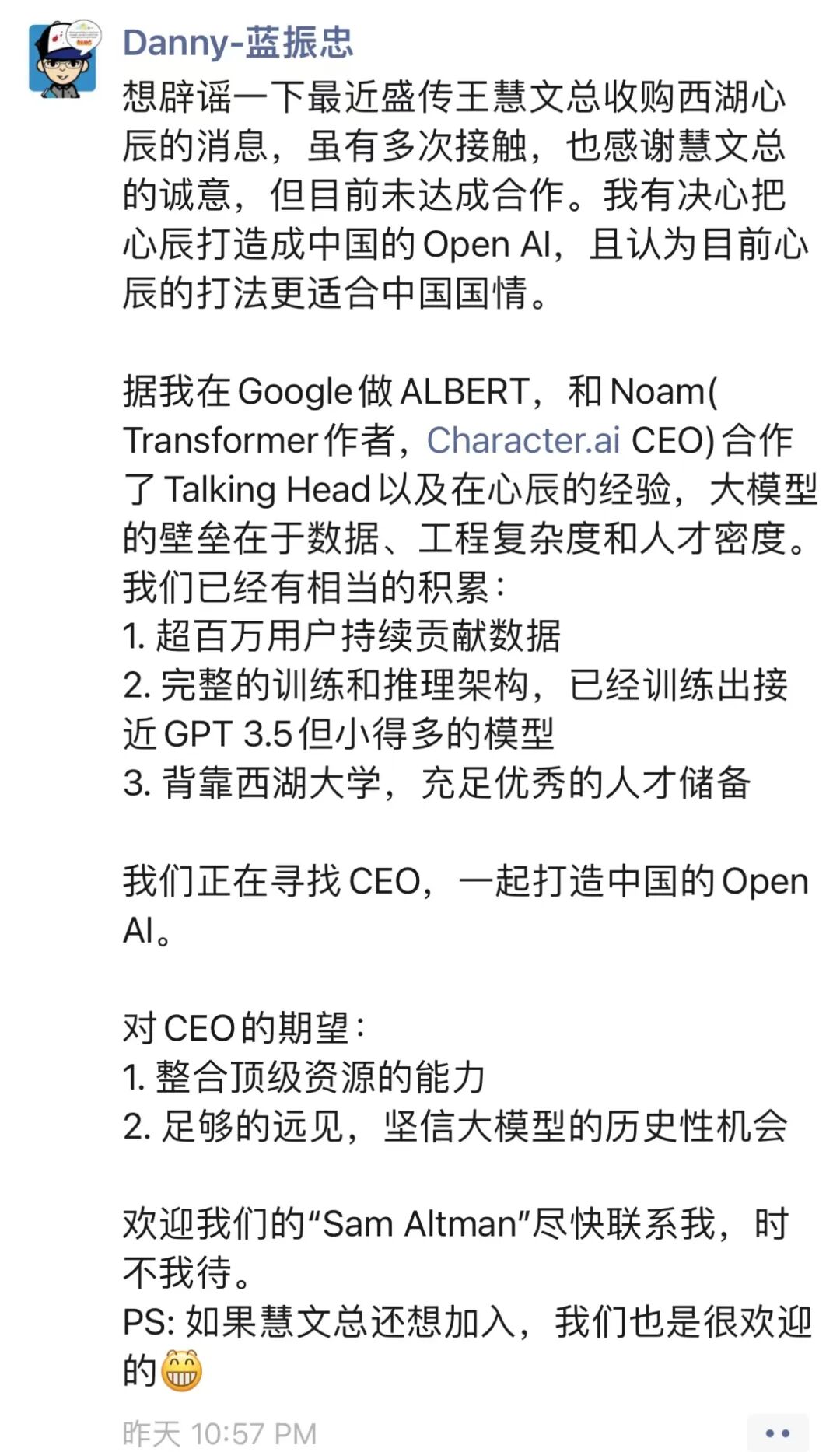
What does an experienced CEO mean for a ChatGPT-type startup? And why join a startup like Xinchen AI?
A Distinctive ChatGPT Player
Among the current wave of ChatGPT players, Xinchen AI is a unique team, and that uniqueness is closely tied to its founder Zhenzhong Lan.
Lan graduated from Sun Yat-sen University for his undergraduate studies, then pursued his PhD at Carnegie Mellon University, focusing on computer vision and multimedia analysis. His vision for AI was something like Samantha from the film Her — versatile, mastering multiple modalities of text, voice, and image — so he committed to becoming a multimodal researcher. In 2018, he joined Google AI's Research and Machine Intelligence group to work on natural language processing (NLP).
At Google, leveraging Google's TPU resources, Lan trained a lightweight version of the 300-million-parameter BERT model in just two months: ALBERT, pioneering research on lightweight large models in the AI field. After returning to China in June 2020 and joining Westlake University, Lan continued developing large-model-based applications, creating a mental health counseling chatbot called "Xiaotian," and founded Xinchen AI.
The founder's combination of language large-model and visual model training capabilities oriented Xinchen AI toward multimodal products from the start. Before Stable Diffusion went open-source, Xinchen astutely judged that text-to-image models were moving beyond the lab to commercial viability, and in August 2022 quickly launched the AI drawing product "DreamMaker" (now renamed "Dream Diary").
According to sources, "Dream Diary" has accumulated over a million C-end users and dozens of B-end clients. As a mini-program with nearly 50% next-day retention, Dream Diary is profitable on the commercial front, providing financial support for Xinchen AI's large-model R&D. At the same time, like Xiaotian and following OpenAI's logic, Dream Diary collects leading-quality data through user interactions, feeding back into algorithm optimization.
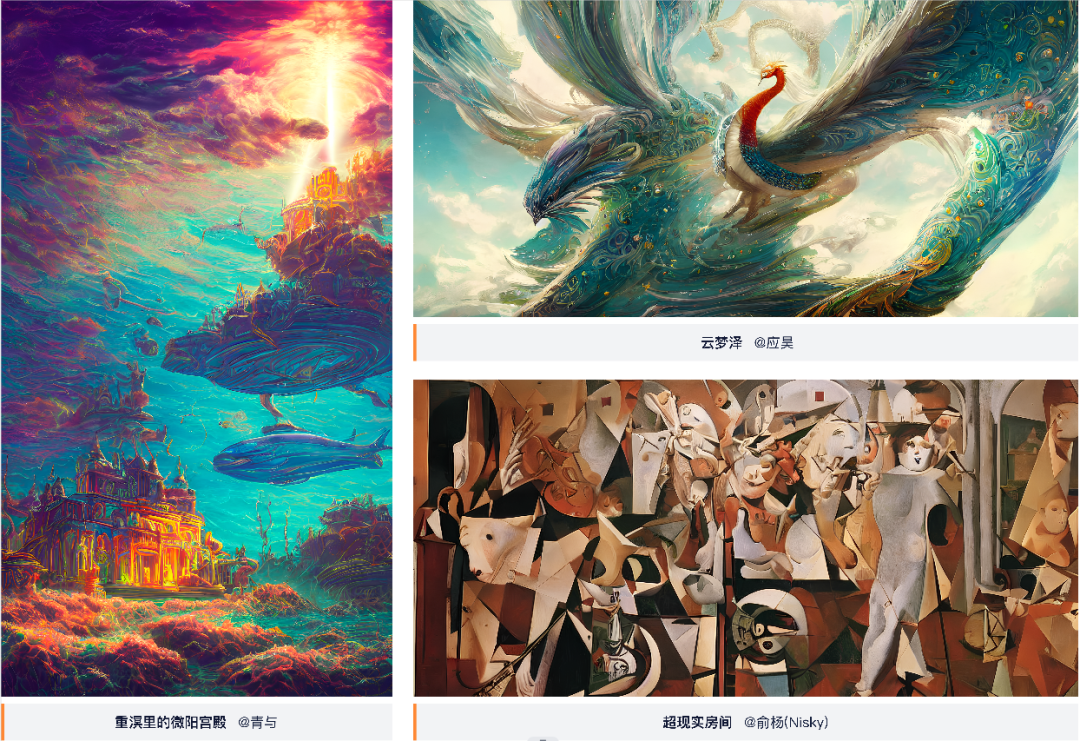
Outstanding Dream Diary artwork selected for the 2022 Louvre International Art Exhibition
The domestic language large-model trend first emerged in academic circles, giving industry-academia-research teams inherent advantages. That Xinchen AI has kept pace with the industry in this ChatGPT wave, competing against companies large and small domestically, is due to its years-long lead in language large-model R&D foundation, commercial product exploration, and solid scientific talent base.
Before ChatGPT emerged, Xinchen AI already had its self-developed text generation product "Hey Friday." They initially promoted it overseas, gaining tens of thousands of users. After AIGC took off domestically last August, they began developing text generation products for the domestic market. Shortly after ChatGPT's release, Xinchen AI launched its ChatGPT equivalent — "Xinchen Chat."
In terms of timing, Xinchen Chat was nearly a month, even two months, faster than a batch of companies claiming they were "about to launch." Compared to many seed-stage "Chinese ChatGPTs" with unclear functionality, Xinchen Chat currently offers more certainty and seized first-mover advantage.
In product design, Xinchen Chat has also introduced numerous innovations:
First, "Xinchen Chat" is an AI system that can independently access the internet. When asked about recent events — "When did Elon Musk acquire Twitter?" "What has Meituan co-founder Huiwen Wang been up to recently?" — it responds fluently.
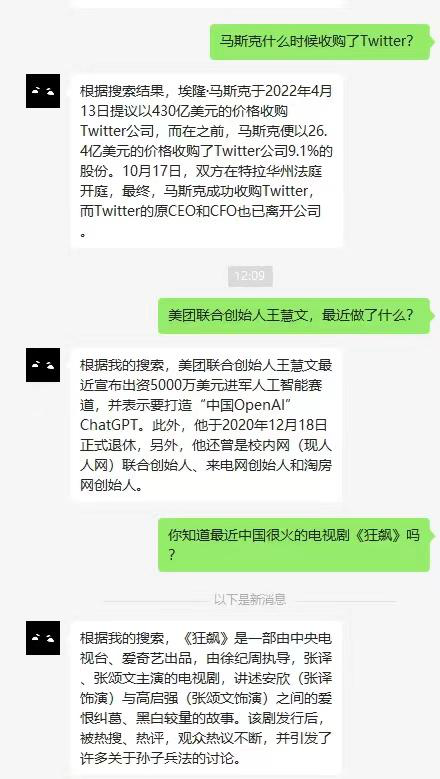
Xinchen Chat Q&A example
ChatGPT currently cannot access internet content directly; it requires Bing search integration to go online. So for the question "When did Musk acquire Twitter," it would give an outdated response like "Musk has not recently acquired Twitter; Twitter remains an independent company..."
Second, "Xinchen Chat" is a multimodal dialogue system. ChatGPT only has single-modal text generation capabilities, but in conversations with "Xinchen Chat," beyond writing, we can also use it to generate images.
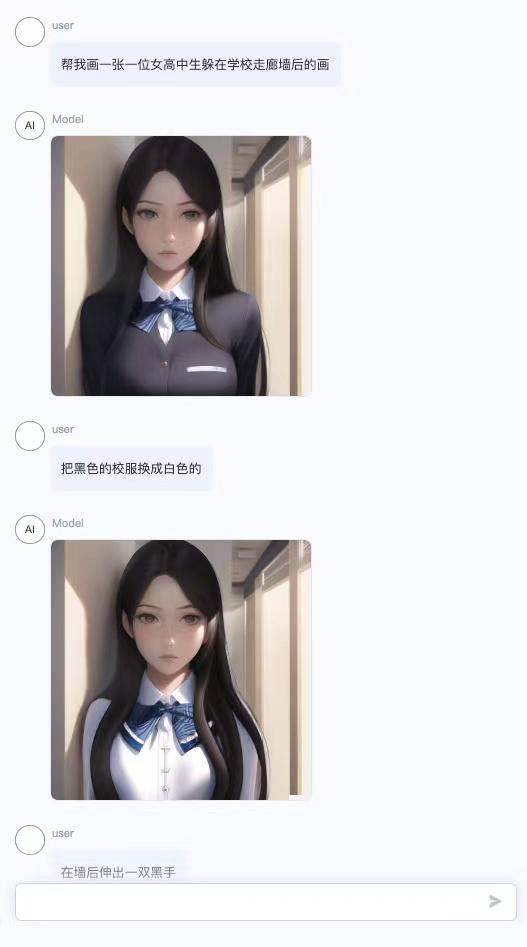
Xinchen Chat image generation example
As shown above, on the generated image, users can directly "edit with their voice," making for convenient and engaging interaction.
In Lan's view, multimodality is an inevitable trend because single-modal learning capability is limited. For example, when a user tells AI a color word like "red," if it cannot "see" the corresponding image, the AI cannot truly understand the word. Similarly, with only text and images about "running," the AI cannot grasp the true meaning of the action.
Although Xinchen AI is a startup, because the founding team has accumulated experience in both text and image modalities, and wanting to avoid the backlash Google faced by hastily launching Bard — a product barely differentiated from ChatGPT — Xinchen AI has chosen to pursue a multimodal "Chinese ChatGPT."
Xinchen AI has accumulation, but Lan also recognizes: as a small team, whether it can use the strategy of Tian Ji's horse racing to break through in the domestic ChatGPT competition, it needs stronger armament and strategy.
Xinchen AI's Strengths and Weaknesses
"If we weren't planning to enter ChatGPT this year, our profits this year would already cover R&D investment and achieve net profit," Lan told AI Tech Review.
An industry consensus: AGI realization is a long march, with many small breakthroughs along the way. Just as DALL·E won't be OpenAI's final product, after ChatGPT, OpenAI will launch even more powerful products on that foundation. AGI requires long-termism, and so does following ChatGPT.
When Lan and the team decided to join the race to build a Chinese ChatGPT, they realized they needed a CEO.
The Great Wall wasn't built in a day, and AGI research is not a day's work either. Though the text generation marvel ChatGPT is a more concrete target, in the eyes of Lan and other players, ChatGPT is merely one stop on the road to Rome. And even for this small stop, the number of teams that can ultimately participate won't be large.
Take language large-model R&D. Data, algorithms, and compute — all three are indispensable. Frankly speaking, Xinchen AI's scientific foundation and technical accumulation in ChatGPT-like models already exceed most AI companies.
First, data.
The key to ChatGPT's outdistancing of global competitors lies in data accumulation. Upon launch, ChatGPT gained a million users within a week, continuously iterating the model with initial data (user feedback), the strong getting stronger. But fortunately, ChatGPT cannot enter China, so Chinese teams still have opportunity.
Currently, the three types of Chinese teams chasing ChatGPT are all at the starting line, with gaps between large companies, startups, and capital giants not yet too large. With technical accumulation, small companies like Xinchen AI have advantages.
Take data as an example. Xinchen AI's product matrix includes Xiaotian, Dream Diary, and Hey Friday, with a combined user base of over 1.4 million C-end users and dozens of B-end clients. Early data accumulation, including user consultations, writing, and painting prompt descriptions, can provide high-quality data sources for Xinchen Chat — something many companies lack.
Second, algorithm talent.
ChatGPT's birth was no accident, closely related to OpenAI gathering a group of scientific geniuses.
A PhD industry observer told AI Tech Review that OpenAI's success is inseparable from its team's youth and idealism.
From the perspective of individual development patterns, regardless of country or whether there's "age-35 layoff" pressure, many research talents universally transition from idealistic young researchers to family-focused, more settled states after 35 or 40. Academia is not immune to the "age 35" watershed: due to the difficulty of passing tenure-track evaluations, many young faculty choose to coast after obtaining tenure.
Therefore, a team that can attract young, idealistic talent will be key to winning the ChatGPT race. And teams relying on university research strength, able to continuously attract young research talent, have unique advantages here.
According to sources, Xinchen AI's team already has large-model R&D technical accumulation, such as the RIO model, one of the earliest commercially deployed instruction-tuned large models domestically, whose performance has surpassed the original GPT-3. For example, Dream Diary's ability to generate images in seconds with stronger Chinese comprehension also results from the Xinchen team's unique optimizations to sampling functions and model understanding layers.
Additionally, Westlake University provides Xinchen AI with strong compute support. Lan notes that if Xinchen AI only focused on image generation and text writing, existing talent resources, client resources, and compute resources would suffice; but in pursuing larger goals like AGI and ChatGPT, Xinchen AI needs more resources.
Compute is one of the important barriers.
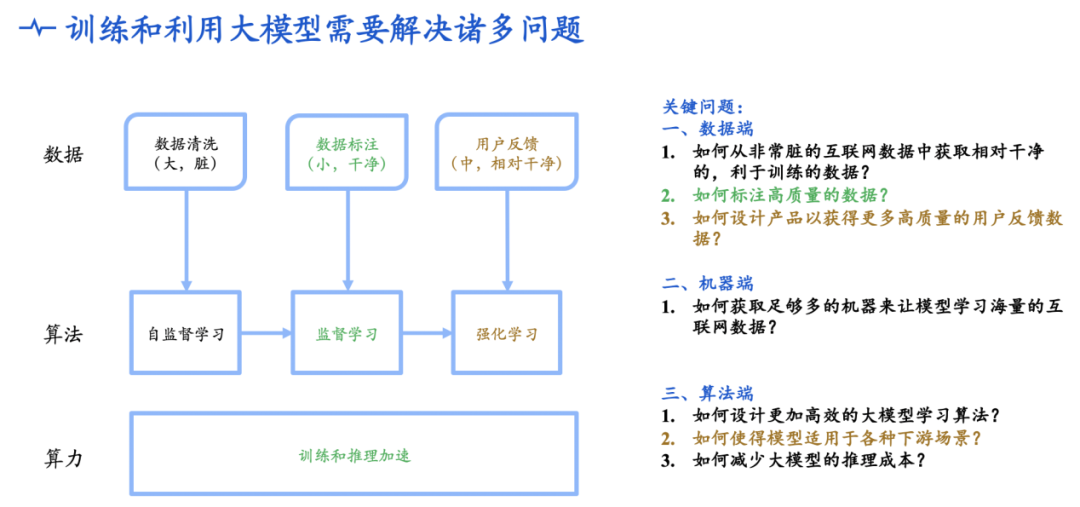
As shown above, large-model R&D needs to solve numerous problems. In the left image, from right to left, from yellow to green to black sections, R&D stages become increasingly foundational, more difficult, and require greater investment. Currently, most teams have only reached data annotation on the data side and supervised learning on the algorithm side, while OpenAI started from data cleaning and self-supervised learning, building from the bottom up.
When Google recently launched Bard to battle Microsoft, industry observers characterized it as essentially a TPU versus GPU showdown. For domestic teams without TPUs (including Xinchen AI), the compute barrier is even higher. According to Lan's understanding, many domestic companies, even large ones, don't have more than a thousand GPUs, making it naturally harder for a startup like Xinchen AI.
On this issue, Lan is rational. He believes solving resource problems requires, first, bringing in more capital; second, partnering with large companies (like the Microsoft-OpenAI model); and third, building strong client relationships (including small B-ends). Currently, Xinchen AI's team, including Lan himself as a scientist, is more adept at research.
Therefore, Xinchen AI needs a CEO!
Finding the Altman
From Dream Diary onward, Xinchen AI entered the sights of many investors and industry observers. This means Xinchen AI is about to enter a larger next phase, while also facing greater challenges.
With more and more players flooding into ChatGPT, and AIGC advancing further toward engineering, Lan knows that finding a CEO who can operate at high altitude and with heavy firepower is critical. They believe Xinchen AI is among the most promising domestic teams to achieve ChatGPT, but practical problems also need grounded solutions.
Early in image generation, Lan told AI Tech Review: "Not just AI painting — in fact, text generation also shows tremendous potential."
Compared to image generation, text generation's user base demonstrates greater cost advantages.
Unlike image generation users constrained to B-end or even small B-end, where the user base is primarily professional with limited scenarios, text generation covers marketing copywriting, email writing, office writing, paper writing, short message replies, and more — more fragmented use cases. An image generation software currently has weaker generalization capabilities in style and content, only able to integrate with vertical domains, while text generation can simultaneously provide multiple functional services, usable and needed by anyone.
Therefore, although language large models require greater investment, when users are numerous enough, billions in costs amortize to near negligible levels — the same logic as highway construction. Meanwhile, user profiles like illustrators have stronger tool-using capabilities, while text generation users are more often C-end consumers, who are more willing to rely on existing products, giving text generation products like ChatGPT greater value-added service space.
In fact, this is also Microsoft CEO Satya Nadella's vision for AI. Since taking over as Microsoft CEO, Nadella has believed Microsoft's business should rest on three technological pillars: cloud computing, AI, and quantum computing. In Nadella's imagination, our lives are far from intelligent enough; if they were, an ordinary worker wouldn't spend so much time on trivial office tasks like replying to emails, writing work reports, daily/weekly updates, booking flights, and so on.
And text generation can help liberate people's time from these trivial routines — this is also Lan's research philosophy. From the start of his AI research, he has believed that in the future there will be AI systems like Her's Samantha, giving everyone a personal assistant.
Lan states that he hopes to find a CEO who shares this philosophy and strongly believes in AI's value potential. Only genuine conviction from the heart enables full commitment.
He notes that Sam Altman's introduction of capital giants like Microsoft was a crucial, indispensable step for OpenAI's development of ChatGPT. Microsoft believed in OpenAI, and to support ChatGPT's R&D, Nadella once firmly resisted internal opposition, even bypassing the CFO to directly reallocate servers originally designated for Microsoft's internal R&D.
On the path to AGI, Sam Altman did not rigidly adhere to technological idealism. With unique vision, he brought in Microsoft, balancing technological development needs with commercial transformation goals, finding a correct path to help OpenAI advance closer to its AGI ideal. With ChatGPT's success, Microsoft made another major investment, and OpenAI's research capabilities will visibly become limitless.
Lan observes: Returning to the Chinese market, Xinchen AI and OpenAI share many similarities in talent and scale. OpenAI broke through in the US market crowded with giants like Google, Microsoft, and Facebook; Xinchen AI has similar opportunity domestically.
As a scientist, Lan is rigorous and doesn't make empty promises. Past product development has validated Xinchen AI's commercial potential. Lan and the team are clear about their technical strengths and recognize their management experience gaps, and cooperation is the foundation of mutual benefit. Xinchen AI needs a CEO, needs comrades-in-arms, and needs partners.
ChatGPT has barriers, and commercial value. Xinchen AI is small but complete, and with the current domestic landscape still unsettled, if you are a successful entrepreneur bullish on ChatGPT, Xinchen AI invites you to become CEO!
Self-recommendations welcome — contact Xinchen AI founder Zhenzhong Lan at lanzhenzhong@westlake.edu.cn



Originating in Silicon Valley, BlueRun Ventures was established in 2005 and is a venture capital firm focused on early-stage startups.
Currently, BlueRun Ventures manages multiple USD and RMB dual-currency funds in China, with assets under management exceeding RMB 15 billion, making it one of the largest early-stage funds domestically. Its investment stages concentrate on Pre-A and Series A, covering hard tech and innovative interaction, enterprise technology, new consumption, and healthcare, with cumulative investments in over 150 startups including Li Auto, Waterdrop, QingCloud, Guazi.com, Qudian, Songguo Mobility, Ganji.com, Energy Monster, Yuntu Semiconductor, Machenike, CloudSaints Intelligence, Anxin Network Shield, and BioMap.
BlueRun Ventures has been ranked first in Zero2IPO's "China Top 30 Early-Stage Investment Institutions," first in ChinaVenture's "China Best Early-Stage Venture Capital Institutions TOP30," and named among Preqin's Top 10 global venture capital fund managers for sustained high-return performance.
Additionally, BlueRun Ventures has repeatedly received honors from Forbes China, 36Kr, Cyzone, Caixin Media, CBNweekly, Jiemian, and other media institutions, including "China's Best Early-Stage Institution of the Year," "China's Top Venture Capital Institution," "Most Entrepreneur-Friendly Early-Stage Institution of the Year," and "Most Influential Early-Stage Institution of the Year."