China's Embodied Intelligence Models Claim Global Top Spot! The Era of Human Data for Robots Has Arrived | BlueRun Ventures Family Headlines

Embodied intelligence is being transformed by this youth revolution.

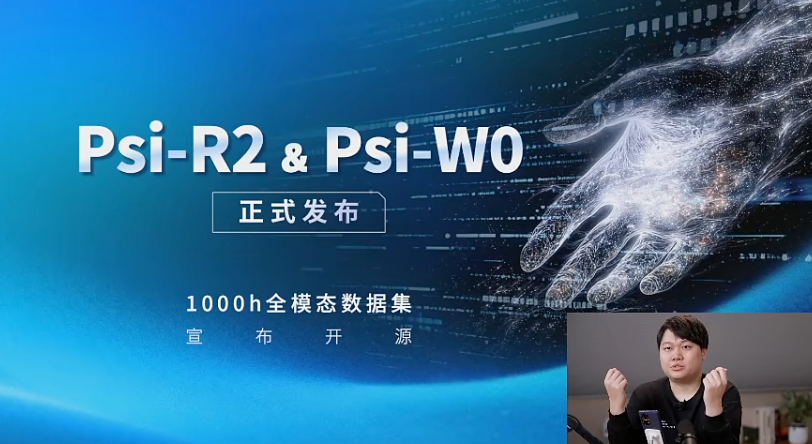
On April 10, Lingchu Intelligence officially unveiled its next-generation embodied intelligence foundation models Psi‑R2 and Psi‑W0, alongside the open-source release of the first 1,000-hour full-modality human hand manipulation dataset. Built on a base of 100,000 hours of massive human data, Psi‑R2 surpassed models from PI and NVIDIA to claim the top spot on the authoritative MolmoSpace benchmark.
In a livestreamed conversation, Gen Z co-founder Yuanpei Chen candidly shared the real paths to model training, data breakthroughs, and technology deployment — the young team's confidence in "running while open-sourcing" proved more memorable than any leaderboard ranking.
Meanwhile, Lingchu Intelligence recently secured another round of financing to accelerate core R&D and industrial deployment. BlueRun Ventures led Lingchu Intelligence's first funding round, and we are thrilled to see its embodied foundation model leap from generation one to two in such a short time. We are even more heartened to see a new generation of Chinese tech companies daring to compete head-on at the global frontier. We look forward to Lingchu Intelligence maintaining this edge and bringing embodied intelligence into real-world scenarios.
Gotta hand it to this generation of Gen Z — terrifyingly strong. One move and embodied intelligence gets completely reshaped.
While others are still stuck on Sim2Real, this Gen Z-led Lingchu Intelligence is already brute-forcing with nearly 100,000 hours of human data.
That number stands alone industry-wide.
After all, most existing human manipulation datasets still cluster in the thousands to tens of thousands of hours. The largest, NVIDIA's EgoScale, contains just 20,000 hours of first-person video data.
Lingchu just raised the bar to 10,000+ hours, with 1,000 hours open-sourced.
And the launch format was on-brand too — livestream showtime.
AI blogger Frank and Lingchu Intelligence's Gen Z co-founder Yuanpei Chen broke it all down for you, hand in hand. (Tech blog here: https://www.psibot.ai/from-human-skill-to-robotic-mastery/)
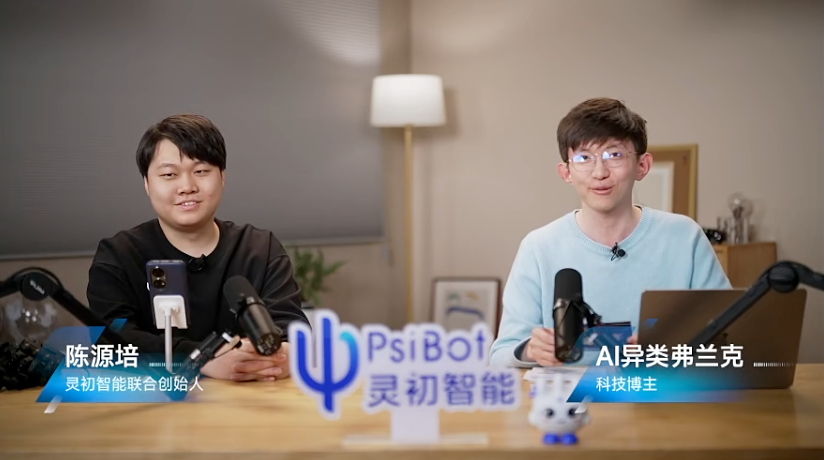
Bottom line, after reviewing the whole livestream, it came down to two things: what to feed embodied intelligence, and what kind of brain to give it.
In plain English, Lingchu offers a distinctive pragmatic path —
No fluff. Direct alignment with human data, then smooth deployment into concrete scenarios through the Psi-R2 and Psi-W0 dual-system architecture.
The results speak for themselves. Lingchu Psi-R2 quickly topped the MolmoSpace leaderboard.
MolmoSpace, initiated by the Allen Institute for AI (AllenAI), is a leading global benchmarking platform for embodied intelligence. NVIDIA, PI, and other top global teams all participated in this evaluation.
Lingchu Psi-R2 surpassed internationally renowned models including PI and DreamZero, significantly outperforming other baseline models — firmly in the top tier.
On success rate, it was nearly 10x higher than comparable VLA models.
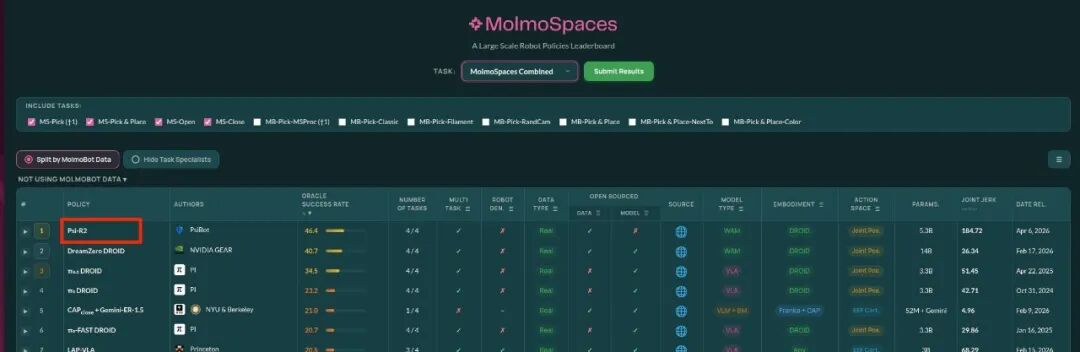
So that's the situation. Lingchu came out swinging with something big: embodied intelligence finally gets its first directly usable, large-scale full-modality human hand manipulation dataset.
Now let's return to the livestream and break it all down.
100,000 Hours — Feeding Embodied Intelligence to the Brim
"Why exactly does embodied intelligence have a data famine?" Frank, playing audience surrogate, opened with this classic soul-searching question.
To answer, we first need to clarify one thing: embodied intelligence has fundamental data differences from autonomous driving, large language models, and other AI domains.
The latter build on real-world scenarios and the internet, accumulating massive stockpiles of data over time, then achieving steady performance gains through brute-force compute scaling laws.
Embodied intelligence is completely different. The complexity of the physical world leaves it with virtually no mature, ready-to-use datasets, and it's hard to accumulate data through usage like internet products can.
So one key factor constraining embodied intelligence development is the data bottleneck.
What to do? Companies including Lingchu have turned their gaze toward human data.
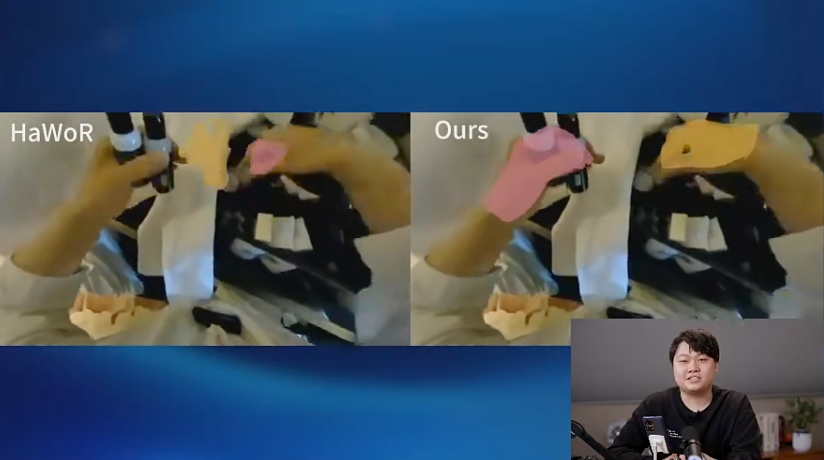
Simulation data still needs transfer processing before real robots can use it, but human data is the best reference object — large volume and high quality.
But here too lies an unavoidable problem: the embodiment gap between humans and robots.
Direct reuse obviously won't work; robots will inevitably encounter mismatches in kinematic structure, dynamic characteristics, and so on.
Second, existing human data can't be directly fed into pretraining either. It's either small-scale open-source data or low-quality first-person videos from the internet.
But beyond human data, there are hardly any better paths. Lingchu's judgment:
For embodied intelligence to deploy in real commercial scenarios, pure human data training is necessary.
On one hand, using human data lets robots preemptively learn standard operating procedures (SOPs) from human frontline work — all commercially validated, ready to use and effective.
In other words, seamless connection to real scenarios minimizes data costs. For example, human tactile data collection costs less than one-tenth of robot collection.
On the other hand, human data SOPs can push operation speeds to the physical motion limits of robotic arms (e.g., 1200), far exceeding the 800 achievable through teleoperation, and better matching the high-tempo demands of commercial factories.
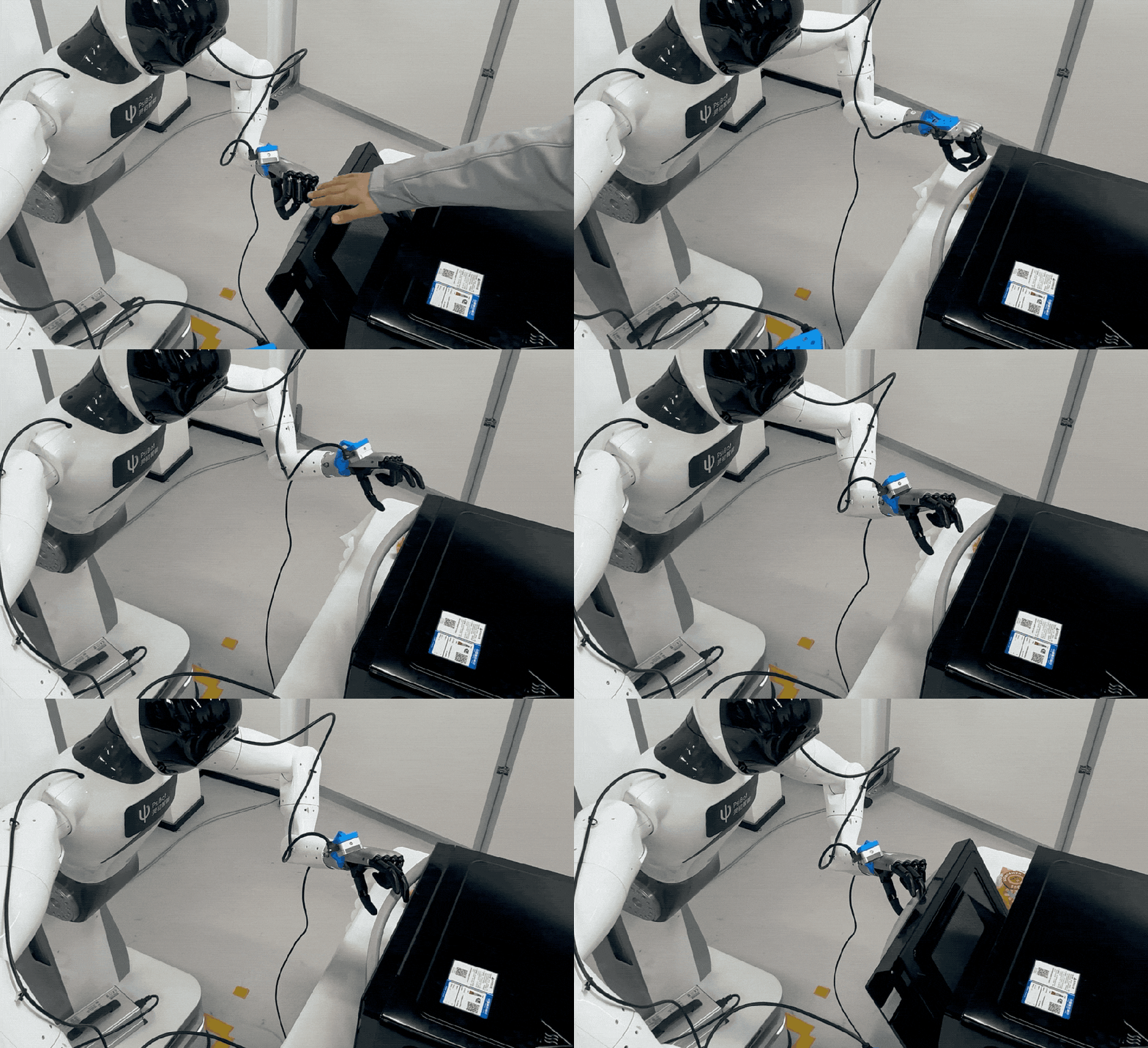
So Lingchu ultimately chose human data and built the first large-scale human manipulation dataset usable for pretraining.
In fusing human and robot data, Lingchu follows a simplifying philosophy: Raw Data In, Raw Data Out.
Discard artificially designed complex data processing; directly perform kinematic alignment between human joints and robot bodies, letting the model explore on its own through massive data. Auto Labeling also replaces manual data quality inspection and annotation, with final human review.
The final pretraining dataset includes real robot data (5,417 hours) and human data (95,472 hours), totaling 100,000 hours.
Currently 1,000 hours are open-sourced; by year-end the entire dataset will scale to millions of hours.
Specifically, human data includes data collected through Lingchu's self-developed exoskeleton gloves and bare-hand operation data, covering 294 scenarios, 4,821 tasks, and 1,382 objects.
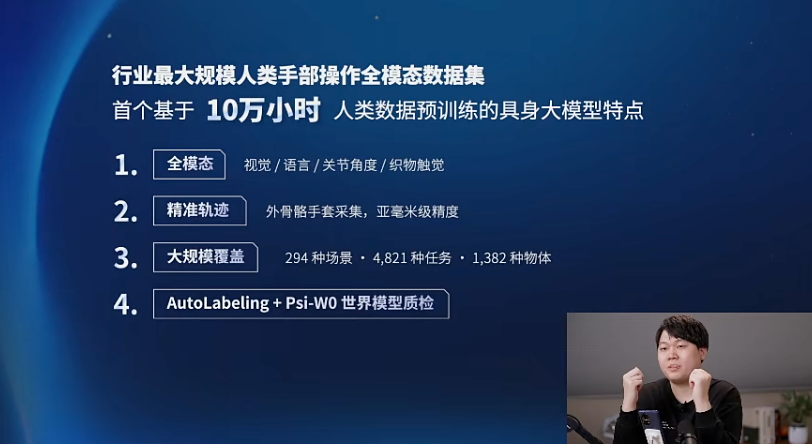
Why emphasize tactile data? Fundamentally, to better bridge the embodiment gap between humans and machines.
While humans and robots differ significantly in many aspects, their contact signals remain strikingly consistent, effectively compensating for dynamic differences while significantly improving world model capabilities and better predicting interactions between robots and objects.
After this entire high-quality data pretraining pipeline, robots achieve breakthroughs in generalization, long-horizon operation, and manipulation precision — requiring fewer than 100 trajectory samples of real robot data for fine-tuning.
Also notably, during this process Lingchu discovered another key insight:
Data signal-to-noise ratio is the core factor determining whether human data can effectively support pretraining. Low signal-to-noise ratio data can even be counterproductive.
To assess signal-to-noise ratio, look at two dimensions:
1. Dataset distribution: task diversity > object diversity >> scenario diversity.
Generalization is one of the hardest capabilities for models to learn, but if the model sees more tasks and manipulation objects during pretraining, it naturally adapts faster to new tasks.
2. Perception modality: precise 3D pose >> tactile modality > 2D image features.
Among full-modality information, full-domain 3D hand pose tracking is key to the 2D-to-3D model transformation and has the highest match with robot dynamic characteristics.
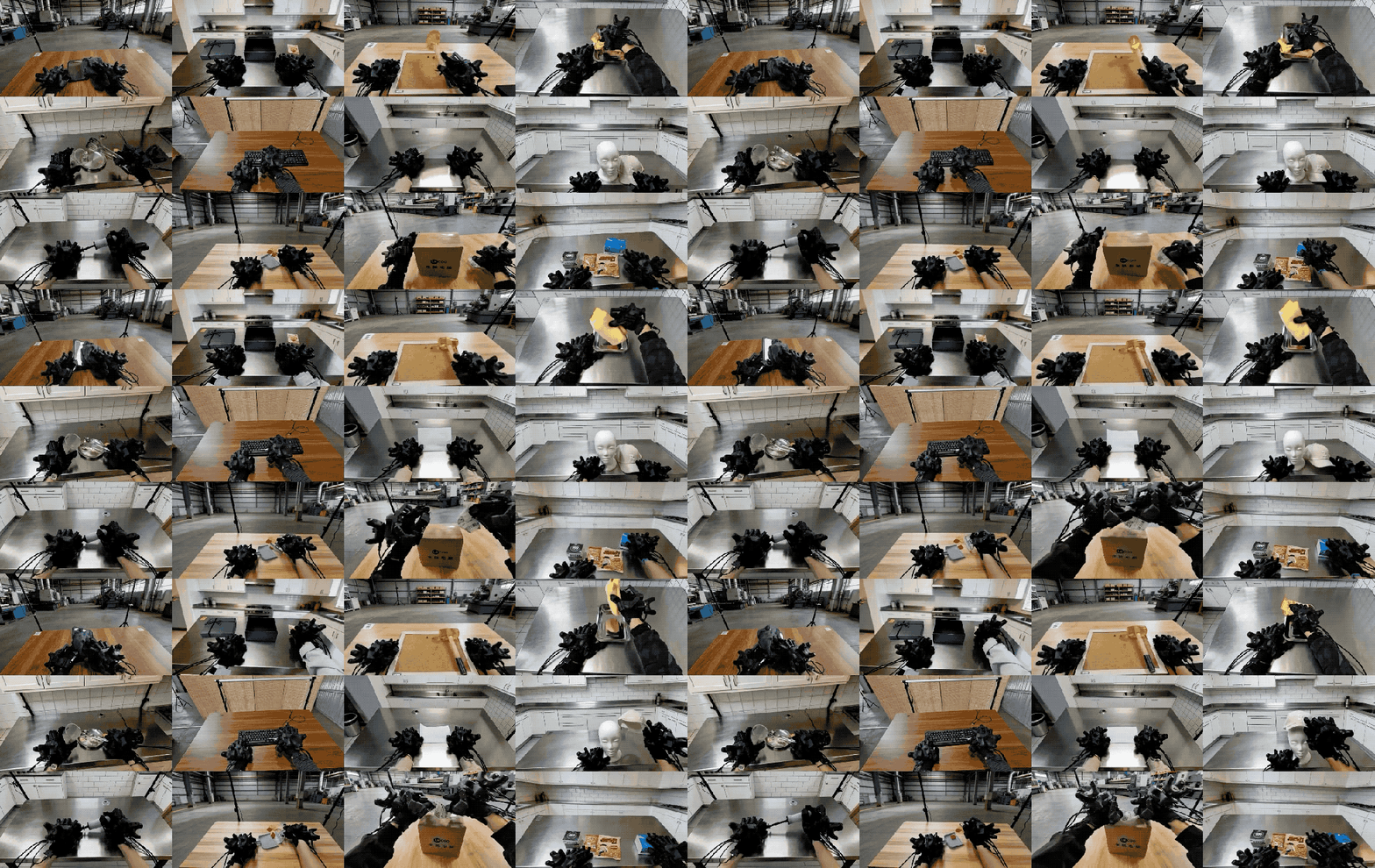
Simply put, Lingchu believes both precisely collected reproducible data and rougher generalization data with partial precision loss are indispensable.
They complement each other, ensuring both model precision and generalization.
Embodied Intelligence Grows a New Dual-System Brain
Based on the above understanding, Lingchu newly released the Psi dual-system architecture — Psi-R2 and Psi-W0.
First, Psi-R2 — a model that lets robots learn how humans do things, core to which is learning fine manipulation from this 100,000+ hour data ocean.
Images and language instructions serve as input; it outputs predicted future operation videos and executable actions. So Psi-R2 can be called a World Action Model (WAM).
The training backbone uses Wan2.2-IT2V-5B-480P, with both real robot data and human data used synchronously during pretraining, plus a complete data processing pipeline from data cleaning, auto-annotation, quality inspection, to human verification — with Psi-W0 also helping check data quality.
Specialized techniques precisely capture human hand motion trajectories, such as through exoskeleton gloves keeping action error within sub-millimeter precision, ensuring human manipulation details can be precisely imitated by robots.
But WAM architectures have a common bug — slow reaction. Single inference takes 2.2 seconds, which translates to obvious lag on the robot.
So Lingchu compressed reaction time to under 100 milliseconds through multiple technical optimizations including DiT caching, Torch compilation, and model quantization.
Now Psi-W0. It shares similar base architecture with Psi-R2 but has a completely different division of labor. Psi-R2 learns how to do; Psi-W0 helps do it better.
Like Psi-R2, it's built on a pretrained video generation model, but in Psi-W0, robot actions are the input and predicted future scene videos are the output. So Psi-W0 is defined as an Action-Conditioned World Model (AC-WM).
This raises another question: Psi-R2 can also output predictions, so why build Psi-W0?
Simple: for counterfactual reasoning. Psi-R2 only learns successful operations — say, successfully grasping an apple — but can't predict failure scenarios like the apple slipping.
But as the saying goes, failure is the mother of success, and robots are no exception. Failure experience helps robots avoid mistakes and optimize actions; Psi-W0 specifically fills this gap.
Specifically, both models share consistent training backbones and data formats, except Psi-W0's training data includes an additional 30% failure samples.
Clearly, Psi-R2 and Psi-W0 don't exist in isolation but coordinate with each other. After Psi-R2 learns human operations, Psi-W0 simulates human operation scenarios for Psi-R2 to rehearse — that is, policy evaluation, checking whether it missed or mislearned anything.
Psi-W0 also has a core function: converting human data to robot data through reinforcement learning.
Traditionally, this conversion relied on simulation environment adjustments — complex and inaccurate. With Psi-W0 replacing this, it simulates robot perspective and action patterns, then through reinforcement learning trial-and-error tuning, adjusts human actions into actions robots can precisely execute.
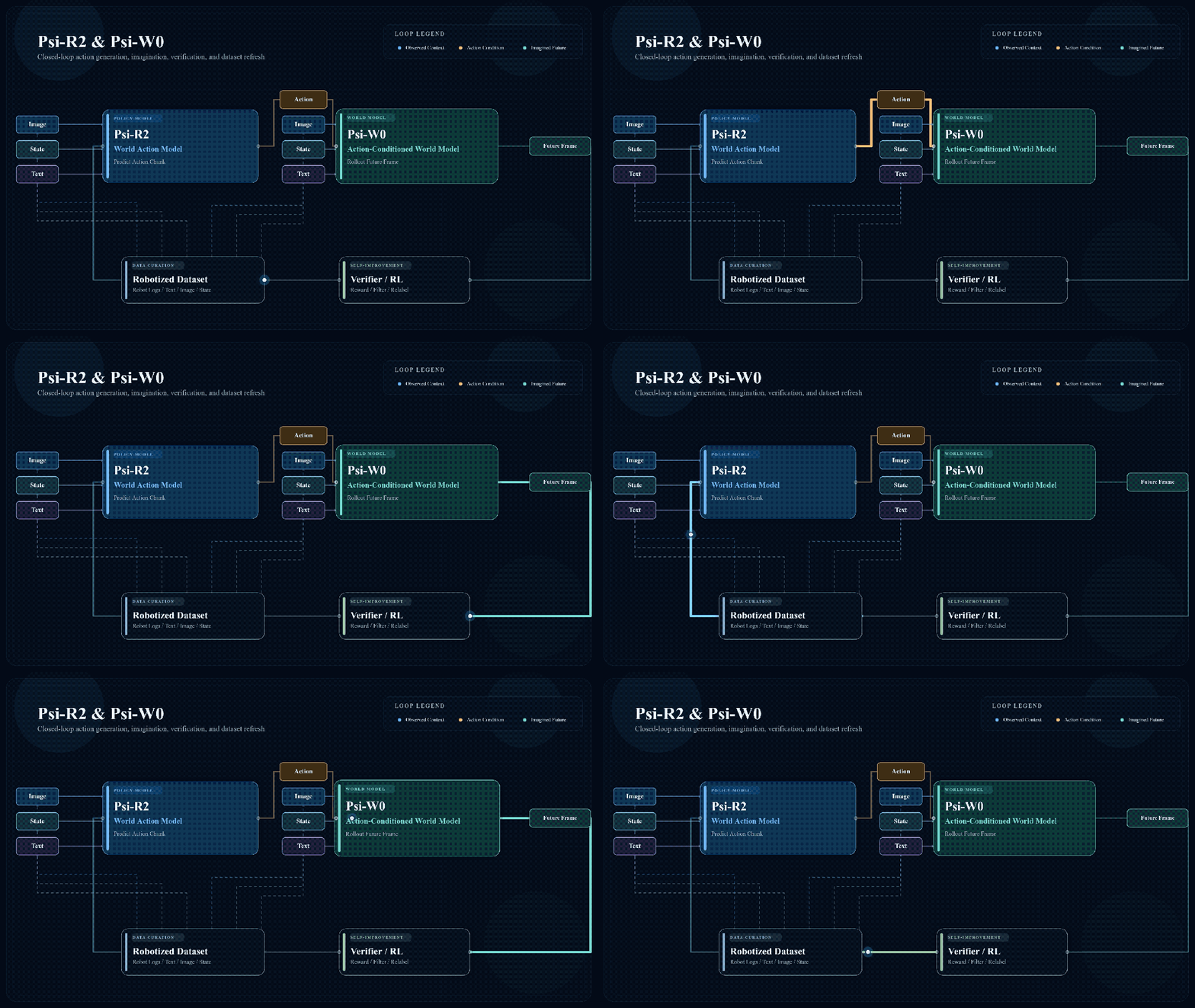
Even more impressive: during this process, it continuously generates new high-quality data. Feeding this data back to Psi-R2 and Psi-W0 for continued learning creates a closed-loop data flywheel.
You can also deliberately introduce random perturbations to Psi-W0 to simulate special scenarios, then generate target scenarios and training data.
High-quality data nourishes high-performance models; model deployment in scenarios feeds back data expansion. And so the wheel spins.
The final system achieves long-horizon task autonomous planning, task autonomous recovery, and adaptation to multi-scenario complex tasks.
Open Source Is the Most Efficient Lever for Deployment
Looking back at the whole livestream, whether from Frank or Yuanpei Chen, one keyword ran through the technology from start to finish: deployment.
Frank, from the audience perspective, wondered when embodied intelligence could actually deploy. Chen, from the vendor perspective, gave Lingchu Intelligence's deployment solution:
On the technology side, everything from large-scale real human data collection to embodied models in actual application is built from concrete deployment scenarios.
On the application side, Lingchu Intelligence also announced co-building a data collection factory with Beijing's Shijingshan District, plus ecosystem partnerships with Tencent Cloud, Douyin, Mifeng, and Zhiyu Jishi.

It's not hard to see that Lingchu was born with DNA focused on technology deployment and providing general full-stack technology. Every step validates an industry consensus:
The destination embodied intelligence has aimed for from birth was never the laboratory, but every concrete, perceptible complex scenario. And that is precisely the standard for testing embodied intelligence.
On the path to deployment, Lingchu also realized early that going it alone isn't optimal — open source is necessary.
For themselves, only through open source can the entire industry help them rapidly collect massive data, filling the critical gap in this data flywheel system.
And in the AI era, time and data are the scarcest gold resources. The earlier you enter and the more data you have, the sooner you reap long-tail benefits.
Looking at the industry broadly, open source isn't just idealism — it's the key to breaking technological封闭 islands. It can build vast developer ecosystems, making embodied intelligence no longer isolated vendor entities through standardized data pipelines and pretraining foundations.
And industry-wide open-source collaboration can in turn feed hardcore players like Lingchu, letting them concentrate on cracking the toughest technical bottlenecks. Collective intelligence is the only shortcut for embodied intelligence to keep pace and achieve commercial deployment.

And Lingchu is undoubtedly the fastest and steadiest star player among them.
Finally, borrowing an old saying to describe Lingchu Intelligence as I see it — the courage to reach for the stars, and the diligence to keep feet on the ground.
Embodied intelligence is being made anew by this youth storm.
(P.S. Click "read original" to jump straight to the tech blog~)

 BlueRun seed project Lingchu Intelligence completes 2 billion yuan financing, tackling "dexterous manipulation" challenges | BlueRun Family
 One of only two in China! Peking University–Lingchu Intelligence Joint Lab chief scientist Yaodong Yang's team and DeepSeek's Wenfeng Liang win ACL 2025 Best Paper | BlueRun Family Headlines
  Lingchu Intelligence Psi R1 becomes first embodied intelligence model to achieve visual-language-action multimodal coordination | BlueRun Family Headlines