How Many Steps Until eVTOL Takes Off? | BlueRun Ventures Headlines

The fundamental challenge of developing an eVTOL is building a proper aircraft first.
How much further does eVTOL commercialization have to go? In the view of Yongwei Huang, founder and CEO of TCab Tech, it can't happen overnight — it should be rolled out gradually, step by step, phase by phase. Start by replacing some helicopter use cases, evolve into fixed-route air bus services, and ultimately become an everyday travel option for the general public.
BlueRun Ventures was the sole seed-round investor in TCab Tech and has continued to increase its stake. Today we're sharing this article to give you insight into TCab Tech's thinking on eVTOL commercialization —
As the electrification wave sweeps from new energy vehicles into the aviation industry, eVTOL has entered the public consciousness and become a hot赛道 chased by global capital over the past two years.
Meanwhile, domestic eVTOL is also accelerating toward real-world deployment. TCab Tech, China's first tech company to independently develop tiltrotor manned electric aircraft, was founded in 2021. To date, TCab Tech's self-developed E20 eVTOL prototype has completed its first round of flight tests and is now conducting regular flight trials. In October 2023, the Civil Aviation Administration of China East China Regional Administration formally accepted TCab Tech's type certificate application for the E20 eVTOL.
In the vast sky of the low-altitude economy, TCab Tech has always stayed close to actual needs, focusing on eVTOL commercialization and dedicated to building safe, convenient air mobility vehicles. Recently, Yiou's "Low-Altitude Economy 20 People" interview series invited Mr. Yongwei Huang, founder and CEO of TCab Tech.
He believes that eVTOL technology development and commercialization won't happen in one leap or overnight. Rather, it requires gradual progress: from manned to unmanned, from suburban to urban, from low-altitude sightseeing to daily travel, from demonstration scenarios to commercial operations. This is a process that needs to unfold in phases and steps, ensuring safe and efficient air travel while providing sustainable momentum for eVTOL and the broader low-altitude economy.
A Safer, More Affordable, More Efficient Air Travel Option
Yiou: eVTOL has developed rapidly as an emerging technology. How does it differ from existing options like general aviation aircraft and helicopters, as well as other exploratory concepts like flying cars? What are its advantages for real-world applications?
Huang: Previously, the low-altitude economy wasn't prioritized because the commercial market hadn't opened up. Take twin-engine, five-seat helicopters as an example — they sell for 50 to 70 million RMB, making helicopter rides extremely expensive.
Compared to helicopters, eVTOL is safer and can achieve a safety factor close to that of civil aviation aircraft. Helicopters have only single or twin-engine power, while eVTOL typically uses multiple distributed power systems. TCab Tech's E20 eVTOL is designed with six independent power units, so the failure of any single unit won't affect normal flight.
Second is economic efficiency. Twin-engine, five-seat helicopters sell for 50 to 70 million RMB, while the E20 eVTOL tiltrotor in mass production would cost roughly 7 to 8 million RMB — a massive price advantage. Because it's electric, maintenance costs are also substantially reduced, so the per-passenger, per-kilometer price of riding an eVTOL can be comparable to a taxi. Thanks to distributed electric propulsion, cruise flight noise is controlled to around 40-45 decibels — very quiet, no need for noise-canceling headphones, and no harmful exhaust emissions. eVTOL flies faster and can take off and land vertically, requiring less infrastructure and operating more efficiently.
Compared to flying cars, eVTOL serves B-end general aviation companies and has no automobile functionality, while flying cars are both aircraft and cars, targeting C-end consumers directly. In fact, the flying car concept has been around for over a century but has never materialized, mainly because flying cars must simultaneously comply with both civil aviation regulations and road traffic laws — two design requirements that are difficult to satisfy at once. So it will still take considerable time.
eVTOL is an electric vertical take-off and landing aircraft — simply put, it's the electrification transformation of aircraft. It expands the air travel market with safer, more affordable, more efficient flight, making full use of enormous low-altitude resources.
Yiou: Although TCab Tech was founded in 2021, your team has extensive experience in this field. Could you share what led to TCab Tech's founding and the opportunity you saw?
Huang: I've worked in aviation for over 20 years. In 2021, I believed electrification had reached a stage where it could be applied to aircraft. The "three electrics" — battery, electronic control, and motor — had already achieved mass production in electric vehicles, and technology, regulations, supply chains, and other dimensions had developed sufficiently to support aviation electrification. So we founded TCab Tech. "Shi De" (时的) means "time taxi" — we want to provide more efficient, faster intelligent three-dimensional mobility services.
As a startup, we first considered product positioning, customer market size, and application benefits. After market research and extensive deliberation, we focused our product on travel scenarios between 30 and 150 kilometers. For distances under 30 kilometers, subways and cars offer greater convenience and economy; beyond 150 kilometers, high-speed rail and planes are available at very low per-capita cost. But for 30 to 150 kilometer travel needs — especially in places like Shenzhen in the Greater Bay Area, where there are special cross-mountain, cross-sea travel scenarios — demand is currently unmet. eVTOL can expand intercity and urban agglomeration travel range, serving as a powerful complement to existing transportation modes.
Product Solutions That Upgrade Step by Step, Staying Close to Demand
Yiou: TCab Tech's E20 eVTOL full-scale prototype successfully completed its first round of flight tests. Could you introduce us to the E20?
Huang: The E20 is a manned electric vertical take-off and landing aircraft. Its main characteristic is the tiltrotor configuration. It has six propellers. During cruise flight, the front two don't tilt — they feather to reduce drag — while the rear four do tilt, transitioning to fixed-wing mode for high-speed, high-performance flight. We chose this configuration primarily based on safety and economic requirements. In multirotor mode, all propellers are positioned higher than people, ensuring passenger safety during boarding and deplaning. Another advantage is faster flight speed. With tiltrotor configuration, vertical lift and horizontal thrust use the same power system — the power units are reusable — enabling air travel at taxi prices but five times the speed.
Yiou: How does the E20 ensure safety performance? Does obtaining an airworthiness certificate alone demonstrate an aircraft's safety?
Huang: Because helicopters have existed for a long time, as a manned aircraft all safety regulations and standards are aligned with helicopters, so essentially all helicopter safety designs are incorporated.
While each country's civil aviation administration may have different policies, airworthiness certification standards are relatively uniform across the aviation industry, and eVTOL can achieve a safety factor close to civil aviation aircraft. I believe that obtaining a standard type certificate issued by the civil aviation administration is sufficient proof that safety performance is ensured.
Yiou: What new technologies are involved in E20's development?
Huang: Currently all eVTOLs are moving toward intelligent development, but technical route choices may differ by company. The E20's architecture can also achieve autonomous flight, but based on current aviation regulations and safety considerations, we're still positioning it as a manned aircraft as the final product configuration, choosing the route of manned first, unmanned later. I estimate that possibly after 2035, when corresponding AI technology, regulations, and new airspace management systems are mature, we might enter the fully autonomous flight era.
For now, the eVTOL industry's biggest goal is to get aircraft flying under pure electric drive. Electrification can bring lower prices and higher-level safety assurance, so we'll focus on electrification first and won't temporarily incorporate unmanned operation or airspace automation elements. As an eVTOL airframer, I believe the industry should in the short term focus on pure fuel-to-electric aircraft solutions rather than stacking multiple innovations — integrating too many new technologies actually makes implementation harder.
Aircraft are passenger travel carriers, constrained by user habits and psychological considerations. A 2019 authoritative survey by the Air Line Pilots Association found that "85% of people would feel uncomfortable in a plane without a pilot." Additionally, public opinion polls showed that "even with sufficiently cheap tickets, the public would not want to fly with airlines operating automated aircraft. 66% of passengers would not take an unmanned flight even with 30% cheaper tickets." Therefore, the world's leading eVTOL players all adopt the technical route of manned first, gradually transitioning to unmanned, progressively cultivating user habits.
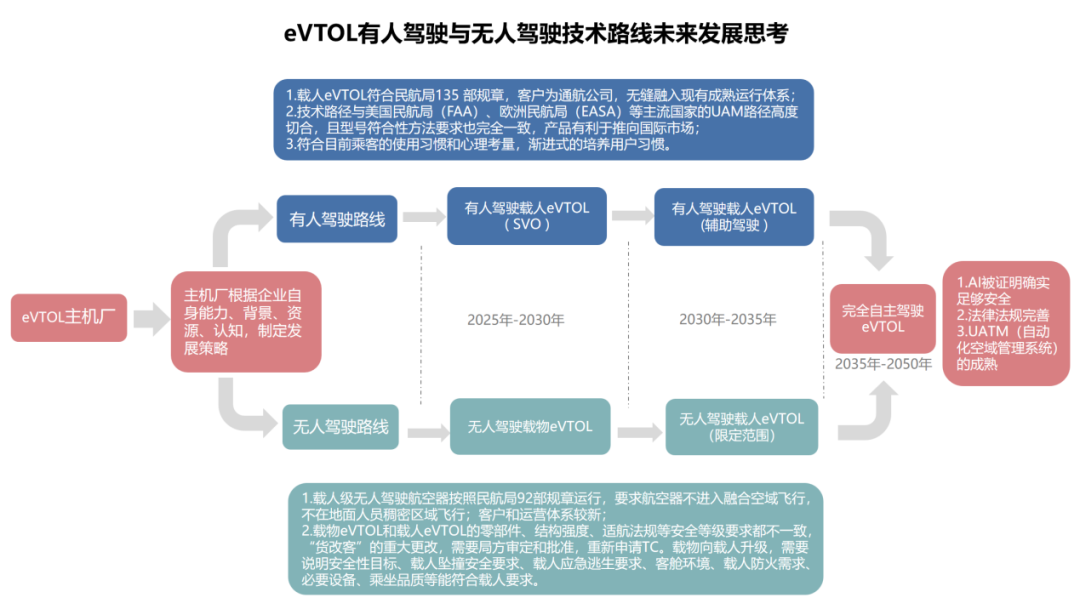
Yiou: In the past, helicopters never achieved large-scale application. In the future, when more convenient eVTOL becomes widespread and flight density increases substantially, will requirements for aircraft system informatization and so on also rise accordingly?
Huang: I believe judgments about eVTOL development need to consider different time dimensions. What are time dimensions? I think commercialization is a gradual process, not as complex as people imagine.
China's airspace is very clean. Today we have 300 million cars on land, but only 5,000 aircraft in the sky, of which only 700-plus are helicopters. Aircraft filling the sky within a few years isn't realistic. If you could see a plane fly by every five minutes in Shanghai, that would mean capacity for hundreds of thousands of aircraft, but we're still very far from millions of aircraft, so the need for autonomous flight and airspace management is also still some distance away.
Looking at eVTOL development across different time periods: because comprehensive eVTOL costs drop by 80%, supply-demand relationships change. In the first phase, eVTOL replaces some helicopter use cases, increasing China's total helicopter fleet, but usage will at most reach the tens of thousands.
On this question, I think the development speed and scale of the drone market may have caused some divergence between public perception and actual eVTOL prospects. But eVTOL is actually an electric airplane — it's equivalent in value to 100 cars — so total volume can't possibly start out approaching cars or drones.
Yiou: What steps and procedures remain before the E20 achieves true commercial deployment?
Huang: Going forward, our main priorities are obtaining the TC certificate and PC certificate. After obtaining airworthiness certification and production approval, we can put the product into the market. According to plan, the E20 will complete certification in 2026. Starting in 2025, we'll gradually build demonstration operation cases, and after certification we'll simultaneously launch commercial routes and low-altitude sightseeing projects. Around 2027 or 2028, through bilateral mutual recognition, we expect to sell aircraft to overseas markets.
A Phased Commercialization Process Starting from Air Buses
Yiou: Beyond capital support and aircraft R&D and production itself, what supporting infrastructure is needed before eVTOL practical application? And for systematically promoting eVTOL commercialization, what other support is needed?
Huang: For the first question, different application scenarios may have different answers. For us, we're essentially a small aircraft electrification upgrade solution, so I think the main supporting elements are pilots and charging stations. For pilot training, we plan to implement this around the time we obtain the TC certificate. For charging stations, we currently use 800-volt high-voltage charging stations consistent with electric vehicles, which need to be installed after routes are determined.
For promoting commercialization: on one hand, I think government needs to provide more policy support. We see that beyond capital investment driving early EV R&D, when EVs entered the market, operators and customers also received considerable subsidy support. We now hope government can establish unified standard charging stations, while also providing certain subsidies for operators' procurement or leasing of electric aircraft, and supporting route planning and airspace needs.
On the other hand, emerging things need容错 mechanisms. All emerging technologies have more or less some problems when first applied. For example, when EVs first launched, there were also EV fire incidents. If caused by accidental, sporadic factors, government and societal understanding and tolerance are also very important.
Yiou: You just mentioned that eVTOL's safety factor can approach that of civil aviation aircraft — that's an extremely low probability. So what does this容错 mechanism refer to?
Huang: eVTOL uses distributed electrification, so safety and reliability are higher than helicopters, but that doesn't mean this aircraft can achieve 100% zero accidents. In fact, no transportation method in human history has been zero-accident. But people generally pay more attention to aircraft accidents — actually, road traffic accident probability is far higher than aviation accidents. So the容错 mechanism refers to whether we can accept aircraft having problems or making forced landings within probability bounds, and whether public opinion will affect continued eVTOL development.
Yiou: If you were to describe low-altitude economy application scenarios over the next ten years, what would they look like?
Huang: The biggest priority for low-altitude economy development is how to utilize "low altitude" to generate more social value. eVTOL is just one part of the low-altitude economy — the entire ecosystem also includes logistics small aircraft, consumer drones, and so on. Within ten years, we'll see more last-mile logistics beginning to use drones, consumer drone applications will also increase, and hailing an air taxi will become part of people's daily habits.
For eVTOL specifically, we'll start from urban peripheries to build low-altitude sightseeing routes for operation, then gradually replicate applications from suburbs toward cities, achieving intercity flight, and finally achieving intra-city flight. I'm still full of confidence about industry development because government has listed the low-altitude economy as a strategic emerging industry, and I believe more industrial support policies will be introduced.
Yiou: Do you think eVTOL can become a transportation method accessible to ordinary people within ten years? Because currently there are intra-city helicopter routes domestically, but they're mainly for high-end business use — ordinary citizens still choose cars or subways.
Huang: Current helicopter costs are too high, preventing them from becoming regularly operated transportation. For citizens, if there aren't enough passengers during a certain time period, they need to pay higher fees or the flight can't depart on schedule — this can't become a daily travel option. As a transportation method, it should first satisfy providing regular operations and safe, reliable service.
I mentioned earlier that eVTOL's emergence can reduce comprehensive costs by 80%. So when routes can achieve regular operations with fixed-frequency travel service, it can become an everyday option for the general public.
Yiou: In the past eVTOL was more often called an "air taxi." From what you just said, in the short term will eVTOL more exist as an "air bus" positioning?
Huang: Yes, the air taxi concept comes from overseas "Air Taxi" or "Flying Car," which may have caused many misconceptions. We very much hope to use media to help popularize understanding, letting the public recognize and accept the low-altitude economy industry.
In the short term, eVTOL's more applicable scenarios are fixed routes, shuttling between two points like a bus, making future scenarios concrete. Passengers simply buy tickets in advance and arrive at designated locations at scheduled times to board. As an aircraft capable of vertical take-off and landing with only four passenger seats, eVTOL doesn't need terminals or long runways, truly making travel more efficient and convenient.




Originating in Silicon Valley, BlueRun Ventures was established in 2005 and is a venture capital firm focused on early-stage startups.
Currently, BlueRun Ventures manages multiple USD and RMB dual-currency funds in China, with assets under management exceeding 15 billion RMB, making it one of the largest early-stage funds domestically. Its investment stage focuses on Pre-A and Series A, covering technology, consumer, and healthcare sectors, with nearly 200 invested startups including Li Auto, Waterdrop, QingCloud, Guazi.com, Qudian, Ganji.com, Energy Monster, Gaussian Robotics, Songguo Mobility, Yuntu Semiconductor, Machenike, Yunsheng Intelligence, Anxin Netshield, and BioMap.
BlueRun Ventures has been ranked first in Zero2IPO's "China Top 30 Early-Stage Investment Institutions," first in ChinaVenture's "China Best Early-Stage Venture Capital Institutions TOP30," and among Preqin's Top 10 global VC fund managers with consistently high returns.
Additionally, BlueRun Ventures has for multiple consecutive years received honors from Forbes China, 36Kr, Cyzone, Caixin Media, CBNweekly, Jiemian, and other media institutions, including "China Early-Stage Firm of the Year," "China Top Venture Capital Firm," "Most Entrepreneur-Friendly Early-Stage Firm of the Year," and "Most Influential Early-Stage Firm of the Year."