BlueRun Ventures Continues to Back Fabarta, Which Closes Pre-A Round of Over 100 Million RMB | BlueRun Ventures

Building AI-Native Infrastructure
On April 18, graph intelligence company Fabarta announced it has secured tens of millions of RMB in Pre-A funding. This round was led by Langmafeng Venture Capital, with BlueRun Ventures and The Jiangmen participating. Within the past year, Fabarta has completed two consecutive rounds totaling hundreds of millions of RMB. BlueRun Ventures led Fabarta's angel round in early 2022, with The Jiangmen and Jiasheng Nest Capital also joining. The new capital will accelerate Fabarta's core technology R&D, expand market share, and advance its positioning in AI infrastructure centered on graph intelligence.
BlueRun Ventures stated: "Graph intelligence is the critical infrastructure for current graph analytics and future cognitive intelligent computing. Fabarta has unique insights and years of technical and industry accumulation in graph intelligence innovation, high-performance scalable algorithms, and industry scenarios, enabling it to better meet enterprise demand for high-quality graph intelligent computing. Its team combines technical, product, and successful commercial experience, with products already in commercialization and gaining customer recognition. As Fabarta's first-round investor, BlueRun Ventures looks forward to the company continuously delivering cutting-edge results in the fusion of cognitive and logical computing."
Founded in 2021, Fabarta focuses on solving complex business value extraction through graph intelligence technology in heterogeneous data environments, building AI-oriented infrastructure (Infra). Its founding team brings an exceptional track record of combining frontier technology with commercial success. Core members have extensive experience in graph and AI engineering R&D and marketization, having previously worked at Alibaba, IBM, Baidu, Microsoft, and SAP, with rich productization capabilities in the B2B sector and deep expertise in cloud-native and distributed database technologies.
Fabarta's graph intelligence product matrix, built on cloud-native distributed graph databases and graph computing engines, helps enterprise customers and business partners more easily accomplish data asset沉淀, governance, and management, while rapidly and efficiently building rich graph intelligence applications — using explainable AI to power enterprise intelligent transformation. Fabarta also tightly integrates with large model technology to build core technical infrastructure for AGI, while constructing a global map of data assets based on graph intelligence technology to create a next-generation enterprise data platform based on Data Fabric.
01
Carrying Data in the Graph Paradigm
Will Form the Next Generation of AI Infrastructure
With the development of big data, cloud computing, IoT, and other technologies, AI application scenarios have become increasingly diverse and complex. Next-generation AI infrastructure needs to process and analyze complex data more efficiently to provide more precise and intelligent decisions and predictions.
Fabarta believes that large models and large graphs are the two core infrastructures supporting next-generation AI development. Large models typically refer to models with massive parameters and powerful representation capabilities. Correspondingly, "large graphs" can be understood as complex graph structures with海量 points and edges, used to represent massive data and relationships. Graph theory is a mathematical theory for studying graphs (data structures composed of vertices and edges) and their properties. In the AGI field, graph theory can serve as a tool or framework to help AI more deeply understand logical relationships between data, giving it stronger logical and reasoning capabilities.
Traditional data processing methods, such as relational databases, primarily focus on structural relationships between data tables. The graph paradigm, by contrast, emphasizes the connectedness between data elements, better capturing and expressing complex relationships in the real world. Graph technology applications are extremely broad, including social network analysis, recommendation systems, and financial risk control. Compared to traditional relational databases, graph databases better handle complex data structures and enable more efficient querying and analysis.
Large models have already achieved breakthrough progress, particularly in multimodal processing represented by GPT-4. These advances have made machine learning systems more efficient and intelligent, providing strong support for further development across industries. Meanwhile, as an explorer in the graph intelligence field, Fabarta believes the continued development and application of graph technology will be the next key milestone for AI breakthroughs. Currently, mainstream LLMs have begun using graph technology to manage Context and Prompt, deeply integrating graph concepts into the pre-training process to give traditional large models more excellent reasoning, logic, and explainability capabilities.
02
Fabarta Builds AI-Oriented Infra
Driving Business Value Innovation
As an emerging technology field, graph intelligence shifts the focus of data processing and analysis to connections between data centered on graph technology. Compared with traditional data processing methods, graph intelligence has greater advantages in processing unstructured data and complex data relationships, because graph structure represents true data relationships in nature. Graph intelligence technology includes graph databases, graph computing engines, graph neural networks, graph visualization, and graph intelligent analytics. Just as data warehouse technology is known as BI-oriented Infra, Fabarta positions itself as an AI-oriented Infra technology vendor, focusing on graph intelligence problems in heterogeneous data environments and applying graph intelligence to broader scenarios — for example, building enterprise and individual全域 data asset maps through graph intelligence technology, creating a true next-generation enterprise data organization architecture based on Data Fabric.
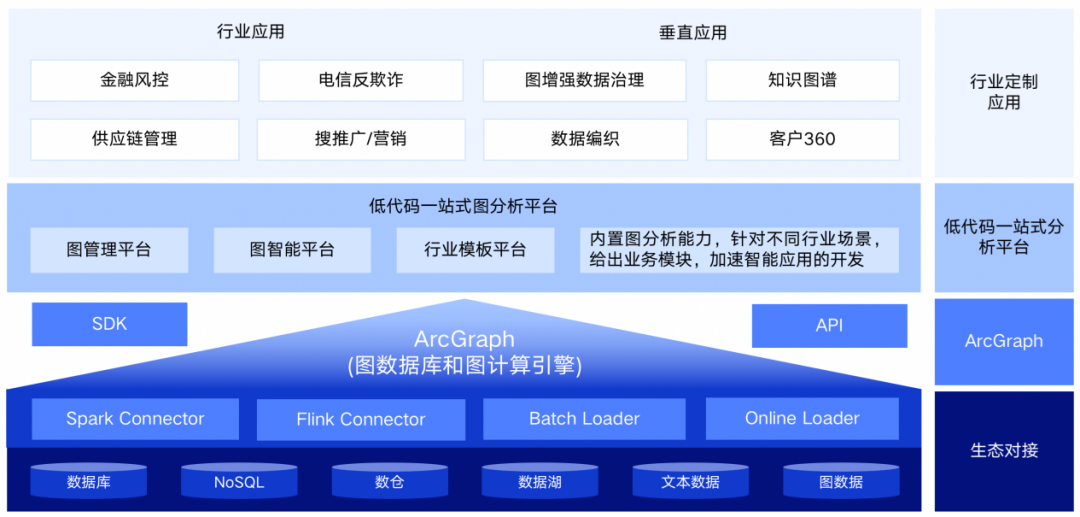
Fabarta Product Matrix and Ecosystem
Fabarta's current graph intelligence product matrix helps enterprises rapidly and efficiently build rich graph intelligence applications. Within one year of founding, it has completed commercial value validation of graph intelligence technology, with delivered implementations in commercial banking, manufacturing, and intelligent healthcare — initially demonstrating business value innovation in powering enterprise intelligent transformation with explainable AI. The complete closed commercial logic confirms market demand for graph intelligence technology in practical applications. More importantly, customer feedback enables timely optimization and upgrading of products and underlying technology, ensuring products maintain competitiveness and value through continuous development.
This round of funding will primarily be used in the following areas: First, increasing R&D investment in graph intelligence technology, optimizing cloud-native, storage-compute separated distributed graph databases and graph computing engines, improving system performance, and collaborating with industry-leading open-source pre-trained model providers to enhance pre-trained models' logical reasoning capabilities through the core capabilities of distributed graph computing engines. Second, further optimizing the product matrix and deepening industry integration to meet more industry and scenario needs. Third, expanding market promotion, raising brand awareness, and attracting more quality customers and partners. Fourth, recruiting and cultivating more top talent to strengthen the company's technological innovation and competitiveness in graph intelligence.
Industry insiders note that next-generation AI infrastructure needs to process and analyze complex data more efficiently to provide more precise and intelligent decisions and predictions, and graph intelligence technology will have very broad application prospects across many industries. These include finance, telecommunications, healthcare, manufacturing, energy, and IoT. Fabarta's graph intelligence capabilities and product matrix will help accelerate intelligent, efficient operations in these industries and enhance overall competitiveness.
More Content




Originating in Silicon Valley, BlueRun Ventures was established in 2005 as a venture capital firm focused on early-stage startups.
Currently, BlueRun Ventures manages multiple USD and RMB dual-currency funds in China, with assets under management exceeding 15 billion RMB, making it one of the largest early-stage funds domestically. Its investment stage focuses on Pre-A and Series A, covering hard tech and innovative interaction, enterprise technology, new consumer, and healthcare. It has cumulatively invested in over 150 startups, including Li Auto, Waterdrop, QingCloud, Guazi.com, Qudian, Songguo Mobility, Ganji.com, Energy Monster, Yuntu Semiconductor, Machenike, Yunsheng Intelligent, Anxin Wangdun, and BioMap.
BlueRun Ventures has been ranked #1 in Zero2IPO's "China Early-Stage Investment Institutions Top 30," #1 in ChinaVenture's "China Best Early-Stage Venture Capital Institutions TOP30," and named among Preqin's Top 10 VC Fund Managers Globally for Sustained High Returns.
Additionally, BlueRun Ventures has for multiple consecutive years received honors from Forbes China, 36Kr, Cyzone, Caixin Media, CBNweekly, Jiemian, and other media institutions, including "China Early-Stage Firm of the Year," "China Top Venture Capital Firm," "Early-Stage Firm Most Welcomed by Entrepreneurs," and "Most Influential Early-Stage Firm of the Year."