First Step of a Massive Undertaking: miHoYo-Backed Fusion Company Ignites Plasma | BlueRun Ventures Headlines

It's the first step, and a significant one at that.
This article is republished with permission from LatePost (ID: postlate). Author: Qianming He | Editor: Junjie Huang
In the summer of 2022, hundreds of millions of RMB in venture capital flowed into two Chinese nuclear fusion startups. We covered the advances in controlled nuclear fusion and investment trends in our tech column.
Two years later, a nuclear fusion experimental device was completed in Shanghai's Lingang district, passing preliminary technical verification. It doesn't look imposing — the main structure is only three meters tall, surrounded by pipes delivering gases, coolant, electricity, and other "inputs" for experiments.
Before firing it up, technicians spend weeks pumping air out of the device to create a vacuum. Then surrounding equipment spends several more weeks flooding the area outside the vacuum chamber with liquid nitrogen and liquid helium, cooling it to around minus 240 degrees Celsius. Current is then fed into the superconductors inside, generating powerful helical magnetic fields. Maintaining this environment costs 300,000 yuan per month in electricity alone.
Energy Singularity's nuclear fusion experimental device, Honghuang 70.
Its primary function is experimental: to determine whether the facility can successfully ignite plasma — the fourth state of matter beyond gas, liquid, and solid — the most basic condition for achieving nuclear fusion.
The moment engineers hit the "start experiment" button, a torrent of electrons bombard hydrogen gas pre-injected into the vacuum chamber, following the helical magnetic field and transforming it into rapidly spinning plasma. Simultaneously, surrounding equipment emits electromagnetic waves matching the plasma's rotation frequency, heating it to 5 million degrees.
The entire test lasts mere tens of milliseconds — shorter than a single blink. Yet to achieve this fleeting moment, Energy Singularity, backed by miHoYo, NIO Capital, and HSG, spent two years and nearly 200 million yuan building this experimental device named Honghuang 70.
Energy Singularity CEO Zhao Yang says this test validated the company's technical approach. They will invest billions of yuan developing the next-generation device — Honghuang 170, targeted for completion in 2027, aiming for energy gain greater than 10x: inputting 10 kWh of energy to generate 100 kWh. No controlled fusion device has yet achieved this goal.
Energy Singularity's progress is one of many developments among controlled nuclear fusion startups. Another Chinese fusion startup, Xinghuan Jueneng, also completed its first-generation experimental device last July and successfully operated it; it is now developing its next-generation device.
American nuclear fusion startups are more aggressive. Helion plans to build a power-generating fusion device by 2028 and has already signed a power supply agreement with Microsoft. TAE Technologies announced plans to commercialize fusion by 2030. At least four companies have set targets to generate electricity from fusion by 2030.

Long before the Manhattan Project launched to build the fission atomic bomb, scientists had already grasped the principle of nuclear fusion: when two light atomic nuclei (such as deuterium and tritium) combine, they release enormous energy.
The first artificial nuclear fusion was achieved in 1952, when the first hydrogen bomb detonated above Bikini Atoll in the Pacific — 500 times more powerful than the bomb dropped on Hiroshima.
Light atomic nuclei carry positive charges and naturally repel each other. To make two nuclei collide and fuse requires specific conditions. First they must be converted into plasma (that fourth state of matter beyond liquid, solid, and gas) and heated to at least 100 million degrees Celsius, enough to overcome repulsion and allow the nuclei to fuse. The region on the sun's surface where fusion generates energy reaches only 15 million degrees Celsius.
All hydrogen bombs achieve fusion by detonating an atomic bomb. But using fusion for power generation obviously requires a gentler method of heating plasma.
Some devices have already successfully heated plasma to over 150 million degrees Celsius, but they can't sustain it for long — mostly measured in seconds. Because plasma is extraordinarily unstable, like a constantly churning mass of electrified hot gas. Reactors need to compress plasma continuously and stably within a confined space (plasma confinement) to enable frequent nuclear collisions and sustained energy release.
A nuclear fusion researcher with 20 years of experience says plasma "is a bottomless pit to study," exhibiting numerous complex physical phenomena. No model currently exists to precisely predict plasma behavior; the only approach is to find ways to compress it through external forces.
The longest-studied and most promising approach is the tokamak device invented by Lev Artsimovich and others in the late 1950s, alongside the inertial confinement fusion (ICF) device developed at Lawrence Livermore National Laboratory in California — representing magnetic confinement and inertial confinement routes respectively.
In a tokamak device, atoms are fed into a donut-shaped vacuum toroidal chamber and heated by microwaves into plasma. Every direction of the chamber is wrapped with differently shaped magnetic coils. When electrified, these coils generate magnetic fields that compress the 100-million-degree plasma to a certain density, transforming it into a high-speed helix.
The inertial confinement fusion (ICF) device proposed by American scientists simulates the process of an atomic bomb triggering hydrogen bomb detonation: using lasers or particle beams to strike fuel sealed in a specific space, creating high-temperature and high-pressure environments to achieve fusion.
Partial internal structure of an inertial confinement fusion device. Image from Lawrence Livermore National Laboratory, California.
The longest sustained artificial nuclear fusion to date came from JET, a tokamak device jointly funded by multiple European nations. Late last year it achieved 5.2 seconds of fusion, producing 69.26 megajoules of heat — 19.24 kWh. And it consumed more energy than it produced — still not commercially viable. Shortly after this experiment, JET was dismantled; the experimental facility, built in 1983, was no longer an ideal platform for continued research.
The inertial confinement fusion device at Lawrence Livermore National Laboratory in California achieved net energy gain in fusion experiments in 2022 and 2023 — producing more energy than was directly input — but they didn't count the energy consumed to power the lasers. Moreover, the device produced only 3.15 megajoules.
If high temperatures can be maintained and plasma retains high density as designed, fusion can occur controllably and continuously — giving birth to a super power plant equivalent in output to existing nuclear facilities but with virtually no radioactive contamination risk.
Government agencies have actively pursued nuclear fusion research along this direction, but with low efficiency. The most typical example is the massive tokamak device ITER (International Thermonuclear Experimental Reactor). The entire structure stands about 30 meters tall — roughly ten stories.
This project, initiated by the Soviet and American governments in 1985, carried hopes for Cold War cooperation and represents the most ambitious investment in fusion research to date. In theory, tokamak devices large enough become easier to control with magnetic force, enabling more efficient fusion. ITER's goal is to heat plasma to a maximum of 300 million degrees Celsius, sustaining fusion experiments for 500 seconds, using 50,000 kWh of energy per hour to release 500,000 kWh. At that point, controlled fusion would be within reach.
After the Cold War ended, Russia's finances were limited and the U.S. government was cutting fusion R&D spending. It wasn't until 2006, when China, the EU, Japan, India, and South Korea joined, that ITER's construction plan was formally finalized.
Multinational cooperation can share costs, but efficiency drops significantly. ITER isn't expected to be completed until next year, followed by a decade of debugging before formal operation in 2035.
ITER's decades of setbacks have exhausted many who held hope for fusion, giving rise to the quip that "controlled fusion is always 30 years away."

The turning point came in 2021. Commercial fusion research made new advances, and private capital flooded in.
In June that year, Helion, an eight-year-old fusion startup, announced it had heated plasma to 100 million degrees Celsius — a feat previously achieved only by government projects. Five months later, Silicon Valley luminaries including OpenAI CEO Sam Altman and PayPal co-founder Peter Thiel, along with venture capital firms, invested $500 million in Helion — a fusion funding record matching U.S. government allocations for fusion research. If Helion continues to break through, they've promised at least $1.7 billion more.
In late November, Commonwealth Fusion Systems (CFS), which had spun out from MIT three years earlier, announced over $1.8 billion in funding — exceeding the total raised by all previous fusion startups combined. Backers included Bill Gates, George Soros, Google, DFJ, Emerson Collective, and 27 other wealthy individuals, companies, or institutions.
Investors considered CFS's breakthrough unprecedented. In collaboration with MIT, they had created the world's most powerful high-temperature superconducting magnet, capable of generating magnetic fields exceeding 20 tesla — 1.5 to 2 times stronger than ITER's magnets.
Stronger magnetic fields mean stronger plasma confinement and improved fusion performance. Their research made another path in fusion development clearly visible: building smaller tokamak devices could also generate energy more efficiently, no longer requiring massive material and time investments like ITER. This is also the technical direction Energy Singularity has chosen.
These new technical advances and two major funding rounds ignited fusion entrepreneurship. According to the Fusion Industry Association, as of June 2023, over 40 global fusion startups had raised nearly $6 billion from investors.
Leveraging decades of government research alongside new technical advances and materials, startups can build small fusion devices for just hundreds of millions of dollars to validate technical directions, with construction timelines shortened to 3–5 years.
"Achieving fusion with tokamak devices is already well-established — we don't need to do much scientific validation or research, we just need to focus on solving engineering problems," said Yuming Ye, COO of Energy Singularity. In this process, cost became critical. He told us that when designing their first-generation device, Energy Singularity — then with limited technical accumulation — considered outsourcing part of the design to a research institution involved in the ITER project, but turned to designing it themselves because the other's price was too high. "Whether copper conductors or high-temperature superconductors, the physics principles are the same." Once the design was finalized, they relied on multiple suppliers with years of experience in the nuclear power sector to build the first-generation device:
- Shanghai Electric Nuclear Power Group produced key equipment for Energy Singularity's Honghuang 70 tokamak host system: the vacuum vessel, cryostat, and thermal shield.
- Shanghai Superconductor provided all high-performance superconducting magnet materials for Honghuang 70.
- China Nuclear Industry Fifth Construction Co., Ltd. assisted Energy Singularity in assembling Honghuang 70.
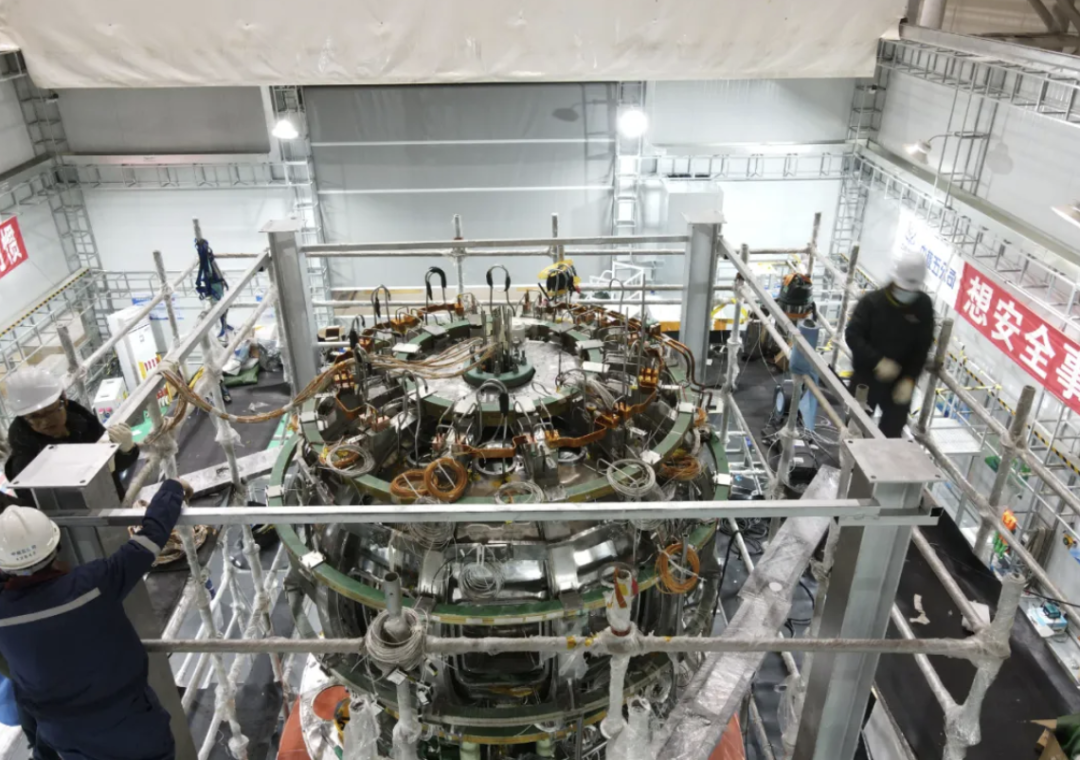
January 2024: Energy Singularity assembling Honghuang 70.
In Energy Singularity's plan, building Honghuang 70 was solely for technical direction validation — "using relatively short time and small cost to verify the feasibility of the technical approach, mitigate risks, then develop and build a larger, higher-performance device with greater investment."
Most commercial companies operate this way. Different fusion startups have chosen over 20 different approaches to building fusion devices, all relying on decades of past research and iterating step by step.
For example, Helion has iterated through seven generations of devices in its decade-plus existence; the fusion facility planned to supply Microsoft in 2028 will be their eighth generation, currently still in design.
"(The Microsoft deal) is a binding agreement — if we don't deliver, there will be financial penalties," said Helion CEO David Kirtley. That same year, Helion also reached agreement with Nucor, planning to build a fusion reactor by 2030 to help it produce steel.
Building previously government-funded massive installations through low-cost solutions, then upgrading iteratively, is a development path SpaceX validated with rockets and spacecraft. The difference: when SpaceX was founded in 2002, government-engineered rockets had already sent humans to space, to the moon, and built the International Space Station. Most of SpaceX's progress involved solving NASA-solved problems at lower cost to stimulate commercial applications. Fusion, by contrast, is a problem major governments have struggled with for over half a century without cracking. Even if commercial companies catch up to government research progress, formidable challenges remain ahead.

Part of commercial fusion companies' confidence comes from advances in AI technology.
Current experiments can already heat plasma to 100 million degrees, achieving controlled fusion. The key is sustaining it — making the energy produced far exceed the energy consumed in the process.
In each fusion experiment, scientists must prepare control parameters for the magnets beforehand based on principles and intuition, adjusting voltage thousands of times per second to vary the magnetic field, trying to prevent the superheated plasma from touching the vacuum chamber walls. Otherwise only two outcomes are possible: plasma temperature drops, or the device is destroyed. Either way, fusion won't continue.
AI can learn from historical data (including simulated data) how to better control plasma. Its learning process resembles how DeepMind's AlphaGo learned Go: first set a goal — precise plasma control — with rewards for success and penalties for failure. Through repeated experiments, AI may find ways to control plasma for extended periods, enabling sustained fusion.
In February 2022, a Google DeepMind research paper, after peer review, was published in Nature: in the tokamak device at the Swiss Plasma Center, AI trained through reinforcement learning could control 19 magnetic coils at once, releasing voltage tens of thousands of times per second — controlling plasma at levels far exceeding experienced scientists.
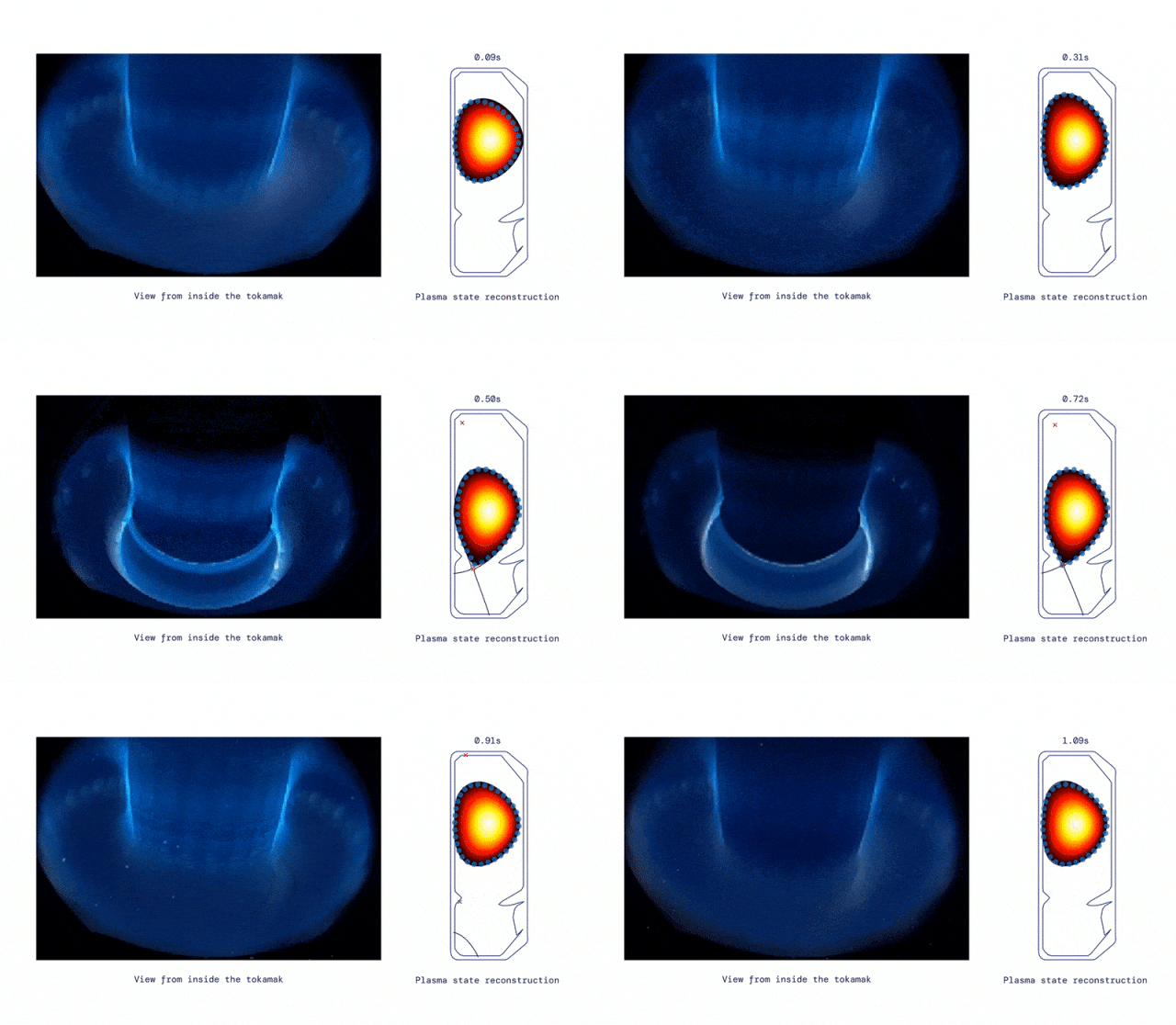
Google DeepMind's AI algorithm controlling plasma.
Since then, research using AI to monitor and control plasma has proliferated. Princeton University published a paper this March introducing an AI algorithm that can predict 300 milliseconds in advance whether plasma will disrupt, assisting scientists in real-time parameter adjustments to extend fusion reactions.
DeepMind has also continued optimizing its algorithms. In a paper published last July, they introduced new methods that reduced training time for plasma-controlling AI algorithms to one-third while improving control precision by 65%.
A Chinese fusion company founder said that after DeepMind's first paper was published, they immediately began replicating its AI model for use in their own projects. It is becoming standard equipment for fusion startups.
As large models have become hot, AI and nuclear fusion — two technologies born together in the 1950s — have developed a deeper connection.
Compared to traditional algorithms, running large models consumes significantly more energy. In a report released earlier this year, the International Energy Agency (IEA) noted that one Google search consumes roughly 0.3 watt-hours (Wh), while one ChatGPT query reaches 2.9 Wh. They project that without reducing algorithmic power consumption, data centers running large models could see electricity consumption double by 2026, exceeding 1,000 terawatt-hours (TWh) annually — roughly equivalent to all of Japan.
As the world transitions to electrification while seeking to reduce carbon emissions, large model deployment is increasing power consumption, placing greater strain on global power systems. Amazon's Ireland data center has already begun restricting users due to excessive GPU power draw.
Some companies are turning to nuclear energy. Microsoft has begun recruiting nuclear energy specialists, hoping to use small modular reactors to power data centers. In March this year, AWS purchased a data center built next to a nuclear power plant.
"Future AI requires an energy breakthrough — AI's power consumption far exceeds people's expectations," Altman said earlier this year. He considers fusion the fundamental solution: "It motivates us to invest more in fusion." He is chairman of Helion's board.
"When society needs fusion technology, fusion will be achieved." So said Soviet nuclear physicist Lev Artsimovich after developing the tokamak device in the 1950s. Society clearly needs a miraculous technology like controlled fusion more than ever now.
Source: WeChat public account LatePost


Sorry, BlueRun Ventures Doesn't Want That Kind of Startup Camp
| Buming 2024 Now Recruiting

The Path to AGI | BlueRun Ventures' AGI Investment Thesis Updated to Version 2.0

BlueRun Ventures and Portfolio Companies Win 36Kr
China Equity Investment Industry Early-Stage Investment Institution TOP 3 and Other Awards