Galaxy Universal Raises 500 Million Yuan in Strategic Funding Round | BlueRun Ventures Headlines

Embodied Intelligence Powers a New Future for General-Purpose Robotics
PEDaily has learned that, following its record-breaking angel round this year, Galaxy Universal today announced the completion of a 500 million RMB strategic funding round, again backed by an impressive roster of investors: Hengxu Capital, Hong Kong Investment Corporation (HKIC), Shanghai AI Industry Investment Fund, Beijing Robotics Industry Fund, Shenzhen Capital Group, CCB International, Zhiyou Scientists Fund, Rongyi Investment, Jinjing Capital, and others. Existing shareholders IDG, Matrix Partners China, BlueRun Ventures, and Beijing AI Industry Investment Fund also made significant additional investments (listed in no particular order).
To date, just over a year since its founding, Galaxy Universal has raised more than 1.2 billion RMB, setting the record for the largest funding amount in the embodied large model track.
BlueRun Ventures led Galaxy Universal's first round and has repeatedly increased its stake since.
Founded in May 2023, Galaxy Universal is led by an academic heavyweight — He Wang, who earned his undergraduate degree from Tsinghua University's Department of Electronic Engineering and his PhD from Stanford University. He currently serves as an assistant professor and PhD advisor at Peking University's Frontiers Computing Center. After one year of development, Galaxy Universal launched its first product, the Galbot G1, and has assembled a lengthy list of backers.
Looking broadly, embodied intelligence is undoubtedly one of the most exciting sectors today. Particularly behind each wave of heated funding, we're seeing major cities launch competitions to dominate this emerging industry.

He Wang is unquestionably the soul of Galaxy Universal.
Born in 1992, Wang earned his bachelor's degree from Tsinghua University's Department of Electronic Engineering before pursuing his PhD at Stanford University under Professor Leonidas J. Guibas, a member of three US national academies. He began researching embodied intelligence during his doctoral studies.
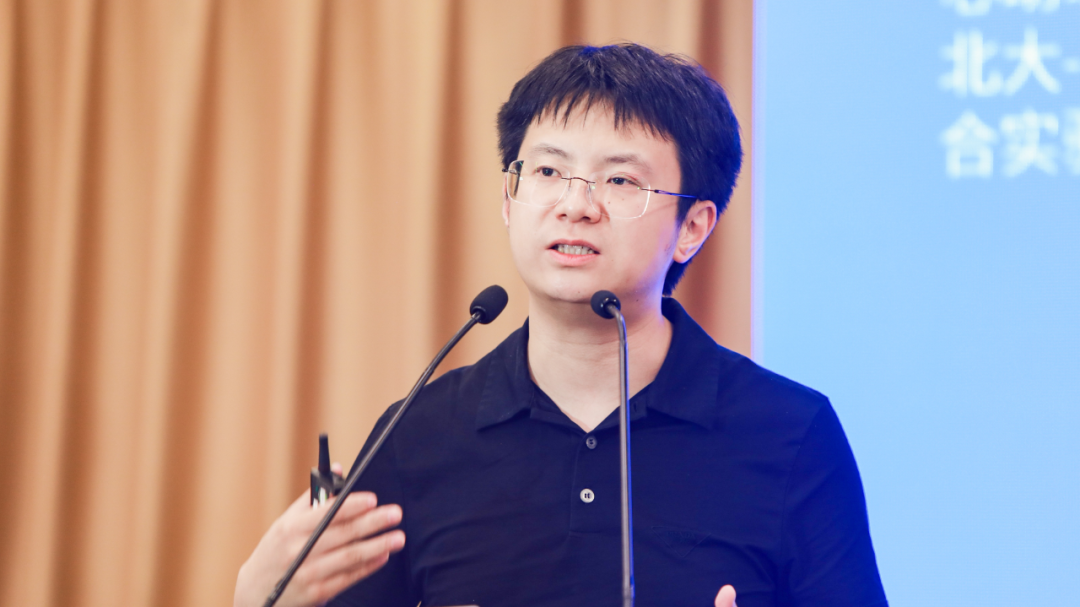
His academic achievements are striking: finalist for the ICCV 2023 Marr Prize (the highest honor in computer vision), ICRA 2023 Best Manipulation Paper nomination, 2022 World AI Conference Young Outstanding Paper Award, 2021 World Generalizable Robot Skill Challenge champion, RSS 2024 SemRob Workshop Best Paper, and 2019 Eurographics Best Paper nomination, among others. Looking back, every step toward entrepreneurship followed a clear trajectory.
In September 2021, Wang returned to China to join Peking University as an assistant professor and PhD advisor at the School of Computer Science's Frontiers Computing Center. He independently founded and leads the EPIC Lab (Embodied Perception and Interaction Computing Lab) at Peking University, and in 2022 established and became director of the Embodied Intelligence Research Center at BAAI.
By 2023, Wang determined that combining multimodal perception large models with embodied manipulation held tremendous promise, and decided to seize this moment to start a company. In May of that year, he partnered with Tengzhou Yao, who had studied under Professor Tianmiao Wang at Beihang University's Robotics Institute and previously worked at ABB Group's Shanghai Robotics R&D Center, to co-found Galaxy Universal in Beijing, focusing on embodied multimodal large model general-purpose robotics.
In Wang's vision, "the physical interaction capabilities of embodied robots — the 'cerebellum's' body control and dexterous manipulation — combined with the 'cerebrum's' cognition, understanding, and planning, constitute the blueprint for future general-purpose robots." Based on this philosophy, Galaxy Universal's first embodied large model robot, the Galbot G1, was officially unveiled this June. According to Galaxy Universal, the Galbot has achieved — for the first time internationally — a success rate above 95% in grasping randomly piled, never-before-seen transparent and reflective objects, and has further mastered generalized manipulation skills such as opening cabinets, opening drawers, and hanging clothes. The team is firmly committed to developing embodied intelligence large models, with full-stack deployment across spatial intelligence, action intelligence, and hardware intelligence, exploring multiple points in parallel to lay a solid foundation for sustainable breakthroughs in industrial application ceilings.
This has brought Galaxy Universal into the sights of international AI giants — founders and current CEOs of Boston Dynamics, Google senior executives, NVIDIA's core robotics team, and Hyundai Motor Group have all visited, identifying Galaxy Universal as an important humanoid robot partner.
No product can succeed without real-world deployment; otherwise it's merely theoretical. In Wang's view, humanoid robots must have "competence" — the ability to actually work in scenarios is what enables commercialization. "Deployment means finding sufficiently general scenarios that can accommodate enough robots, while achieving this with controllable resources using existing methods."
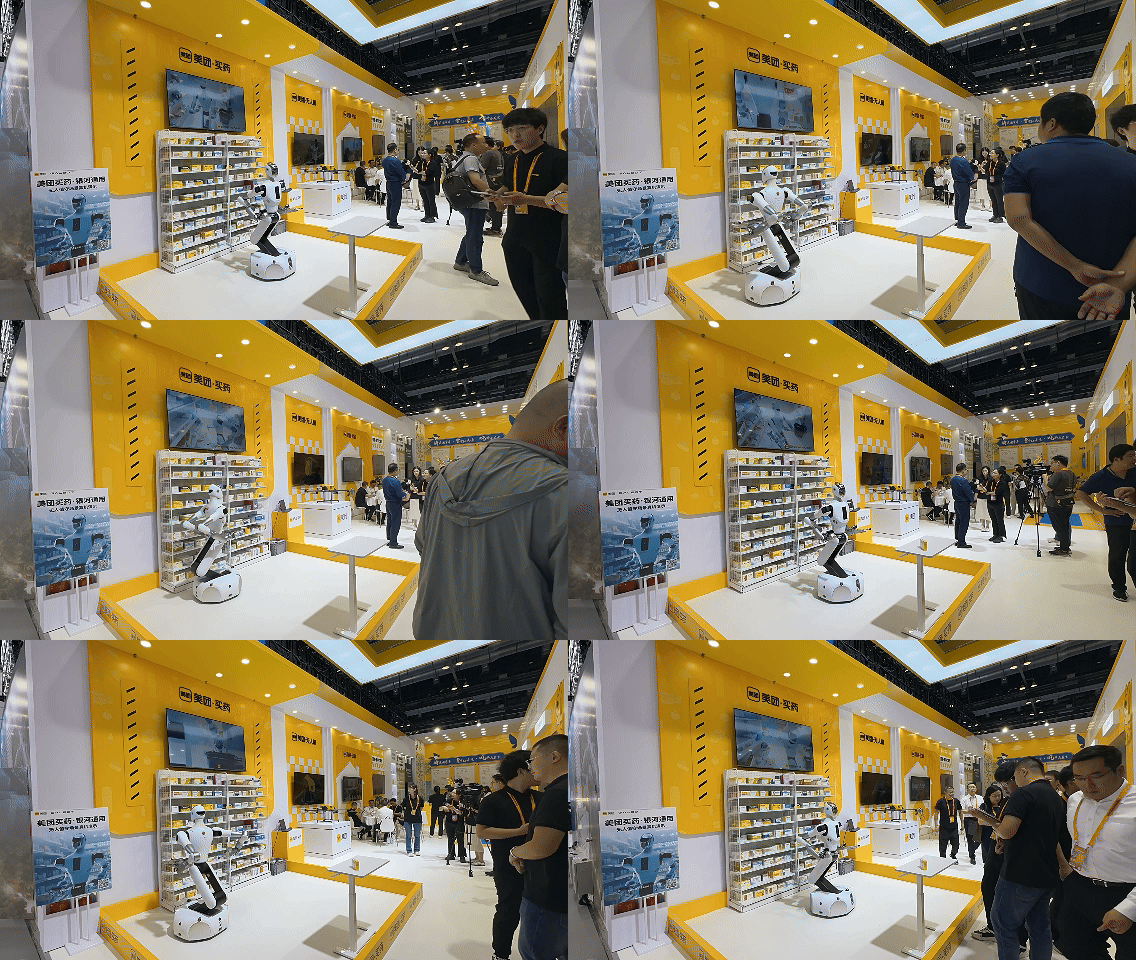
Galbot demonstrating unmanned operation at the Meituan Pharmacy booth at the China International Fair for Trade in Services
For commercial unmanned application scenarios, Galaxy Universal signed a strategic cooperation agreement with Meituan in September this year. The two parties will jointly build the world's first humanoid robot smart pharmacy solution, where Galbot can complete picking, delivery, and restocking tasks, autonomously plan pickup and delivery routes, and achieve 24/7 unmanned operation.
In factory and automotive plant applications, Galbot can generalize to execute sunroof transfer, depalletizing, and container transfer tasks — adapting on the fly to unexpected anomalies, handling stacked and arbitrarily placed containers, all guided purely by vision without requiring any QR code positioning on site. It has already begun partnerships with leading automakers including Mercedes-Benz and Zeekr. Galaxy Universal is also exploring applications in healthcare and elderly care, scientific research and education, and home environments.
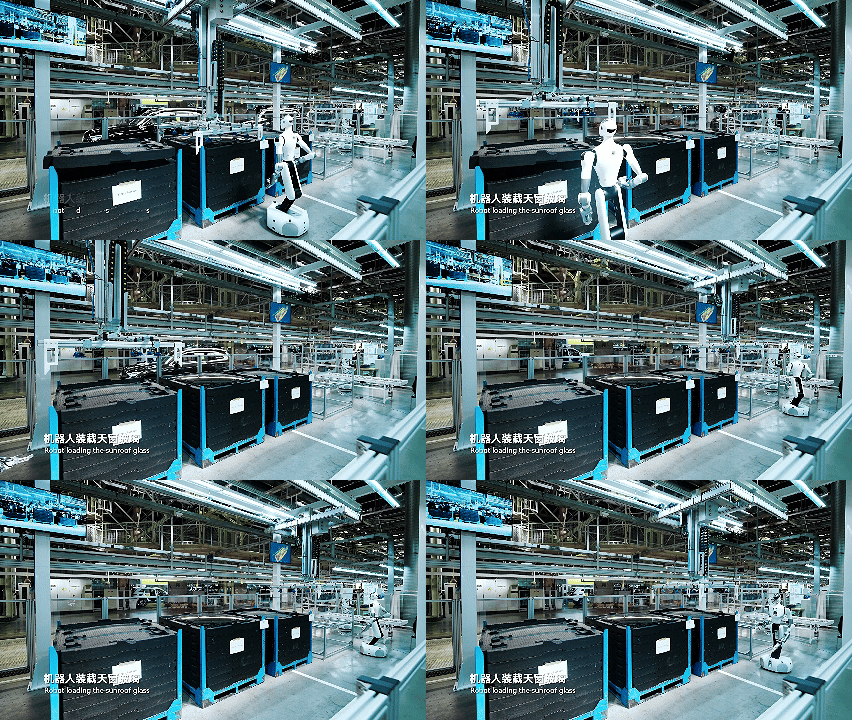
Galbot performing sunroof transfer work at an automotive plant
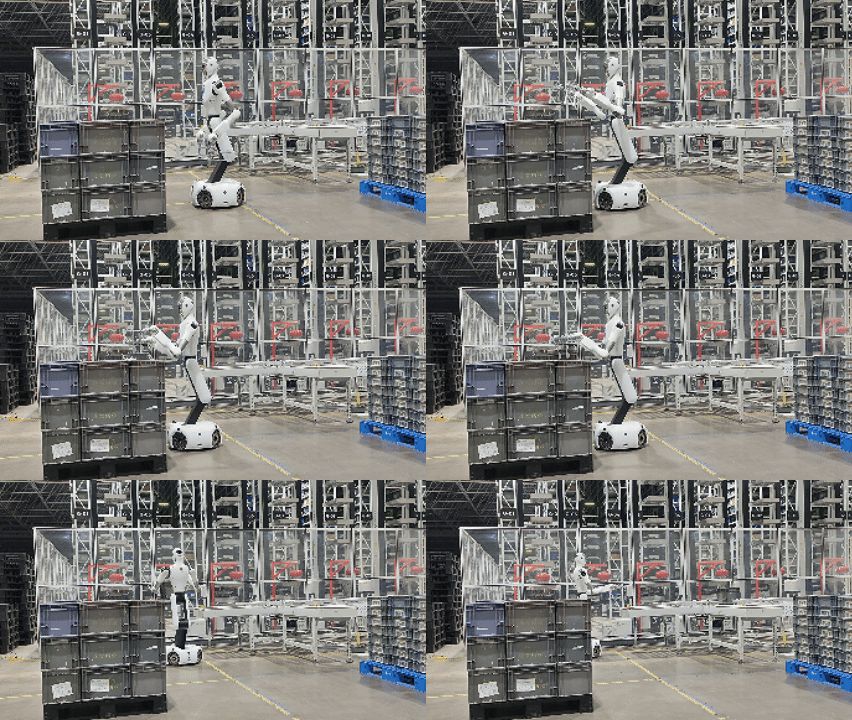
Galbot completing depalletizing and container transfer tasks at a factory
As Wang previously stated, "Beyond serving diverse industries, our ultimate vision is to bring humanoid robots into home environments, serving millions of households."

Behind Galaxy Universal, a lengthy list of investors has emerged.
Going back to May 2023, when Galaxy Universal had just been founded, it completed its seed round, after which top-tier institutions continuously joined. According to informed sources, Galaxy Universal maintains high barriers for investment and a rapid funding pace, leaving many institutions unable to get in.
In June this year, Galaxy Universal announced the completion of a total 700 million RMB angel funding round. Now, the company has completed another 500 million RMB strategic round. A detailed accounting reveals that it has assembled nearly every type of investment institution on the market —
Notable venture capital funds: Matrix Partners China, BlueRun Ventures, Source Code Capital, IDG Capital, Qiming Venture Partners, Lighthouse Capital, and others;
Strategic and industry investors: Meituan, BAIC Capital, Hengxu Capital, iFlytek Fund, SenseTime Guoxiang Fund, Shougang Fund, CMB International, CCB International, Rongyi Investment, Jinjing Capital, JL Mag, and others;
Research institution funds: Peking University, Peking University Yan Yuan Fund, Tsinghua SeeFund, BAAI Fund, Pengcheng Vision Fund, Zhiyou Scientists Fund;
State-backed investment platforms: China Internet Investment Fund, Hong Kong Investment Corporation (HKIC), multiple Beijing investment platforms (AI Industry Fund, Robotics Industry Fund, Shunxi Fund, Jing Guorui, Haidian Zhongguancun Fund), Shanghai AI Industry Investment Fund, Shenzhen Capital Group, and others.
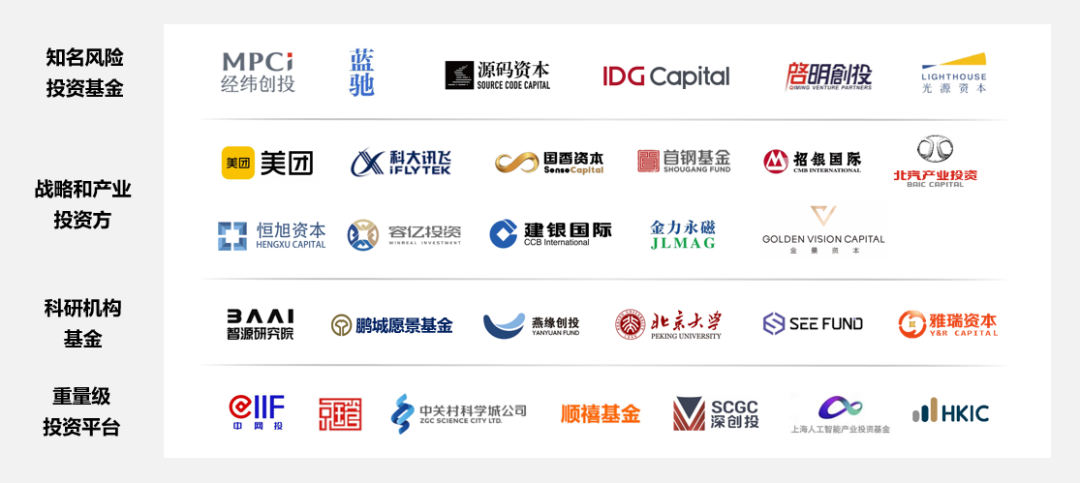
Investor list (in no particular order)Notably, Galaxy Universal's shareholder lineup has brought together government-backed funds from Beijing, Shanghai, Shenzhen, and Hong Kong in one place.
As one of the strategic round investors, Shenzhen Capital Group's investment team believes that Galaxy Universal, as a cutting-edge technology company focused on general embodied multimodal large model robotics, demonstrates excellent comprehensive capabilities in embodied large model R&D, hardware product mass production, and commercial deployment. Moreover, Galaxy Universal's business direction has natural synergies with Shenzhen Capital Group's long-term focus on and investments in high-end manufacturing enterprises, as well as with Shenzhen's local advantaged industries.
In July this year, HKIC formally signed with Galaxy Universal, making the latter the first embodied intelligence company introduced to Hong Kong. Following this signing, the two parties will collaborate to build Hong Kong's AI-driven robotics innovation ecosystem. Hong Kong SAR Government Financial Secretary Paul Chan, who attended the signing ceremony, noted: "Hong Kong has multiple advantages. Combined with the commercialization and intelligent manufacturing capabilities of Greater Bay Area sister cities, plus the concentration of research talent, there is enormous potential for developing embodied intelligence."
Regarding this investment, HKIC CEO Clara Chan stated that HKIC hopes to leverage the characteristics of "patient capital" to accelerate cutting-edge technology R&D and collaboration, explore more落地 applications, conduct more comprehensive talent training, and build Hong Kong's innovation ecosystem — all within the scope of embodied intelligence. "Through this cooperation, HKIC has further refined its multi-dimensional layout in the AI track, with coverage extending from industrial scenarios into daily life."
PEDaily has learned from informed sources that Galaxy Universal's next funding round is already in progress, and its scale will exceed this strategic round. The company is also expected to officially achieve unicorn status upon completion of the next round.

Embodied intelligence has created one fiery scene after another in this year's global venture capital landscape.
Counting beyond domestic companies like Unitree and AgiBot, the international track has seen frequent large funding rounds in the hundreds of millions of dollars this year — most recently, Physical Intelligence announced a round of up to $400 million at a $2.4 billion valuation, led by Amazon founder Jeff Bezos, with participation from OpenAI and venture firms Thrive Capital and Lux Capital.
Also recently announcing funding, Skild AI raised $300 million in Series A funding at a $1.5 billion valuation, led by Coatue, Lightspeed Venture Partners, SoftBank Group, and Bezos Expeditions. Other embodied intelligence-related companies including 1X (backed by OpenAI) and Fei-Fei Li's World Labs have also reached valuations above $2 billion, while Figure is reportedly completing a new round at a $5 billion valuation on top of its previous $2.6 billion.
Why is embodied intelligence so hot?
As the name suggests, embodied intelligence refers to intelligent systems or machines capable of real-time interaction with their environment through perception and interaction, typically possessing capabilities in perception, cognition, decision-making, and action. Humanoid robots are considered the optimal载体 for embodied intelligence. According to Citibank's latest projections, by 2050, the global humanoid robot market will reach $7 trillion, with 648 million humanoid robots worldwide.
Elon Musk is arguably embodied intelligence's most radical advocate, claiming that humanoid robots will become ten times more prevalent than cars. At Tesla's annual shareholder meeting in June, Musk committed that Tesla will begin limited production of its humanoid robot "Optimus" in 2025, with over 1,000 or several thousand units. He boasted that Optimus could one day help push Tesla's market cap to $25 trillion, and that by 2040 there will be over 10 billion robots.
Turning our gaze back to China. Last October, the Ministry of Industry and Information Technology issued the Guiding Opinions on Innovative Development of Humanoid Robots, explicitly stating that by 2025, a preliminary humanoid robot innovation system should be established, breakthroughs achieved in key "brain, cerebellum, and limb" technologies, core components ensured for safe and effective supply, and complete machine products brought to internationally advanced levels.
At its core, embodied intelligence represents a battle over emerging industries.
Shanghai has become the domestic pioneer in pushing embodied intelligence. Last year's Shanghai Action Plan for High-Quality Innovative Development of the Intelligent Robotics Industry (2023–2025) proposed focusing on tackling advanced technologies including embodied intelligence. Additionally, the Xuhui District Trial Implementation Measures for Accelerating Development of the Embodied Intelligence Industry, released this February, represents Shanghai's first district-level embodied intelligence industry support policy.
Shenzhen is not to be outdone. This July, the Shenzhen Action Plan for Accelerating the Creation of an AI Pioneer City was formally issued, proposing to accelerate construction of the Guangdong Provincial Embodied Intelligent Robotics Innovation Center, speed up R&D innovation and industrialization of embodied intelligent robots, and promote deep integration of embodied intelligence large models with robot hardware.
Then in August, Beijing's Haidian District released the Three-Year Action Plan for Building a National Embodied Intelligence Innovation Highland (2024–2026), using breakthroughs in large model and other AI technologies as a driver, with focused emphasis on embodied large models and complete robot machines, deploying six major initiatives.
But reality also stares us in the face — currently, embodied humanoid robots globally remain in the R&D phase. Enabling a robot to imitate various human movements and behaviors, then achieve precise whole-body motion control and generalized manipulation, "is actually a worldwide challenge."
Achieving that sci-fi movie moment still has a long road ahead. Beyond mature humanoid robot hardware, truly generalizable embodied large models are needed to drive them. While American peers routinely receive funding support starting in the hundreds of millions of dollars, China similarly needs to aggregate substantial capital.
Looking broadly, the historical wheel of the AI era rolls onward. Though the path of technological breakthrough behind it is always filled with hardships and twists, and no one can predict when the turning point will arrive.
But we know it will come.


Breaking Out of the Quadrant, Taking the Undefined Path | BlueRun 2024 Annual Fund Partners Meeting

Are You the Most Hardcore Deep Tech Entrepreneur BlueRun and Ant Are Looking For? | Registration Countdown
BlueRun and Hillhouse Lead Lingchu AI Investment, Reinforcement Learning Opens the First Era of Embodied Intelligence | BlueRun Family