Genspark CEO Kun Jing: Stop Asking How to Implement AI — Give Every Employee Unlimited Token Access First

Who Will Still Stand in Five Years, and Who Will Be Gone
Kun Jing has published another post. This time, he's tackling a question every CEO is grappling with: When AI shifts from tool to workforce, how must a company's organization change?
Over the past few months, from the wave OpenClaw set off to Genspark's release of AI Workspace 3.0 and its first AI employee, Genspark Claw, one clear signal has emerged: AI is beginning to complete work independently. Yet most companies remain stuck at the stage of handing employees ChatGPT accounts. Jing traces the gap between these two realities to what he calls the "Token Gap."
Tokens are the fundamental unit of AI work, much as electricity was to the industrial age. Where does the gap lie? Not in whether you have power, but in whether you're using it to light a bulb or to rebuild the entire production line. In his view, what will determine which companies survive five years from now is a seemingly simple structural decision that almost no one has actually executed: Have you given every employee unlimited permission to use AI?
If the answer is no — and for the vast majority of companies, it is — then all AI strategy and pilot programs amount to nothing more than "performing AI adoption." That sounds harsh, but Genspark's own practice bears it out: $200 million in annualized revenue in 11 months, 100% of code written by AI, one person doing the work of ten. This isn't because they hired smarter people. It's because they equipped everyone with an exceptional AI army.
BlueRun Ventures has backed Genspark from its angel round to today. What we see is not merely a rapidly growing AI product, but a paradigm that is redefining work itself. When AI takes on 80% of the workload, a company's cost structure, management logic, and very definition of talent must all be rewritten. Jing's proposal to "move AI spending from the IT budget to the people budget" may look like a simple accounting adjustment, but it represents a leap in organizational cognition.
Jing's essay functions as a mirror. What it reflects is not a technology gap, but an organizational cognition gap. The starting point for this transformation is breaking the shackles of the Token.
Below is his deep reflection, compiled by BlueRun.

"The efficiency gap between companies can no longer be measured in percentages. In the era of AI employees, companies that give every employee unlimited token access will run at 10x, 20x — even 100x the speed of others. This isn't a competitive advantage. It's a civilizational divide."
In my previous six posts, I discussed the arrival of AGI, how individuals can adapt, how to build AI-native teams, the shift in work experience that Vibe Working brings, why multi-model architecture is the future, and how to prepare children for an AI-native world. All of these, in a sense, were about people — about how humans co-evolve with AI. The seventh post is different. This one is about enterprises. Specifically, an organizational decision that I believe will determine who still stands and who has already vanished five years from now.

Almost every week, a CEO, founder, or executive pulls me aside in some setting to ask, in essence, the same question: "How exactly do we implement AI in our company?"
I understand why they ask. The question sounds right — strategic, thoughtful, responsible. It shows they're taking AI seriously, and I'm grateful for that intent.
But each time I hear it, I feel a quiet unease. Because while well-intentioned, the question reveals a fundamental misunderstanding. It treats AI as a project to be "implemented" — with a beginning, scope, execution plan, and completion date. It assumes there's a cautious, step-by-step path from "where we are now" to "an AI-enabled enterprise," and that our job is simply to find that path and walk it.
The question they should actually be asking is far simpler — and far more urgent: "Have we given every single person in our company unlimited permission to think, create, and build with AI?"
If the answer is no — and for the vast majority of companies I encounter, honestly, it is no — then everything else is empty talk. AI strategy plans, task forces, pilot projects, governance frameworks — none of it matters until this fundamental problem is solved. Without this prerequisite, you are not implementing AI. You are performing "implementing AI." The difference between these two is everything.

Let me be specific. When people hear "unlimited AI access," they imagine something vague — like "a culture that's open to AI tools." That's not what I mean. It means something precise and measurable.
Tokens are the fundamental unit of AI work. Every question you ask AI, every document you analyze, every line of code you have it write, every agent task you launch — all of these consume tokens. Tokens, to put it plainly, are the raw material of AI-driven productivity. Their role in the AI era is what kilowatt-hours were to the industrial age, what bandwidth was to the internet age.
A company that sets monthly token caps — requiring employees to go through IT approval to use frontier models, blocking certain AI tools on the company network, having twenty people share one subscription, mandating that AI usage be logged for review — is rationing its employees' ability to think with AI. It is installing a speed limiter on its employees' cognitive output. It is literally limiting how much intelligence employees are permitted to apply to their work.
Think about how absurd that sounds when said out loud. We are limiting how much intelligence our employees are allowed to use.
Yet this is what most companies are doing today. Not out of malice, but out of inertia — that instinct that makes IT departments see new technology as a cost to be controlled, rather than a capability to be unleashed.
I lived through a similar moment in the early 2000s. Some companies gave every employee unlimited internet access, saying: use it however you think makes your work better. Other companies were different — controlled access, blocked sites, monitored usage, wrote policies. The result? Companies that gave unlimited internet access in 2000 were basically the ones dominating their industries by 2010. The rationed-access companies didn't fall behind because their internet policy was bad. They lost because their fundamental attitude toward new technology was wrong — they optimized for control when they should have optimized for capability.
There's an earlier, even more instructive example that I keep coming back to.
In the early 20th century, factories began widely adopting electric motors. Most factory owners did what seemed most obvious: they replaced the central steam engine with an electric motor. The drive belts, the line shafts, the factory layout — all unchanged, just a different power source. The result? Some improvement, but not much. Efficiency up a bit, costs down a bit. But far from the transformative gains that were possible.
The factories that truly unleashed revolutionary power did something entirely different. They ripped out the entire transmission system — the line shafts, the drive belts, the centralized power distribution — and installed individual electric motors at each workstation. Then they redesigned the entire factory around this new architecture. The result wasn't a 10% or 20% productivity gain. It was three times, four times, sometimes five times. Processes previously constrained by physical power transmission could now be reorganized by logic and speed. Production methods that were literally impossible under the old architecture became reality.
Economist Paul David studied this phenomenon in a famous 1990 paper, calling it the "dynamo paradox": electricity had been commercially available for nearly forty years before most factories saw transformative efficiency gains — because most were applying new power to old thinking. They adopted the new technology. But they didn't reorganize around it.
What strikes me most: the factories that failed to transform didn't do so from ignorance or lack of effort. They could buy electric motors just like their competitors. They were paying for electricity too. They genuinely believed they were using the new technology. But what they were actually doing was grafting new power onto old structures — then wondering why the returns didn't match the investment.
What I'm seeing now is exactly the same. Most companies deploying AI are doing what those factories did: replacing the steam engine while keeping the drive belts. A shared subscription, a few approved use cases, a governance framework, a quarterly AI review meeting — the old organizational structure, those old belts and shafts, untouched.
Unlimited token access is, at the organizational level, "rip out the line shafts, install independent motors at every workstation." This isn't merely a cost decision. It's a structural decision — one that says you're redesigning the factory, not just swapping the power source. Like those factories of a century ago, companies that make this structural choice won't improve by 10%. They'll enter a completely different productivity tier from everyone else.
We're at the same fork in the road today. Only this time, the stakes are incomprehensibly larger — and the speed at which the two paths diverge is unlike anything we've seen.

In my third post, I wrote about how to build AI-native teams. In my fourth, I wrote about Vibe Working — the psychological and work-state shift that happens when people stop treating AI as a tool and start treating it as a true partner. Those two posts described transitions "in progress."
I want to be explicit now: that transition is no longer in progress. It is complete. The era of AI employees has arrived.
AI is not a tool for writing emails faster. Not a search engine you turn to when you're stuck. It is a colleague. A co-founder. An army of expert engineers, researchers, analysts, strategists, designers, and writers — on call 24 hours a day, 7 days a week, for every single person in your company, no breaks, no attitude, no office politics. AI doesn't clock out at 6 PM. It doesn't burn out. It doesn't need three weeks of onboarding. It doesn't negotiate salary repeatedly.
But having this army has a precondition: you have to open the door.
At Genspark, we went from zero to $200 million in annualized revenue in 11 months — a pace that, to my knowledge, is unprecedented in enterprise AI. In our first 9 days live, we crossed $10 million ARR, faster than ChatGPT, faster than Claude, faster than any AI product in history. The team producing these results is, by traditional standards, absurdly small. AI writes 100% of our code. One engineer built an AI browser in three months. One PM shipped AI Slides in two weeks. One designer who had never written code built a browser download site in three days. In the 11 months since, we've shipped AI Workspace 3.0, Genspark Claw — our first fully autonomous AI employee — plus Workflows, Teams, Meeting Bots, Realtime Voice, and more. These aren't geniuses. They're normal people, equipped with an exceptional army and unlimited access.
A 50-person company where everyone has unlimited AI access doesn't operate like a 50-person company. It operates like a 500-person company, or even a 5,000-person company. This multiplier effect is real, it's calculable, and we live it every day.
Now consider the alternative: a 500-person company that restricts AI access. Monthly token limits, IT approval workflows, a cautious pilot in one department, quarterly reviews, a carefully controlled rollout plan.
That company operates like a 500-person company. Nothing more.
The 50-person company delivers at 10x the speed, iterates at 10x the frequency, learns from failure at 10x the efficiency, accumulates knowledge at 10x the velocity. Every week that passes, the gap between them widens.

In every previous technology wave — PC, internet, mobile, cloud — there was a gap between early adopters and laggards. The fast movers had advantages. But those advantages, while real, were bounded. The efficiency gap between internet early adopters and laggards was maybe 1.5x. At most 2x. For the very best companies, maybe 3x.
Those gaps could be closed. A company two years behind on cloud in 2012 could catch up by 2015. Painful, expensive, but possible.
What is happening now is fundamentally different. The gap is not linear. It is exponential. And I'm not sure it can be closed anymore.
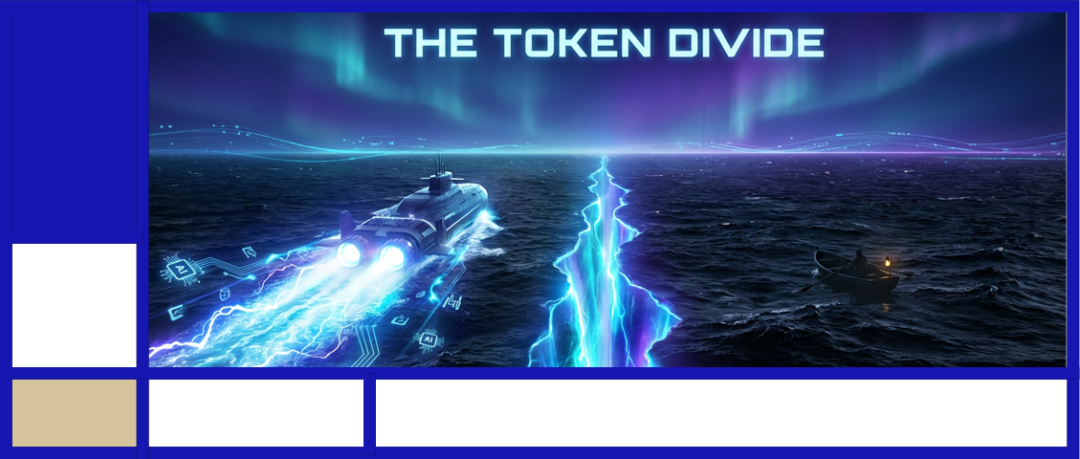
Imagine two ships departing from the same port on the same day. One nuclear-powered, one rowing by oars. On day one, the nuclear ship is slightly ahead. After the first week, it's far ahead. After the first month, the rowers can't even see the nuclear ship anymore. After the first year, the distance between them isn't large, or very large — it's incomprehensible. Not a gap in miles, but a gap in entirely different dimensions of reality.
This is the gap that the Token Gap is creating between companies.
On one side: companies where every employee has unlimited access to the most frontier models. Engineers collaborating with AI in real-time, multi-turn conversations to architect entire systems; product managers completing research reports in minutes instead of weeks; executives running competitive scenarios through AI before they even start on a presentation. Everyone in this company is applying a cognitive multiplier that compounds daily.
On the other side: companies where using a frontier model requires filing a ticket with IT, where AI tool budgets are discussed quarterly, where employees resort to personal credit cards to find alternatives because company-provided tools are too restrictive, where leadership is still debating whether to expand the pilot from engineering to marketing.
The output gap between these two types of companies isn't 10%, isn't 50%. It's the gap between one that's running and one that's standing still. Every day, the running company pulls further ahead — not linearly, but exponentially. Because running faster means learning faster, learning faster means better product, better product means more revenue, more revenue means running even faster.
This isn't a competitive advantage. Over time, this will be a civilization-level extinction event.

"Fully embracing AI" sounds weighty, but it can mean almost anything. Let me be specific about what to actually do.
Starting today, eliminate all token caps and AI tool spending limits for every employee. Not next quarter, not after the security review is complete. There will be costs, but they're negligible compared to the productivity gains; they're orders of magnitude smaller than the cost of falling behind.
Stop treating AI as an IT expense. AI spending belongs in the people budget — not the IT budget. Moving that line item changes everything. It signals to the entire organization: AI is not a software tool to be managed and minimized — it's a member of the team. Think of it this way: every AI agent in your company should have its own position, its own desk, its own reporting line. It has a role, it has output, it has an owner. When you treat AI this way — when it appears on your org chart, not just in your vendor contracts — your people will start treating it this way too. No rational CFO looks at payroll and thinks: "How do we squeeze this?" Payroll is the cost of buying human capability. AI access is the cost of buying AI capability. In a world where AI does 80% of the work, that spend deserves the same respect — the same investment logic — as the person sitting next to it.
Build a culture where using AI for everything is the default, not the exception. At Genspark, we don't have a policy of "use AI when it makes sense." We have: "if you didn't use AI for this, tell us why." This inversion is critical. It tells everyone the company is serious. It creates peer accountability. It accelerates collective learning, because when everyone is actively using AI, knowledge spreads incredibly fast.
Stop piloting. Let me be clear: if your company is still in a "test and evaluate AI" phase, you're not being prudent — you're being slow. The time for pilots was 2023. The companies winning now aren't piloting — they're deploying, iterating, compounding. Every month you spend evaluating is a month your competitors spend executing.

Let me paint a picture — not to accuse anyone, but because I think some leaders genuinely don't realize how they look from the outside.
The lagging company looks like this: a monthly "AI strategy committee" meeting; one AI subscription shared among every twenty people; a pilot in the engineering team, with plans to "expand to other departments" after the pilot — in two more quarters. Employees using their personal phones and credit cards to access frontier AI tools — not because they want to break rules, but because their work requires it.
This company's leadership believes they're being responsible. Managing risk. Moving cautiously.
Meanwhile, at another company, a 26-year-old engineer is in real-time conversation with an AI agent — which is simultaneously writing code, running tests, analyzing errors, and proposing architectural improvements. All of this happens in the few minutes it takes the engineer at the first company to submit a ticket requesting access to a basic AI coding assistant. By the time that ticket is approved, the 26-year-old has shipped a feature.
These two companies aren't operating in different eras. They're operating in different civilizations.

Here's what worries me most — and I want to be explicit about this, because people often feel the urgency without truly understanding the mechanism.
The Token Gap isn't just a gap in current output. It's a gap in learning velocity, and that's what makes it most dangerous.
A company that has given every employee unlimited AI access for the past two years hasn't just done twice as much work. It has accumulated two years of organizational learning — intuitive ways of working, muscle memory, internal culture — that money cannot buy. You cannot acquire your way to being AI-native. You cannot catch up in six months by hiring. "Organizational readiness" is compounding quietly, invisibly. The gap between companies that have built it and those that haven't is no longer a performance gap — it's a capability gap of an entirely different magnitude.
Companies that moved first, and moved fully, have entered a flywheel that is almost impossible to stop. Better product, more users; more users, more data and feedback; more data and feedback, faster product iteration; faster iteration, faster learning; faster learning, more AI investment; more AI investment, even faster iteration. Meanwhile, the best talent — those who thrive in AI-native environments — naturally flows to them. No ambitious engineer or designer wants to spend their career waiting for IT to approve access to a frontier model.
Latecomers face a compounding deficit. They're not just behind on output — they're behind on intuition, behind on culture, behind on talent density, behind on the flywheel itself. At some point — and this is what genuinely scares me — this deficit crosses a line where the question is no longer whether they can catch up. It's whether they're still in the same game.
You cannot row fast enough to catch a nuclear-powered ship. Falling three years behind on the Token Gap may be permanent. This isn't metaphor. I mean this literally.

For months, I've been observing two types of companies. The first type is riding the wave — not surfing perfectly, but in motion. They decide fast, accept uncertainty, embrace the mess of full AI deployment, and compound their learning every week. The second type is still standing on the shore, watching the wave approach, meeting to discuss whether to get in the water.
When I wrote my first "Seeing AGI" post, I was a father worried about my 12-year-old son's future. That worry remains — but now it's directed at the founders and operators reading this post. Because I see what's coming next, and I genuinely don't want anyone to be swept away.
A tsunami doesn't wait for your board meeting. It doesn't wait for your governance review. It doesn't give you one more quarter to expand your pilot. It's here. The organizations already in the water — riding the wave, harnessing its momentum — will survive and continue forward. Those still hesitating on the shore will be swallowed.
The window hasn't closed. But it's closing. Every founder, CEO, and operator reading this needs to answer this question today — not next week, not next quarter: Have you given every single person in your company unlimited permission to think, create, and build with AI?
If not, what are you waiting for?

I've been in tech for nearly twenty years. I've seen market cycles, company deaths, paradigms flip overnight. But I've never seen anything move this fast, with this depth of impact.
What keeps me up at night isn't the technology itself. It's the image — of smart, hardworking people; of founders who sacrificed everything to build their companies; of operators who gave years of their youth to their teams — waking up one day to find the gap with their competitors is unbridgeable. Not because they weren't smart enough, not because they didn't care enough. But because at a critical moment, they hesitated. They waited for one more data point. They convened one more committee. They asked for one more quarter to evaluate.
I don't write these posts to fearmonger. It's because I genuinely believe most people haven't yet felt how big this is — and by the time they feel it, it may be too late.
So finally, I want you to remember one thing.
The efficiency gap between enterprises is increasingly no longer about talent, strategy, or capital. It depends more and more on a single decision: Have you given every single person in your company unlimited permission to think, create, and build with AI?
Companies that have said yes — even if imperfect, even if messy — are compounding their advantage daily. Companies still hesitating aren't standing still. They're falling behind at a pace never before seen in history.
This gap used to be measured in percentages. Now it's measured in multiples. Soon, for some industries and some companies, it will become incalculable — because one side of the equation is no longer in the game at all.
I hope you're on the right side. If you're unsure — if reading this far, there's a moment where a voice inside says "this might be us" — then don't wait for the next board meeting. The wave is already here. The only question is: are you in the water, or on the shore?
There is still time. But not as much as you think.

Genspark CEO Kun Jing: Don't Want to Be Eliminated by AI? Here's What I Recommend You Start Doing Now

Genspark's Kun Jing Column Update: Multi-Model and Multi-Agent Are the Future
Genspark CEO Kun Jing: I See AGI, and I Hope I'm Wrong | BlueRun Family Headlines