Farewell to the "Novice Brawl": How Domestic Robots Are Breaking Through | Highlights from the BlueRun Ventures Robotics Salon

The key is not being a rookie yourself.

It's hard to say whether COVID's net impact on the robotics industry has been negative or positive.
The pandemic certainly created plenty of headaches, but it also delivered a powerful market education: robots matter enormously for automation. Amid this uncertainty, how can domestic robotics companies move beyond the "newbie free-for-all" of the last phase and break through to the next level?
Recently, BlueRun Ventures held the first installment of its Robotics Salon Series online. The event was hosted by Cao Wei, Partner at BlueRun Ventures, and featured Dr. Wang Jiegao, former Chief Scientist at Estun; Dr. Tan Weijia, Full-time Deputy Secretary-General of the Shenzhen Robotics Association; Zhang Chaohui, Founder and CEO of Youibot; and Cao Yunan, Chairman and CEO of Elite Robot. Together, they discussed how robotics startups can find breakthroughs and plan for the future amid cyclical volatility.
# TL;DR:
-
Despite COVID's impact, the robotics industry as a whole is trending upward: average deal sizes with major clients are increasing, and demand in new energy has exploded.
-
Pursuing profitability has become paramount; startups are choosing to break through first with "value customers" who have both strong willingness and ability to pay.
-
When it comes to local government incentives, the ideal is mutual help — not just expecting handouts. Otherwise, the burden may become unbearable.
-
One key to quickly building presence overseas: the "be integrated" strategy — push mostly standard products, and let overseas system integrators and distributors handle implementation and delivery.
-
Don't let customers sell you vague requirements that suck up R&D resources. Better to "dig deeper" — master one industry thoroughly and understand real demand.
If you want more, below is a partial transcript of the conversation. As a fund focused on early-stage tech investing, BlueRun Ventures foresaw the massive potential of the robotics industry back in 2014 and has invested in numerous outstanding robotics companies. We hope to build a platform for multi-stakeholder dialogue to explore real problems, identify real demand, and create real value. Stay tuned for more from the BlueRun Ventures Robotics Salon Series:
How has the robotics track changed this year from a market and capital perspective?
Tan Weijia: The ongoing pandemic has indeed significantly affected overall automation expectations for manufacturing this year. On the industrial robotics side, companies looking to deploy robots across entire production lines are finding decision-making and payment capacity increasingly difficult, so they're leaning toward more flexible automation solutions. Whenever the pandemic's impact eventually shifts, it will certainly create new demands for automation approaches.
On the non-industrial robotics side, getting customers to shift from rental-to-own consumption habits back to purchasing is also a major challenge. Companies need to adjust their business models, and even their products. The market environment is genuinely tough, but some leading companies have already begun adjusting. I believe we'll see more new developments in the industry soon, if not by next year.
At the same time, we're seeing that capital is reluctant to pull the trigger on Series A or angel projects this year, partly due to concerns about whether projects will be able to raise Series C. However, the ratio of early-stage to late-stage projects in Shenzhen remains relatively balanced.
Wang Jiegao: The robotics industry is closely tied to economic cycles. To maintain steady growth during a downturn, you need products that fit multiple industries. When the cycle is up, push hard on product promotion and sales volume; when it's down, expand into niche segments.
Since the pandemic began, robot sales have actually grown noticeably. On one hand, COVID made many customers realize the benefits of robots. On the other, technological advances have not only dramatically reduced robot costs but also improved performance. This year, demand in traditional automotive and 3C electronics has actually contracted, but we've seen explosive growth in new energy and other sectors. From a secondary market perspective, as long as a company has core competitiveness and fundamentals for sustained growth, volatility is normal.
Zhang Chaohui: Youibot focuses on industrial mobile robots. This year, different robotics segments have seen quite varying levels of activity, but overall demand hasn't dropped. One clear change this year: smaller customers are decreasing, but average deal sizes with major clients are increasing, with many projects involving dozens of units.
Last year capital was extremely hot, and frankly we grew worried about the industry in the second half. Mobile robots have been developing at scale since 2015 and are still in a relatively early stage. Entering a "newbie free-for-all" competitive phase too early disrupts the industry. Indeed, some areas saw intense competition last year, even fierce price wars. But this year, as demand patterns have shifted, the industry has actually returned to a relatively orderly, healthy competitive landscape, with players beginning to find their own positions and drive industry progress.
Cao Yunan: Elite Robot focuses on collaborative robots. We were significantly affected by COVID in the first half of this year, but based on our second-half momentum, our full-year volume probably won't differ much from expectations. As Dr. Wang said, collaborative robots can apply to multiple industries, so we're not limited to the existing industrial market, which validates our original product thesis.
To some extent, capital markets amplify both strengths and weaknesses, so I ask colleagues to filter out market noise as much as possible. A robotics company's capital market performance essentially stems from its growth potential, so you must focus on fundamentals — products, competitiveness, and so on. Sometimes you don't get what you obsess over; just keep your head down and do what you should.
How do you deal with the "newbie free-for-all" phase of losses and low margins?
Tan Weijia: The industry is actually returning to rationality this year. For quite a while before, internal competition was severe. Many companies expanded into new industries by underpricing to win benchmark clients, or engaged in unhealthy competition to boost valuation for the next funding round.
But this year, many companies have made strategic adjustments — some have even put "pursue profit" on the wall, which we hadn't seen before. We're also seeing companies become more selective about customers. Previously they'd handle implementation for orders of a few or a dozen units themselves; now they're setting thresholds and farming out smaller deals to integrators, which will certainly cultivate some system integrators along the way. Another approach is going overseas, especially for some commercial service robots that can sell directly abroad.

Cao Yunan: The newbie free-for-all is actually a phase-specific problem. The core issue is "how do I stop being a newbie," not "how do I peck the others to death." So as an entrepreneur, I think the most important thing is conviction in your own direction.
But on the other hand, you can't stay aloof when market competition is too intense, so you need long-term competitive strategy planning. At the tactical level, I think you can break through with value customers — first, those with strong potential purchase intent, and second, those with good margins themselves and strong willingness to pay.
How do you handle and leverage local government resources?
Wang Jiegao: Government help for startups comes in two forms: local government investment attraction, and early-stage support in project funding, talent, and so on. In practice, some investment attraction policies that look great on paper don't always materialize. Startups need to vet these carefully. If certain promises won't be fulfilled, opening branches with great fanfare may just scatter your energy.
Tan Weijia: The logic of government investment attraction is based on the output value a company contributes locally. If the promised incentives exceed the value the company could possibly create, the deal is inherently unsound. When a company's R&D and product applications are concentrated in a particular city, deploying teams there may indeed make more sense. But if a city has a highly concentrated and distinctive industry, robotics companies need to consider establishing a presence there. Actually, setting up multiple branch offices poses enormous management challenges for a company. If you're going to make such moves, you need to build corresponding capabilities.
Cao Yunan: Investment attraction is indeed something to treat with caution. Especially when a company is still weak, the fertility of the soil matters enormously. If your company isn't yet capable of being the core of local investment attraction, and you arrive to find you're expected to develop the industrial cluster yourself, that's extremely difficult. I placed our company headquarters in Suzhou because of the local ecosystem dividends — supply chain, customers, and so on can help us more, making it a natural, mutually beneficial arrangement. So cooperation with local governments must go with the flow: assess whether you genuinely need each other before partnering, rather than just thinking about what they can do for you.
Zhang Chaohui: We didn't interact much with government in the past. Now as the company has grown, many local governments want us to set up regional offices, and we're quite cautious about this. We have a dedicated government relations lead to handle this work, helping reduce the energy drain from these matters.
What experience can you share on robotics companies going overseas?
Zhang Chaohui: In our industrial mobile robot segment, overseas competitors actually don't have much deployment. So when the pandemic first broke out, we developed a mobile robot for epidemic prevention. This product was an instant hit overseas, selling to over 30 countries, and Youibot established more than 60 channels as a result. This showed us the potential overseas advantages in scenarios and technology.
Later, Youibot announced its overseas "be integrated" strategy: we basically push only standard products, with overseas integrators and distributors handling implementation and delivery. The results have been good — overseas orders account for roughly 15% of our business this year. We have two strategies: first, going out alongside domestic companies, providing automation services as they build factories. Their demand is sometimes even stronger than domestic, because local labor quality is lower. Second, finding major overseas clients directly, such as our partnership with DHL. Notably, we didn't send our own people to overseas sites for this. We found that with standard documentation and implementation processes, as long as the materials are thorough enough, overseas engineers can follow the steps and complete the work, with good results.
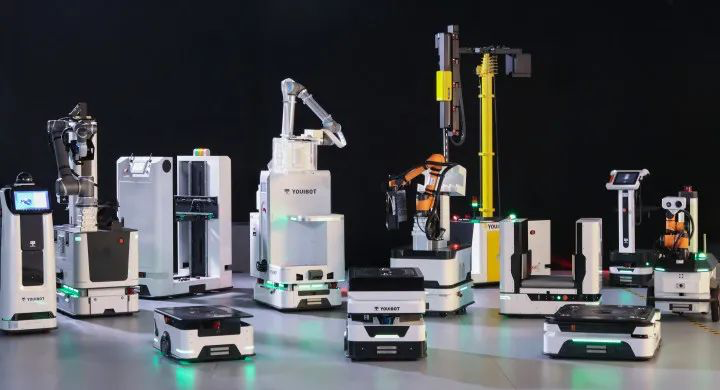
(Youibot product matrix)
Wang Jiegao: In Estun's early overseas efforts, we tried establishing branches or sales centers, but the results weren't ideal. Later we found that for more mature companies, overseas M&A is a very good approach. The acquired overseas companies not only use our robots themselves but also recommend us to their customers.
Cao Yunan: Overseas markets are something we both love and hate. Overseas customers' product demands actually fit our company ethos very well, but we also have frustrations because the domestic brand label can suffer from outdated stereotypes. So our approach to going overseas is "aggressive yet cautious" — aggressive in organizational setup and footprint, cautious in resource deployment. Somewhat "don't release the hawk until you see the rabbit." We only commit people and resources after genuinely sensing local demand.
I'd also suggest valuing partners and huddling for warmth. Even if you can't find suitable partners overseas, look for companies whose products don't directly conflict or compete with yours. If they already have overseas presence, you can share channels and after-sales teams.
In a cooler market, how do startups balance long-term value building with short-term revenue pressure?
Wang Jiegao: Probably every startup faces this kind of dilemma. For industrial robots, when the product isn't mature enough, you naturally want to do projects to understand customer needs and better refine the product. But later you should hand such projects to integrators — don't think about competing with partners for business. Overall it's a growth process; doing projects or doing R&D are both meant to make the product more competitive.
Cao Yunan: This is something I've been thinking about constantly for the past year. Capital backing may want you to keep iterating on product R&D; but back to business fundamentals, you ultimately need self-sustaining cash flow. If forced to choose, I'd say the latter is more important. Long-term value building is actually, on the foundation of short-term profitability, "having extra capacity" to develop more aggressive products. A common startup mistake is wanting to build an ideal, perfect product that may exceed actual customer needs, then having to walk it back — wasting a lot of resources. In a colder market, you still need to maintain a sales-target-driven logic, or anxiety comes easily.
Zhang Chaohui: We've encountered customers "selling us pies" before and learned lessons the hard way. So now we're very cautious, investing effort to thoroughly understand demand before committing more resources. Some R&D is also customer-demand-based — for instance, if a customer already buys our products, R&D costs can be included in the project amount. We try hard to reduce超前投入 with no one paying for it.
Especially with mobile robots, there are vast amounts of vague demand. Going "a little here, a little there" dissipates company resources; better to "dig deeper" and thoroughly master one industry, then evaluate whether it's worth going deep. In a generally tough environment, we're still adjusting around profitability. This year we've established many project baselines, and on product strategy we're ensuring that profitability for each project can be further improved.
▶ More Content ◀




Originating in Silicon Valley, BlueRun Ventures was established in 2005 and is a venture capital firm focused on early-stage startups.
Currently, BlueRun Ventures manages multiple USD and RMB dual-currency funds in China, with assets under management exceeding RMB 15 billion, making it one of the largest early-stage funds domestically. Its investment stage focuses on Pre-A and Series A, covering hard tech and innovative interaction, enterprise technology, new consumption, healthcare, and other sectors. It has cumulatively invested in over 150 startup companies, including Li Auto, Waterdrop, QingCloud, Guazi Used Car, Qudian, Songguo Mobility, Ganji.com, Monster Charging, Yuntu Semiconductor, Machenike, Yunsheng Intelligent, Anxin Network Shield, BioMap, and others.
BlueRun Ventures has been ranked #1 on Zero2IPO's "China Top 30 Early-Stage Investment Institutions," #1 on ChinaVenture's "China Best Early-Stage Venture Capital Institutions TOP30," and named among Preqin's Top 10 Global VC Fund Managers for Sustained High Returns.
Additionally, BlueRun Ventures has repeatedly received honors from Forbes China, 36Kr, Cyzone, Caixin Media, CBNweekly, Jiemian, and other media institutions, including "China Early-Stage Firm of the Year," "China Top Venture Capital Firm," "Early-Stage Firm Most Welcomed by Entrepreneurs," and "Most Influential Early-Stage Firm of the Year."