A Conversation with Haivivi's Li Yong: How to Build a Jellycat with AI and Hit Ten Million RMB in Monthly Revenue | BlueRun Ventures Family Headline

AI + Plush Toys + Emotional Value = BubblePal

This article is republished with permission from LatePost (ID: postlate)
Author: Yutong Wang
Editor: Manqi Cheng
In September 2024, we first visited Haivivi's Beijing office to meet CEO Yong Li. During our two-hour conversation, he was repeatedly pulled out of the meeting room by staff to check his phone. After several interruptions, he explained that BubblePal — the smart conversational AI device kids hang around their plush toys' necks — had gone viral in a livestream that day, and he urgently needed to handle procurement and payment matters.
BubblePal had just launched. By then, Haivivi had been operating for three years, with a year and a half spent on AI plush toys. Before pivoting from educational hardware to toys, Haivivi received angel investment from BlueRun Ventures; during the transition, Professor Ping K. Ko, former dean of HKUST's School of Engineering, also invested personally.
Following BubblePal's launch, from late last year to now, Haivivi has secured additional funding from HSG, Joy Capital, Huashan Capital, and other institutions, with cumulative financing exceeding $10 million. The device, priced at 399 yuan each, now generates monthly revenue exceeding 10 million yuan.
"I was surprised too, honestly unprepared," Li said. The product had just launched with only one streamer and one customer service rep, completely overwhelmed by thousands of viewers flooding the livestream. "Since graduating with my master's in 2005, I've spent twenty years in hardware. I know every product starts with a small group of enthusiasts before gradually reaching broader audiences."
As for why it suddenly took off, Li believes BubblePal was the first toy to truly leverage large language model capabilities.
The scenario was meticulously designed: engaging in conversation with children aged 3 to 6 who have basic language skills, are endlessly curious about the world, yet lack phones or smartwatches — answering their questions, reminding them to drink water, telling them stories.
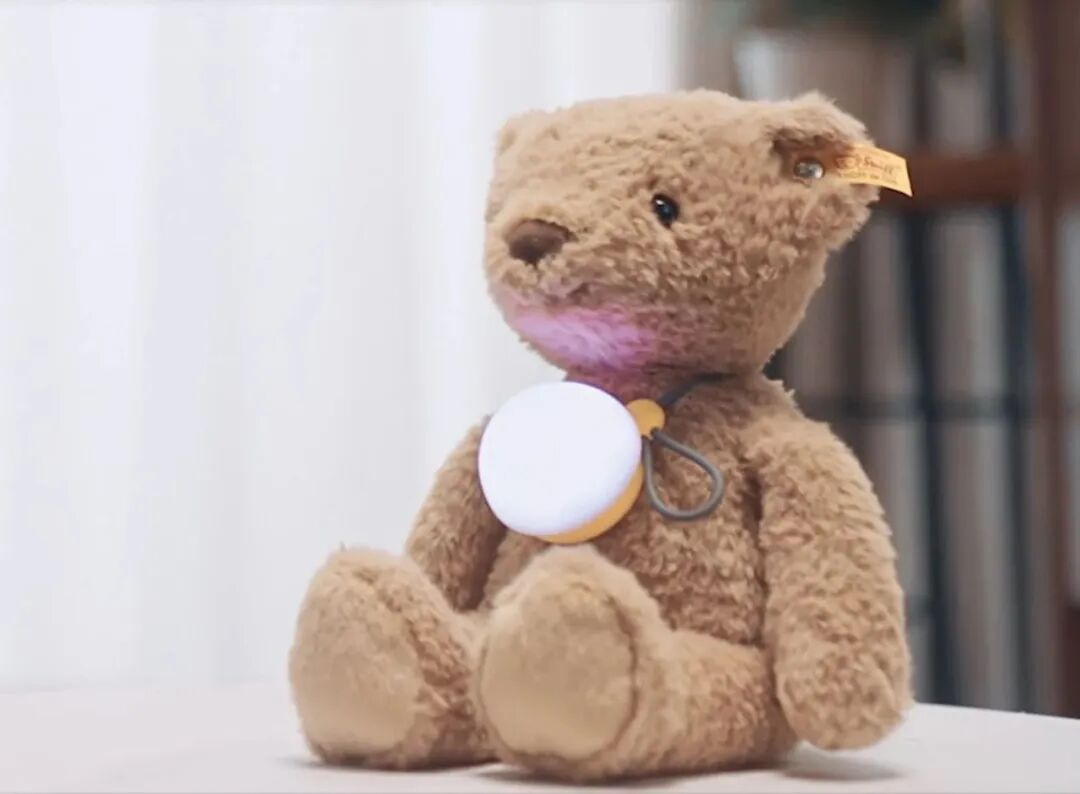
BubblePal attached to a Steiff plush toy
Li was among the founding team of Tmall Genie. Since its 2017 launch, Tmall Genie sold over 30 million units in three years — outpacing Baidu's and Xiaomi's competing speakers — yet still fell short of expectations. Alibaba had envisioned it becoming young people's personal AI assistant and a new gateway for home retail.
This experience yielded an unexpected insight: most conversations on Tmall Genie came from children. Thus began Li's exploration of children's AI hardware.
His logic: to avoid head-to-head competition with tech giants, target the emotional value segment that giants overlook and can't execute well; plush toys are the ideal vessel for emotional value, as humans are innately drawn to soft, furry things; and as large models matured, hardware could finally deliver emotional value. AI + plush toys + emotional value — the direction was set.
"For the first product, we just wanted to survive," Li said. So they addressed the existing market first — creating an AI pendant that hangs on plush toys, allowing children to converse with both the IP character and the device simultaneously.
Haivivi's second product line, complete AI + IP plush toys, will launch this summer. These plush toys with independent personalities and emotional interaction capabilities will also provide emotional value for adults. "In the future, we want to create AI friends."
When Li first joined Tmall Genie in 2017, he gave every team member a copy of Stefan Zweig's The World of Yesterday, because experiencing the AI transformation era was precious. It was shortly after AlphaGo defeated Lee Sedol, when China saw a wave of innovation opportunities in computer vision, AI hardware, and autonomous driving.
Li admits he was "too optimistic" then. But now, with end-to-end voice models and on-device models maturing, and DeepSeek-R1 unexpectedly performing well at delivering emotional value for adults, this twenty-year AI hardware veteran who was once "too optimistic" seems to have finally arrived at the AI era he once imagined.

LatePost: When we met in summer 2024, you mentioned that if end-to-end voice models like 4o could be applied, the product experience would improve significantly. Now GPT-4o is available, and more domestic companies are developing end-to-end voice models. You should have integrated different end-to-end voice models by now — how do they actually perform?
Yong Li: Pretty well. OpenAI's 4o was delayed several times, but we eventually tested it and it met expectations. However, costs remain relatively high. Given another quarter or two, it should meet our needs, making emotional value for adults achievable.
LatePost: What new trends or innovation directions do you foresee in the toy space in coming years?
Li: Many possibilities. Could we add cameras and connect to multimodal large models? Could specialized chips run smaller on-device models?
There are even more directions at the algorithm level. For example, our envisioned "Toy Story" mode — multiple IP toys playing together with a child, where AI agents can chat, interact, and interrupt each other — requires significant advances in end-to-end voice models. Or the background audio mixing we're currently beta testing: when a story reaches pirates, ocean waves emerge; when snow falls, footsteps crunch through drifts.
Essentially, we want to build AI friends. Whatever large model technology fits IP character-user interaction scenarios, we'll adopt. Recent model iteration is rapid — we're tracking multimodal, end-to-end voice, and on-device models. We currently partner with IP companies, chip companies, and large model companies.
LatePost: Would you consider integrating DeepSeek? How much value could a large model with stronger reasoning capabilities bring?
Li: We're in a voice Q&A scenario, so we're not using R1 but V3. Several characters have already switched over, but compared with Doubao's new version, V3 shows limited improvement in children's Q&A experience. The critical factor for voice Q&A is latency; COT (Chain of Thought) isn't needed yet.
DeepSeek's main significance for us: marketing-wise, integrating DeepSeek brings new traffic to Douyin livestreams; large model costs are declining; it stimulates and accelerates iteration from all large model providers toward lower costs and better performance; and on-device small models that can run locally on hardware will arrive faster.
LatePost: Would reasoning capabilities enhance emotional value for adults?
Li: Although we're not currently using chain-of-thought reasoning, as model quality improves and model emotional intelligence increases, emotional value delivery will significantly improve — whether for children or adults.
LatePost: Over the past two years, what technologies have underperformed your expectations?
Li: We were overly optimistic about some technologies. End-to-end voice models, for instance — OpenAI announced around May last year, but kept delaying. I kept waiting expectantly. Later I realized: end-to-end voice demands are extremely high, eliminating traditional ASR (Automatic Speech Recognition) and TTS (Text-to-Speech) steps — how could it be that magical? But at the time, I genuinely thought AGI was coming.
LatePost: Does your focus on children's products connect to your Tmall Genie experience?
Li: When we started Tmall Genie in 2017, we were extremely optimistic, believing AI technology would advance enough in three years to make smart speakers omnipotent AI assistants. In reality, it's taken seven or eight years to get here. Had this AI wave arrived then, things would have been much better.
We initially felt somewhat disappointed discovering that children dominated backend interactions. In retrospect, young adults have higher expectations for AI, and the previous generation of AI simply didn't deliver good enough experiences.

LatePost: Why did you target the 3-6 age range for your first product?
Li: First, we wanted to build AI hardware for children. Current large model capabilities aren't sufficient to deliver enough utility or emotional value for adults. Within the children's segment, we chose 3-6 years old primarily to manage user expectations: children this age have relatively developed language skills, and during kindergarten years they grow rapidly, asking all kinds of questions.
We worried that younger children's language development might be insufficient, creating poor voice recognition experiences; older children might have higher expectations for large models, or already possess phones and smartwatches, making them less interested in our product.
LatePost: How did you initially settle on your current product form — AI + plush toys + children + emotional value?
Li: When we started, we made early learning devices and sold several hundred thousand units. So when ChatGPT emerged in late 2022, our first instinct was to apply it to early learning devices. But then we realized online education giants would inevitably outperform us, leading us to consider how to compete differently from giants.
We still needed to make hardware. Since educational hardware was off-limits, toys were the alternative. We then examined which toy categories best combined with large models — blocks, puzzles, essentially the full spectrum. Our conclusion: plush toys.
First, pursuing emotional value avoids competing with tool-attribute hardware, which is where tech giants will inevitably focus.
Second, at the time large models weren't yet open-source and the technology was immature. Having a children's IP character helps manage user expectations — if a four-year-old Peppa Pig answers incorrectly, so what?
Third, plush toys have seen rapid global growth in recent years — it's a category on the rise.
When we were fundraising in 2023, we met Professor Bingqiang Gao, who decided to invest on the spot. He'd been looking for a product combining AI, hardware, and children. His thinking was that with the arrival of large models, Chinese hardware startups had real advantages: pure software AI applications face intense competition from overseas teams in Silicon Valley, but China has supply chain advantages in hardware. At the time, AI hardware capabilities weren't mature enough to deliver good experiences for adults. Even if a company had bigger ambitions, its first product needed to focus on kids.
LatePost: Why plush toys specifically instead of other categories? Building blocks, for example — they previously accounted for the largest share of China's toy sales, even bigger than plush toys.
Li Yong: Building blocks are a great form factor too. The question is how to integrate them with large models. Our team brainstormed this — it's not common for kids to talk to blocks. So making talking blocks would require enormous time and cost to educate the market.
Tmall Genie faced the same challenge. In 2017, when we told ordinary users that a smart speaker could talk, it took a long time for them to understand how it talked and what it said. The user perspective differs fundamentally from the product manager's or engineer's perspective.
LatePost: What led you to choose a pendant form that hangs on a toy's neck?
Li Yong: Initially we wanted to acquire a bunch of IP and make complete AI-enabled plush toys. But considering our actual operating situation, we decided to first create a product for the existing plush toy market — something that could combine with current plush toys and let users grasp the large model concept more simply and clearly, keeping our market education costs low.
If you're building on existing toys, hanging around the neck works well from a user experience standpoint — it maximizes compatibility with all kinds of plush forms: rabbits, bears, little lions, whatever.
From a brand perspective, we made it a round bubble shape. On one hand, bubbles in fairy tales represent dreams and magic, so we wanted to convey magical bubbles falling to Earth, landing on the plush toy at a child's bedside, enabling the toy to speak and chat with the child. On the other hand, bubbles themselves carry connotations of dialogue — the WeChat logo is two speech bubbles.
LatePost: What makes directly making plush toys difficult?
Li Yong: The world's top ten plush toy companies all operate with multiple SKUs and frequent new releases, not like iPhone's one or two models per year. We hope to launch a series of IP products too, but that demands strong capabilities in creating or acquiring IP, plus delivery capacity.
More importantly, when we started this in early 2023, we hadn't raised enough money to buy that much IP, and first-tier IP review processes take considerable time.
LatePost: But isn't making talking plush toys now essentially re-educating the market to accept that plush toys can talk?
Li Yong: The thinking behind this is: what do large language models fundamentally bring to children's hardware? Most importantly, more natural voice interaction — and plush toys talking is extremely natural.
From a child's perspective, Peppa Pig talks in cartoons, but the Peppa Pig on their bedside doesn't talk — that's what's strange. Previously technology couldn't achieve this, so as adults we accepted this reality, or simply overlooked it. But children talking with plush toys is very natural and common.
Young children believe everything around them is alive. So we're not crudely educating the market — this aligns with human nature. When iPhone introduced multi-touch, users didn't find it strange at all, even though no multi-touch phones had existed before.
LatePost: You have to long-press to talk with BubblePal — it can't be remotely activated. Don't kids need time to learn this?
Li Yong: Remote activation isn't technically difficult — our first-generation Tmall Genie in 2017 had it. Our choice not to use remote activation isn't technical; it's based on comprehensive considerations around battery standby life, company operations, product pricing, and time-to-market. Hardware is always full of trade-offs.
What you mentioned became our second-ranked complaint or criticism after selling tens of thousands of units — kids couldn't learn to press and hold. Our 2025 new product will enable remote interaction without holding.
LatePost: What's the top-ranked complaint?
Li Yong: The top complaint is connectivity — many people don't know the product needs WiFi and requires downloading an app.
That might sound unbelievable. Most AI hardware — AI earphones, AI glasses — sells first to the tech community, so users naturally know they need WiFi and app downloads.
BubblePal, as the first AI hardware to break out of tech circles, reached many young mothers in tier-one and tier-two cities who maybe got hooked by a question in a Douyin livestream and placed an order. Only after buying did they discover they needed to download an app and connect to WiFi.
LatePost: Hardware really does require a lot of trade-offs.
Li Yong: The steps get quite involved. For our current pendant, we considered button styles, triangular or star shapes, silicone versus plush materials, how long the strap should be... After industrial design, there's mold-making, then mold revisions — the process takes months. So if your initial decision is wrong, you've wasted months.
LatePost: How were BubblePal's many detailed design decisions made?
Li Yong: An investor once asked me, suggesting this should be done by young people. I gave an example: many product decisions weren't mine, and some of my ideas were wrong and got overturned. Our product lead, design lead, and marketing lead are all young mothers who studied abroad — they have good aesthetic sense and excellent grasp of emotional value. Many details, from my engineering-male perspective, seemed unnecessary. They add process steps, bring extra cost. Why so complicated? Why not the simplest version?
For our current pendant, I thought we completely didn't need two rings. But the design language has a small bubble alongside the product's large bubble, representing dialogue.
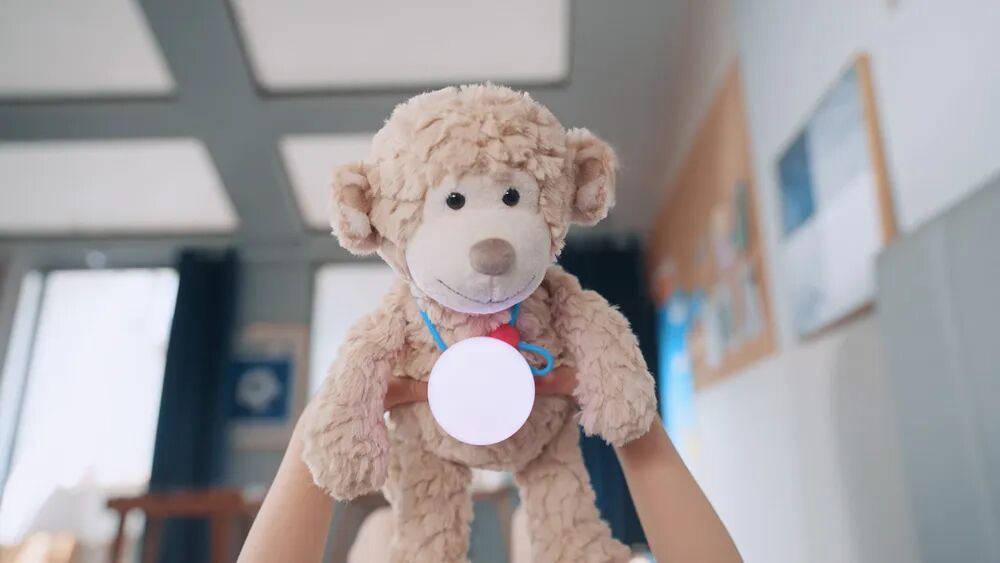
Bubble Pal on a Steiff plush toy
Our packaging is also expensive, uses quality materials, and is beautifully designed — to give users a sense of ceremony when they first buy it. Many such details, I was persuaded on.

LatePost: Are BubblePal's users and payers two different groups? How do you balance them?
Li Yong: All children's products work this way — surrogate consumption.
In our app, we provide many features for parents. Based on a child's characteristics or parents' expectations, they can set various prompts — like having the toy encourage the child more, help them be braver; or set reminders to drink more water, practice more English, talk more about astronomy. Parents also receive periodic growth reports from us, helping them discover their child's potential.
We consider both parents' and children's needs.
LatePost: You said you don't want to do education this time, but "talk more about astronomy, talk more English" — doesn't that lean educational?
Li Yong: Education in the serious sense implies a system, a curriculum. We don't want to go that direction. Education in the broad sense might mean cultivating good habits in children — that I think is okay.
We don't do serious educational content. First, because of where large model technology currently stands, issues like hallucinations aren't solved yet. So large models aren't necessarily good at serious educational content. Second, educational products need professional teaching research teams providing high-quality content — that's not our team's strength.
When we discussed this with Professor Gao, he also agreed with not doing serious education. Professor Gao is in his seventies, taught at UC Berkeley for many years, later became a dean at The Hong Kong University of Science and Technology, and knows technology very well. I said that for 3-to-6-year-olds, what's more important is cultivating curiosity and interest in technology — no Chinese parent can match large models in patience or breadth of knowledge.
Professor Gao said: "Exactly right. If a child wants to know what quantum mechanics is, by high school or college there will be expert professors like me to explain it clearly."
LatePost: Many education giants are now exploring large models combined with education — Haivivi really doesn't need to compete with them.
Li Yong: Online education giants have excellent educational content systems, teaching research teams, and brand and marketing capabilities.
In 2021, we made Tmall Genie plus early education devices — that category was indeed popular. But the AI education hardware track isn't friendly to startups; it's a must-win battleground for online education giants. For a startup, even if I react faster than them and make some money, maybe survive year one — but what about year three or five? So at this stage, we still want to do well as an AI friend, giving users more emotional value rather than education.
LatePost: Birth rates keep declining, and current 3-to-6-year-olds will grow up soon. How do you view the market ceiling? How do you respond?
Li Yong: For leading plush toy companies, children's products might only account for 20% of total volume. Most plush toys' main consumer base is actually young adults, not children. So our future AI plush toy products can address this.
Going global is also an important strategic opportunity. Our company moved from Beijing to Shenzhen in 2023 partly for this. We're already selling overseas, including in the United States. Because overseas models, servers, and regulations differ from China's, we needed preparation time, including strictly separating data.
LatePost: AI plush toys for adults — will adults actually pay?
Li Yong: We still want to make AI hardware that provides emotional value, and plush toys are inherently the best vehicle for emotional value. It's written in human genes — when humans see fluffy things, they feel happy inside.
The world's top-ranked plush brand is Steiff, the most expensive and premium brand. They have a Kids series, but it doesn't account for much of overall revenue. Most Jellycat buyers are young adults. Jellycat originally made toys for children, but later called itself a gift company — to expand into the young adult market.
Our first-generation product was for kids because of limitations in large model capabilities: even now, the emotional value these models can provide to young adults probably still isn't quite enough. But I think 2025 should be the turning point. The key milestone will be the maturation of end-to-end voice models — both cost and experience will improve.
So the children's product was our entry point into the market. Going forward, we still hope to have more products targeting young adults.
LatePost: You've been talking about providing emotional value to adults — what are the specific criteria? Accuracy, understanding intent, response speed, or something else?
Li Yong: It's not really about specific technical metrics. What matters more is the user scenario. Imagine this: it's late, you've just come home from work exhausted, and you want someone to chat with you, accurately recognize what you need, and give you a full, emotionally rich response. We've seen from the large model demos we've released that the effect is already sufficient.
As for what specific emotional value young adults need, there's no need to overthink it. A Jellycat that can't talk at all provides emotional value. If it could respond emotionally, it would definitely improve the product experience. There's no doubt about that.
LatePost: When children talk to BubblePal, they're not really talking to BubblePal — they're talking to the toy it's attached to, because they believe that toy is alive, not because they're conversing with some virtual machine. Adults can tell the other side isn't human, so what do they want from AI? Don't people fundamentally still prefer people?
Li Yong: If that logic held, there'd be no opportunity for products like Character.AI, Talkie, or STARFIELD, right? Plenty of people are willing to chat with apps. Having a physical object is better than having nothing.
Or let me give an extreme example: say you're a big fan of an idol. You have a figurine of him that can actually talk to you like he would in person. Would you like that? You already liked it when it couldn't talk. If it can simulate him chatting with you, you'd definitely like it.
Of course, large model technology may not be able to simulate an idol perfectly right now, but the demand is beyond question.
LatePost: Is providing emotional value to adults harder than providing it to children — is it an upgrade, or are they two completely different directions?
Li Yong: The emotions themselves are the same — there are only so many kinds of emotions. But at the technical level, they're genuinely different.
Adults are relatively simpler, because current models are fundamentally built for adults. Forget emotional value — they can already boost productivity.
For children, you need a massive amount of child-world understanding. The problems kids face between ages three and six are different from what adults encounter. So in terms of dataset selection and model fine-tuning, the values you instill are different, and the content and manner of responses differ from those for adults.
LatePost: How do you handle content filtering for children?
Li Yong: There are some things we don't want children exposed to, so we do value-level fine-tuning for children's products.
For example, discussing death is normal for adults — we need to talk about death when exploring the meaning of life. But it's not appropriate for children. So we've built in avoidance for questions like that.
Previously, Character.AI had some tragic incidents, partly because characters could be freely created and guided. So our characters don't allow user creation — you can only choose from our character library. If you want to create a character, it has to go through our review.
For some sensitive questions, we won't answer directly but instead guide the child to ask their parents. Here's an example: your child gets hit at school — should they hit back? In our interviews we found different answers, with reasonable arguments on both sides. So we'll answer with something general like "protect yourself" and "don't get hurt," and most importantly, tell the child they should ask their own parents about this.
There's another category of sensitive questions where we generate warmer responses. Once a user asked in our livestream: "Host, what if mom doesn't want me anymore?" Our answer was roughly that mom might be busy, adults have their own considerations, but mom will always love you. Unexpectedly, the user bought right after we answered. She said she was a stepmother, and her child kept asking her and dad why his birth mother didn't want him — she and her husband didn't know how to answer.

LatePost: If Pop Mart did this too — made Dimoo able to talk, providing emotional value to adults — what impact would that have on you?
Li Yong: That hypothetical probably doesn't mean much. Let me ask you something: there are plenty of Pop Mart knockoffs now — do they have much impact on Pop Mart?
We're currently working with several A-share toy companies, and they especially want to add AI technology. So can they just connect to Doubao or MiniMax's large models and make AI toys? The reality is all of these companies are talking to us about partnerships.
What we're doing has a relatively long chain: software, hardware, algorithms, plus understanding of emotional value and user scenarios. Even after the product is made, you still have to think about IP and marketing. Every company has its strengths. Pop Mart, or big internet companies, may not want to do this. Once the chain gets long, it becomes genuinely hard for large companies to compete. More importantly, it depends on whether this fits their strategy.
LatePost: Big internet companies wouldn't make toys that provide emotional value?
Li Yong: I don't think so.
Before starting my company, I worked at Alibaba on the Tmall Genie children's story machine. In my last few months there, we'd already sold tens of thousands of units — but for Alibaba that was a tiny number. And pushing this project forward was extremely difficult; it got shut down soon after.
From a big company's perspective, making toys isn't their strategic direction at all. Large companies have bigger strategic priorities to pursue. For AI hardware specifically, what they want is to compete for the entry point: phone + AI, earbuds + AI, glasses + AI, even car + AI. And for tool-type hardware like phones, glasses, and watches, you probably only need to buy one — you won't buy many — so these categories are extremely competitive. There's only first place, no second place.
Toys belong to the emotional value category. Emotional value categories aren't as cutthroat — you can buy IP A and also IP B, they don't conflict. You can buy Pop Mart and still buy Jellycat. So there's room for many small companies.
Tool-type products serve universal human needs, so they're massive categories. Emotional value is a relatively niche category — you have to provide value for different emotions of different user groups.
LatePost: There are already many companies providing emotional value to adults — Character.AI, ByteDance's Maoxiang, MiniMax's Talkie and STARFIELD. They're just not in toy form; they're pure software "talk therapy." Aren't toys and software competing for the same user's attention?
Li Yong: That's looking at it from a product and technology perspective: underneath it's all large models, all AI bots. But from the user perspective, one is a free app download, the other is a physical product you pay for.
Software products can iterate quickly — if you're not satisfied, I'll push a new version, since downloading costs nothing. But hardware can't. Hardware requires payment upfront, which creates expectations. If the experience falls far short of what was imagined, users won't buy.
So users have higher expectations for paid hardware. Managing those expectations is critical.
LatePost: You guys aren't typical tech entrepreneurship — it's not just rational analysis, you also have to be very感性 [sensibility-driven], paying attention to many details.
Li Yong: Many investors missed out on Pop Mart because rational analysis alone makes it very hard to invest in. So purely rational judgment doesn't work. Even if you've reasoned through the logic, the reality is that many tech giants fail at certain categories because of team execution issues.
LatePost: As a hardware veteran, you also worked on AR/VR glasses at iQIYI. Now seeing AI glasses hot again, how do you feel?
Li Yong: When large models emerged in early 2023, we anticipated they'd combine with glasses. Glasses are undoubtedly the next-generation computing platform — they're so close to the human body, and the efficiency improvement is so obvious. Compared to phones, that's another discussion, but compared to earbuds or watches, glasses are definitely the better scenario.
But I didn't expect Meta to be the one to do it first — I thought Apple or one of the domestic giants would. Meta had been working on VR glasses for a long time. They had the courage to drop the display entirely, keeping only the camera and microphone array, without knowing before launch whether it would sell. They were the pioneer. That kind of boldness — I really didn't see it coming. Apple's Vision Pro still tries to do everything, so it's still the old form factor.
LatePost: AI hardware used to be a relatively niche category, and now so many people are pouring in at once. How do you feel about that? There are people from many different backgrounds — which backgrounds will have the advantage in the supply chain?
Li Yong: Specifically in the toy space, because it's so niche, collaboration between different backgrounds is important. There won't be winner-take-all competition — someone who likes Pop Mart isn't prevented from also liking Jellycat.
For AI hardware more broadly, I honestly don't have an answer. It probably requires multi-dimensional, cross-disciplinary capabilities. As mentioned, the chain is long, so you need a team with compound backgrounds — no weak links anywhere. But which specific background will do better — that probably can't be reasoned through logically.
LatePost: Do you think other startups will try a product form similar to Haivivi's?
Li Yong: I think that will definitely happen — it's nothing unusual. Watches, earbuds, story machines, speakers — many hardware categories have gone through this.
I'm not really focused on competition. Because if we're the fastest, then our next main challenge comes from ourselves. Originally we could only make one product a year — can we now make more products in a year? Is our team's execution strong enough? We used to lack money; now if we don't lack money, can we maintain the same pace of progress? Will the organization face challenges?
LatePost: Now that you've raised more funding, will team size increase too?
Li Yong: Subjectively I want to build out and expand the team quickly. But in reality we need to be very cautious.
When people join, they dilute the values. I hope to select people who can go further with the company. I've experienced too much organizational chaos and efficiency loss from rapid team expansion, so I'd rather go slower.


From VLA to ViLLA: AgiBot Unveils GO-1, Its First General-Purpose Embodied Foundation Model | BlueRun Ventures Portfolio Headlines

What Went Down at Last Week's Hottest AI Hardware Meetup in Shenzhen | Booming Hub Recap

After ByteDance's Full Acquisition of Oladance, AI-Native Hardware Is Ready to Take the Stage | The Road to AGI
When Embodied Intelligence Enters the Real World | The Road to AGI