BlueRun Ventures in Conversation with AgiBot, Galaxy Universal, Tashi Zhihang, Lingchu Intelligence, and Hillbot — Embodied Intelligence: The "Breaking" and "Making" at Dawn

The Dawn of Embodied Intelligence
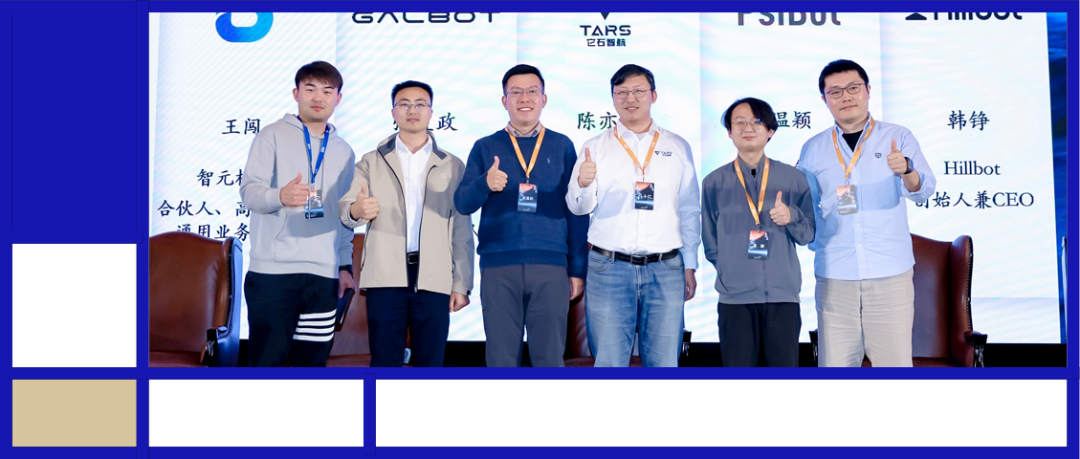
As the core vehicle for AI's transition from the digital world to physical reality, embodied intelligence is entering a critical phase — moving from "technically feasible" to "commercially credible." At BlueRun Ventures' 2025 RMB Fund Annual Partners Meeting, BlueRun Ventures Investment Vice President Xiaoheng Zhang sat down for an in-depth discussion with Wang Chuang, Partner at AgiBot; Zhizheng Zhang, Co-founder and Head of Large Models at Galaxy Universal; Yilun Chen, Founder and CEO of Tashi Zhihang; Ying Wen, Chief Scientist at Lingchu Intelligence; and Zheng Han, Founder and CEO of Hillbot. We set out to clarify several key questions: Why is embodied intelligence reaching its "dawn" right now? What kind of robots can truly enter our lives and workplaces? Does China possess systemic advantages in this race? And what are the critical metrics for bridging the gap from technology to business?
This conversation goes beyond technical path selection — it points to the decisive factors that will determine winners and losers in embodied intelligence over the next five years. We've compiled the full dialogue to bring you insights from those on the front lines.

Xiaoheng Zhang: Please briefly introduce yourselves, your company's core mission, and what makes you most distinctive.
Wang Chuang, AgiBot: I'm Wang Chuang. My first job was at DJI, and I've been at AgiBot for nearly two years, participating in the entire journey from the lab to shipping our thousandth mass-produced robot in January 2025. What sets AgiBot apart is our full-stack approach from cognition to action. We built teams for the robot body, motor intelligence (the "cerebellum"), voice interaction, and operational intelligence early on. Embodied intelligence is extraordinarily complex — it requires integrated hardware-software co-design, systematically fused from the very beginning. That's the best way to actually deploy.
Zhizheng Zhang, Galaxy Universal: I'm Zhizheng Zhang, head of large models at Galaxy Universal. I previously led the team at Microsoft building systems on top of OpenAI's models, making me among the earliest to fully commit to using large models to transform AI's capabilities in perception and cognition. I wanted to bring AI into the real world, which is Galaxy Universal's mission too. We want AI to transition from "thinking inside a computer" to "autonomously operating in the physical world" — and for this autonomous operation to scale stably and deliver diverse services to millions of households and industries.
Yilun Chen, Tashi Zhihang: I'm Yilun Chen, founder and CEO of Tashi Zhihang. Over the past decade, my team and I built China's autonomous driving industry from scratch, creating the country's best L2/L4 ADS systems. Today, many of my friends and neighbors commute, travel, and tour using the systems we developed back then. The driving force behind our entrepreneurship is transforming the era's best technology into products that the masses genuinely love. We believe embodied intelligence will surpass all previous robot technologies in user experience and value demonstration. Over the next decade, on this thrilling track of embodied intelligence and robotics, we'll continue building more powerful physical-world AI.
Ying Wen, Lingchu Intelligence: I'm Ying Wen, an associate professor at Shanghai Jiao Tong University's School of Artificial Intelligence, with a long-term focus on reinforcement learning and multi-agent systems. In 2023-2024, we saw embodied intelligence reaching a critical inflection point and joined Lingchu with my senior colleague Yaodong Yang. Our long-term vision is building a general embodied intelligence system serving all industries. In the near term, we're focused on bimanual dexterous manipulation. Dexterous hands, compared to grippers, currently target niche scenarios, but we hope to expand to broader B2B and B2C applications.
Zheng Han, Hillbot: I'm Zheng Han. Hillbot was founded two years ago in the United States by myself and my undergraduate classmate Hao Su. Professor Su has been working on machine learning since 2008, collaborating with Fei-Fei Li on the ImageNet project at Princeton and Stanford. Our company's biggest differentiator is nearly a decade of embodied intelligence experience. We pursue two main technical paths: one based on reinforcement learning, particularly using simulated data for RL; and the other, the physical intelligence approach. Our ultimate goal is achieving manipulation-capable technical models. I used to envy Chinese robotics companies for their proximity to supply chains and rapid iteration, so this year we're bringing part of our core R&D team back to China.
Xiaoheng Zhang: Today's theme is "Dawn" — light has appeared but hasn't fully brightened the sky, much like embodied intelligence's current state. As the true drivers of this dawn, please share what questions brought you into embodied intelligence, and what changes over the past two years have strengthened your conviction.
Wang Chuang, AgiBot: I've long wondered: Why haven't robots appeared in our daily lives? Why, after decades of development, do they still fail to address the core problems of labor shortages, aging populations, and elderly care? It wasn't until 2022-2023, when large model reasoning capabilities exploded and hardware stability improved, that I truly felt the robot I'd imagined was becoming real for the first time. I joined AgiBot to build robots that can actually enter homes and factories and deliver genuine value.
When I first joined, no one in the industry had achieved mass production — even getting a robot to walk was a luxury. In two years, we went from the lab to shipping a thousand full-size humanoid robots. Though these years haven't been easy, seeing our products grow in the real world every day, I'm certain we're pulling the future forward.
Zhizheng Zhang, Galaxy Universal: I've been thinking about one thing: Where does intelligence fundamentally lie? Human progress has come through "trial and error" rather than "observation and contemplation" — gaining knowledge through practice. Today's large models can understand the world but remain trapped behind screens. The true scaling law of intelligence is: Learn to interact, interact to learn. Only by letting models act in the physical world can intelligence truly evolve toward understanding and autonomy. This is the meaning of embodied intelligence.
Unlike autonomous driving, which solves a single objective, embodied intelligence lays eggs along the way — every increment of intelligence can become a real product. Over the past two years, we've achieved real deployments in retail, industrial, and home scenarios, which convinces me that embodied intelligence doesn't need to reach an ultimate general form to be useful. It can complete tasks with limited autonomy in constrained scenarios, thereby achieving generalization.
Yilun Chen, Tashi Zhihang: Three years ago, when I left Huawei's autonomous driving team, the last feature I delivered was an end-to-end system. After deploying it in extremely complex mixed human-vehicle scenarios in urban villages, the engineers were stunned by its flexible, intelligent navigation. A black-box neural network, relying solely on end-to-end architecture, achieved remarkable results. In that moment, I realized: the era of algorithms replacing complex engineering stacks had arrived.
Autonomous driving and robotics share the same roots — the early autonomous driving stack came entirely from robotics teams. When end-to-end demonstrated such power in autonomous driving, I became convinced that robotics itself must have an equivalent fully AI-ized algorithm stack. The robotics industry is now heading toward full AI-ization from the start. We see this as both challenging and预示ing enormous potential. Autonomous driving is essentially mobile embodied intelligence; robots simply operate in higher-dimensional environments with more complex manipulation.
Ying Wen, Lingchu Intelligence: Actually, we attempted a large model startup in 2021, but it was too scattered and underfunded, so the company shut down in 2023. By 2023-2024, large models and vision-language models were developing rapidly, and hardware costs were dropping fast. Early on, a dexterous hand cost nearly a million RMB; now costs have fallen dramatically. Additionally, our current team composition is much more robust — we have people strong in technology and hands-on ability, plus others with ample commercialization and engineering experience. Compared to our previous "pure scientist entrepreneurship," this feels much more viable, so I see it as a good opportunity.
Zheng Han, Hillbot: Looking back, my entry into this industry started with a basic judgment around this time in 2022. First, where would embodied intelligence data come from? When I saw generative models, especially DALL-E emerge, I judged that new approaches to open-world generated data could appear — though the path from text to 2D to 3D would take time. Second, in our collaboration with the Google Robotics team, we found that relying on simulation to advance foundation models struggled to teach the smartest people. This led us to start our own company and build end-to-end, providing a complete solution.
I think everyone on this stage shares a common goal: whether through vertical scenarios or generalization capabilities, we ultimately need to put real robots in real environments for people to try. Currently, simulation learning and reinforcement learning are advancing simultaneously. As for which is superior, we feel that by the first half of next year, the discussion around these two paths will show clear convergence.

Xiaoheng Zhang: We often say embodied intelligence is China's actively chosen AI main battlefield. From the front-line perspective, what specific advantages does China hold in this "China-US embodied intelligence competition"?
Wang Chuang, AgiBot: My fundamental judgment is: China will ultimately win in embodied intelligence, but it won't be easy. For decades, in every advanced technology competition, we've been catching up. But after finishing my PhD and joining DJI, I saw cracks appearing in that massive iceberg — from drones to lidar (dominated by Chinese companies), robot vacuums to lawn mowers, Chinese manufacturing has become the world's best. In new energy, overseas markets are "a single big tree on the prairie," while China is "a forest" — more vibrant, with stronger talent.
Embodied intelligence connects to all these industries because it requires mass production capability, intelligence, integrated hardware-software co-design, and supply chains — areas where China holds massive advantages. Additionally, Chinese people are exceptionally hardworking, pragmatic, and can easily access global knowledge, while many overseas professionals may only know English. Based on these experiences and the current industrial landscape, I believe the winner could be determined within five years, and Chinese companies will be the best.
Zhizheng Zhang, Galaxy Universal: This isn't about looking from one company or individual's perspective, but comparing two countries or systems at the industry level. We must first ask: What ultimate value does embodied intelligence pursue? In my view, it's using new productive forces to bring greater economic and social efficiency.
Toward this goal, China has three major advantages: First, a sufficiently large market. Embodied intelligence ultimately needs to solve social problems and productive work. A massive market enables timely validation and rapid iteration, which is crucial for technology to transform into systematic products. Second, a mature and complete industrial production system and supply chain. Embodied intelligence needs not just a smart brain but a hardware载体. Like autonomous driving's reliance on vehicle manufacturing, we need domestic supply chains. We must pursue not just high motor performance but automotive-grade hardware reliability to enable large-scale stable deployment without exploding operational costs. Third, rapid connection between technology companies and customers/industries. With capital and government guidance, technology companies can quickly connect with customers, forming synergies that achieve TPF (Technology-Product Fit) and PMF (Product-Market Fit).
I believe with these three unshakeable advantages, China's embodied intelligence will lead the world, and also lead global embodied intelligence companies to truly transform this technology from a single-point breakthrough into a systematic capability, ultimately forming productive and service forces that benefit users and society.
Yilun Chen, Tashi Zhihang: I believe three elements determine success in embodied intelligence or robotics: real and rich scenarios, continuous data streams, and high-frequency hardware-software iteration. China undoubtedly holds first-mover advantages in all three. America's strengths lie in: world-class team cognition, abundant resources (especially compute), and higher tolerance for failure. The US easily breeds disruptive technologies with major impact, so we must also pay attention to its progress.
But I believe compute's advantage for embodied intelligence is unclear. Its compute needs fall between autonomous driving (thousands of GPUs) and large models (tens of thousands) — roughly in the low thousands range. From this perspective, US compute doesn't form a clearly decisive advantage. Finally, in hardware-software integration, I don't think China has ever lost. For this next battle in embodied intelligence or robotics, in my view the best competitor is still Tesla.
Ying Wen, Lingchu Intelligence: For the overall ecosystem, from component supply, manufacturing, data, algorithmic models to downstream application scenario richness, China far surpasses other countries. There's strong consensus and acceptance domestically for introducing embodied technology to transform processes. Additionally, we have an information asymmetry advantage relative to the US. Many scholars and entrepreneurs returning from overseas in recent years bring cutting-edge information, but the hardware and operational knowledge accumulated domestically is hard for outsiders to access. With such asymmetric information advantages, we're even more confident we can outperform them.
Zheng Han, Hillbot: I also agree China will ultimately win — at minimum, we have very strong teams. But I want to raise one concern: US-China decoupling has created barriers to core technology exchange. Over the past few years, at academic conferences and offline events, core technology exchanges between China and the US have clearly decreased. If you're not consistently in that environment communicating with people, much information quickly becomes outdated, which creates certain obstacles to technical iteration. Even when events are accessible, what the other side can share is limited — these are objective conditions. This is indeed a challenge, but I believe Chinese teams will ultimately prevail.

Xiaoheng Zhang: If we gather here again in one year, what do you hope your company will have brought to this industry by then?
Zheng Han, Hillbot: I hope the industry develops consensus on upstream-downstream division of labor and collaboration, rather than simple competition.
Ying Wen, Lingchu Intelligence: On the commercialization front, achieving 1,000 robots providing continuous, stable service across various logistics and factory scenarios.
Yilun Chen, Tashi Zhihang: I hope to present a complete report on embodied intelligence's Scaling Law next year.
Zhizheng Zhang, Galaxy Universal: I hope to show real deployment results that are unimaginable today.
Wang Chuang, AgiBot: I hope AgiBot becomes the company with the most commercial deployments.

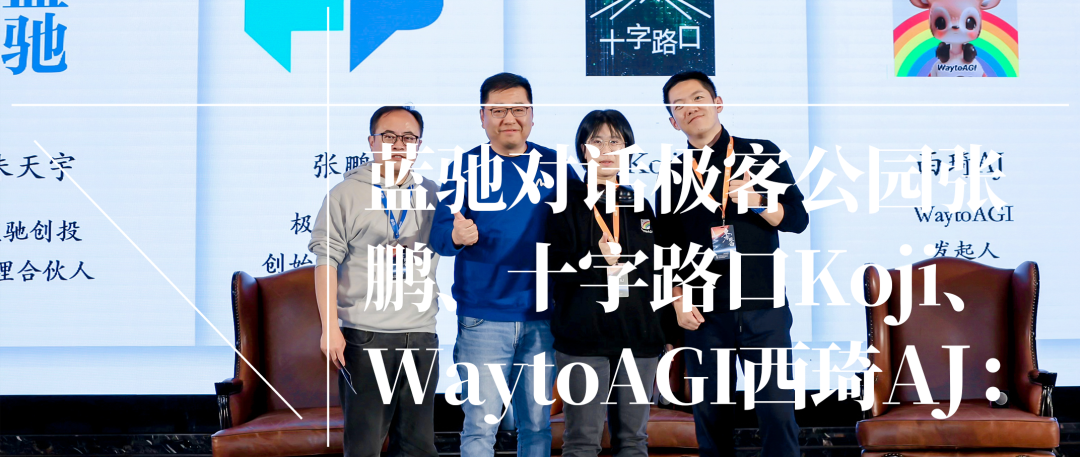 BlueRun Dialogues with GeekPark's Peng Zhang, Crossing's Koji, and WaytoAGI's Xiqi AJ: "New Species" and "New Ecosystems" in the AI Wave
  The East Already Bright, Walk Toward the Light | BlueRun 2025 Annual Fund Partners Meeting
  Break Out of the Quadrant, Walk an Undefined Path | BlueRun 2024 Annual Fund Partners Meeting