How He Rode Two Internet Waves — and How He's Catching the AI Startup Wave | Buming Startup Camp

On Organization, Talent, and Endgame Thinking

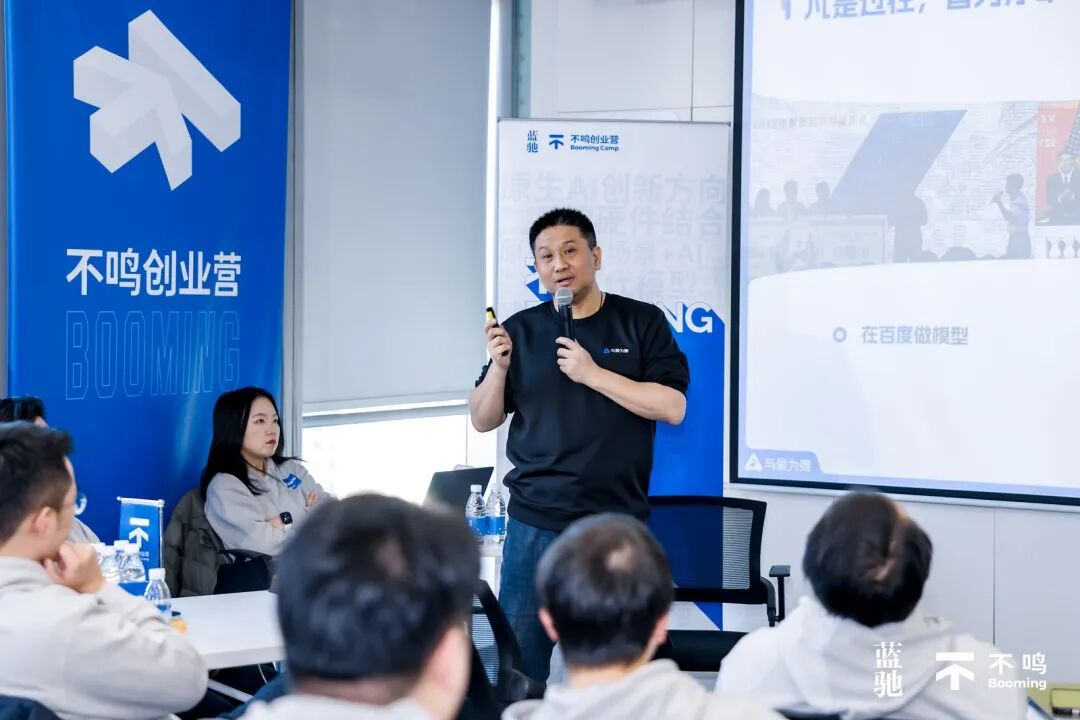
In mid-January, at BlueRun Ventures' fifth "Buming Entrepreneurship Camp," Huaiting Zhang, founder and CEO of Yuaiweiwu, joined as a mentor to share his firsthand observations and reflections from the front lines of AI entrepreneurship. Zhang has lived through nearly all three waves of China's internet — PC internet, mobile internet, and now AI. He was once a core leader of Baidu's "Fengchao" commercial system, and later co-founded Gaotu Techedu (formerly known as Gaotu Techedu), serving as COO. Today, he founded Yuaiweiwu, hoping to harness AI to make technology a force for good and education more accessible. He believes the key to this wave of AI entrepreneurship lies in balancing model uncertainty with business fault tolerance. "Current AI products are still intelligence-driven, human-escorted offerings. The stage to which intelligence drives and the degree to which humans escort — that determines organizational scale." In Zhang's view, organizational building isn't a lesson to catch up on once a company reaches hundreds or thousands of people; it should be treated as a core competitive advantage from Day 1. Beyond entrepreneurship methodology, he also shared his "problem-solving approaches" to personal growth questions: How do you use endgame thinking to choose a direction you truly want to commit to? Over longer time horizons, what kinds of work will sustain their vitality? One participant wrote in feedback: "Teacher Zhang is more than full marks." But at the event, Zhang reminded everyone at least two or three times: "If you look back at my judgments today in the future, they may well be wrong — this is just my current understanding." As an investor partner that has accompanied Yuaiweiwu's growth since the angel round, BlueRun Ventures has always looked forward to AI truly reshaping education. Below are highlights from Zhang's Q&A with Buming entrepreneurs, hoping to offer you fresh perspectives:


Buming Entrepreneur: How can a startup build its core competitive advantage?
Huaiting Zhang: Take education as an example. The industry has two natural advantages: one, it's easy to form a data flywheel; two, it heavily depends on brand mindshare. Look at all the study-abroad education companies on the market today — but the first one that comes to mind is probably still New Oriental. In education, brand has long-term influence.
But the problem is, for startups, you have no brand at the beginning, so how do you build advantage?
There's a hierarchy of core competitive advantages for a company: network effects > brand mindshare > organizational capability > first-mover advantage > fast-follower.
Before a company finds the right path, don't expand at large scale. Probe with the simplest, most economical methods possible. Once validated, you must expand fast — in today's intensely competitive environment, taking it slow usually means elimination.
But honestly, network effects involve a certain element of "luck." For startups, you can neither have brand nor network effects from the start, so the first battle must be fought on organizational capability.
For AI-native application companies, organizational management isn't about headcount — it's about balancing two things: first, the fault tolerance of the business itself; second, the uncertainty of the model.
For example, if you make an education product that simply wraps a model and delivers it to users, would users dare use it? Current AI products are still intelligence-driven, human-escorted.
Organizational scale ultimately depends on two factors: one, how far intelligence has developed; two, how much human escort can be reduced. When these two change, organizational form naturally follows. If companies can leverage AI to replace "management-driven" with "technology-driven," the hidden costs of hiring, training, selection, and management drop dramatically.
In education, especially AI education, we have the opportunity to be "friends of time." Because this industry allows you to slowly accumulate brand, and naturally has a data flywheel. If you can continuously reduce costs through underlying technology while steadily improving user experience, you have a shot at building brand.
Once brand takes root,叠加 with scale advantages, a positive data flywheel forms — that's our underlying thinking. Of course, I must admit this judgment may not be correct; it's just based on my current understanding.
Buming Entrepreneur: Suppose you were back around age 30, your social circle were all peers, and you only had $1 million in the bank. In this situation, how would you attract top-tier talent? Or under these conditions, what kind of person counts as "top-tier"?
Huaiting Zhang: I think you need to separate two things: whether you have money, and how you recruit, are different matters.
Even for us, our funding scale isn't large — roughly one billion RMB. We can't compare at all with those large model companies that raise one or two billion, even two or three billion USD. Many of our model-related hires came with significant pay cuts, not raises.
The core isn't money, but rather what you want to do, and whether that thing can truly move them.
In early-stage entrepreneurship, especially at the partner level, my logic has always been: take as little salary as possible. In my first startup, I took only 5,000 RMB a month. If you only have $1 million, don't think about doing something big from the start. Make the demo first, prove the path works, then raise funds and recruit.
As for core frontline partners or those one level below you, early on you similarly need to screen slowly. You might interview 100 people and end up keeping only 1–2.
Look at Alibaba's early eighteen co-founders, Tencent's early team — perhaps not every single one was "top configuration." Entrepreneurship happens in stages. My principle: aim for high configuration, but don't insist on top configuration; if you can't find the right fit, don't settle randomly.
Buming Entrepreneur: Suppose 20% of interviewees get offers, but only 1/10 of those accept. What do you think are the main reasons?
Huaiting Zhang: In this world, people truly willing to join a startup team may only be 1% to begin with. Entrepreneurs themselves are a rare species.
In today's environment, top talent has abundant choices. If they don't have an entrepreneurial mindset, aren't willing to bear short-term losses, they'll probably stay at big tech companies.
Buming Entrepreneur: If at the very earliest stage, with very limited money, you can only hire one full-time person and outsource everything else, who should that full-time person be?
Huaiting Zhang: Someone whose abilities complement yours, and who is absolutely indispensable at the launch stage.
This person doesn't have to be a co-founder. You need to first think clearly: which direction to enter from, what the path is. Direction matters more than path. Given current conditions, which thing must have someone doing it — without whom it can't launch — go find that person.
Buming Entrepreneur: What key changes does a CEO go through as an organization grows from roughly 100 people to over 1,000?
Huaiting Zhang: Managing 100 and managing 1,000 are genuinely different. With a dozen people, you rely on relationships, rallying each other; with around 100, you rely on rules, managing; beyond that scale, you must rely on corporate culture.
You can't watch everyone. Corporate culture is the behavioral code that tells people what to do whether you're present or not. But honestly, companies that truly understand and use corporate culture well are exceedingly rare.

Buming Entrepreneur: Your sharing was excellent and showed strong endgame thinking, which reminds me of a line from The Art of War: "Victorious warriors win first and then go to war, while defeated warriors go to war first and then seek to win." AI's impact on Chinese education in the future may not be merely at the tool level, but structural disruption. From an endgame perspective, how do you think about this, and how do you incorporate it into your company's value design?
Huaiting Zhang: This is an excellent question. Everything unfolds in stages. What we're doing now addresses the clearest, most easily landed needs, but we must simultaneously think about what the world will look like in five, ten, or even longer years.
Today students spend enormous time learning "foundational knowledge," but what should people actually learn in the future — what pulls that learning content? Essentially, it's what kinds of work society will need humans to do, which in turn determines what we should learn today.
Take my child as an example. He's in ninth grade now, torn between choosing an international school or a domestic high school. I told him: don't fixate on where first, but answer a directional question first — what kind of value do you want to create in society? What do you want to do? Why does this thing have sufficient leverage? I suggested using an Agent to research future trends.
The second question: why will this thing happen at that particular time? Not "because I see it now, so I think it will happen." After all, he won't truly enter the workforce for at least another decade-plus.
I even suggested he look at history, like how long geopolitical cycles roughly last. He needs to give himself a relatively coherent, logically sound projection. Once these questions are thought through, reverse-engineer: what do you need to learn? Where is appropriate to learn?
At the broader level, large numbers of white-collar jobs may disappear, and after embodied intelligence matures, some blue-collar jobs may also be replaced.
But I believe three types of work will retain vitality for a considerable time — we internally call them "LDT":
First, Leadership. Leading a group of people to do creative things. Thinking about how to organize carbon-based life, silicon-based life, even various Agents together.
Second, Designer. Once direction is set, how should the system be designed? That's what designers solve.
Third, Trainer. How are systems and models trained? Where does data come from? How to form closed loops? How to build data flywheels? These embody the core value of trainers.
If we judge that these three roles will be the main ones sustaining development, we can reverse-engineer: what capabilities need to be cultivated to become such people? What cognitive structures need to be built?

Buming Entrepreneur: Will Yuaiweiwu adopt external technical solutions, such as audio-video transmission systems?
Huaiting Zhang: We are building a fully AI-driven one-on-one education product. Frankly, globally speaking, we may currently be the only ones providing this kind of service.
You can understand it this way: in the past, a real human tutor would spend one to two hours teaching you knowledge one-on-one. Now, this is entirely completed by AI — we've already served over a million students.
We currently self-develop basically everything at the link layer, business layer, and model application layer, with core links largely in our own hands.
Our digital human technology results have been published at top international academic conferences, with more to come. Our voice model is self-developed. Our teaching model built on top of the base model is also self-developed. Currently only the base model isn't self-developed, but that doesn't mean we won't do it in the future.
Why must we use self-developed solutions?
Because the entire one-on-one AI teaching process is itself a highly complex, strongly real-time system: you need to understand what the student is saying, do speech recognition; make judgments and generate responses based on the model; output content and drive the digital human to present in real time.
If you use others' technology, can these data be connected? Can the model iterate quickly? What's the cost structure? How much interaction delay? You can't control any of these critical questions.
So we chose full-stack self-development. And after going full-stack, we're gradually merging the voice model and digital human model, reverse-driving a truly multimodal large model from the business. If you only do the business layer and rely entirely on external procurement for core technology, in the latter half of AI-era competition, you're more likely to be eliminated. Because what you can buy, others can buy too — there's no irreplaceable advantage.
Many successful companies today were able to form large-scale supply chain systems because they used massive product scale to force supply chains to continuously reduce costs. But the prerequisite is: core technology must be in your own hands. Otherwise, once competitive dimensions shift, you have no defensive capability.
To break the traditional education paradigm's "impossible triangle" of large scale, high quality, and low cost, we need to use model technology to turn services into manufacturing.
If you were to cross over into the electric vehicle industry now, which company would you choose as a learning target? I said internally before: if we're going to learn, we'd learn from car brands whose underlying technology is fully self-developed.
From a manufacturing perspective, core competitive advantage comes down to two things: technology and supply chain. Drive costs low enough through technology, price low enough — marginal profit per unit is thin, but because of price advantage, you easily gain scale advantage in competition, and overall profit isn't low.
If you're just doing the "selling cars" thing, it's actually hard to maintain order-of-magnitude gaps over the long term. So when I later looked at competition in this industry, I stopped paying much attention to factors that easily homogenize — car feature design, brand marketing, autonomous driving — and returned to essence: can you continuously improve technical capability, and under the same features, performance, and experience, push costs lower?

AI Native Builder:你总能找到和这个世界打招呼的方式 | 不鸣创业营

Moonshot AI's Yutong Zhang Shares Her AI Entrepreneurship "Chain of Thought" for the First Time | Buming Entrepreneurship Camp
From Tantan to Qianshou: A "Shamelessly Persistent" Entrepreneur's Confession | Buming Entrepreneurship Camp