In the Age of Human-Machine Coexistence, How Do We Live With Machines? | BlueRun Ventures Book Club

When facing machines, humans must not abdicate the responsibility to choose and to control.

From the perspective of information theory, both humans and machines are carriers of information. When a machine can interact with humans naturally and smoothly, it deserves equal standing with humans.
As human-machine coexistence gradually becomes reality, an increasingly urgent question arises: How do we coexist with machines as equals? In the eyes of Norbert Wiener, the master of cybernetics, machines could undoubtedly benefit human life, yet he also felt like a Prometheus stealing fire — anxious that humanity might ultimately abdicate its responsibility for choice and control, submitting instead to machines.
Today, his urgent call from the last century resonates more than ever: The human use of human beings — do not abandon your ultimate responsibility.
Source | Gao Shan Academy
Author | Yike Guo
01 When Machines Possess Intelligence
Wiener is known as the father of cybernetics, a pioneer of modern computing, and a heretic to mainstream artificial intelligence. While Turing posed the question "Can machines think?", Wiener produced Cybernetics. Cybernetics primarily studies the common essence of behavior in living systems — humans, animals, and machines — and from there, examines the mechanisms of human-machine interaction and symbiosis. Wiener's famous work The Human Use of Human Beings addresses precisely this question of how humans and machines coexist.
Why does the question of "how humans and machines coexist" even arise?
In 1950, Wiener already foresaw a future: We have created new intelligent machines, and the most important relationships in human society have become those between humans and machines, machines and humans, machines and machines, and humans and humans. This web of relationships would become the most crucial one in our future society.
In his book, Wiener articulated a vital insight: From an information perspective, both humans and machines are merely components of information theory, both carriers of information. In terms of communication and information processing, there is no fundamental difference between a human issuing commands to a machine and a human issuing commands to another human. In the process of interaction, if a machine can provide natural feedback to a human, then at that moment, human and machine should have equal standing.
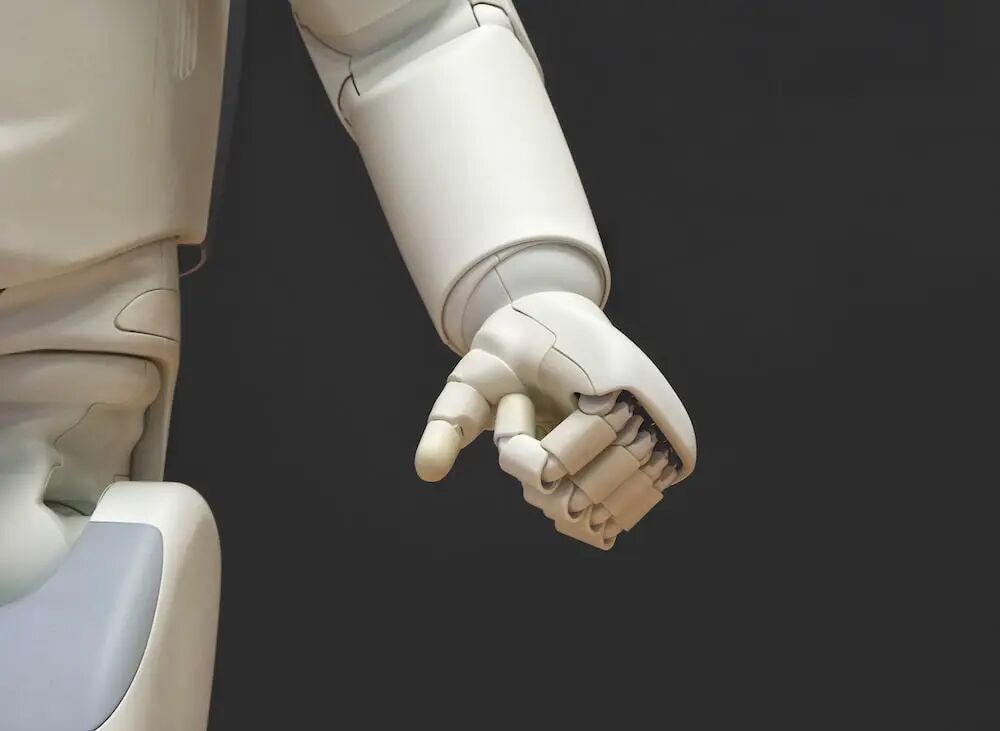
Thus, when machines possess intelligence, we must confront and resolve an essential question: How do humans communicate, interact, and coexist with machines?
Today, our machines have been endowed with intelligence, and humans themselves have become machines of sorts, giving rise to digital twins. Our communication devices operate in a Web 3.0 environment where virtual and physical worlds coexist and thrive together — enabling instant communication regardless of distance.
The parallel and converging concepts of virtual and physical space, the metaverse, have transformed human society into one of human-machine coexistence and co-creation. In this society, information exchange and coexistence between humans and machines, machines and humans, and machines and machines represent our most fundamental scientific and social challenges.
02 Control Is the Pursuit of Entropy Reduction
In his work What Is Life?, Schrödinger proposed the concept of "living on negative entropy" — that life is a negative entropy system.
Entropy measures the degree of disorder in a system. The second law of thermodynamics, the law of entropy increase, states that in an isolated system, without external work being done, total disorder will continuously grow. Without external work, all isolated systems in the world experience entropy increase.
In The Human Use of Human Beings, Wiener writes that control is the pursuit of entropy reduction, the establishment of desired order.
The book opens with a definition of living organisms. Wiener believed that our life is a process of control — reducing the natural disorder of a system, battling against entropy increase. Through openness to absorb energy, we transform ourselves into a negative entropy, entropy-reducing system, creating order.
Thus Wiener's epistemological foundation is this: Whether machine or human, if its actions control entropy increase through interaction with the environment and feedback from that environment, both serve identical functions in society. At this level, machines and humans are alike.
In the control process, several fundamental concepts merit attention. First, the means of control; second, the controlled object must possess uncertainty; third, changes in this uncertainty must be measurable as information; finally, after each action, results must be compared against purpose through feedback, which then guides the next action to reduce uncertainty.
Under this theoretical framework, Wiener explored two questions: "What is progress?" and "What are intelligence and learning?"
What is progress? Progress is establishing local order within global chaos. Humans and machines alike drive progress forward. Yet progress carries a cost — when we push society forward, we gain new stability while also facing new constraints and challenges.
What are intelligence and learning? Here Wiener emphasized the plasticity of cognitive systems and feedback. He believed that for both machines and humans, learning exists for adaptation.
Humans possess special learning capabilities because the human brain has plasticity — it can receive feedback from learning, develop methods to adapt to the environment, and thereby alter the brain's memory and neural structures.
Feedback mechanisms are the foundational concept behind many of today's AI algorithms, such as reinforcement learning.
03 Wiener vs. Turing
The two founding fathers of artificial intelligence — Wiener and Turing — held divergent views on machine intelligence.
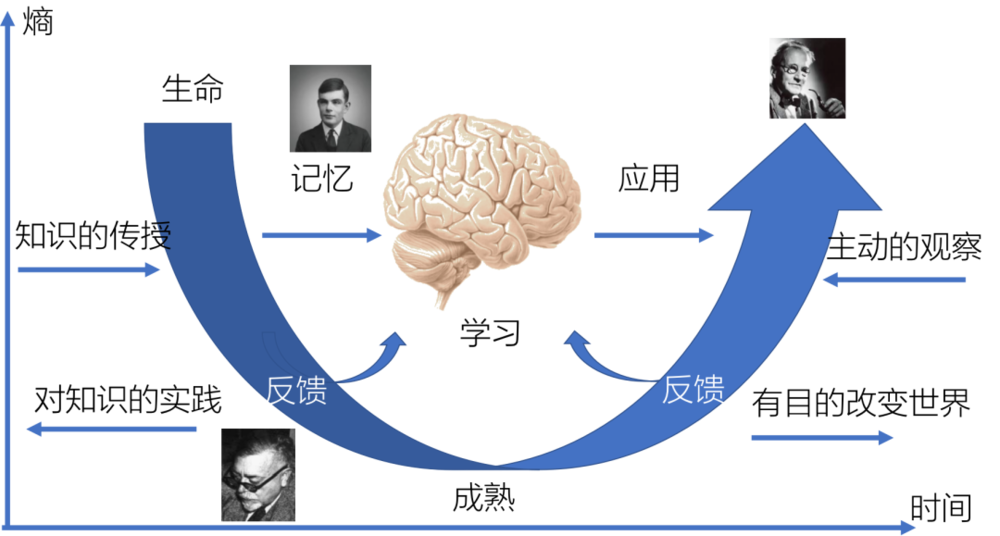
The blue line in the figure above can be understood as the entropy of our brains. At birth, entropy is high, but it rapidly decreases as we absorb knowledge. We reach minimum entropy — maximum order — at maturity. Yet as we age, entropy increases again, until finally reaching maximum entropy: death.
Before maturity, we primarily receive indirect knowledge. After maturity, we gradually develop our own thoughts, begin observing, use knowledge to change the world, and decide what new knowledge to absorb.
Turing focused on human thinking. In his theory, he believed machine "intelligence" simulates humans, with human intelligence as its limit. Thus the Turing Test defines "intelligence" as: when you ask a question and cannot distinguish whether the answer comes from a machine or a human, the test is passed.
But Wiener saw things differently. Wiener focused on human behavior. He believed that when a machine, through repeated exploration, verification, and adjustment, achieves the same ability to complete specific tasks as humans, that is intelligence. Machine intelligence has no imposed ceiling.
So within this curve, Turing cared about the interior: memory and the application of memory; Wiener cared about the exterior: how to interact with the world and how the world feeds back.
04 If Wiener Were Alive Today
If Wiener were alive today, he would surely cheer for deep neural networks and foundation models in AI. In his book, he already discussed the "Gestalt trap" — rotational invariance. When we see a circle, viewed horizontally or from the side, it remains a circle; its form is independent of its position. This is the fundamental concept behind convolutional neural networks. Wiener's feedback theory, applied to guide machine learning today, becomes reinforcement learning.
If Wiener were alive today, he would be deeply concerned about AI-driven unemployment. He always believed that as machines develop, humans would become enslaved. But this is actually incorrect, because technological progress can improve the utilization rate of natural resources.
If Wiener were alive today, he would favor smart contracts and blockchain while opposing decentralization. He could not imagine a self-organizing structure operating bottom-up without central control, as this would impede control and entropy reduction.
If Wiener were alive today, he would not particularly appreciate big data, because he opposed the commodification of information. He valued big data's contributions to humanity, but data must not become a commodity. Articles published for career advancement or works created to win followers cannot produce information in Wiener's sense.
If Wiener were alive today, he would embrace the metaverse with great enthusiasm. He believed that if we are not merely to survive but to flourish as a civilization and species, we must encode these same emotions and values of respect into our machines, information systems, and communication technologies, so that new paradigms are used to benefit humanity, increase human leisure time, and enrich spiritual life — rather than merely serving profit and machine worship. This aligns closely with how we discuss the metaverse today.
If Wiener were alive today, he would believe cybernetics could solve many problems: addressing global warming, controlling power grids through cybernetic principles, integrating various technologies within this framework.
Yet Wiener harbored a profound concern throughout his life. He felt like Prometheus stealing fire, bringing machines to humanity, yet constantly worried that humans would submit to machines, abandoning their right to choose and control.
This concern underpinned his writing of this book. He wanted to tell the world: No matter how capable machines become, you must never surrender your responsibility to them — this is your ultimate responsibility.
Because the human use of human beings.
(The author Yike Guo is a big data expert, Fellow of the Royal Academy of Engineering, Member of Academia Europaea, Vice President of Hong Kong Baptist University, and Provost of The Hong Kong University of Science and Technology)
** ▶ Join BlueRun Ventures ◀**

** ▶ More Content ◀**




BlueRun Ventures was established in Silicon Valley in 1998. BlueRun Ventures China was founded in 2005 and is a venture capital firm focused on early-stage startups.
Currently, BlueRun Ventures China manages multiple USD and RMB dual-currency funds, with assets under management exceeding RMB 15 billion, making it one of the largest early-stage funds in China. The firm invests primarily at Pre-A and Series A stages, covering hard tech and innovative interaction, enterprise technology, new consumption, and healthcare. It has invested in over 150 startups, including Li Auto, Waterdrop, QingCloud, Guazi.com, Qudian, Songguo Mobility, Ganji.com, Energy Monster, Yuntou Semiconductor, Machenike, Clouds Intelligence, Anxin Network Shield, and BioMap.
BlueRun Ventures has been ranked #1 on Zero2IPO's "China's Top 30 Early-Stage Investment Institutions" and ChinaVenture's "China's Best Early-Stage Venture Capital Institutions TOP30," and was named among Preqin's Top 10 Global Venture Capital Fund Managers for Sustained High Returns.
Additionally, BlueRun Ventures has repeatedly received honors from Forbes China, 36Kr, Cyzone, Caixin Media, CBNweekly, Jiemian, and other media outlets, including "China's Best Early-Stage Firm of the Year," "China's Top Venture Capital Firm," "Early-Stage Firm Most Welcomed by Entrepreneurs," and "Most Influential Early-Stage Firm of the Year."