"Jishi Design" Closes Tens of Millions of Dollars in Series B+ Funding, User Base Surpasses One Million | BlueRun Ventures

Achieved million-scale user growth, supporting the development of China's open-source design community.
Chinese cloud-based UI design tool Jishi Design (即时设计) recently closed a Series B+ round of tens of millions of dollars. The round was led by Unicorn Capital Partners, with continued participation from existing investors Coatue Management, SIG Asia Investments, and Source Code Capital.
Previously, BlueRun Ventures was a co-lead investor in Jishi Design's Series A round, and subsequently doubled down in the company's Series A+ and Series B rounds.
Jianping Shi, Investment Partner at BlueRun Ventures, commented: In the roughly year and a half since BlueRun invested in Jishi Design, the company has achieved leapfrog development across product capabilities, user growth, partner ecosystem, and organizational capacity. Its product now rivals internationally renowned competitors, making it a leading domestic startup in cloud-based collaborative design SaaS. Jishi Design has surpassed one million cumulative users, built a sizable ecosystem of creative content, APIs, and plugins, and grown from a 10-person team to a fully structured organization of over 100 people. As an early investor in Jishi Design, BlueRun is honored to be a partner accompanying the company's growth and witnessing its evolution. We congratulate the company on gaining support from more top-tier industry institutions, and hope Jishi Design continues to reach new milestones.
According to sources, Jishi Design has been notably active since completing this counter-cyclical financing, with strong performance across product improvement, user growth, and industry influence. Beyond multiple upgrades to product features, performance, and user experience, the company recently opened its plugin API to global users, allowing all developers, design teams, and enterprises to freely customize plugins according to their needs — significantly enhancing practicality and extensibility. Alongside continuous product progress, Jishi Design also achieved million-scale user growth and jointly launched the "Design Open Source Initiative" with UI China, contributing to the development of China's design open source ecosystem and creating value for the industry.
01
Filling the gap in domestic professional design software, real-time online collaboration boosts user efficiency
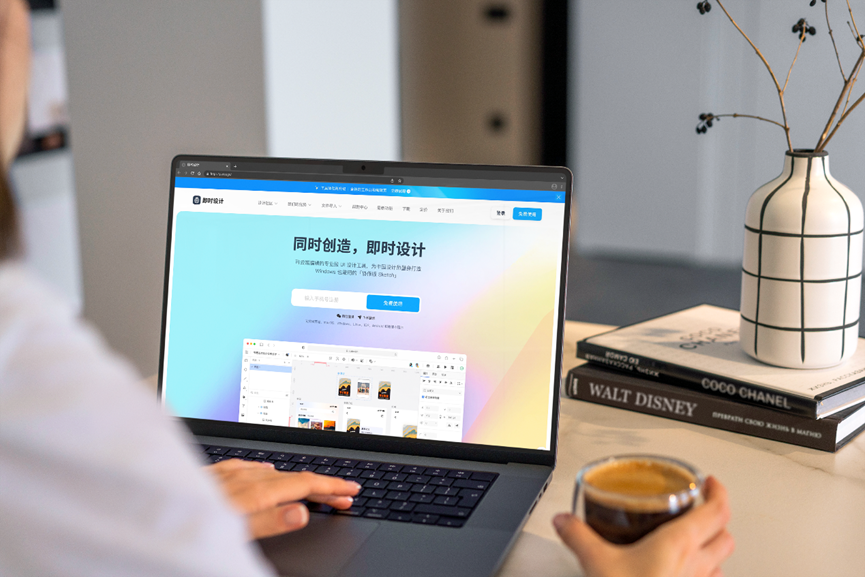
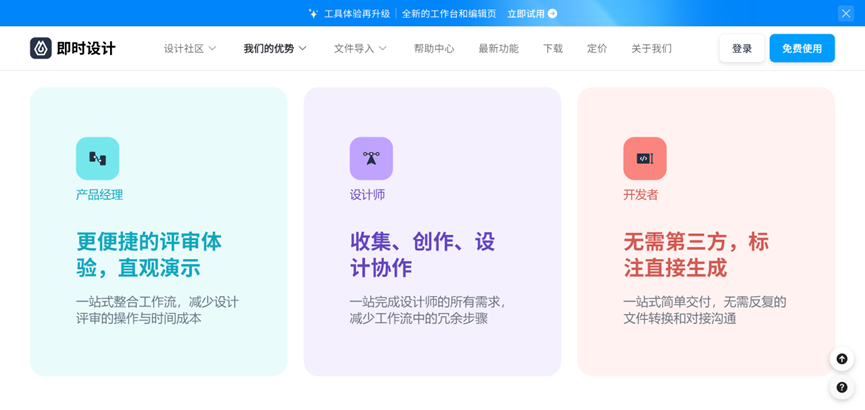
In recent years, as market and business environments have shifted, domestic enterprises have reached unprecedented levels of emphasis on "efficiency," broadly stimulating demand for productivity tools. However, constrained by technical barriers and engineering complexity, significant gaps remain in the professional-grade productivity tool market for domestic software. In this context, Jishi Design launched in September 2020 as China's first professional-grade cloud-based UI design software. Users quickly discovered that Jishi Design was not merely a UI design tool, but an online collaboration platform for product and R&D teams. To date, Jishi Design has developed comprehensive Sketch foundational features alongside advanced Figma capabilities in professional UI design functionality, supporting multi-user real-time online editing with livestream-level synchronization. Additionally, its collaborative features — including product prototype interaction wiring, built-in developer handoff with annotations and asset slicing, and real-time pinned commenting — address end-to-end product and R&D team workflows, enhancing remote collaborative efficiency. In China, Adobe's suite and Sketch remain mainstream tools among designers. The cloud-based, collaborative wave that Figma sparked overseas presented Jishi Design with enormous domestic opportunity. The vast market space and first-mover advantage in filling the gap for domestic cloud-based professional design software became important factors enabling Jishi Design's counter-cyclical fundraising.
02
Driving product engine through daily iteration, building co-creation dynamic with users
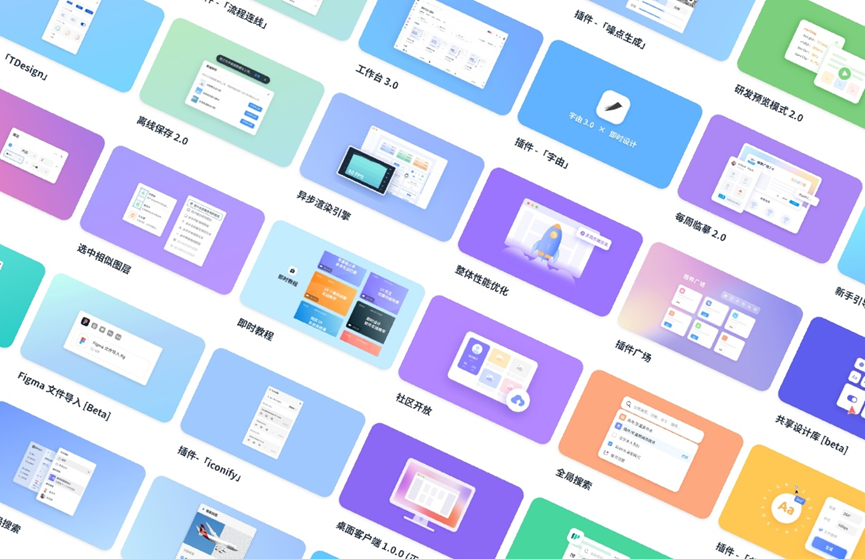
In previous coverage, Jishi Design's founding team stated: "Product capability improvement is core; efficient feature iteration is what drives rapid user growth." Their performance over the past year appears to validate this. In March 2022, Jishi Design announced it had surpassed one million users. In the comment section, many users' messages centered on "witnessing Jishi Design's growth." "A product that gets better to use every day" became the collective impression among users.
Take Jishi Design's recently launched Workspace 3.0: sensing users' growing file management needs, the team comprehensively optimized file lists, folder covers, and team directories, helping users locate needed content immediately upon entering the workspace. This received widespread user acclaim while demonstrating that efficiency gains hide in the details. This sustained, thoughtful attention to users built a connection between Jishi Design and its users that transcended the conventional "user" and "productivity tool" relationship.
"A significant portion of our user growth comes from organic promotion by existing users," the Jishi Design founding team revealed, attributing this to their persistent product-driven approach. "After all, we're building a product users spend 4-5 hours with daily. You can't fake whether it's good or not to use. So we've maintained a daily iteration cadence, keeping the product continuously improving." The team also noted: "Our users are incredibly enthusiastic about submitting requests, pushing timelines, and giving optimization feedback daily. This culture of co-creating products with users has injected tremendous energy into Jishi Design's product improvement and user growth, and gives us confidence in long-term, sustainable development." On commercialization, Jishi Design has also engaged in deep partnerships and exploration with numerous well-known domestic enterprises, with阶段性成果 to be distilled into more diverse solutions delivering superior service to enterprise clients.
03
From "China's Figma" to "China's Jishi Design"
In recent years, incidents such as Matlab banning Chinese universities and Figma banning DJI have brought the urgency of domesticizing and localizing professional-grade software to the forefront. As the only player in the domestic market that had launched Figma file import functionality before the DJI ban, Jishi Design attracted considerable attention and expectations — would it carry the banner of domestic design software independence and become "China's Figma"? The Jishi Design team has its own perspective on this.
"On one hand, we will move at maximum speed to match Figma's comprehensive experience, encompassing product capabilities, plugins, community, and more. To achieve this, a smooth and efficient fundraising rhythm is essential — it allows us to stay focused on product improvement," the founding team stated. "On the other hand, we will continue innovating and developing features based on domestic market needs. Designers and product/R&D teams in China have different work habits, culture, and business processes from their overseas counterparts. We believe what domestic users truly need isn't a Chinese version of Figma, but an independent product with comprehensive experience on par with Figma. We hope to achieve this goal soon — first becoming a Jishi Design from China that wins broad user recognition, then competing with top overseas products."
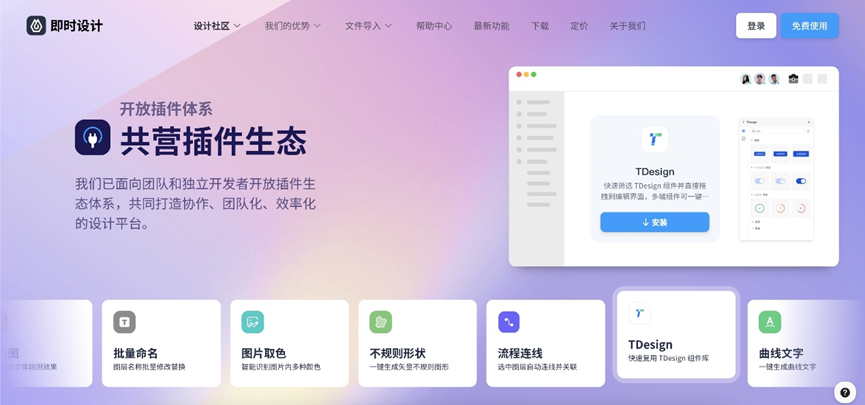
According to sources, Jishi Design has officially opened its plugin API to global users, allowing all developers, design teams, and enterprises to leverage API extensibility to freely customize plugins for internal use or distribution to all Jishi Design users. Meanwhile, dozens of plugins have already launched in Jishi Design's plugin community. This open ecosystem will qualitatively elevate Jishi Design's tool attributes — its own rapid iteration combined with future massive third-party plugins will bring unimaginable new vitality through truly crowdsourced co-creation.
Currently, Jishi Design's team has grown to nearly 100 people, maintaining over 75% in product and R&D roles. With capital favor and user recognition, this team that has consistently focused resources on "making the product better to use every day" continues to expand. According to the founding team, they expect to double team size within this year, hoping more like-minded partners will join in realizing the vision of "defining China's design tools together with Chinese designers."
Further Reading
BlueRun Ventures Closes New RMB 5.5 Billion Dual-Currency Fund
What Does a Career You Define Yourself Look Like? | BlueRun Talent Philosophy

BlueRun Ventures was established in Silicon Valley in 1998. BlueRun Ventures China was founded in 2005 as a venture capital firm focused on early-stage startups.
Currently, BlueRun Ventures China manages multiple USD and RMB dual-currency funds with over RMB 15 billion in assets under management. It focuses on Pre-A and Series A investments across hard tech and innovative interaction, enterprise technology, new consumption, and healthcare, having invested in over 150 startups including Li Auto, Waterdrop, QingCloud, Guazi.com, Qudian, Songguo Mobility, Ganji.com, Energy Monster, Yuntu Semiconductor, Machenike, Clouds Intelligence, Anxin Network Shield, and BioMap.
BlueRun Ventures has been ranked #1 in Zero2IPO's "China Top 30 Early-Stage Investment Institutions" and #1 in ChinaVenture's "China Best Early-Stage Venture Capital Institutions TOP30," and was named to Preqin's Top 10 VC Fund Managers Globally for Sustained High Returns.
Additionally, BlueRun Ventures has repeatedly received honors from Forbes China, 36Kr, Cyzone, Caixin Media, CBNweekly, Jiemian, and other media institutions, including "China's Best Early-Stage Institution of the Year," "China's Top Venture Capital Firm," "Most Entrepreneur-Friendly Early-Stage Institution of the Year," and "Most Influential Early-Stage Institution of the Year."