Jui Chan of BlueRun Ventures in Conversation with Wang Zhongyuan of BAAI, Wang He of Galaxy Universal, and Li Dahai of ModelBest: Long-Term Value and the Next Curve in the Large Model Era

From "Moats" to "Scaling's New Curve" in the Age of Foundation Models
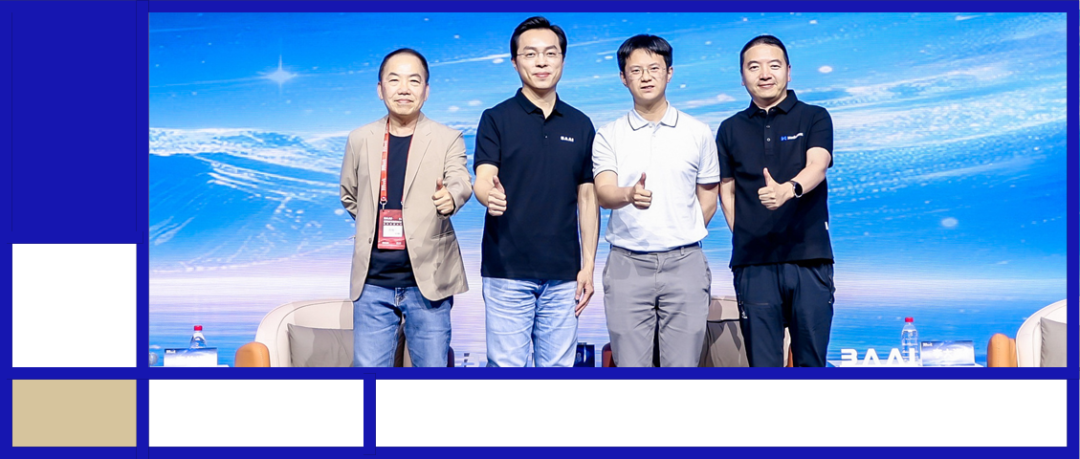
In the era of large models, the trajectory of technological evolution, the moats of enterprises, and the boundaries of intelligence are all being remeasured.
Will large model companies eventually end up like water or electricity utilities — high volume, low price? Is the Scaling Law failing, or merely evolving? At the large model industry forum held during the 2026 BAAI Conference, Jui Chan, Managing Partner of BlueRun Ventures, joined Wengyuan Wang, President of BAAI, Dr. He Wang, Founder and CTO of Galaxy Universal, and Dahai Li, CEO of ModelBest, for an in-depth dialogue on the long-term value of the large model era.
From the essence of competitive moats to the next leg of the scaling curve, from embodied intelligence technical routes to China's unique AI opportunities, their insights and judgments offer multifaceted perspectives for understanding long-term value in the large model era. Selected highlights from the conversation follow:

Jui Chan: Large models are rapidly converging, token prices keep falling, and some people seriously question whether AI model companies will ultimately become like water or electricity utilities — high volume, low price. From your perspectives, where does the long-term value and competitive moat lie for AI companies, especially model companies?
Wengyuan Wang: To be frank, I don't entirely agree with this view. Because overall large model performance iteration hasn't hit a bottleneck yet, we can't definitively say whether everyone will converge. There could be many evolutionary patterns — one superpower with multiple strong players, several giants, or ultimately similar capabilities across the board.
At this stage, looking at actual conditions, leaderboards are indeed not that trustworthy. Sometimes I find them dizzying to look at, and many results can't be fully verified. But as we often say, you can tell a mule from a horse by taking it for a ride — at least that gives people a tangible sense.
Take Galaxy Universal, for instance. My biggest impression of them is their willingness to show real machines, to do live demonstrations. ModelBest's edge intelligence is the same. These model companies that dare to show real results — I think they have confidence, and can find data flywheels in certain scenarios.
AI technology hasn't converged yet; it's still evolving rapidly with all kinds of possibilities. So today we probably can't conclude whether these companies will converge, or where their moats lie.
He Wang: This question really reflects people's judgment about intelligence in the digital world, about LLMs. But as Dr. Wang said, LLMs themselves still have many variables. Looking one step further, to multimodal, VLMs, or VideoGen, the variables multiply.
From the perspective of embodied intelligence, which I primarily work on, the industry is actually converging. In past years, the industry had VLA and World Models; now it's iterating toward World Action Models — a single model that can both predict future states and action execution, that can absorb both human data without action labels and robot data with action labels. So I think embodied intelligence is still at a GPT-1 to GPT-2 stage.
Looking ahead, once the industry enters scaling, everything will advance rapidly, so the industry now needs much larger capital. In fact, today we're still years behind LLMs in terms of capital scale, data, and model level.
What's the real moat for the future? For embodied intelligence, it's actually a complete system: you need source data supply, the ability to process different data types — whether synthetic data, human data, or robot data — and effectively refine and utilize them. Going further, you need continuous hardware iteration capability and co-design capability. Finally, it's about model integration capability, overall performance, and ultimately the ability to deliver the complete hardware product to customers. To date, no product globally has truly integrated all these capabilities. So its moat is actually quite deep, and whether doing vertical applications or going deeper and broader, there's still enormous potential.
Dahai Li: Inspired by the two guests, I suddenly thought that large models should be what we used to call "T-shaped talent" — they must be general, but being merely general and homogeneous with others is meaningless; you must have your own strengths. Take Anthropic — the reason it's strong and has achieved impressive commercial results is that on the premise of a general model, it achieved unmatched coding capability. So large models aren't enough with just horizontal generality; they need vertical depth.
How does that vertical depth come about? I agree with Dr. Wang's view, but I'd use another word — closed loop. You must treat the large model as an engine, but the engine's continuous optimization has to coordinate with the whole vehicle; you can't separate it from applications and say what you want to achieve. From the past two years of large model development, we've seen a very important trend: models evolve as systems, including what people are now doing with Agentic AI and reinforcement learning — essentially all revolving around the entire agent system to further train and optimize the model. Looking forward, a very important direction is contextual memory. Currently people mostly achieve this through harnessing, but I believe harnessing alone isn't enough; it must be combined with the model's own reinforcement learning.
In summary, I believe large model technology is far from converged. At the same time, any model company must separate technological generality from commercial generality. Currently there's very little general commercial applicability; to do business well, you need to optimize the model around specific directions. And precisely because of this, moats can take many forms — each company, once it finds its direction, can develop well.
Jui Chan: It seems this industry easily drifts toward black-and-white discussions, with everyone wanting to immediately conclude that large models have no long-term barriers. But listening to the teachers' sharing, I think scenarios matter, data matters, and the closed-loop capability Teacher Li just mentioned also matters very much.
From an investor's perspective, we've met many entrepreneurial teams, and one important judgment is that different teams' DNA varies enormously. There's also a common market view that once large model companies move downstream to applications, they'll crush application companies. But actually engaging with these teams reveals that the two types have very different cultures and capability orientations: large model teams clearly have a lab atmosphere about them, while application teams focus more on scenarios and user needs. And these differences themselves will gradually sediment into respective barriers.


Jui Chan: There's a very common discussion in the industry now: if we continue along the traditional language model path, are we starting to hit bottlenecks? Will marginal returns from continued investment keep diminishing?
Especially last year, as the dividends from Scaling Law gradually weakened, many people began to feel that pouring more compute and data into pre-training wasn't improving model capabilities as noticeably as before, so attention shifted more toward reinforcement learning, post-training, and other directions.
Teacher Wang, what's your view on this? And with new technical routes like Diffusion emerging, could they become breakthroughs for the next stage of model development?
Wengyuan Wang: I'm quite convinced that scaling is far from exhausted. Last year people thought scaling was failing mainly because internet data was basically used up and model performance hit bottlenecks. But looking back today, scaling didn't fail — it became more diversified. Post-training, reinforcement learning, and inference have opened new rounds of capability improvement. Going further, agent and recursive self-evolution both show that even as internet data nears depletion, AI capabilities can still continuously improve — it's evolving from a chat tool to something that can truly execute tasks.
BAAI has always positioned itself to do what universities can't do and enterprises aren't yet willing to do — to explore the next curve of intelligence development.
Over the past two years, we've focused on multimodal, hoping to explore scaling paradigms in multimodal domains based on Next Token Prediction. Taking Emu3 and Emu3.5 as examples, they've already demonstrated multimodal scaling potential — though our current data usage is less than 1% of total data scale, and model parameters are only at the tens of billions level, we can already see very clear performance improvements. We believe the multimodal scaling paradigm has at least found a viable path.
When we feel technology is mature, we hand it to industry to push forward, and move to the next direction ourselves. Now we're exploring scaling paradigms toward the physical world — world foundation models. The Wujie physics shared earlier is investigating this direction. So I'm quite optimistic about this question: whether it's mature language models, AI coding, digital world large models, or future world foundation models, there are still massive scaling questions worth exploring.
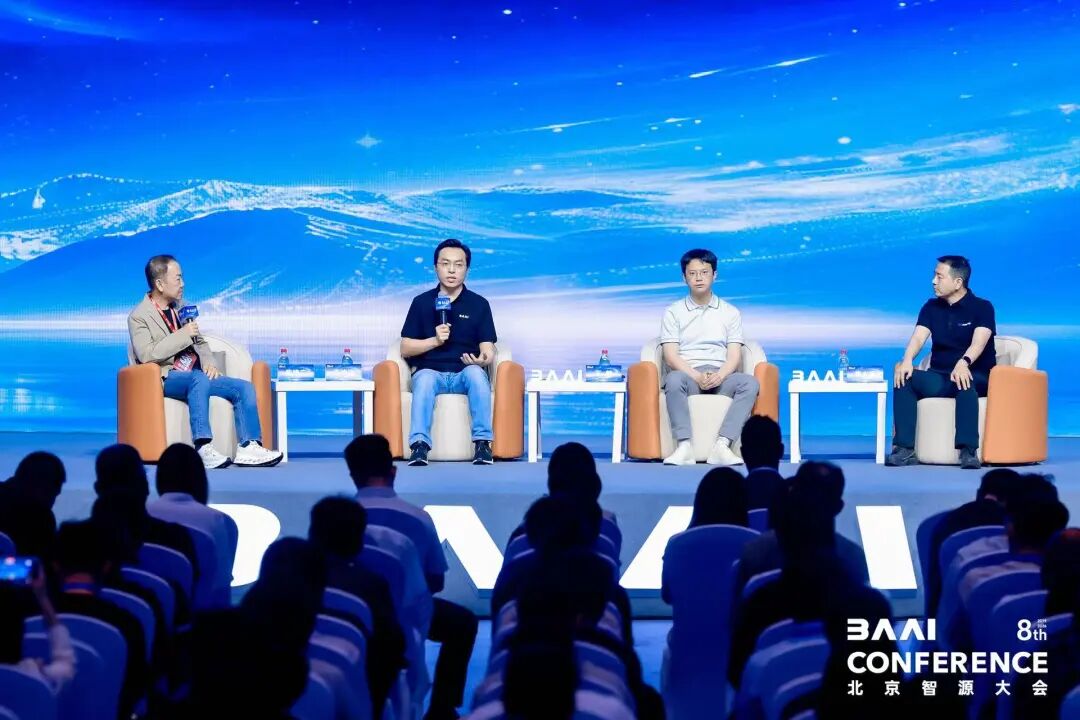
Jui Chan: I'd like to ask Dr. Wang — in the Physical AI domain, there's been considerable discussion about technical routes recently. One view holds that VLA still has many unresolved issues, so why is the industry already shifting attention toward world models? How do you see this trend?
He Wang: Galaxy Universal, including myself, firmly believes in scaling. Before the WAM paradigm emerged, under the VLA route we focused on grasping, using 1 billion frames of simulation data to verify that a single skill can grow into a true foundation model through scaling. Our GraspVLA, completed in early 2025, can zero-shot grasp arbitrary novel objects in the real world. To date, models trained purely on real-world teleoperation data haven't achieved GraspVLA's zero-shot grasping capability.
But synthetic data has limitations for expanding to more tasks, and teleoperation is hard to scale. Today, embodied intelligence is welcoming a very critical and very bright scaling-up moment, and this change largely stems from WAM — World Action Model. WAM's core is Action: it uses prediction of future states for visual-level action planning, without needing action labels. This means we can massively leverage human first-person video to train embodied intelligence, allowing skills to continuously scale toward more tasks and richer scenarios.
Galaxy Universal published the world's first WAM-themed paper in March 2025. WAM's key advantage over VLA is that it incorporates both human data and robot data into the training system. As Jim Fan, head of NVIDIA GEAR Lab and my Stanford classmate, said: the end game of robotics is WAM. Today, embodied pre-training has no data type limitations. I predict that in two years, embodied intelligence will comprehensively reach its GPT-3.5 moment — but this requires tens of millions of hours of high-quality data and billions-level annual investment. Only with both of these, plus strong model capabilities, can you get the ticket to sprint toward ChatGPT. Jui Chan: Let me extend this question slightly — based on your analysis, does this mean what people call "world models for physical AI" is all unreliable?
He Wang: WAM is itself a kind of world model. When many people talk about World Models, they emphasize using it as a simulator where robots do reinforcement learning. On this point, I can't say it's entirely unreliable. In fact, we ourselves have much work using World Model as an interactive differentiable simulator.
But if people believe you must first build a World Model that can simulate everything in the world and interact with all environments, and only then can you train true embodied intelligence — I don't think so. Even humans can't simulate everything in the world or precisely know the next physical state, yet we can still interact with everything. So I don't think becoming a mature world simulator is a prerequisite for building embodied intelligence's ChatGPT.
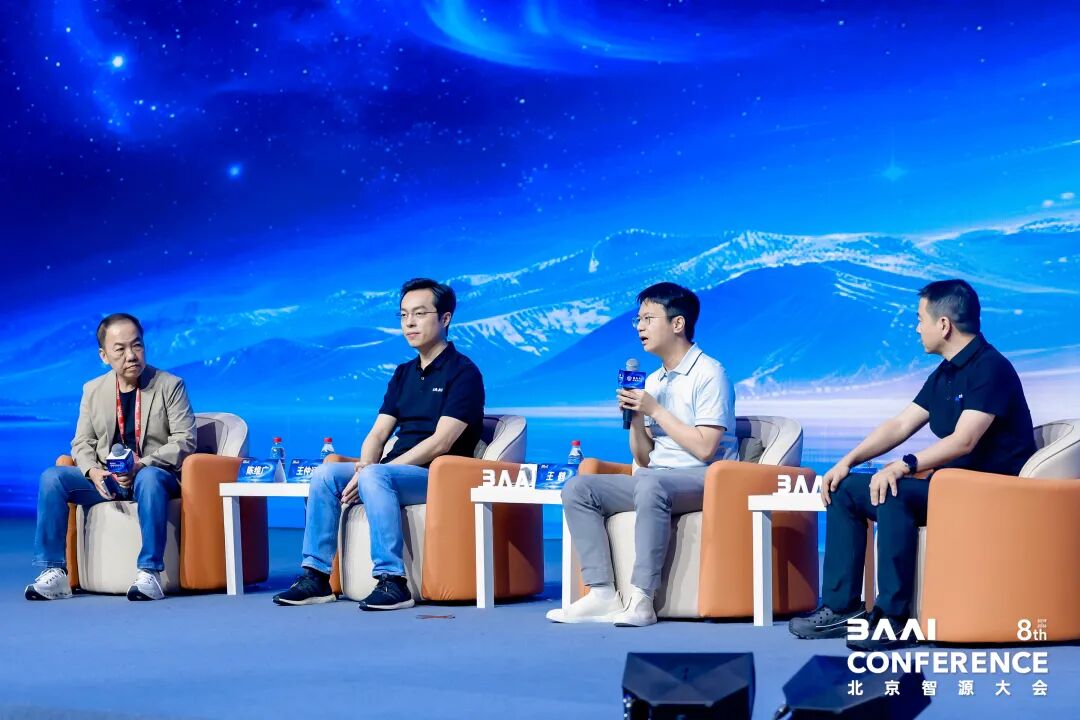
Jui Chan: Teacher Li, in past years when people discussed Scaling Law, they focused more on cloud models. But there's also a view in the industry that edge devices can't scale continuously like the cloud. ModelBest has always focused on edge — what's your view on this?
Dahai Li: Simply put, everything is scaling. ModelBest's proposed knowledge density law can be understood as a formula: large model intelligence = knowledge density × parameter count. From this perspective, while people were still questioning whether scaling was failing, cloud coding models were already getting bigger — Opus is getting bigger, and all domestic coding models are getting bigger too. Edge models are similarly getting bigger.
Last year when ModelBest deployed edge models for OEMs, we could only deploy 1B at the time — not that we could only make 1B models, but that was what terminal hardware compute and bandwidth could support then. Today that number has grown from 1B to 4B, and next year it may become tens of billions, growing very fast.
Edge is mainly resource-constrained, and embodied intelligence carriers essentially also belong to edge — their "brain" is similarly an edge model. So in model capability and skill optimization, embodied intelligence still has enormous room to mine; the real bottleneck lies in hardware physical conditions.
Additionally, large language models on long-context task processing — whether in cost or effectiveness — still fall far short of the human brain, which handles long-range contextual tasks excellently and at low power. Behind this also lies huge scaling space. So the road is long and far from converged. The industry often uses阶段性认知 to build narratives, but these narratives have very short shelf lives — we're constantly breaking them.
Jui Chan: Just now you said edge models went from 1B to 4B, mainly because edge hardware got more powerful, right?
Dahai Li: Yes, and also quantization technology improvements. Knowledge density has increased, and after quantization the memory and resources used are the same as before, but you can fit in a larger model — these are all means.
Jui Chan: There's another market view that edge models are rising mainly because people find the cloud too expensive, and everyone's trying to move compute to the edge. Does this theory hold?
Dahai Li: I think this is part of token economics. For device manufacturers, this is a very clear accounting calculation. In China, ordinary people buying phones or cars don't subscribe — I buy a phone, I don't then think about paying the manufacturer 19 yuan monthly. So for device makers wanting to provide good AI experiences, how to bear subsequent costs is a very practical problem. Edge and cloud must coordinate, because edge resources are limited and can't do the same work as cloud. Whatever edge can do, people still prefer to do on edge — lowest cost.

Jui Chan: The previous two questions are challenges people outside the industry often raise to AI practitioners. But if agents automatically execute tasks and make errors, who bears responsibility? If robots harm users, or large models generate problematic content — what's your view on this, Teacher Wang?
Wengyuan Wang: This reminds me of Dr. Jian Wang's podcast interview at this morning's opening, which also touched on how humans and AI coexist.
New technologies always go through a process from worry and fear, to adaptation and use, to integration into society and formation of governance systems. Autonomous driving and assisted driving have already gone through this: who ultimately defines responsibility — software vendors, hardware vendors, or users? AI and agents will follow a similar process.
More crucially, if a technology can truly improve efficiency 3x or 5x, it can't be blocked — it will inevitably become increasingly prevalent in society, industry, and life. Responsibility allocation after problems occur is something for the entire social governance system and policy to address. Humans have been through so many technology waves, we'll find a way.
He Wang: Embodied intelligence in industrial automation actually has a very practical logic. When delivered to industrial clients, whether embodied or traditional robots, they mainly look at your success rate for a given process. A failure in some link causing production line shutdown is the same as an employee error causing shutdown — fines. So regarding impact on economic activity, the logic is simple: embodied intelligent robots must work like humans and be accountable on economic tasks.
The longer-term question is how to clearly define rights and responsibilities when embodied robots handle tasks involving both physical and mental labor. From today's widespread agent use, I believe solutions will gradually emerge. For example, today if you use a coding agent and it writes a bug, responsibility still lies with the user — they didn't do comprehensive evaluation. For future embodied robots in production lines, is it a technology loophole or management loophole that takes responsibility? Going further, when everything is AI with no humans involved, who takes responsibility? I believe we'll explore this step by step.
Dahai Li: Let me say something truly unsettling: all of human society's development is built on "learning from one's mistakes." Those annoying safety rules on airplanes — stowing tray tables and opening window shades during takeoff and landing — every single one comes from lessons learned through historical air disasters. Often people don't understand these rules, but that's how they came about.
Under AI empowerment, we're finding that the efficiency of discovering security vulnerabilities and filling security gaps is also increasing. So while we may still not avoid taking losses first, the price paid may be less than in the past. Additionally, as enterprises, we see that our government regulators take security baselines very seriously — from day one, enterprises must pass CAC security filing, considering whether generated content meets security standards. These are all good directions. But overall, security issues will always emerge from angles you can't imagine, teaching lessons that then become ways to make societal governance safer. This may really be unavoidable.
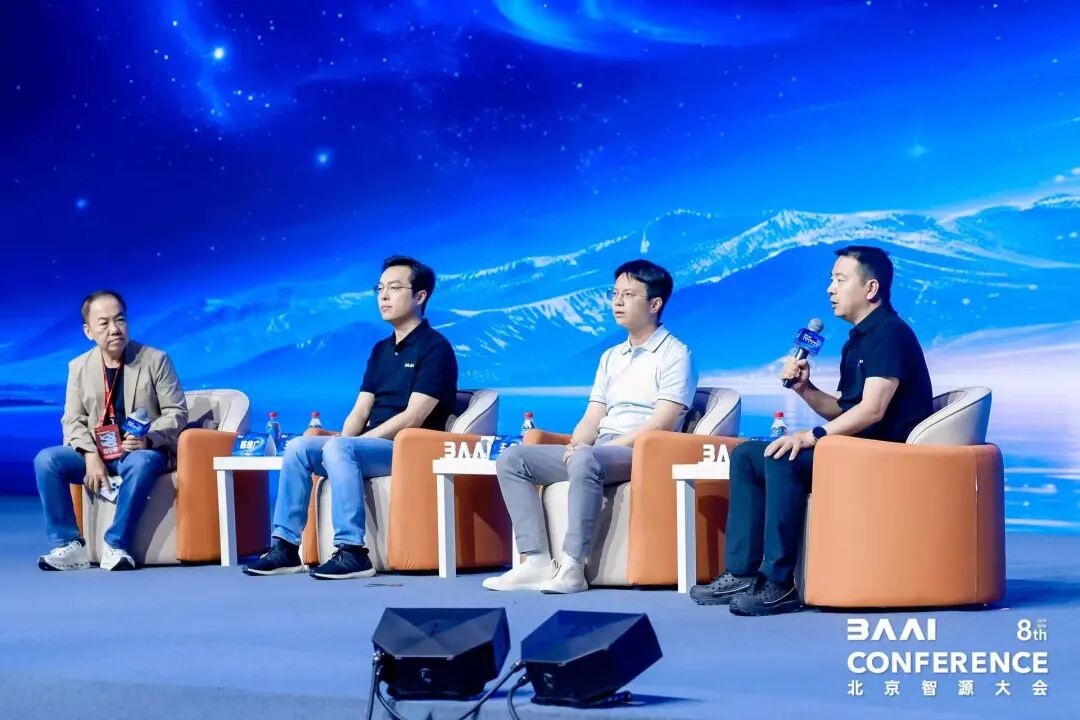

Jui Chan: Our final question: from your own perspective and domain, where do you think China AI and Euro-American AI will ultimately diverge?
Wengyuan Wang: I think China still has many unique advantages, including supply chain, manufacturing, and scenarios. Our own market is already large enough to incubate and catalyze many technologies' emergence and landing. Of course, we also hope these technologies ultimately radiate globally. I personally feel that combining China's advantages, embodied intelligence and world models are very likely to be domains where China will have uniqueness and to some extent lead.
He Wang: I'll mainly discuss this tomorrow at the embodied intelligence and humanoid robot forum; my talk is titled "Pushing Embodied AI's AlphaGo and ChatGPT Moment." I firmly believe embodied intelligence is China's opportunity. The AlphaGo and ChatGPT moment of embodied intelligence, I firmly believe, will be realized in China — this is also the responsibility of Galaxy Universal and China's embodied intelligence community. If embodied intelligence's 0-to-1 is completed in China, I believe the 1-to-100 will also mature in China.
Dahai Li: I'll just add one point: talent. China has the brightest young minds, and probably the largest number globally — I think this is the most fundamental and important factor. With this, plus ecosystem and supply chain advantages, and government emphasis on this domain, these factors combined will ensure China makes great strides in artificial intelligence.
Jui Chan: We've recently compared China-US AI talent structures, and one notable difference is that China's AI talent skews younger. The BAAI Conference grows larger every year, with many young researchers actively participating. Many startups BlueRun invests in, beyond their founders and teams, also maintain deep cooperation with universities and BAAI. This may be the most distinctive point between China and US AI ecosystems.
To quickly summarize the core of this session: First, large models or embodied intelligence do have competitive moats — each team can form differentiated barriers based on landing scenarios, data flywheels, and engineering capabilities. Second, Scaling Law is far from truly peaking, especially in embodied intelligence where there's still enormous room. Third, regarding AI safety, I somewhat agree with Teacher Li's evolutionary logic of "learning from one's mistakes" — each failure will push governance rules toward improvement. Finally, we hope the BAAI Conference continues to succeed, and increasingly clearly demonstrates the growth of China's AI strength.

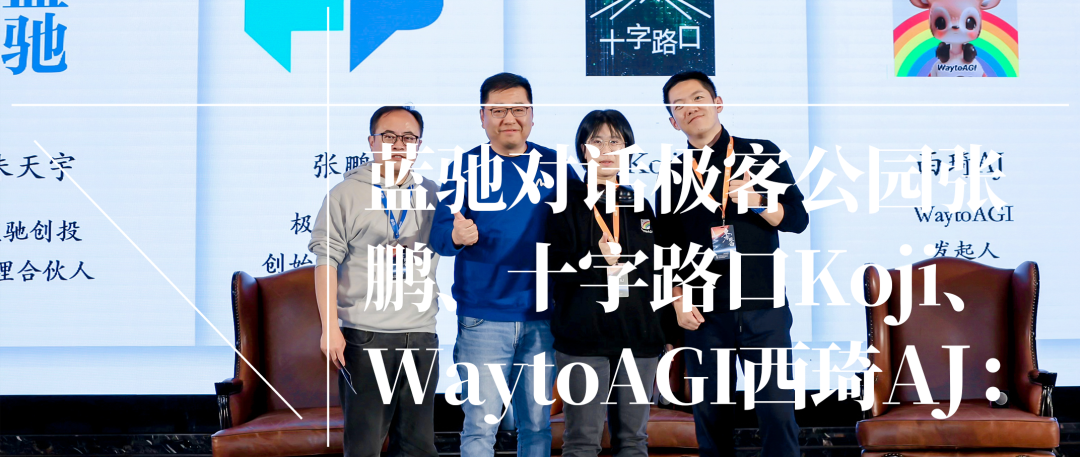 BlueRun Ventures in Conversation with GeekPark's Peng Zhang, Crossing's Koji, and WaytoAGI's Xiqi AJ: "New Species" and "New Ecosystems" in the AI Wave
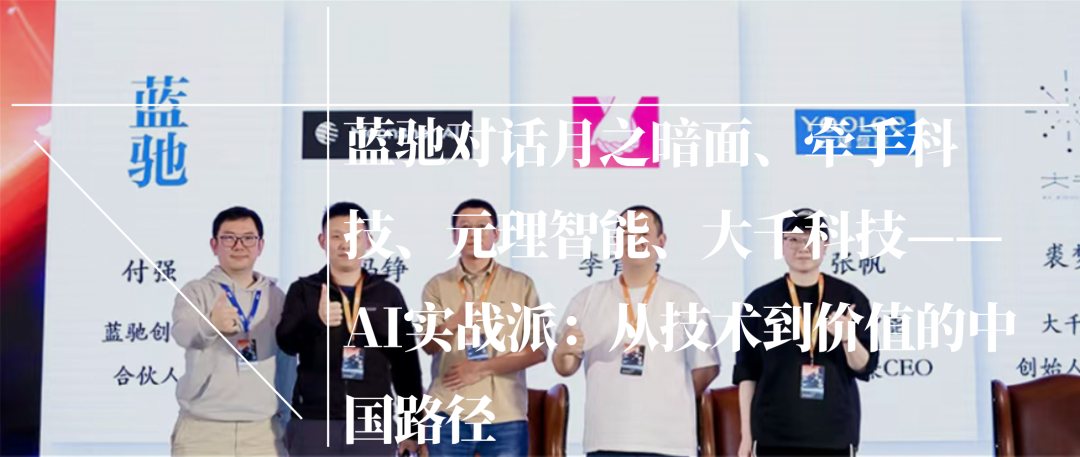 BlueRun Ventures in Conversation with Moonshot AI, Qianshou Technology, Yuanli Intelligence, and Daqian Technology — AI Practitioners: The Chinese Path from Technology to Value
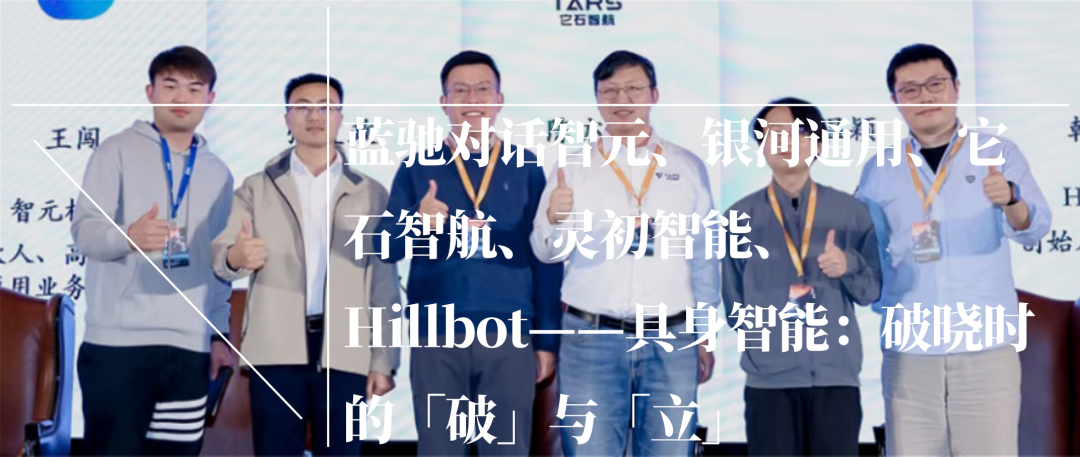 BlueRun Ventures in Conversation with AgiBot, Galaxy Universal, Tashi Zhihang, Lingchu Intelligence, and Hillbot — Embodied Intelligence: "Breaking" and "Establishing" at Dawn