Moonshot AI K2.6 Released and Open-Sourced: Major Advances in Coding, Long-Horizon Tasks, and Agent Swarms | BlueRun Ventures Portfolio Headlines

Minor Version, Major Upgrade
Late last night, Moonshot AI released and open-sourced Kimi K2.6, becoming the first model capable of autonomously advancing complex tasks in agentic environments.
Throughout BlueRun Ventures' journey with Kimi, one belief has remained clear: The AI revolution rewards the purity of taste. We believe that beyond the noise of compute, extreme discernment helps teams identify simpler, more elegant underlying logic amid complex paths.
This K2.6 release demonstrates another advance in how this "purity" translates into concrete productivity:
- Continuity in long-horizon coding: K2.6 demonstrates deep-work endurance with 13 hours of uninterrupted coding, writing over 4,000 lines of code. This means the model is beginning to possess the stamina required for real engineering, capable of entering production scenarios that demand sustained focus.
- Collaborative density in agent swarms: Supporting 300 agents working in parallel directly addresses real business needs for agent delivery at scale, while also mapping out a more efficient form of labor organization in the digital world.
- Aesthetic consciousness in code-driven design: Beauty is not merely visual decoration, but the manifestation of higher-order logical structure. When a model gains the ability to understand and reproduce beauty, it helps elevate overall product interaction quality, building deeper competitive moats at the application layer.
As an early investor in Kimi, BlueRun Ventures has made four consecutive follow-on investments since the Series A, and was the first to issue a term sheet in the A1 round. At that time, technology risks remained, commercialization was unproven, and upstream resources could even be monopolized by competitors — yet we still backed Zhilin Yang and his team, who practice "ten thousand hours of passion." We expect this pure creative force to carry us further toward the dark side of the moon.
Below is Kimi's official release in full. Enjoy.
Talk is cheap. Show me the code.
Linus Torvalds
Today, we are releasing and open-sourcing the Kimi K2.6 model, bringing industry-leading, state-of-the-art capabilities in code, long-horizon task execution, and agent swarms.
Kimi K2.6 is now live on kimi.com, the latest Kimi app, the Kimi API, and Kimi Code, our programming assistant. All users can start using it now.
(Full benchmark results available in the technical blog.)
Kimi K2.6 has achieved comprehensive improvements in general agent capabilities, code, and visual understanding. It has attained industry-leading results on benchmarks including the full doctoral-difficulty Humanity's Last Exam, SWE-Bench Pro (which tests real-world software engineering ability), and DeepSearchQA (which evaluates agent deep-retrieval capability), matching or outperforming closed-source models such as GPT-5.4, Claude Opus 4.6, and Gemini 3.1 Pro.
Kimi K2.6 is our strongest code model to date. Its long-horizon coding ability has also improved significantly — in testing, it can code uninterrupted for 13 hours, writing or modifying over 4,000 lines of code to complete complex system development and optimization. By deeply integrating code and visual capabilities, K2.6 has elevated code-driven design to new heights, capable of delivering professional-grade web applications with exceptional design creativity.
Kimi K2.6 substantially enhances agentic autonomous execution, helping us further expand the scope of agent capabilities:
- The "Agent Swarm" architecture powered by the K2.6 model has received a major upgrade. It now supports 300 sub-agents working in parallel across 4,000 collaborative steps, achieving greater parallelization at scale, with significant improvements in task completion and delivery quality compared to K2.5;
- For proactive agent frameworks such as OpenClaw and Hermes Agent, K2.6 demonstrates exceptional automated task processing ability, supporting continuous autonomous operation for up to 5 days

K2.6 has achieved breakthroughs in long-horizon code tasks, demonstrating more reliable generalization across different programming languages (such as Rust, Go, Python) and task scenarios (such as frontend, DevOps, and performance optimization).
On Kimi Code Bench — our internal, rigorous code evaluation benchmark covering various complex end-to-end tasks — K2.6 improved approximately 20% over K2.5.
Based on our real-world testing, the Kimi K2.6 model demonstrates powerful long-horizon reasoning in complex software engineering tasks:
Scenario 1: K2.6 successfully downloaded and deployed the Qwen3.5-0.8B model locally on a Mac, implementing and optimizing model inference using the niche Zig language, proving the new model's generalization capability. After more than 4,000 tool calls and over 12 hours of continuous operation, the K2.6 model iterated 14 rounds, improving throughput from approximately 15 tokens/s to approximately 193 tokens/s, ultimately achieving inference speed 20% faster than LM Studio.
Scenario 2: Kimi K2.6 autonomously completed a deep refactor of exchange-core, an open-source financial matching engine with 8 years of history. Over 13 hours of continuous work, the model iterated through 12 optimization strategies, making precise modifications to over 4,000 lines of code through more than 1,000 tool calls. Acting as an expert-level systems architect, Kimi K2.6 analyzed CPU and memory allocation flame graphs to identify hidden bottlenecks, and boldly restructured core thread topology (from 4ME+2RE to 2ME+1RE). Even though the engine's performance was already near its limit, Kimi K2.6 still achieved a 185% median throughput leap (from 0.43 to 1.24 MT/s), with peak throughput surging 133% (from 1.23 to 2.86 MT/s).
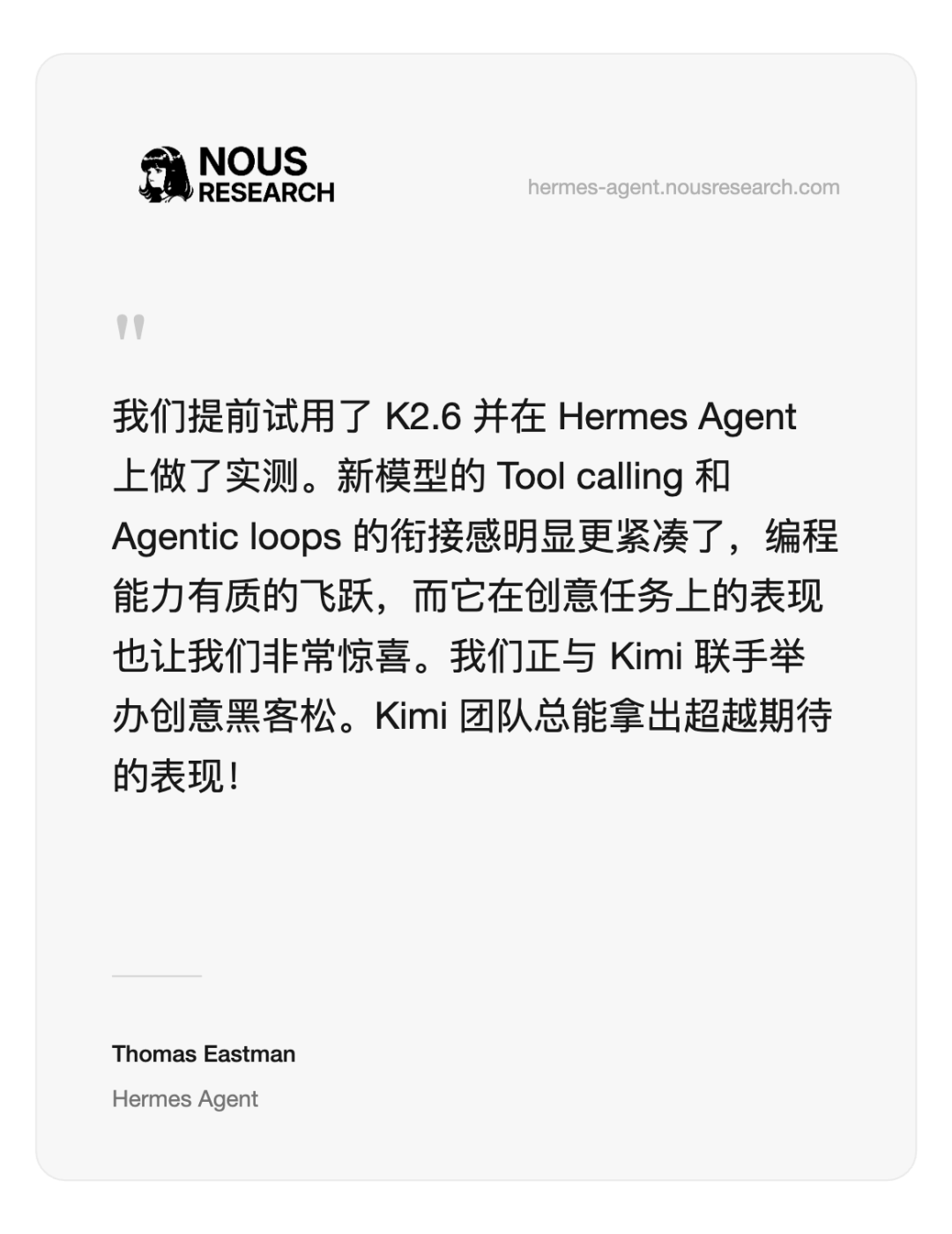
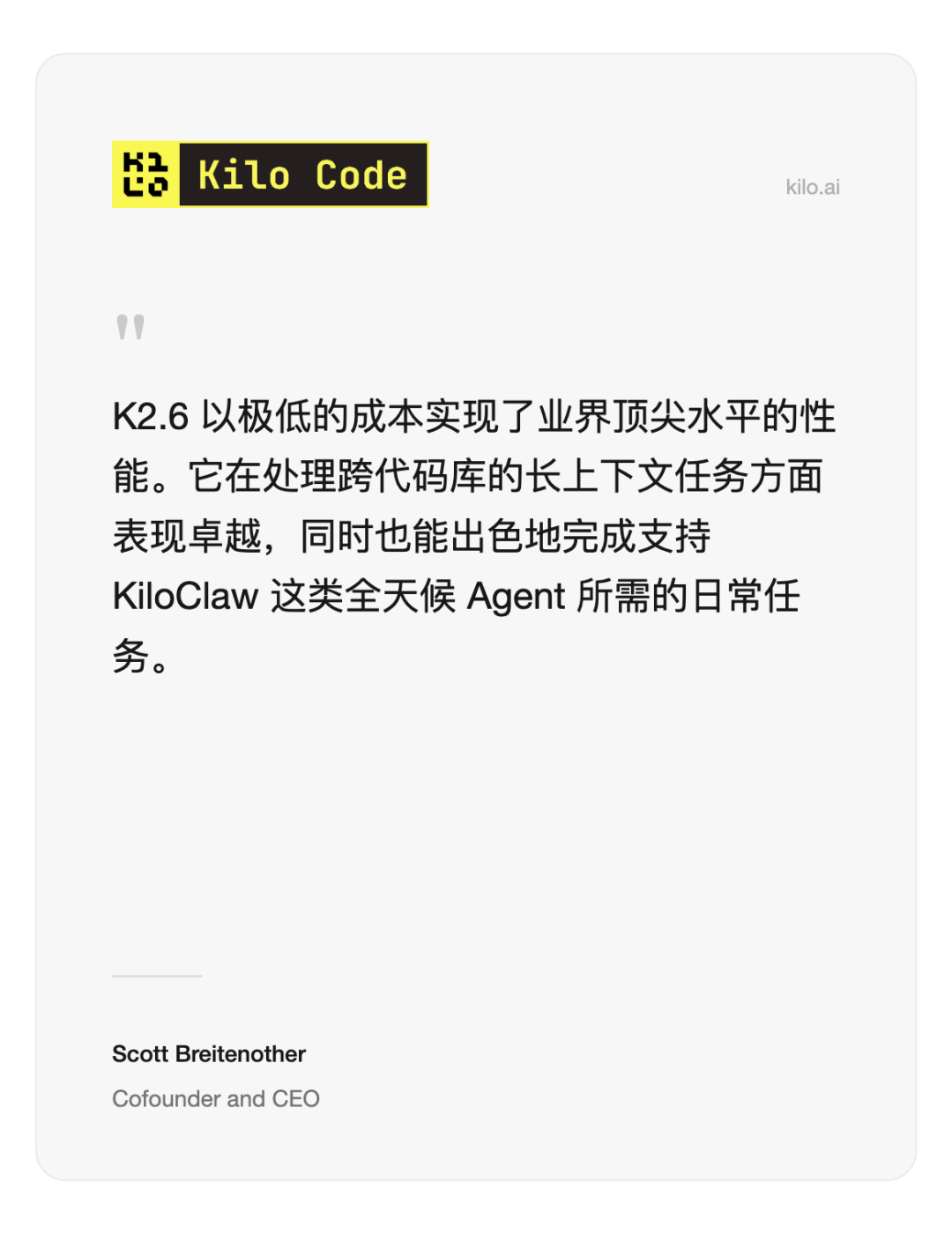
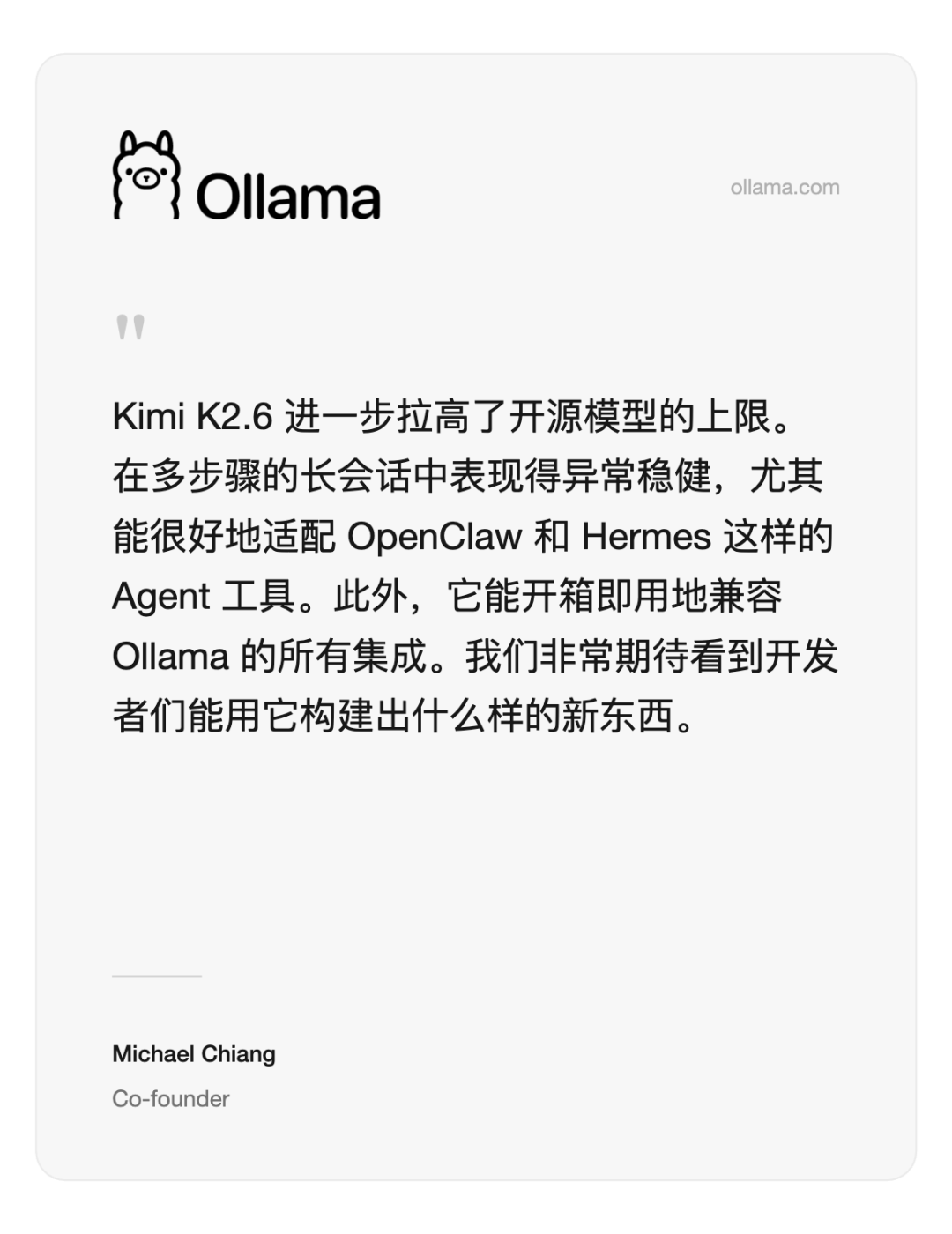
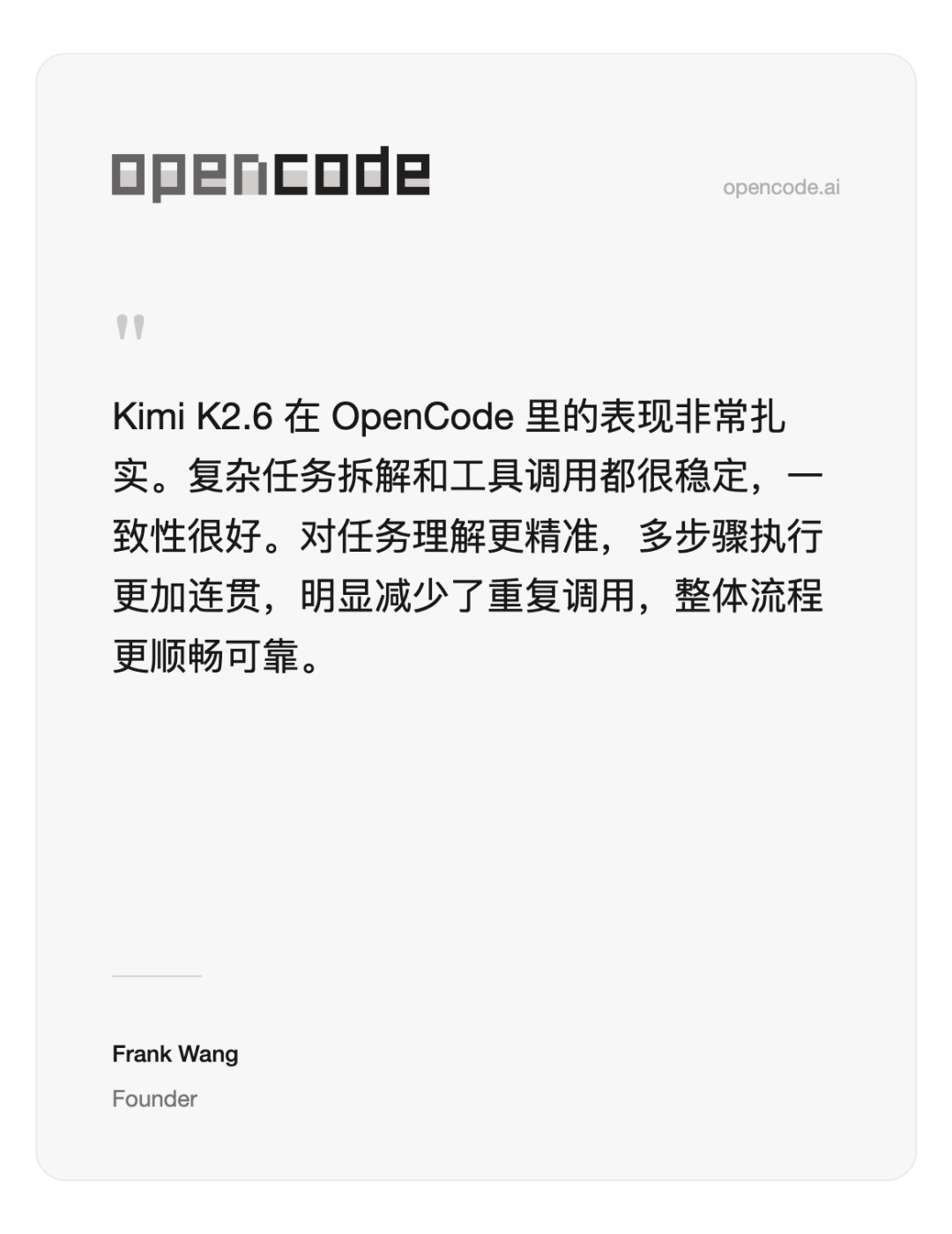
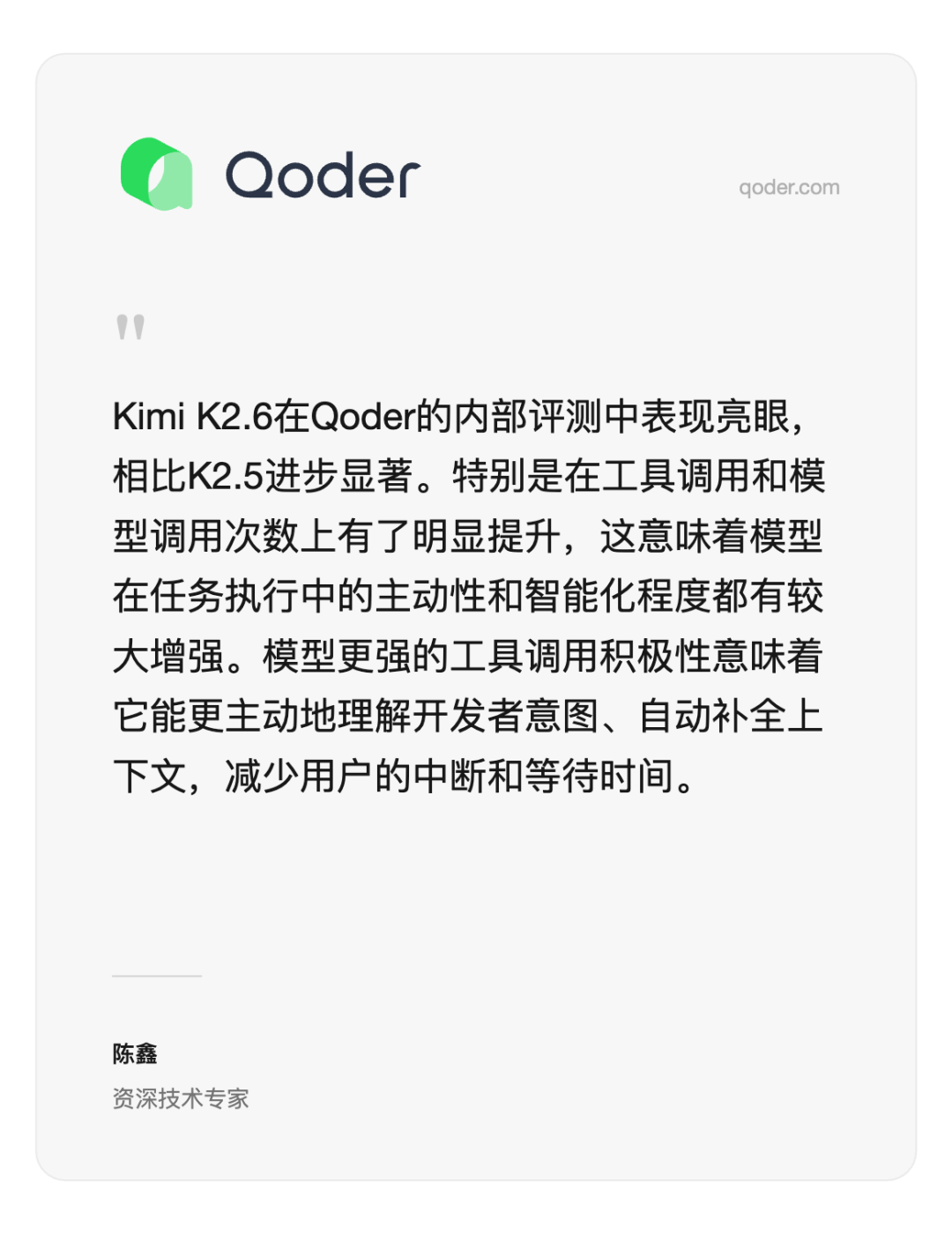
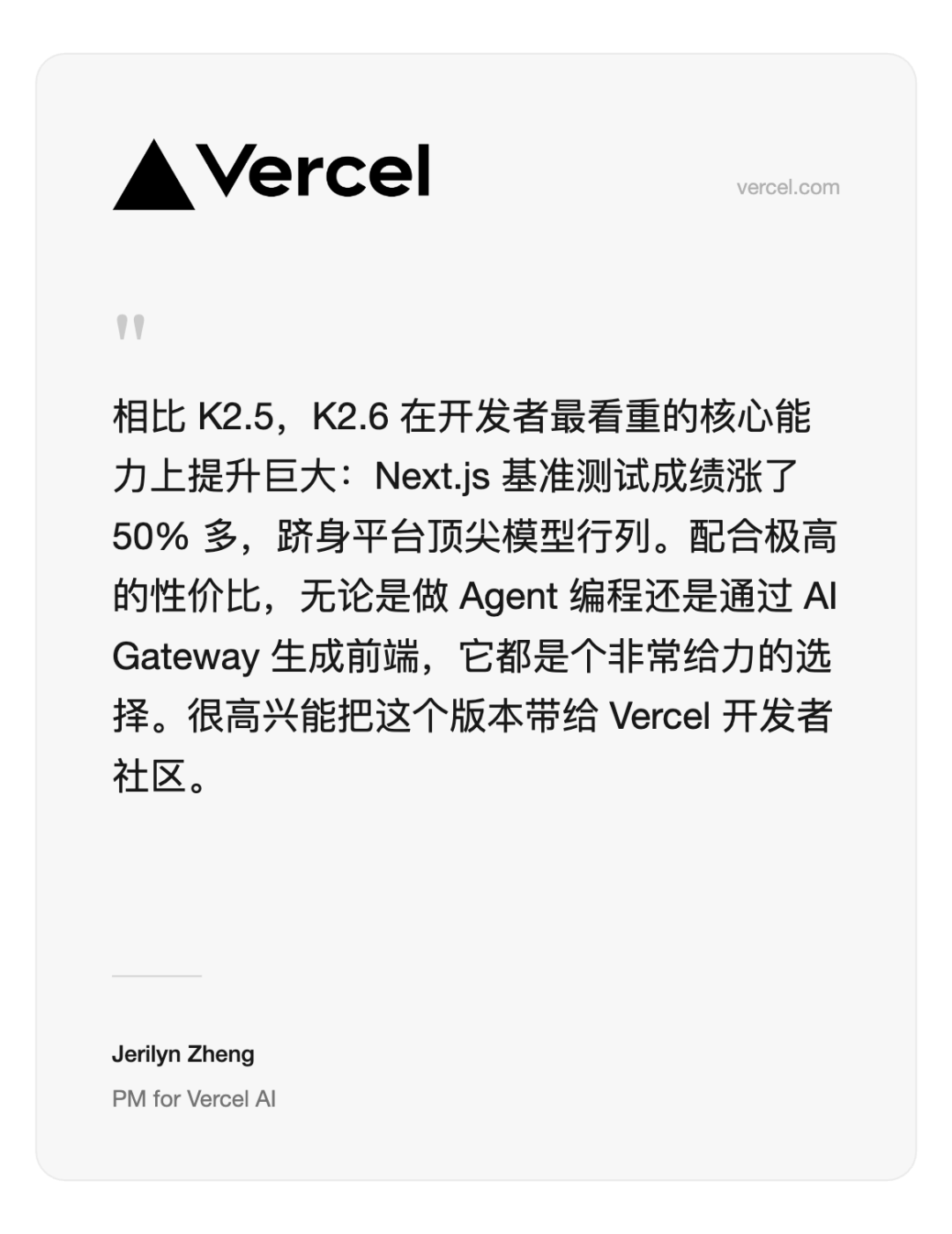
Enterprise customers including Baseten, Blackbox AI, CodeBuddy, Factory (Droid), Lark Miaoda, Fireworks AI, Nous Research (Hermes Agent), Kilo Code, Ollama, OpenCode, Qoder, and Vercel tested the K2.6 model in advance. Below are excerpts of their genuine feedback:
Alphabetical order (1-6)
← Alphabetical order (7-12)

We believe beauty itself is a form of productivity. In K2.6 Agent mode, you can now create websites with exceptional design sensibility and visual impact.
With proficient invocation of image and video generation tools, the K2.6 Agent can produce visually cohesive assets, construct hero sections with strong focal points, and implement interactive elements along with rich scroll-triggered animations.
The K2.6 Agent isn't limited to frontend pages — it also supports basic backend database modules, such as embedding form-based data collection within generated web pages.
With enhanced multimodal programming capabilities, K2.6 can more precisely translate image and video assets into code:
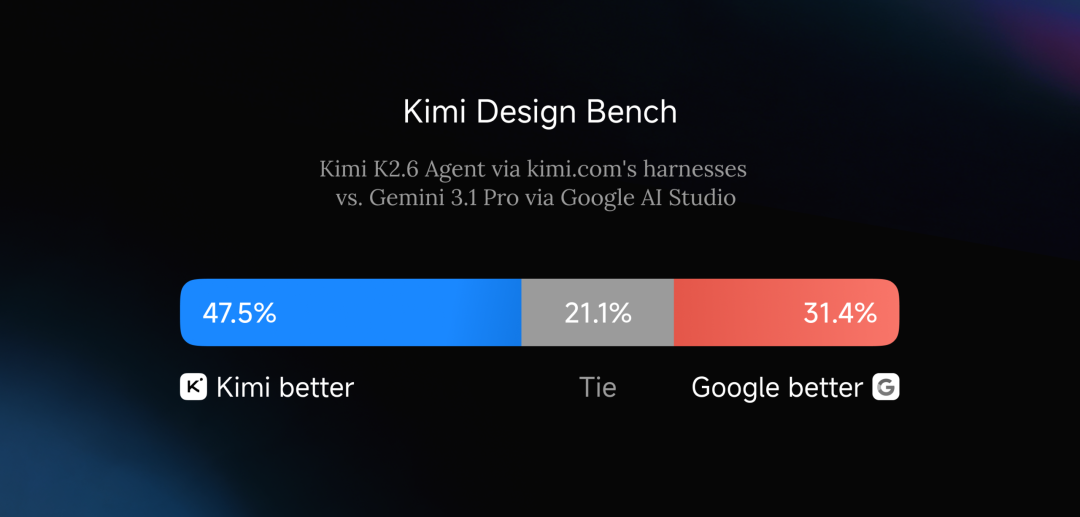
We developed a dedicated frontend development and design benchmark (Kimi Design Bench), covering four dimensions: visual input tasks, landing page construction, full-stack application development, and general web development. Compared against Google's Gemini 3 model in AI Studio, the K2.6 Agent built on the kimi.com framework demonstrates a clear and substantial lead.

Breaking through the performance limits of individual Agents is essential for scaling Agent capabilities. "Agent Clusters" — a capability we introduced starting with the K2.5 model — dynamically decompose complex tasks and autonomously spawn specialized Agents to process them in parallel.
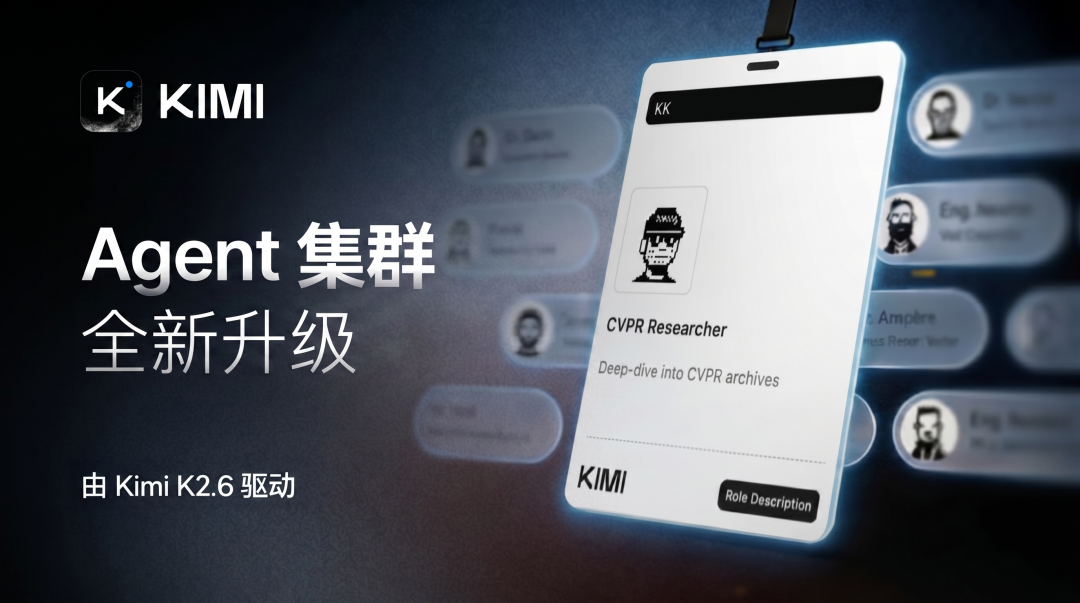
Building on K2.5, K2.6 delivers a comprehensive upgrade to Agent cluster collaboration. Agent clusters can now orchestrate Agents with complementary skill sets, combining capabilities in search, deep research, document analysis, and long-form content creation — with significantly improved task completion quality compared to K2.5. In a single run, an Agent cluster can independently deliver end-to-end multi-product outputs, from documents to web pages to presentations and spreadsheets.
The Agent cluster architecture has also been upgraded, now supporting up to 300 sub-Agents working in parallel across 4,000 collaborative steps, enabling greater parallelization and pushing the upper limits of multi-Agent system coordination.
Here are two use cases:
Case 1: An Agent cluster designed and executed five quantitative strategies targeting 100 global semiconductor stocks. It distilled McKinsey-style presentation logic into a reusable skill, ultimately delivering detailed modeling spreadsheets and a complete set of briefing documents.
Case 2: An Agent cluster transformed a high-quality astrophysics paper containing massive visual datasets into a reusable academic skill. By extracting the paper's reasoning pipeline and visualization methods, the system produced a 40-page, 7,000-word research paper, a structured dataset with over 20,000 entries, and 14 publication-grade astronomical charts.
K2.6 significantly enhances Agent autonomous execution capabilities, particularly in OpenClaw and Hermes Agent-style automation scenarios — contexts that demand AI operate across applications with 24/7 continuous uptime.
Unlike traditional conversational interaction, these workflows require AI to function as a persistent background Agent that proactively manages task planning, executes code, and coordinates cross-platform operations.
Our RL infrastructure team used a K2.6-based Agent to achieve five consecutive days of autonomous operation. The Agent handled monitoring, incident response, and system operations, demonstrating sustained context retention, multi-threaded task processing, and full-cycle execution from alert receipt to complete resolution. Below is the K2.6 work log (sensitive information has been anonymized):
K2.6 delivers tangible reliability improvements in real-world usage: more precise API calls, greater stability during extended runs, and enhanced safety awareness when executing complex research tasks.
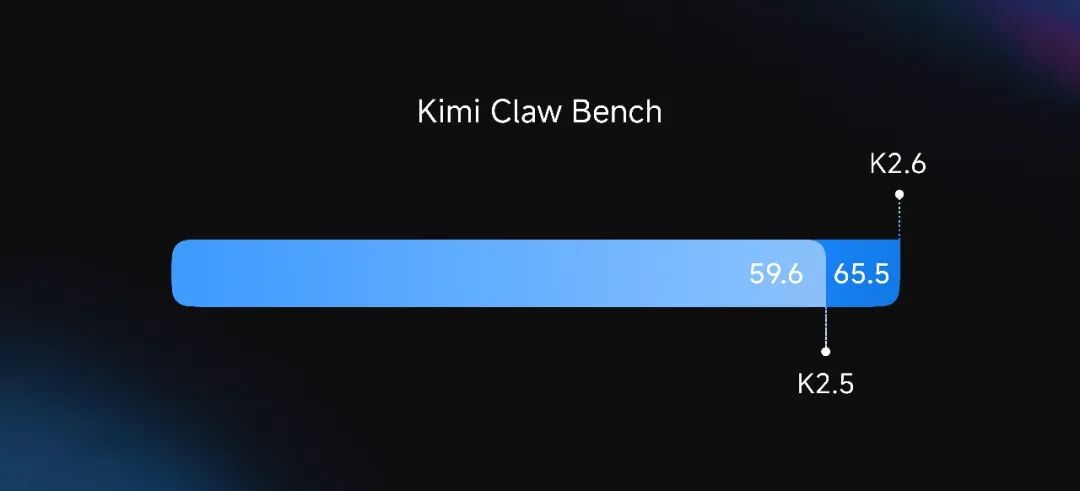
Kimi's internal Claw Bench results show that K2.6 achieves a 10% comprehensive performance improvement over K2.5. This benchmark spans five dimensions: programming tasks, instant messaging ecosystem integration, information retrieval and analysis, scheduled task management, and memory recall. Across all metrics, K2.6 surpasses K2.5 in both task completion rate and tool call accuracy, with particularly pronounced advantages in workflows that require extended autonomous operation without human intervention.

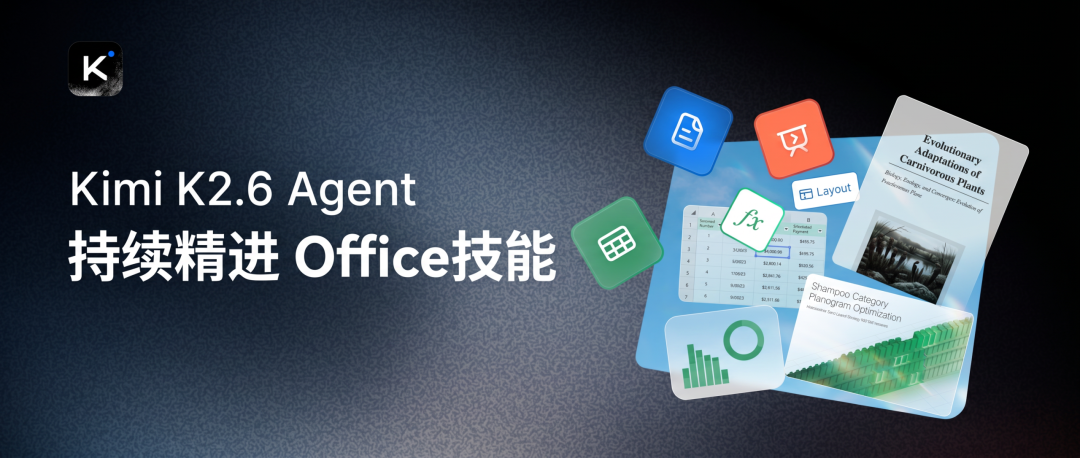
With K2.6's stronger coding and visual understanding capabilities, Kimi Agent mode now supports creating and invoking Skills.
The system comes with over a hundred officially recommended skills out of the box. These include an investment research skill pack built by Moonshot AI's internal expert team. By packaging institutional-grade equity research workflows, it lets users generate professionally formatted one-pagers for A-share, Hong Kong, and US-listed companies, or deep-dive investment reports with a single click — quickly getting up to speed on a company with a comprehensive overview of key fundamentals, industry landscape, and the core stock price drivers the market cares about most.
We'll continue updating the recommended skill library to help more knowledge workers achieve "plug-and-play" productivity gains across the entire workflow, from finding materials and organizing ideas to delivering finished work.
Starting now, type a slash "/" in Kimi Agent mode to begin creating and invoking skills. Every user can build a skill from scratch through conversation with Kimi.
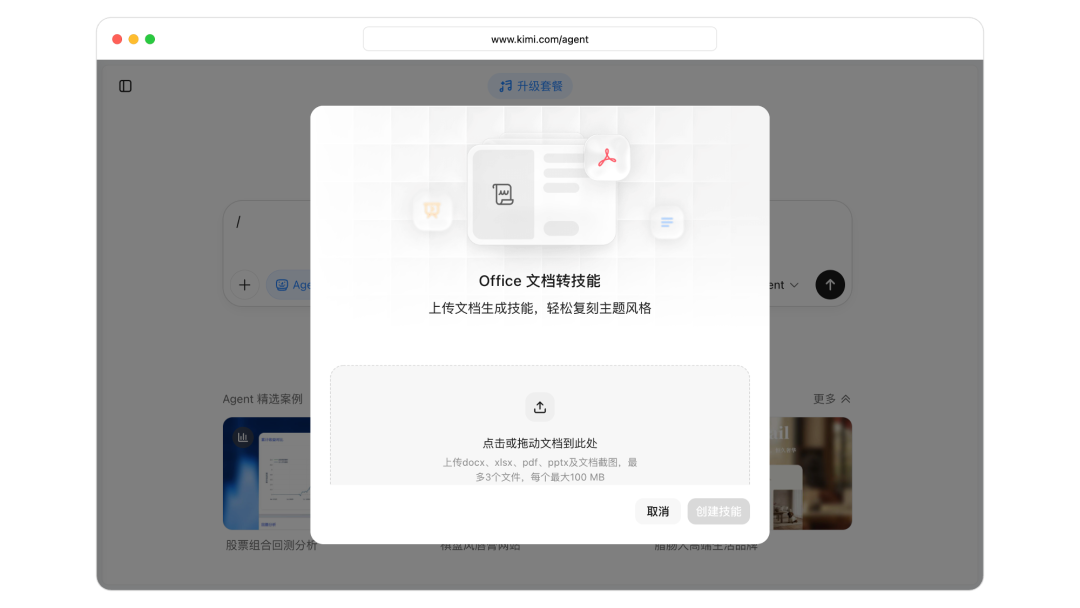
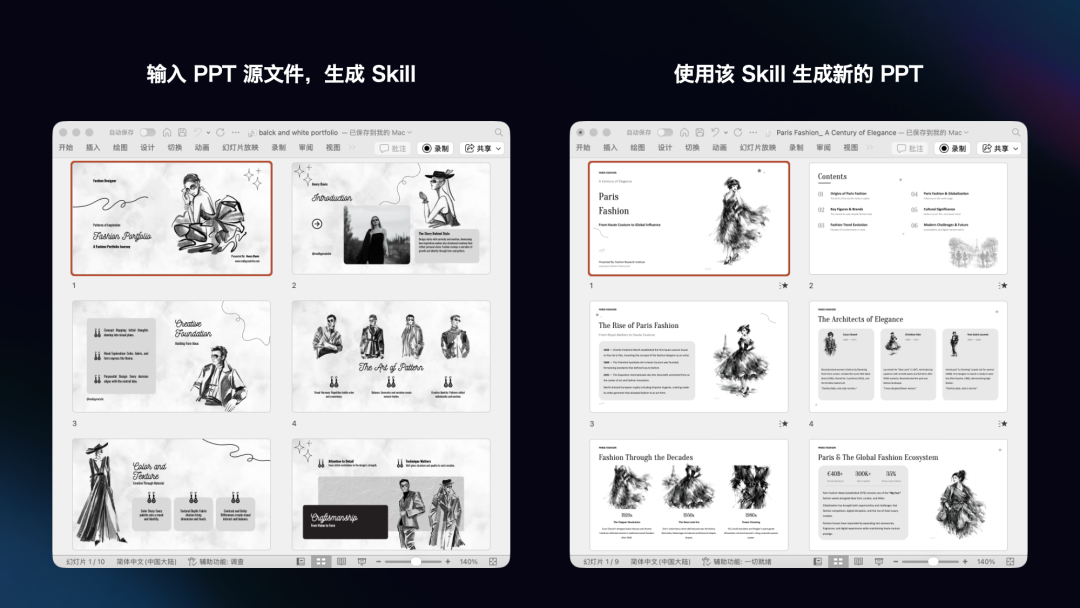
But creating genuinely useful skills still demands considerable knowledge and professional expertise — the barrier remains high. To help users easily transform their carefully crafted documents into reusable Skills, Kimi Agent now supports "Office Document to Skill" conversion: upload a high-quality Office document, and Kimi will attempt to understand the original document's structure and stylistic DNA to generate a bespoke, reusable document-creation skill for you.

Through teamwork and organizational division of labor, humanity created the internet, built large models, and landed on the moon. If AI agents are to help humans tackle complex real-world problems, they too must evolve toward teamwork and organizational specialization.
"Agent Swarm" represents our exploration of automated AI task division. Today we're venturing in another direction: putting humans and various always-on agents together in a group — how can they divide labor and collaborate to accomplish what neither a single person nor a single agent could achieve alone?
This is "Claw Groups" — now in limited internal beta. Claw Groups aim to embrace an open, heterogeneous ecosystem: multiple agents and humans operate as genuine collaborators. Users can connect always-on agents from any device, any vendor, running any model (initially supporting OpenClaw, with Hermes Agent framework support to follow). Each agent brings its own professional toolkit, skills, and persistent memory context. Whether deployed on a local laptop, mobile device, or cloud instance, these diverse agents can enter the same collaborative workspace.
In Claw Groups, K2.6 serves as the coordinator. It dynamically matches tasks to agents based on their skill profiles and available tools, achieving optimal capability allocation. When an agent encounters failure or stalls, the coordinator detects the interruption, automatically reassigns tasks or spawns subtasks, and proactively manages the full lifecycle of agent deliverables from initiation through validation to completion.
Kimi Claw users will gradually receive invitations to the Claw Groups beta — stay tuned.
Kimi K2.6 is now available to all free users, paid subscribers, Kimi Code users, and enterprise API users. Get started at kimi.com, the latest Kimi App, Kimi Code, and the Kimi API Open Platform (platform.kimi.com).
Enterprises and developers can begin using it immediately by specifying kimi-k2.6 as the model in the Kimi API. To celebrate the K2.6 model API launch, the Kimi Open Platform is running a limited-time top-up bonus of up to 30%.
Meanwhile, the official Kimi K2.6 API has debuted on Tencent Cloud TokenHub and other platforms. Tencent Cloud users are welcome to try out the Kimi K2.6 model. We also recommend calling the official Kimi API directly to reproduce Kimi K2.6 benchmark results. For those using third-party API services, the Kimi Vendor Verifier (KVV) can help identify higher-accuracy service providers. Learn more: https://kimi.com/blog/kimi-vendor-verifier
Quick Start ↓ Chat with K2.6, process Office documents, or create web apps
- Chat with Kimi: kimi.com or download the latest Kimi App
- Try Kimi Agent: kimi.com/agent
- Try Agent Swarm: kimi.com/agent-swarm
↓ Use K2.6 for coding assistance
- Use Kimi Code monthly coding plan: kimi.com/code
↓ Build applications with Kimi API
- K2.6 Quick Start: https://platform.kimi.com/docs/guide/kimi-k2-6-quickstart
- View limited-time top-up promotion: https://platform.kimi.com/docs/pricing/promotion
↓ Local model deployment
- Hugging Face: https://huggingface.co/moonshotai
- ModelScope: https://www.modelscope.ai/organization/moonshotai
No Job Levels, No Departments, No OKRs: How 300 People Carry a $120 Billion Valuation at Kimi | BlueRun Ventures Family Headline
BlueRun Ventures early portfolio company Moonshot AI releases and open-sources K2.5 model, bringing new visual understanding, coding, and agent swarm capabilities