Kimi Researcher Team on Itself: Agents Aren't Frankenstein's Monsters, They're the Model Itself | BlueRun Ventures Family Headlines

When Agents Become Everyday Foundation Models

This article is republished from Silicon Stance (ID: gh_1b4c629a6dbd)
Annotations and editing: Yixiao Zhou
Moonshot AI has its first AI Agent. Recently, Kimi Researcher (Deep Research) began internal testing. According to the official introduction, it is positioned not as a simple "search tool," but as an AI Agent capable of generating in-depth research reports with cited sources. According to data disclosed in a technical blog, Kimi Researcher averages searches across more than 200 URLs and runs over 70 search queries during actual operation, ultimately generating deep reports exceeding 10,000 words. On Humanity's Last Exam (HLE), a high-difficulty benchmark test, it scored 26.9%, setting a new record for that test. Since 2024, the AI Agent field has shown two clear trends: first, a shift from "external" to "internal" approaches — moving from reliance on external tool calling to enhancing the model's own capabilities; second, a shift from rule-driven to learning-driven methods, allowing AI to autonomously discover problem-solving strategies through large-scale training. The launch of Kimi Researcher is a concrete manifestation of this trend. In the current AI field, Agents are widely considered an important path toward artificial general intelligence (AGI). Currently, one of the mainstream methods for building Agents in the industry is the "workflow" model. For example, both Devin and Manus adopt a clear task-decomposition + predefined execution flow architecture: first a Planner formulates a multi-stage plan, then an Executor calls tools step by step to complete the task, adjusting based on feedback. This approach links large language models with various external tools through prompt engineering and modular design. Its advantage lies in clear, controllable processes. However, this model of relying on human-designed processes also faces challenges of insufficient flexibility and difficulty generalizing when confronted with open, complex tasks — prompting some teams to explore new technical paths. Kimi Researcher has chosen a different technical route: end-to-end reinforcement learning (E2E RL). The core of this method is to let the model learn through extensive autonomous exploration and trial-and-error in a simulated environment, with the goal of having the model itself "figure out" strategies for completing tasks, rather than strictly following a fixed set of human-written steps. This approach of "internalizing" capabilities within the model itself differs significantly from the workflow model's thinking of the model as a "caller." Adopting end-to-end reinforcement learning to train Agents faces numerous technical challenges. First is environmental instability — web search results change over time. Second is the long-horizon decision problem: a research task may require hundreds of steps. Finally, there is computational resource consumption: each training iteration requires extensive "trial-and-error" processes. Moonshot AI improved training efficiency by 1.5x through technical innovations such as partial rollout. Notably, applying E2E RL to research-oriented Agent exploration is not an isolated case. OpenAI's official Deep Research system card mentions that the model learned abilities including browsing, using Python tools for computational analysis, and reasoning to synthesize information from numerous websites. Its training method is consistent with the reinforcement learning approach used for the o1 model. According to sharing from OpenAI team members Isa Fulford and Josh Tobin on Sequoia Capital's podcast OpenAI's Deep Research on Training AI Agents End-to-End, Deep Research was not built by manually stitching models and tools into a workflow, but rather trained end-to-end with reinforcement learning on browsing + reasoning tasks, allowing it to autonomously plan, backtrack, and adjust strategies. Deep Research used similar end-to-end reinforcement learning for training. Since Deep Research often handles tasks without standard verifiable answers to provide reward signals, analysis suggests they may have used LLM-as-Judge (large language model as evaluator) to implement reinforcement learning. In reinforcement learning, the reward mechanism is core, and LLM-as-Judge is a method of evaluating Agent behavior and providing feedback through a language model. This approach is particularly suitable for complex tasks without explicit reward signals, and can optimize Agent performance. When different teams coincidentally choose similar technical directions, their respective accumulated technical foundations may lead to differences in final products. For example, Moonshot AI builds on its long-context technology, while OpenAI builds on its model series known for general reasoning capabilities. These different technical emphases may affect how their Agents perform and their capability boundaries when handling tasks. At the product level, Kimi Researcher presents backend technology to users in a "dual-report system" format: one is a deep report with detailed text and traceable citations, the other is a dynamic, visual web report that uses mind maps and charts to improve information acquisition efficiency. Additionally, the product attempts to proactively clarify users' vague needs in interaction to help define clear questions. To understand the specific thinking, challenges, and surprises behind this technical choice, first-person sharing from core team members provides the most direct perspective. Below are answers from Moonshot AI researchers Yichen Feng and Shaoguang Mao to the Zhihu question "Moonshot AI's First Agent Kimi Researcher Begins Internal Testing, Can Generate Traceable 10,000-Word Reports — What Are the Technical Highlights?" Officially authorized for republication; some parenthetical text is editor's notes.

Thanks for the invitation — I'm glad to share some technical thinking behind Kimi Researcher, the first product in our Kimi Agent lineup. Kimi Researcher is an Agent model that achieved SOTA (State-Of-The-Art, referring to the current best/most advanced result) of 26.9% on Humanity's Last Exam (a large-scale multidisciplinary closed-ended Q&A benchmark created in 2024 by the nonprofit Center for AI Safety (CAIS) and Scale AI, containing approximately 3,000 expert-level high-difficulty questions covering biology, chemistry, physics, mathematics, humanities, and other fields, regarded as the ultimate test of whether AI systems possess genuine expert-level reasoning ability), and can generate traceable 10,000-word reports. It's also the first large-model Agent product we've built from scratch using end-to-end reinforcement learning (RL). Our core philosophy in building Kimi Researcher is this: we are not building a "search tool," but training an AI Agent that truly knows how to "do research." To achieve this, we chose a harder path — one we firmly believe is the necessary road to more powerful intelligent Agents: end-to-end reinforcement learning. This project was actually initiated in the first half of last year, with the exploration edition released in October, and our team went through quite a few shifts in understanding along the way. As the thinking-model path gradually clarified, we realized two key variables are extremely important: first, building an Agent that can "think long," and second, using end-to-end reinforcement learning. Why build long-thinking models? Flood (Flood Sung, Moonshot AI researcher) explained this in detail in this answer (https://www.zhihu.com/question/10114790245/answer/84028353434), so I'll focus on why we insist on end-to-end RL.
Limitations of Traditional Agent Methods
There are currently two main approaches:
Workflow (predefined task execution steps and logic; traditional Agents complete tasks by combining different workflows, such as fixed processes of "search → analyze → summarize") assembly: for example, building on OpenAI/Claude (calling underlying models through APIs, then combining various tools through preset rules) with "multi-Agent + planner + subtasks," relying on manual prompts and conditional rules to break complex tasks into small modules. Every time the underlying model changes, the entire workflow needs major revision — flexibility is limited. Moreover, Agents built on OpenAI/Claude cannot be openly used in China.
SFT (imitation learning): manually annotating complete task trajectories for the Agent to imitate, improving the Agent's overall capability. But collecting data here is labor-intensive and difficult to scale to large amounts of data.
These solutions are essentially limited by the ceiling of "what humans can design / what humans can annotate," which doesn't align with the scaling we believe in.
Advantages of End-to-End Reinforcement Learning (RL): Letting the Model "Evolve" Itself
Under the reinforcement learning framework, we built a virtual environment for the Agent, letting it explore autonomously at massive scale, trial-and-error, and learn from successful experiences of "getting it right" — like a true research novice — ultimately "evolving" powerful research capabilities. Benefits compared to traditional methods:
- Breaking free from "fixed process" constraints, becoming more flexible and general. RL Agent behavior isn't hard-coded by rules, but dynamically generated based on the current task. This gives it the ability to explore creative solutions when facing unprecedented complex problems. When we upgrade the underlying model, we don't need to reconstruct the entire Agent system.
- Higher capability ceiling, driving growth with "data" rather than "design." When we find the Agent underperforming on certain problem types, our solution isn't to rack our brains modifying prompts or workflows, but to add these problem types to the training data, increasing "training volume" and compute to let the model learn how to solve them itself. The former's ceiling is "human intelligence," the latter's ceiling is "data and compute" — we firmly believe the latter is far higher.
- It can scale. Compared to SFT's reliance on human annotation, the RL path lets the Agent continuously explore in the environment. As long as we can accurately judge whether a task succeeded (i.e., provide accurate reward signals), increasing compute for rollout (in RL, referring to letting the Agent execute a series of actions in the environment and collect experience data; for long tasks, rollout consumes substantial compute resources and time) yields an endless stream of high-quality on-policy training data (data collected under the current policy, which better reflects the model's actual behavior patterns and trains more effectively than using historical data or data generated by other models), letting the model continuously self-iterate and improve. (Interested readers can check out The Bitter Lesson) (a famous article by Richard Sutton, father of reinforcement learning; core argument: in AI research, complex methods relying on human knowledge are ultimately surpassed by general methods that better leverage large-scale computation).
RL Results and the Pleasant Surprise of "Emergence"
This path is difficult, but end-to-end reinforcement learning has brought many surprises. On the Humanity's Last Exam benchmark, our Agent model score leaped from an initial 8.6% to 26.9% — this massive improvement is almost entirely attributable to reinforcement learning. This result also reached the world frontier. Compared to the OpenAI Deep Research team's related work improving from around 20 points (o3) to 26.6 points, this further proves the tremendous value of reinforcement learning in Agent training. On the HLE evaluation set, our pass@4 (pass@k is a common metric for evaluating AI models, indicating the probability of at least one success in k attempts) metric reached 40.17%, meaning that even when facing very difficult problems, the Agent has over a 40% probability of successfully solving them within 4 autonomous attempts. For training purposes, as long as the Agent can explore the correct path, we have the opportunity to transform it into the model's intrinsic capability. More interestingly, we've observed much intelligent "emergence":
- After quickly finding a preliminary answer, the model doesn't immediately stop, but proactively conducts multiple rounds of search, cross-verifying information from different sources to ensure conclusion accuracy.
- We've even observed that when encountering an extremely specialized problem that existing information cannot answer, the model "thinks" and generates an action — "email the author of this paper to seek an answer." (Of course, we intercept such actions for safety reasons.)
These behaviors were not pre-designed by us, but are effective strategies the model learned itself in pursuing the ultimate goal of "completing the task." This gives us hope for the path toward more general intelligence.
What Kimi Researcher Can Do
It can help you quickly get up to speed on an unfamiliar field, generating a deep report with citations; help with paper reading and literature review; even become your research copilot. We ourselves frequently use Kimi Researcher for information gathering and analysis.
- Scenario 1: Due Diligence and Search
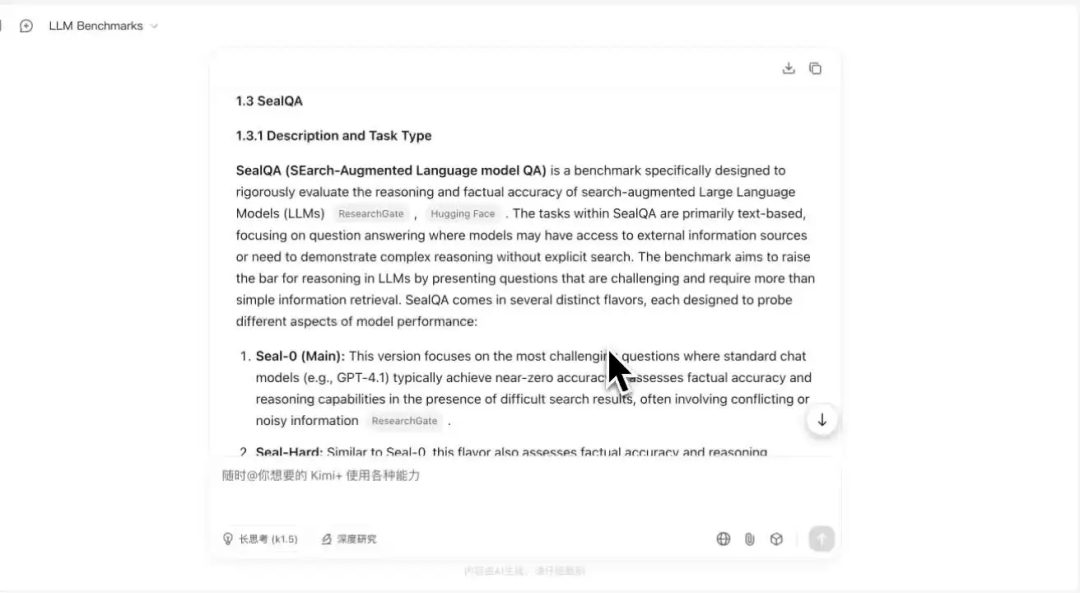
We ourselves used Kimi Researcher to investigate "what benchmarks measure model reasoning ability with SOTA scores under 20 points," and it successfully found several latest benchmarks our team hadn't yet noticed — very valuable. Beyond AGI-2, HLE, and OlympiadBench, Kimi also found FrontierMath and Seal QA, newly released on June 1.
https://www.zhihu.com/video/1920921616197595879
- Scenario 2: Knowledge System Organization
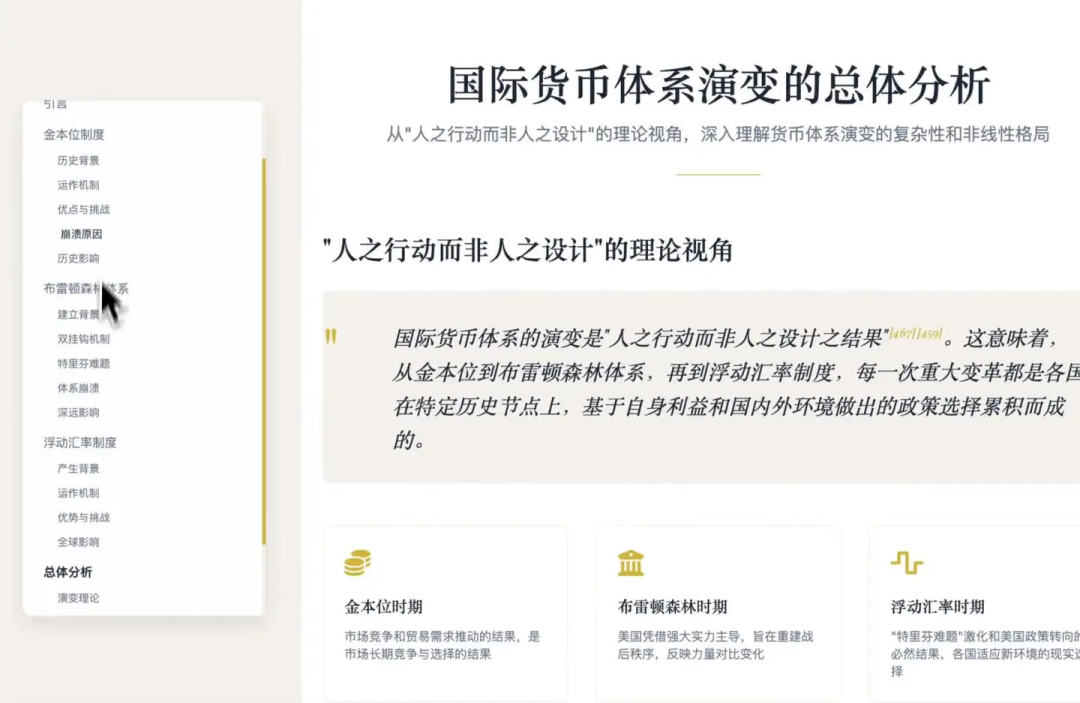
Kimi Researcher can help you understand complex knowledge structures. In the case below, Kimi organized key events, institutional differences, and influencing factors along a timeline, helping quickly grasp the logical threads of three major systems and providing structured material for classroom teaching and research writing.
https://www.zhihu.com/video/1920921886524694751
- Scenario 3: Make a 101
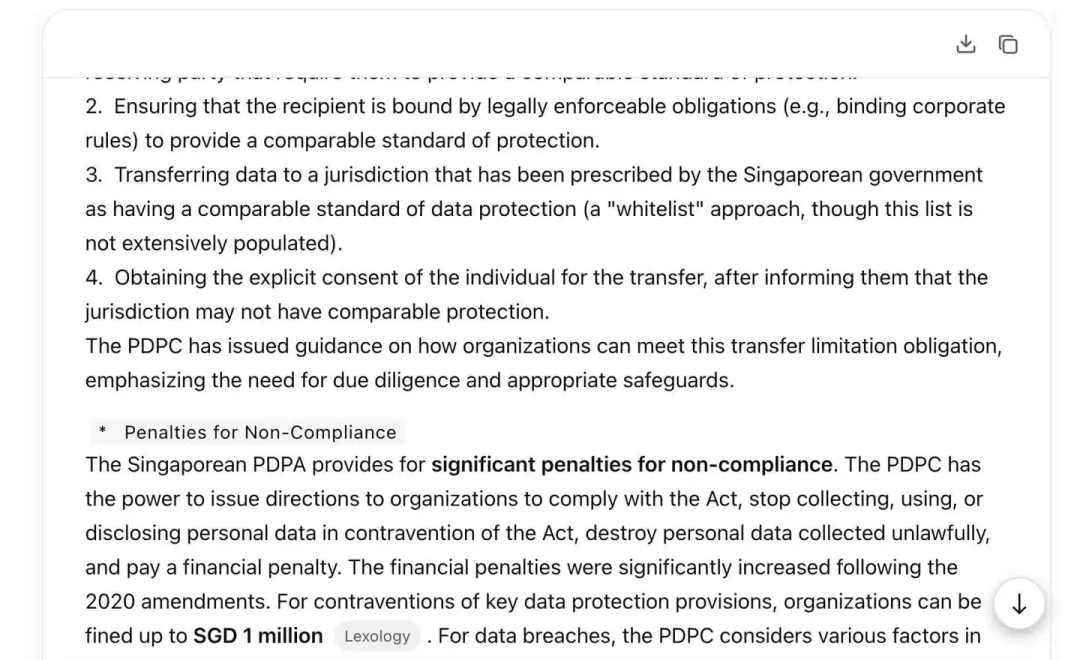
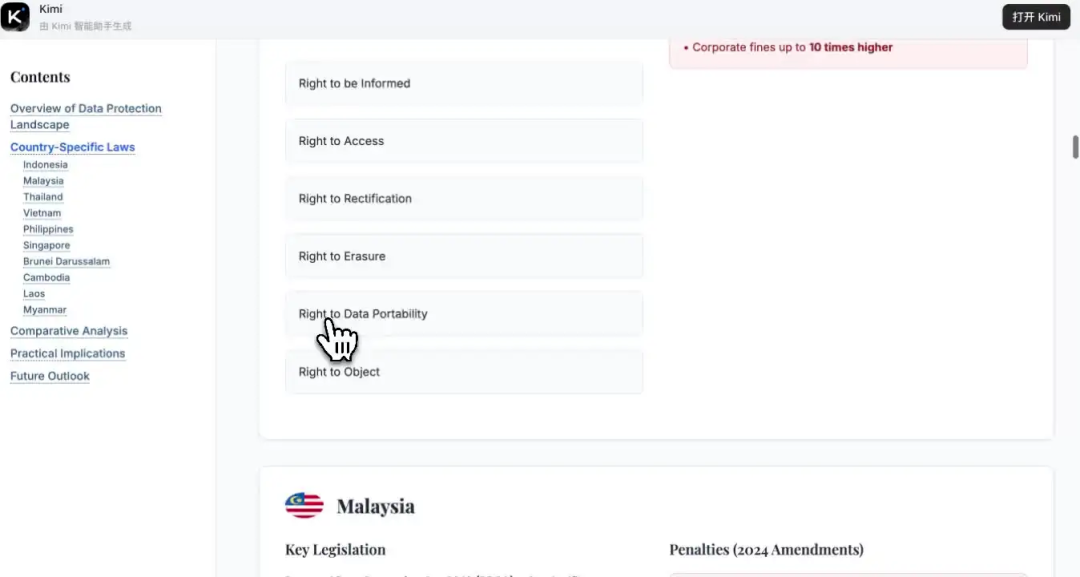
Quickly understand an unfamiliar field, such as privacy law, with an overview: in just over ten minutes, Kimi generated a comprehensive, clearly structured 10,000-word report covering key regulations and policy information from 10 countries, plus comparisons of core provisions.
Key data points are clear at a glance in the interactive report. Which country is more lenient, which has stricter requirements — no more need to compare text paragraph by paragraph.
https://www.zhihu.com/video/1920922628375422634
- Scenario 4: Explore Your Passions With You
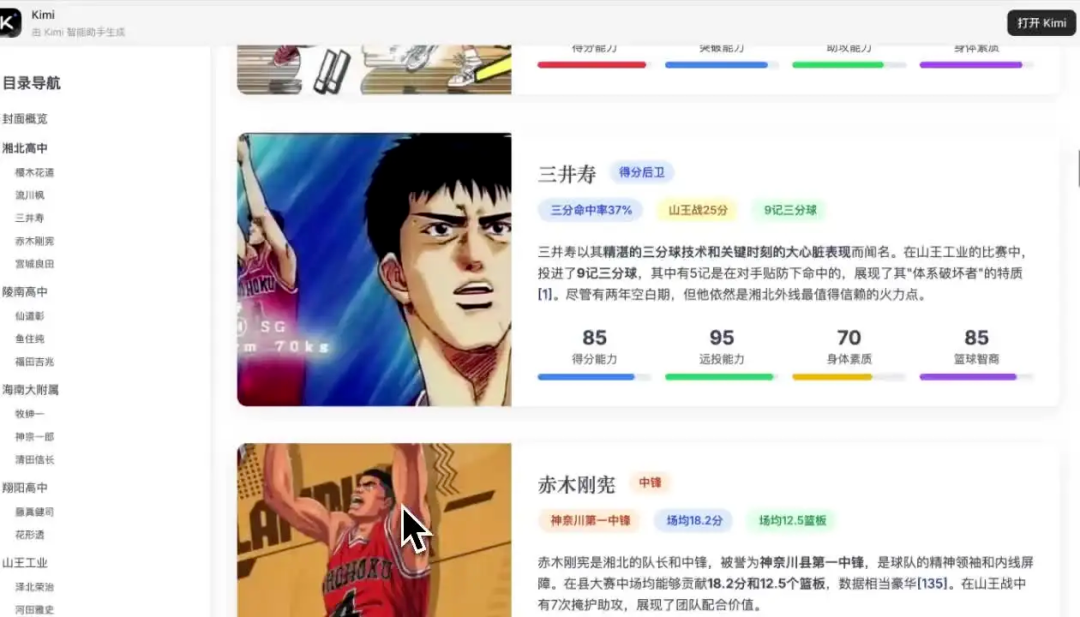
It can even analyze character technical characteristics based on competition data in a virtual comic world:
https://www.zhihu.com/video/1920922963701663133
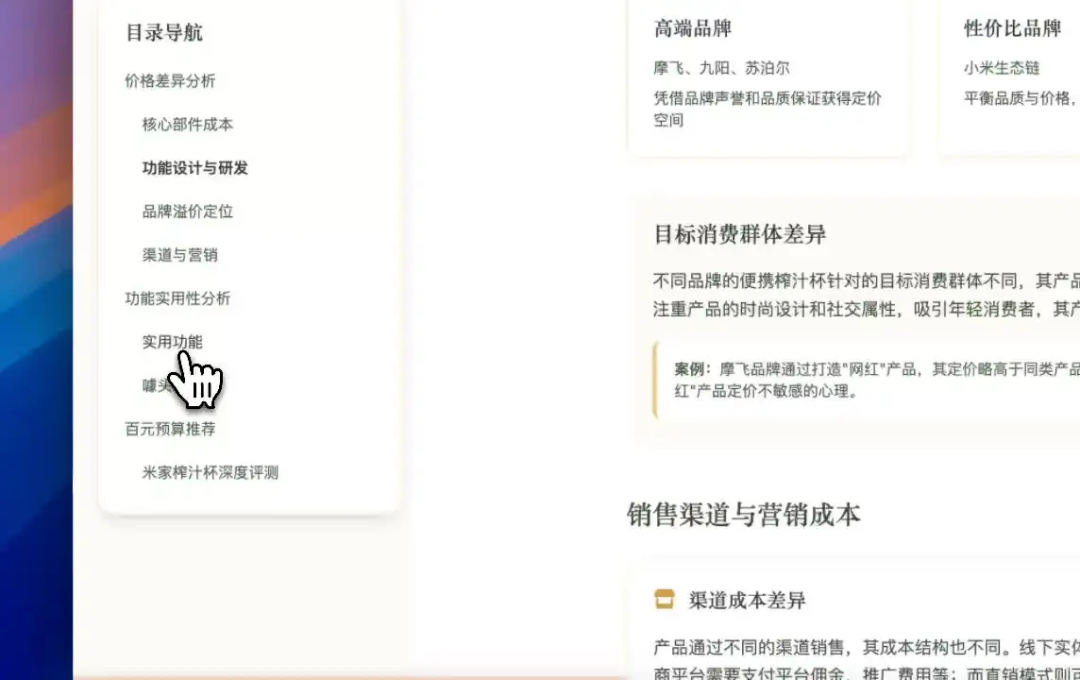
- Scenario 5: Help You Choose Complex, Highly Personalized Products
https://www.zhihu.com/video/1920923023407575891
We also welcome everyone to share more use cases and suggestions. In summary, Kimi Researcher is not just a new feature, but a firm exploration and阶段性成果 on our Agent technical path. We believe that through reinforcement learning, future AI Agents will no longer be merely "tools," but "partners" that can deeply collaborate with humans. The product will continue to be updated and open-sourced going forward — very welcome to experience and follow our technical blog (https://moonshotai.github.io/Kimi-Researcher/).

Thanks for the invitation — I'm very happy to have participated in this Kimi Researcher work, and very excited to see this model/product come to fruition. As an Agent-direction researcher, this work has been a wonderfully memorable journey for me personally. I'd like to take this opportunity to share some thinking on Agent direction development and some thoughts from the Kimi Researcher work.
As we mention in our tech blog, Kimi Researcher is an Agent model trained entirely with RL (RL即Reinforcement Learning强化学习,这是AI领域的一种训练方法,通过试错和奖励机制让模型学习最优策略), and getting this to work is pretty cool. After ChatGPT, the concept of Agent was revived again, and I participated in some early Agent-related work at my previous company (joined Microsoft in 2019, senior R&D engineer in the General AI group, main research directions being language-model-based reasoning, AI agents, and multi-agent systems; developed technologies applied to products including Microsoft 365 Word), including some of the earliest work in early 2023 using prompts to link ChatGPT to APIs to extend model capabilities, and some MultiAgent work. There were some quite good works in the early Agent field. After building more and more frameworks and application demos (LangChain, AutoGPT, etc.), the concept became increasingly popular. Later, Agent entered a "somewhat strange" direction — for a period, people working on Agents and people working on models went their separate ways, as if the model layer and application layer were separated. Agent became prompt engineering at the model level and engineering-side external modules, and Agent work gradually converged, with little differentiation — nothing more than writing prompts to call tools, defining workflows, etc. — no particularly exciting papers or work to be seen. When chatting with fellow researchers, we'd also feel this direction was becoming increasingly uninteresting, somewhat accelerating toward decline.
Starting roughly in the second half of last year, I began to believe that Agent should be a model itself, not just Model + Workflow. In my view, while workflow expands the model's boundaries, as task complexity increases, the complexity of workflows to be defined rises exponentially, and in the workflow Agent operation process, such workflow Agents are difficult to generalize and struggle to produce generality for tasks they haven't handled, causing workflow Agents to become patchwork — encounter a problem, solve a problem.
So we faced two choices: first, wait for base models to become stronger, build workflows based on APIs, and stably capture the gains from building workflows; second, let Agent capabilities enter the model itself, moving from Reasoner (language models with reasoning capabilities) to Agent, where the Agent itself is the model.
By fortunate coincidence, I joined Kimi early this year, and found everyone's vision very aligned here: improve model intelligence, expand model boundaries, or in other words, do AGI. Naturally we firmly chose the second path. Training an Agent Model faces many challenges. Although RL showed astonishing effects in training reasoning models, Agent RL still faces many different challenges. For example, Agents work in real environments, and the environments they face are dynamic — environments often experience some jitter, and the same tool produces different call results under different conditions. Another example: Agent tasks are long-horizon (referring to complex tasks requiring the model to perform multi-step, long-sequence reasoning and decision-making to complete; research tasks the Agent needs to complete may contain dozens or even hundreds of steps, with each step affecting subsequent decisions), which brings many challenges to the model's own context length management, rollout efficiency, and training stability. Another example: how to find training data that can stimulate the model's Agent capabilities, and how to effectively learn when each successful trajectory (in RL terminology, referring to the complete sequence of states, actions, and rewards the Agent experiences from initial state to terminal state) is extremely long context. Some specific details are in our technical blog (https://moonshotai.github.io/Kimi-Researcher/), and there will be a technical report sharing more details in the future.
The AI field changes daily, with new news every day. I joined Moonshot just four months ago, yet today it feels like a long time ago.
The biggest feeling from this journey is cognition + persistence: in early stages, use sufficient experiments to gain cognition, confirm the direction, then persist in doing it, give training some patience, and give yourself some沉淀. Working at Kimi is very satisfying — communication and interaction between model/product/development/data is very efficient, and shared cognition and data accelerate our project progress. Colleagues around me are both confident in AI and brilliantly talented.
Kimi Researcher has gradually begun opening to everyone starting June 20, but due to service stability concerns, we need some time to gradually roll it out to larger user groups. We hope Kimi Researcher can bring everyone deep reports and a good experience.
Kimi Researcher is just the beginning of this journey. It verifies that we can internalize Agent-required capabilities into the model itself through RL. Going forward, we will continue adding tasks and tools, letting the model further generalize through exploration. General Agent is in the not-distant "tomorrow"!

 BlueRun Ventures Family Headlines | Kimi Partners with Tsinghua University and Other Institutions to Open-Source and Jointly Build Large Model Inference Architecture Mooncake
 BlueRun Ventures Dialogue with Moonshot AI, Muyan Zhiyu: Standing at the Crossroads of the AI Industry | The Road to AGI
 Kimi Exploration Edition Is Here — The Best Search Is Not Having to Search Yourself | BlueRun Ventures Family Headlines