BlueRun Ventures in Conversation with GeekPark's Zhang Peng, Crossing's Koji, and WaytoAGI's Xiqi AJ: "New Species" and "New Ecosystems" in the AI Wave

Walking boldly on the AI path
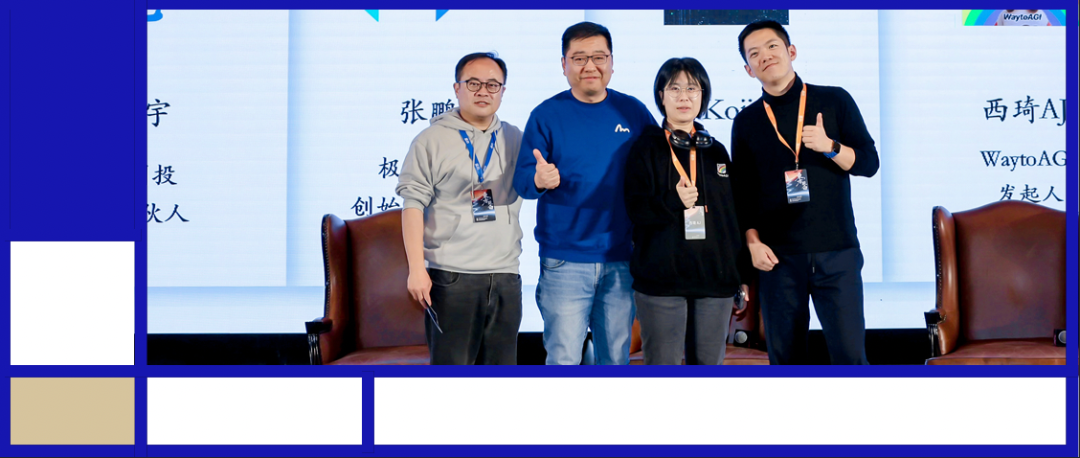
The AI wave is reshaping how entrepreneurs see themselves, how communities create value, and how founders tackle challenges. How do you spot the next generation of great entrepreneurs? What makes them different from the last? And how will they navigate uncertainty amid rapid technological change? At BlueRun Ventures' 2025 Annual Fund Partners Meeting, Terry Zhu, Managing Partner at BlueRun Ventures, sat down with three AI-native community builders — Peng Zhang, founder of GeekPark; Koji, founder of Crossing; and AJ Xiqi, founder of Way to AGI — to explore the entrepreneurial spirit and founder ecosystem in the AI era.
From building communities to moving fast, from niche markets to global vision, their stories and reflections offer diverse perspectives and vivid inspiration for understanding this new generation of entrepreneurs. Selected highlights from the conversation:

Terry Zhu: Let's start with a one-minute introduction — how do you see your identity in this era?
AJ Xiqi: I originally started this community as a side project, extending from my day job as a product manager. The initial motivation was to collect unknown AI skill tutorials. We built group chats and a knowledge base, aggregating everyone's conversations. The content kept growing, attracting more people to contribute. Around the three-month mark, the knowledge base hit 1 million visits.
Later, people asked to meet offline. Now we host a large monthly gathering — the AI Exchange Conference — where people get together in their local cities to take action. We've held 18 sessions so far, with 2,000 to 4,000 participants each time, spanning 39 cities. We've also run hackathons in Singapore and Japan.
How I see myself: I'm a connector, bringing people together and getting more people involved in building. In the AI era, communities have developed an open-source atmosphere where everyone can draw on information, knowledge, and co-creation. Many people here have formed their own small teams or studios, quit their jobs to go full-time, and become new entrepreneurs of the AI era. They might start small — making AI short videos, delivering a prompt or workflow — gradually landing orders from this era and stepping out of their comfort zones. That's the warmth and value our community brings.
Not everyone who emerges from our community is a venture-backed entrepreneur. Some become the next generation of interns, better equipped to use AI tools in the workplace. Of course, some do go on to start companies. Those who spend more time in the community often find product-market fit more easily. You can be a very small person doing something great. As our community's name says: Way to AGI.
Koji: What I'm doing now is "Crossing" — a podcast, WeChat account, and community. I do this because my golden era was around 2010, when I worked as a product manager alongside Xing Wang. Back then at Beihang University, I felt like a nonconformist. My classmates wanted to join big companies or apply to American grad schools; I was the only one who biked to Wudaokou to join a 16-person startup. I deeply felt how I was infected and shaped by the physical environment and community of entrepreneurship — I found my people.
When this new wave of AI entrepreneurship arrived, I felt I had the energy to host a new "Wudaokou." So we launched AI Hacker House in Shanghai's Caohejing — a 300-square-meter physical space for events and hackathons for the new generation of AI entrepreneurs. Our goal is to help young people who feel like nonconformists — because entrepreneurship is always lonely — find more of their kind here. If I had to answer in one word: connector.
Peng Zhang: I started covering the internet industry right out of college and got swept into the wave. My biggest frustration was people around me thinking this crowd of internet friends wasn't as lucrative as those in retail or real estate. So I created GeekPark. From day one, it was like a community, bringing these people closer together.
GeekPark's important mission is to bring Silicon Valley's "Founders backing Founders" culture to China. The previous generation of entrepreneurs can offer not just early capital to the next generation, but also tremendous value as mentors. Today, what's more important is how to effectively organize these people's resources, experience, datasets, and energy to help generation after generation of entrepreneurs. This is something relatively scarce in China's startup environment.
GeekPark evolved from a hobby into something more structured: effectively collecting and organizing incremental resources, turning them into a new form of energy injected into the entire startup ecosystem, and distributing it more efficiently. This support isn't just at the cognitive level — it includes our early-stage fund practice, where the capital comes mainly from entrepreneurs and carries know-how experience.
So my identity is: a new energy network in China's startup and venture capital space. Organizing new resources, effectively "connecting to the grid," increasing everyone's success rate, letting entrepreneurs innovate standing on the shoulders of the previous generation.
Terry Zhu: In this massive wave, why do you want to be part of solving this problem, and what specific problem are you responding to?
Peng Zhang: Looking at this AI wave, AI is fundamentally a major shift in productive forces, but it's still in a very early stage. From past internet and mobile internet waves, we know there's an inevitable sequence: from technology infrastructure to products, users, business models, to industry chain reshaping. Today's environment is still being built, growing, and changing, so the challenges today's entrepreneurs face are enormous.
At this moment, how can a community and richer energy amplify this? Fundamentally, it's about helping everyone survive through it — I call it "surviving the spring."
Terry Zhu: Do you think this generation's entrepreneurs face greater challenges than the last?
Peng Zhang: The challenges are definitely much greater. The main reason is that so much today is in dynamic motion. When mobile internet first emerged, the paradigm was structured; but today's AI wave is unstructured, continuously evolving, dynamic. This dynamism fundamentally changes how entrepreneurs operate.
We can't just watch entrepreneurs charge forward with enthusiasm only to retreat in complete defeat. That's very damaging to the entire industrial ecosystem. So we must provide buffering and more support in the middle — that's why we stay active. We deeply understand the special nature of this wave. As a community and platform, we must step up. What AJ and Koji are doing is connecting to the grid with us (co-working), jointly adding energy to this environment.
Terry Zhu: In the deep waters where real entrepreneurs swim, the inner challenges they face are actually synchronized with the industry's characteristics — models are still iterating and evolving. Under this paradigm, how do you find your entrepreneurial foothold?
Koji: Everyone building entrepreneur communities genuinely wants to find the next Yiming Zhang. Otherwise, in ten years no one will remember your community — it'd be like you did it all for nothing. I've been thinking: I worked with Yiming Zhang early on, and was Xing Wang's product manager when they were both under 30. Today, everyone's searching for the new generation of entrepreneurs — some funds mention post-98 founders. There's a consensus: as Outliers describes, Bill Gates and Steve Jobs succeeded not just through ability, but because they were born in the right years, with era-defining transformations hitting right at their most energetic golden period.
So I keep wondering: how do we identify such entrepreneurs? What do they need? I remember at Crossing community's 100-day mark (100 days of podcast episodes), we held a centennial celebration. Looking back, one attendee was a co-founder of Dify, who spent half an hour debating everyone, preaching what Dify was, while everyone asked "what's it actually for? Don't get it." Now Dify has gone global and become a top-tier infrastructure company. Another attendee was the co-founder and product lead of Hicloud and Manus — he wasn't working on either yet.
I recorded a podcast with him then. He had this evangelist quality, repeatedly telling everyone: In the AI era, you have to get your hands dirty. He said, especially for someone like him (born in 1987, a veteran), you need to personally build something, write a line of code, to truly feel where AI's capability boundaries lie today. That left a deep impression. Being around these people makes me happy, so I've kept going.
Terry Zhu: You mentioned wanting to identify these people, but how does podcasting help you do that?
Koji: A podcast is content first. Content needs to be interesting, useful, resonant — that's the baseline. But how to identify the next generation of founders? I think this circles back to early-stage investment theory. I'm a big fan of Paul Graham, author of Hackers & Painters and Silicon Valley's startup godfather. He had a viral article last year, "How to Do Great Work."
He wrote about what to look for in early founders — points most people agree with: resilience, natural passion, ability to inspire teams, vision. But one point struck me deeply: how to find something that comes effortlessly and excellently to you, but is hard for others. He argues that even if it seems far from business, you should deeply cherish this gift.
Then he gave an example, also Y Combinator's core investment philosophy: when you face a field, don't choose to cultivate the entire field — instead, find a well and dig deep. This is about finding a vertical need, drilling through it, then expanding.
So back to the question: how to identify the next great entrepreneurs? Beyond basic entrepreneurship, I see two more things: one, gets your hands dirty — you have to build today; two, whether they can find a vertical niche they believe in and are solving problems in.
AJ Xiqi: We have a slogan in our community: "from -1 to 0," because this generation of AI entrepreneurship really differs from the last internet wave. Every day brings new changes and opportunities — who catches the next one is unclear. We don't know if some new model will overturn transformer.
But I've noticed one group with distinctive traits: they're endlessly curious, constantly building, and genuinely excited. In our community we see many "kids" — even elementary schoolers. Using no-code tools combined with their imagination, they create projects like "jargon translators" or "astronomy agents," quickly becoming "little stars" at school. There are era and opportunity factors, but individual traits and ability to seize opportunity matter enormously — that's irreplaceable. Moreover, many interesting projects start purely from interest, only later getting connected through hackathons or venture capital.

Terry Zhu: After hearing from all three of you, it's clear why you're on this stage. We're also "connecting to the grid," hoping to reach the most vibrant, energetic entrepreneurs and young people over the next 5 to 10 years through different methods. What we've discussed shows everyone a very dynamic force in this cycle. Despite macroeconomic fluctuations, the temperature in AI entrepreneurship is genuinely high.
I want to follow up with Peng Zhang. As a practitioner integrating communication, community, and capital investment tools, what's the biggest difference between this wave of entrepreneurs and the last?
Peng Zhang: One immediate feeling is that this new generation of entrepreneurs at this AI stage already dares to "build stuff" — whether crazy or pragmatic ideas, you see them doing it. I think their general baseline is higher than the previous generation. This doesn't mean they're naturally more talented than Yiming Zhang, but because they stand on the previous generation's shoulders. Like large models, new models are inevitably better because their datasets are richer, more complete, compute is higher. They start with better open-source datasets than we had. Today they have AI assistance, equivalent to having a computationally powerful person beside them — their starting point is naturally higher.
Their challenge isn't model pre-training, but the reinforcement learning part. This must happen through practice, so entrepreneurship itself is the best reinforcement learning arena. Conversely, experienced entrepreneurs' resources deserve to be organized, because this dataset isn't open-source. Organizing it through mentorship, dinners, etc. is essentially open-sourcing this experience, preventing them from repeating reinforcement learning in wrong directions.
Today's entrepreneurs start from a high baseline, but they always face a challenge: they must have their own reinforcement learning process. Combined with the dynamic technology environment, we should look for entrepreneurs who return to fundamentals. We've summarized it simply: eyes bright, mind clear, feet swift. Eyes bright means having intrinsic motivation, nuclear power — not doing it for money. Mind clear means having reasoning ability and pursuing its continuous strengthening. Feet swift means seeing results tomorrow after discussing today.
Entrepreneurship today is no longer "tug-of-war," more like "basketball" — a highly dynamic environment where you must keep moving to find opportunities. I saw an interesting example: an entrepreneur in an extremely narrow domain, but a deep enthusiast. When discussing it, his "eyes light up." He's not from an AI background, but deeply understands scenario needs and pragmatically maps product development. After discussion, he'd share experimental results the next day. This kind of person, even if not successful this time, will definitely make it later. The power of passion has more穿透力 today, and "passion" manifests as whether you've put in your ten thousand hours.
Koji: I named my podcast "Crossing" because with AI's arrival, everyone stands at a new crossroads. But what we seek are the new generation of entrepreneurs and active doers in the AI era. Don't linger at the crossroads, because in the AI era, all roads lead to Rome — just take any step forward.
In an era of major technological transformation, the most active doers get rewarded. I recall how back then, to find opportunities, we'd quickly scrape popular apps off Facebook's open platform to see what we could copy and improve. In the AI era, the faster you act, the stronger the returns.
For example, BlueRun-invested Moonshot AI, which first built momentum among domestic large models, became the top brand, immediately rolling in recruiting and funding, securing first-tier position. Or Manus — Xiaohong Xiao and team, already successful with Monica, still actively sought the next big thing and launched Manus at extreme speed, gaining huge first-mover advantage. This active spirit and the leverage it can move are greater today. To capture dividends, you have to build harder, do things, ship products.
AJ Xiqi: If there's anything different, I think it's really all the same: active action. We build communities, host events — speed matters, don't worry about perfection, that's especially important in this era. Hesitant entrepreneurs will definitely miss opportunities.
Second, small niche markets are excellent choices, especially starting from personal interest. I have many such cases around me, like "fujoshi communities" (users averaging 8 hours daily active), or in Japan many hamster-enthusiast communities. Ten thousand hours of passion you invest, plus AI skills, satisfying a small need, can gradually expand. This is a quick entry path in the AI era.
Third, AI tool users are getting younger. We need to deeply understand them. For example, today's elementary schoolers using no-code tools can make professional requests like "after submission this should be preview mode not edit mode." They grew up with electronics but don't type well because they use iPads too much. They use AI tools like Doubao (daily active users already at 100 million) by voice, not typing or tapping. User habits are being fundamentally changed by AI, and entrepreneurs need to deeply enter these new domains to see what they're actually doing.
Our community is called Way to AGI. Many enthusiastic people aren't doing charity — they're "powering their passion." I'm an active doer and player in the AI era.
Terry Zhu: Finally, can you summarize your understanding of the entrepreneurial spirit in the new era in one sentence?
Koji: In an era full of uncertainty, the entrepreneurial spirit is to propose a vision and burn for it, attracting others to build together.
Peng Zhang: Entrepreneurial spirit lies in using existing resources to pursue larger goals, and in constantly changing environments, bravely innovating and continuously evolving.
AJ Xiqi: We must bravely walk the AI path, continuously exploring — whether the ultimate goal is AGI or not, what matters is keeping moving forward on this road.


Dawn breaks, walk toward the light | BlueRun 2025 Annual Fund Partners Meeting
Break out of the quadrant, walk the undefined path | BlueRun 2024 Annual Fund Partners Meeting

See you in Tokyo — An invitation from Booming Hub to those exploring