Milestone: Humans Achieve Laser Fusion Ignition for the First Time, Claiming the "Holy Grail" of Clean Energy | BlueRun Ventures

Will the rules of the game be changed?
At the tail end of a surreal 2022, we witnessed history once again last night.
On December 13, the U.S. Secretary of Energy and scientists at LLNL announced that humanity had achieved fusion ignition for the first time. This means we have claimed the "holy grail" of clean energy — nuclear fusion.
BlueRun Ventures has long kept a close eye on controlled nuclear fusion and invested in the "artificial sun" startup Energy Singularity. In our view, while there's still a long road to practical application, this ignition success marks an important milestone in the history of controlled nuclear fusion. It validates the engineering feasibility of laser ignition and boosts industry confidence — which will attract more resources and talent into the fusion sector and accelerate technological development.
Energy Singularity, however, is pursuing a different technical path: the tokamak magnetic confinement approach. In addition to auxiliary heating, this method uses magnets to heat and contain hydrogen atoms. Energy Singularity has completed its preliminary design and is currently developing and manufacturing the relevant equipment.
People always overestimate a technology's impact in three years and underestimate its transformation in ten. If nuclear fusion lives up to its promise, many assumptions constrained by energy consumption will be shattered, and many products, services, and relationships will be restructured. Today, we want to share this news with you and look forward to an exciting future together. Enjoy~
The bombshell news about controlled nuclear fusion has finally been confirmed.
At a press conference on the evening of December 13, the U.S. Secretary of Energy and LLNL scientists jointly announced this major scientific breakthrough for "unlimited clean energy"!
For the first time in history, humanity has achieved net energy gain from a nuclear fusion reaction — meaning the fusion reaction produced more energy than was consumed in the process: fusion ignition. This also marks the first experimental validation of the scientific foundation for inertial fusion energy (IFE).
According to official reports, after delivering 2.05 megajoules (MJ) of energy to the target, LLNL produced 3.15 megajoules of fusion energy output, yielding an energy gain of roughly 1.5.
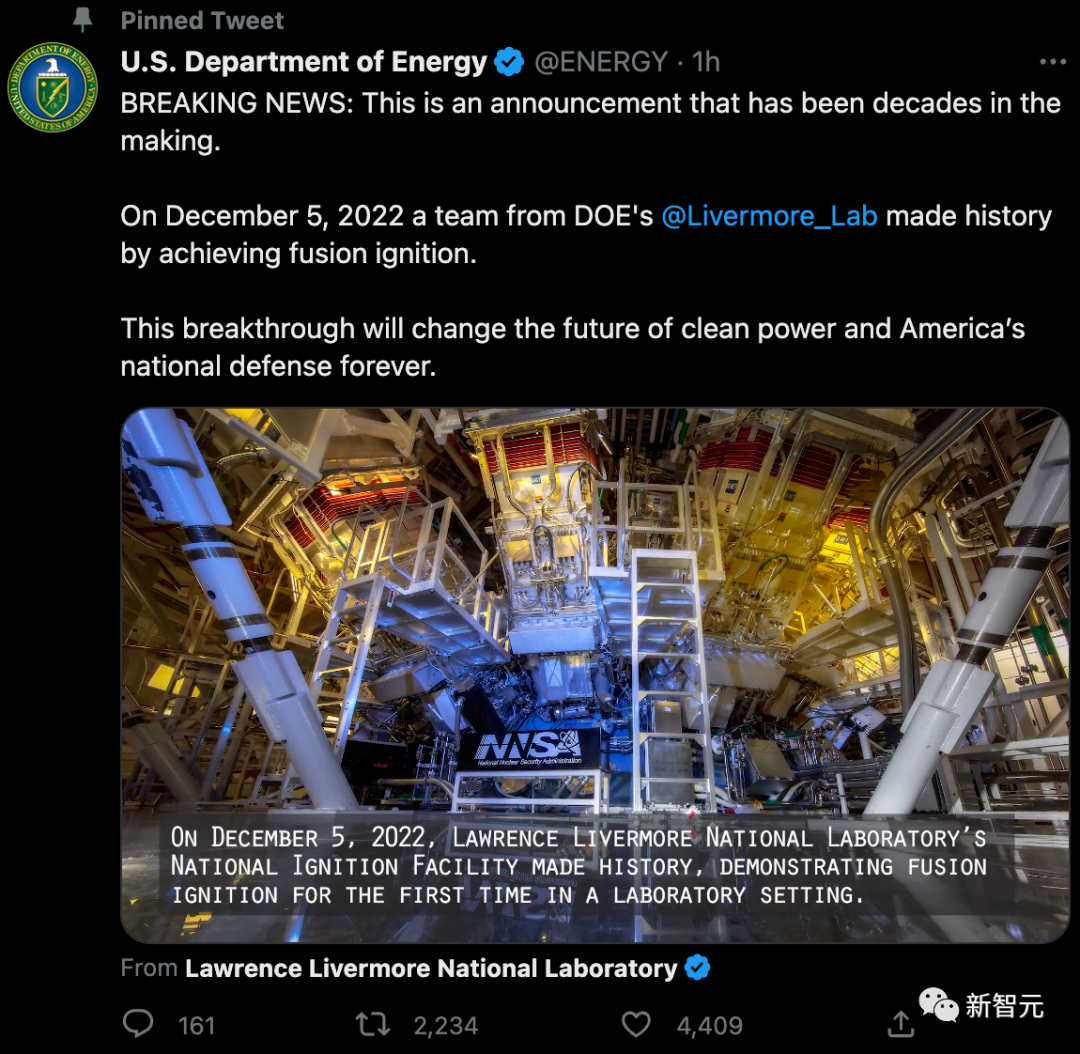
In response, U.S. Secretary of Energy Jennifer M. Granholm stated: "This is a historic moment. From this point on, the rules of the game will be changed forever."
The "Holy Grail" of Clean Energy
Nuclear fusion is considered the "holy grail" of clean energy production. It powers stars like our sun, and can generate massive amounts of energy with virtually no pollution.
For decades, getting close to this holy grail has been the dream of scientists worldwide.
And now, LLNL scientists have "claimed" it.
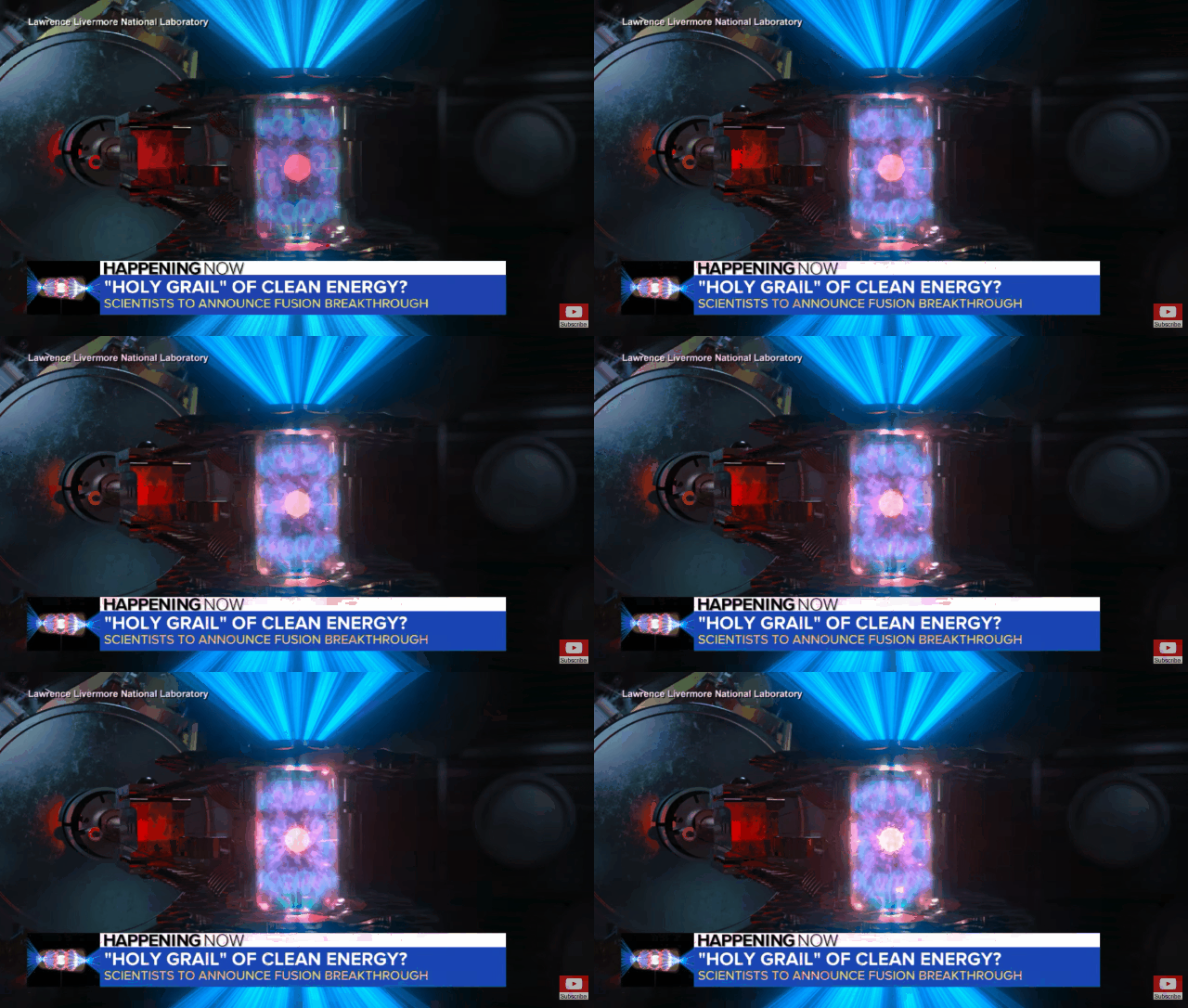
On December 5, scientists at Lawrence Livermore National Laboratory (LLNL) achieved a major breakthrough in fusion research, producing net energy gain for the first time.
However, the energy generated in this experiment was only enough to boil 15-20 kettles of water.
Moreover, although the energy produced exceeded the laser input, it fell far short of the total energy required to operate the lasers (approximately 300 megajoules).
Clearly, before this process can be deployed at commercial scale, it needs to be repeated and refined continuously, and the energy output must be significantly increased.
But consider the bright goal ahead: "unlimited clean energy."
After all, compared to nuclear fission (used primarily in nuclear power plants and atomic bombs), nuclear fusion produces far less radioactive waste and cannot trigger the runaway chain reactions that could lead to reactor meltdowns.
Carlos Paz-Soldan, professor of applied physics at Columbia University, noted that this experiment represents an important milestone for humanity in the field of controlled nuclear fusion.
Because it proves that net energy gain from fusion reactions is genuinely achievable.
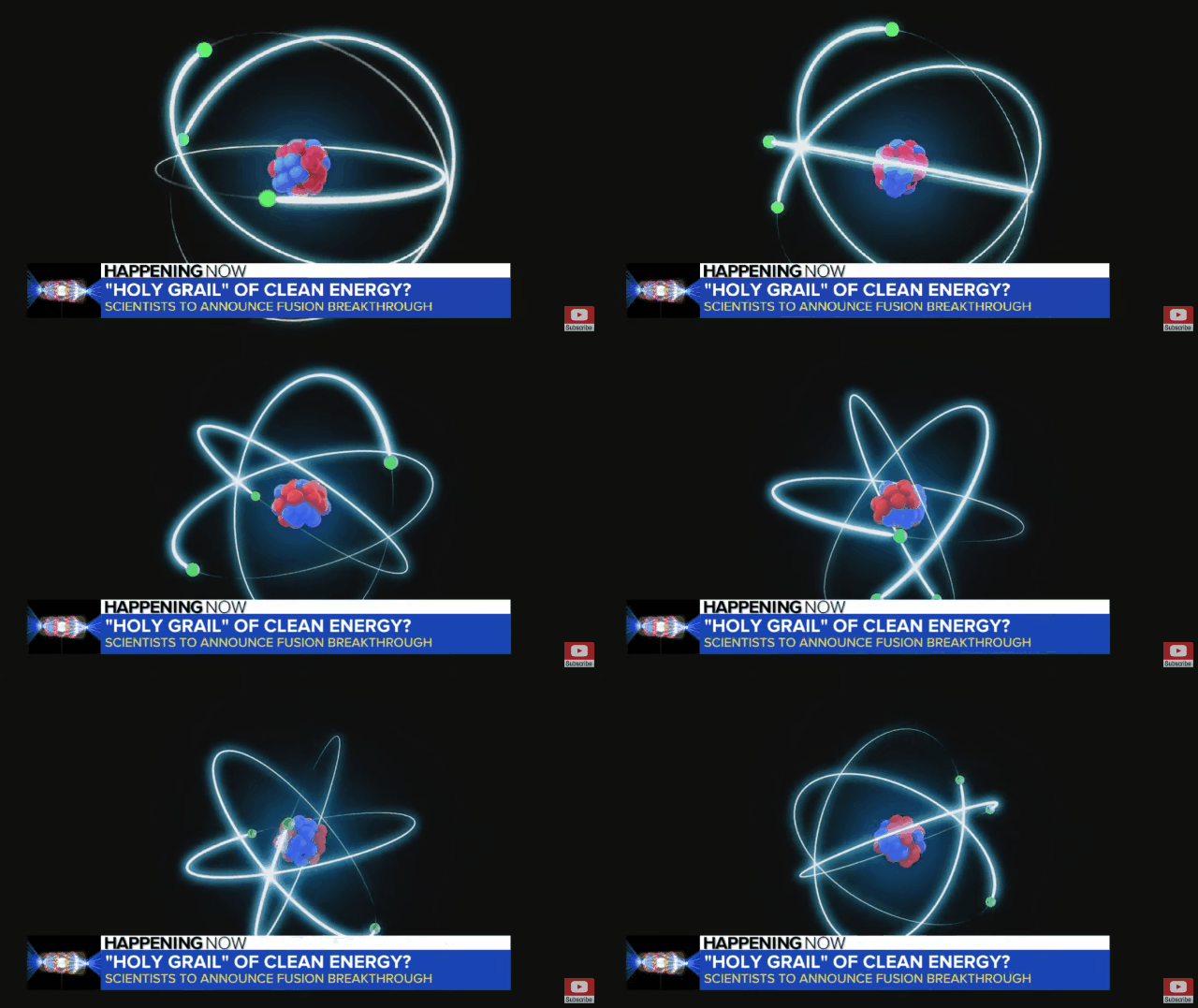
Although the implosion lasted only a billionth of a second, that was sufficient time to provide crucial data for scientists studying nuclear weapons.
This LLNL experiment had been in the making for at least a decade, and had reached a milestone roughly a year prior.
In an August 2021 test, LLNL's laser array achieved a record-breaking output, producing 10 quadrillion watts of fusion power in 100 trillionths of a second.
That earlier fusion reaction generated 70% of the laser's emitted energy. This time, the output energy fully exceeded the consumed energy.
Commercialization: Not 50-60 Years Away
Current fusion reactors typically employ one of two methods to generate the required heat:
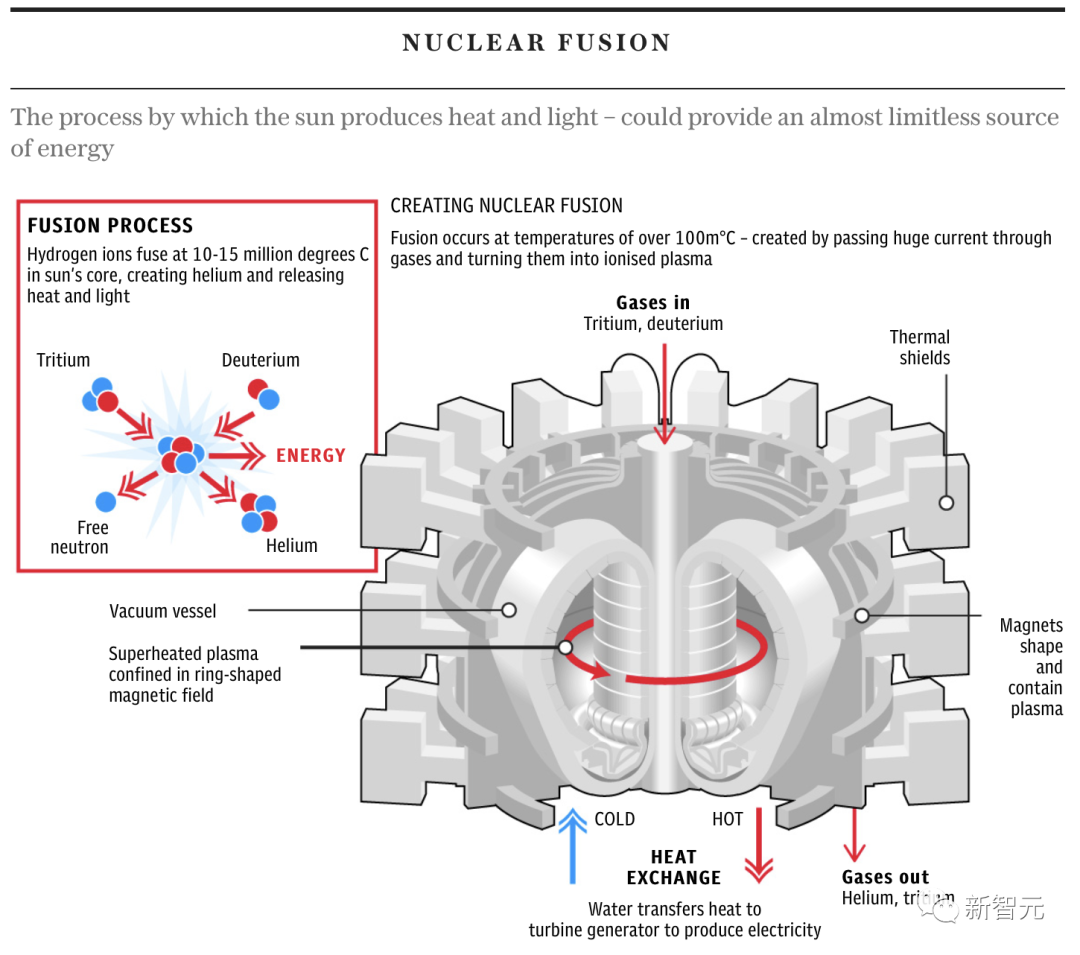
- Magnetic confinement reactors (tokamak ring reactors), which use magnets in addition to auxiliary heating to heat and contain hydrogen atoms;
- Laser-based systems, which use massive laser pulses to bombard hydrogen atoms.
The tokamak works by heating hydrogen isotope plasma to over 100 million degrees Celsius, causing it to spin and collide, producing fusion reactions. Superconducting magnets then generate magnetic fields to contain the plasma and prevent it from damaging the reactor.
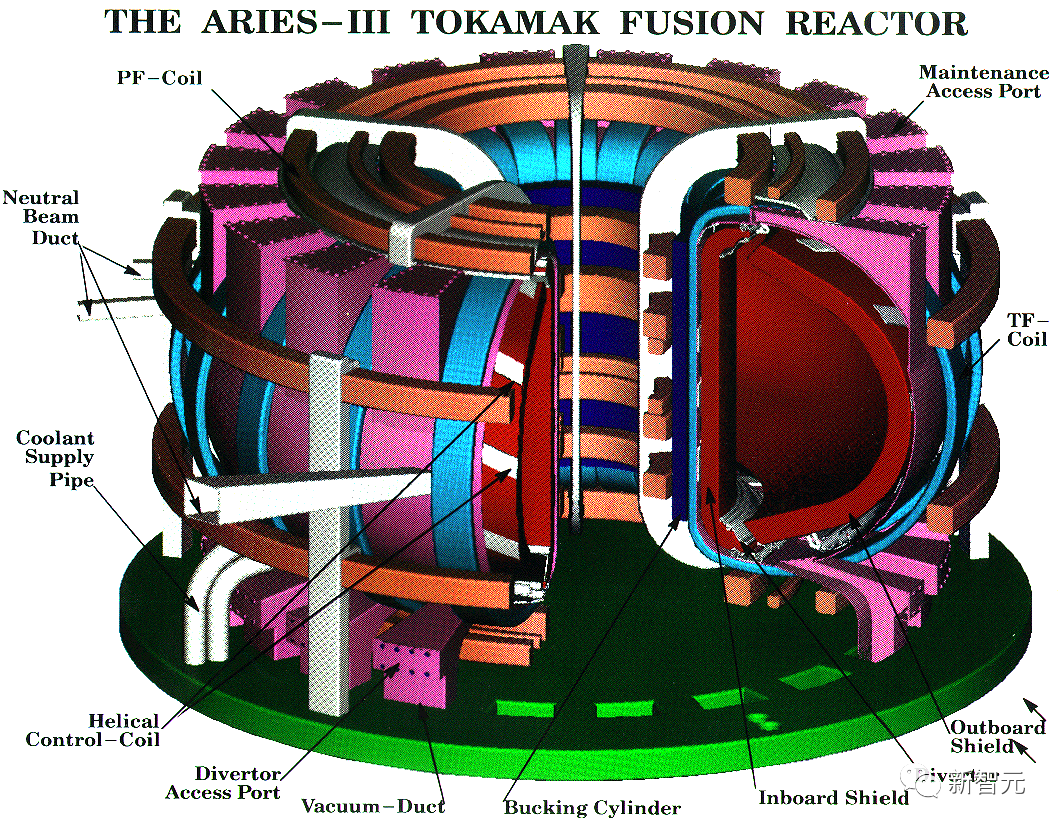
The key difference between the two reactor types lies in the duration of the fusion reaction.
Magnetic reactors can sustain the fusion process longer but require more energy.
By contrast, laser-based reactors enable fusion to occur in extremely brief bursts, and have now crossed the threshold of net energy gain to some degree.
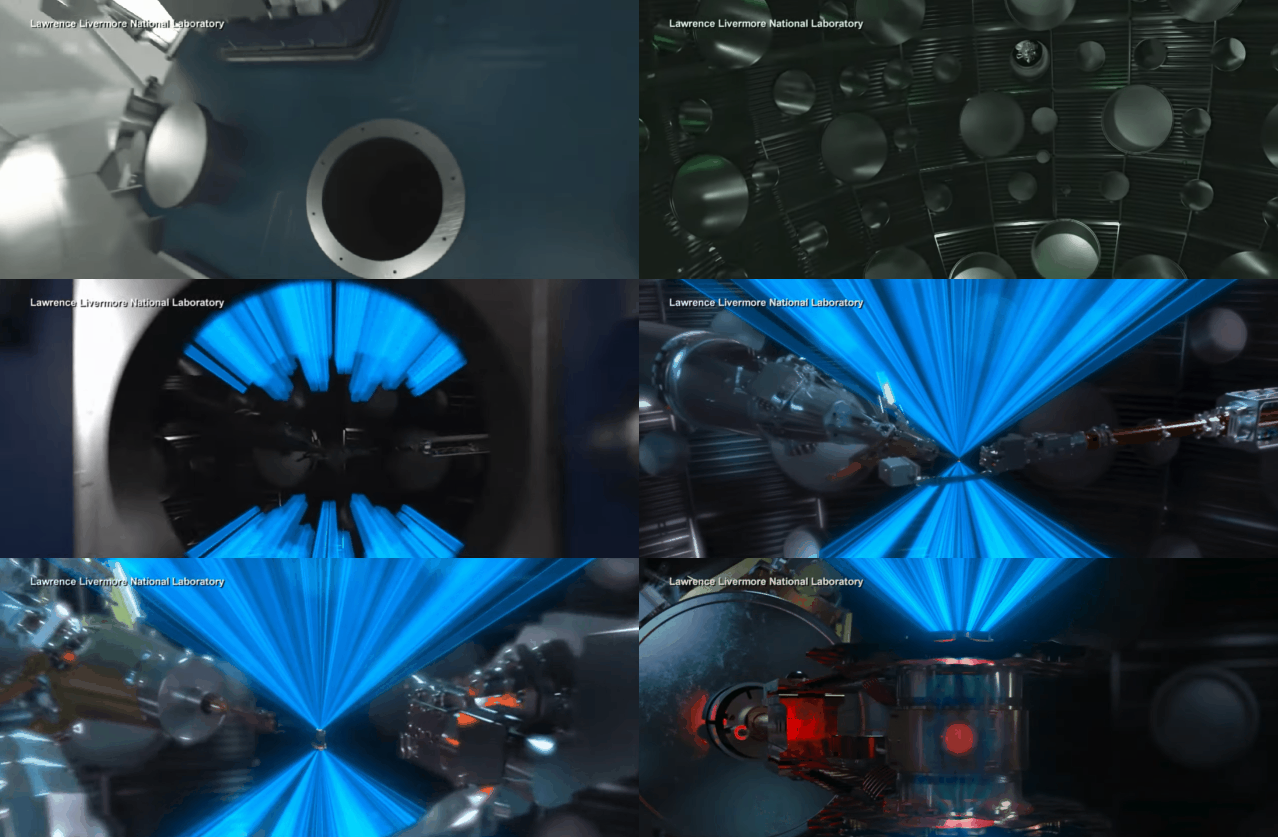
However, LLNL — representing the laser reactor approach — despite having the most powerful system to date, capable of focusing 192 laser beams on a single target, can only fire once every few hours.
For fusion reactors to be used in commercial power generation, lasers would need to heat targets 10 times per second. This isn't fundamentally impossible, but from an engineering standpoint, it's extremely difficult.
Still, this experiment's success demonstrates the possibility of commercializing fusion reactions.
At the press conference, the U.S. Secretary of Energy stated that fusion commercialization could potentially be achieved within "a few" decades, though likely not the previously cited 50-60 years.
When that day comes, humanity could generate virtually carbon-free electricity — a development of immense significance for Earth's ecological environment.

Moreover, fusion relies on hydrogen — the most abundant fuel in the universe — and hydrogen's fusion byproduct is the relatively benign element helium.
In nuclear fission, chain reactions can spiral out of control. Fusion is entirely different: it's just difficult to get started.
The $3.5 Billion National Ignition Facility
LLNL's National Ignition Facility (NIF) cost $3.5 billion to build.
Its origins trace back more than 60 years.
In the 1960s, a pioneering group of LLNL scientists hypothesized that lasers could be used to induce nuclear fusion in a laboratory setting.
Under physicist John Nuckolls' leadership, this revolutionary idea evolved into inertial confinement fusion.
To realize this concept, LLNL built a series of increasingly powerful laser systems, culminating in the NIF — the world's largest and most energetic laser facility.
The NIF is the size of a sports stadium. Its powerful laser beams can create temperatures and pressures like those at the cores of stars and giant planets, and in nuclear weapon explosions.
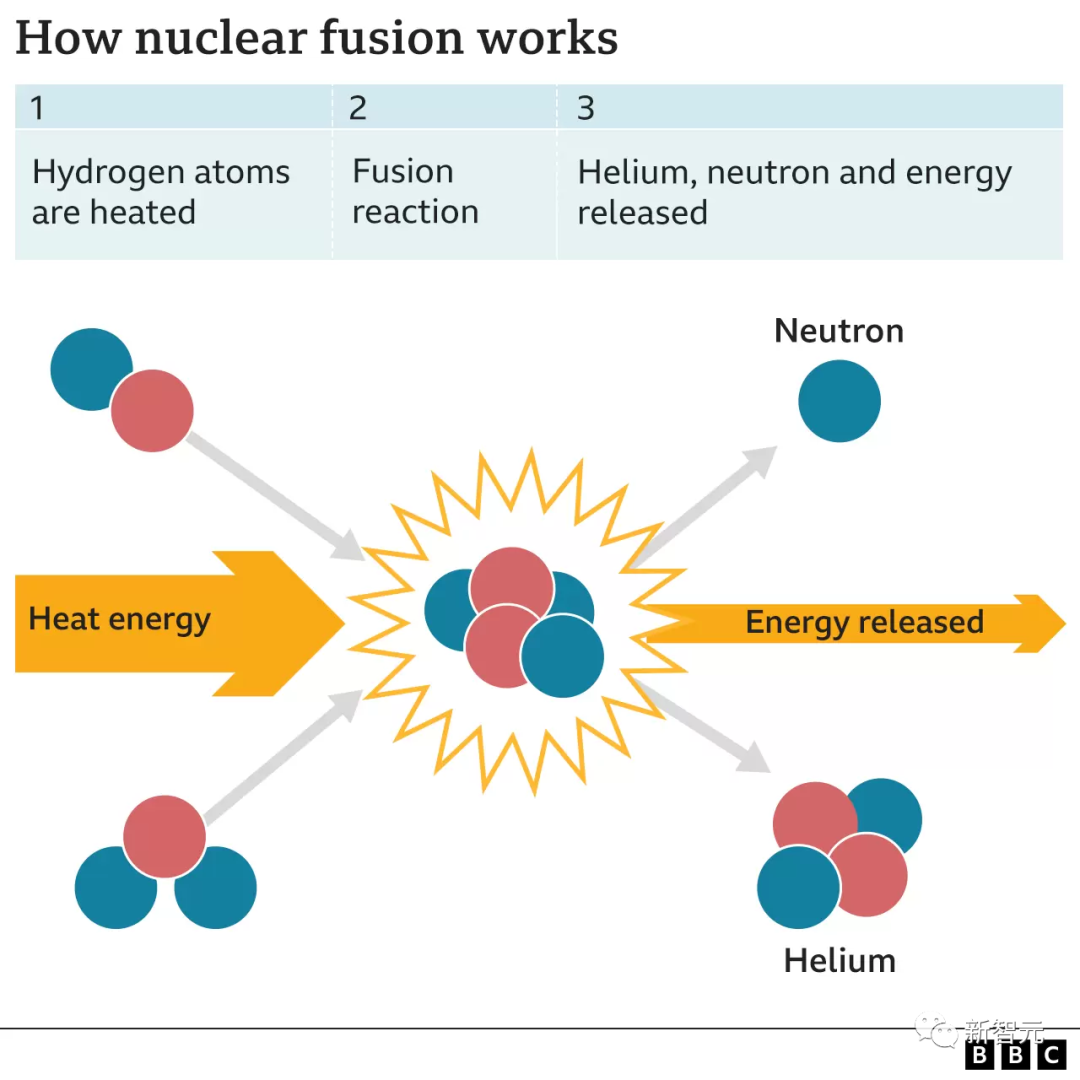
In this experiment, the lasers simulated conditions at the sun's center, fusing heavy hydrogen isotopes — deuterium and tritium — into helium.
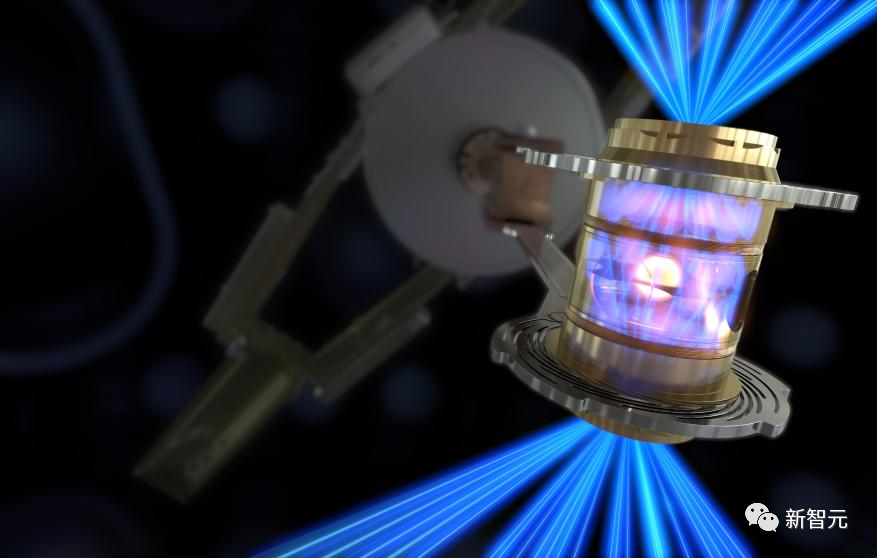
Specifically, several hydrogen fuel pellets were placed in a peppercorn-sized device, then heated and compressed using 192 powerful lasers.
After entering the hohlraum, the lasers strike the inner walls, causing them to emit X-rays. These X-rays then heat the fuel to 100 million degrees Celsius — hotter than the sun's core — and compress it to more than 100 billion times Earth's atmospheric pressure.
The high-energy lasers plasma-ize the pellet's surface, and the remaining central material, driven by Newton's third law, ultimately implodes inward.
During implosion, applying the correct combination of high temperature and pressure to the fuel pellet triggers a chain reaction — "ignition" — releasing massive amounts of energy.
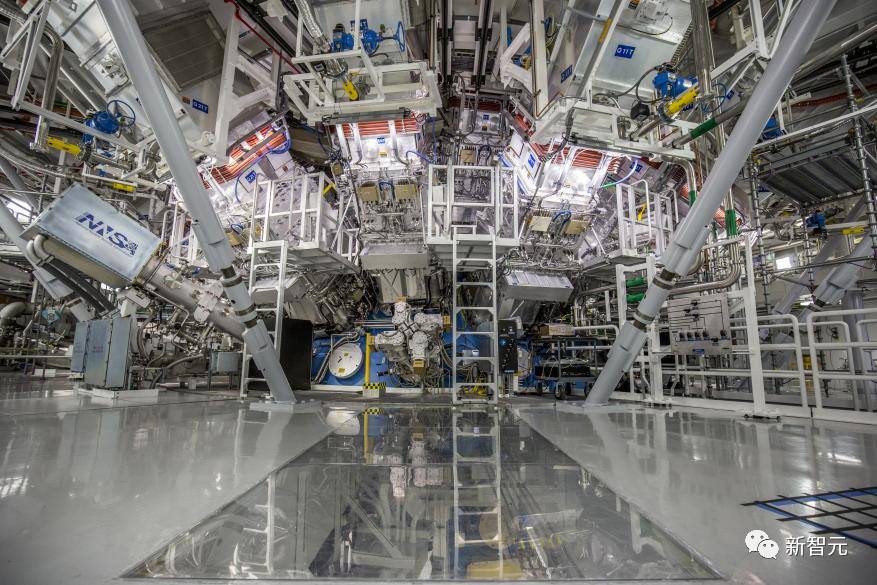
However, of greater importance to the United States is that scientists working on nuclear stockpiles can bypass underground nuclear tests halted by the Comprehensive Nuclear-Test-Ban Treaty, instead conducting nuclear reaction experiments at smaller scales and collecting data from them.
Mark Herrmann, director of LLNL's Weapon Physics and Design Program, noted that this output — 30,000 trillion watts of power — itself creates extremely extreme environments much closer to actual nuclear weapon explosions.
Some analysts have also pointed out that in hydrogen bombs, deuterium-tritium is in a condensed state and compressed by atomic bombs to achieve instantaneous overall nuclear reactions. In laser inertial confinement fusion, deuterium-tritium is also in a condensed state, the difference being that lasers provide the compression. This opens new avenues for hydrogen bomb research.
"Fusion" vs. "Fission"
So what exactly distinguishes still-research-stage nuclear fusion from currently widespread nuclear fission?
Left: Nuclear fission; Right: Nuclear fusion
What is nuclear fission?
Like cell division, in nuclear fission an atom splits into smaller particles, releasing nuclear binding energy.
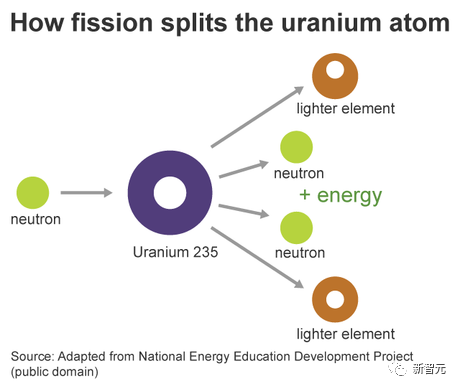
This energy is released as heat and radiation. The heat is used to boil water into steam, which turns turbines and drives generators to produce electricity.
In practice, nuclear plants first place uranium in sealed metal cylinders within steel reactor vessels, then fire neutrons at uranium atoms to split them and release more neutrons. These neutrons hit other atoms, creating a chain reaction that splits additional atoms, releasing energy as heat and radiation.
As target nuclei, uranium-235 atoms split into krypton and barium nuclei, along with three additional neutrons, which strike other uranium-235 atoms to sustain the fission chain reaction.
What is nuclear fusion?
Nuclear fusion is the process of combining atomic nuclei to produce energy. It releases several times more energy than fission and does not produce long-term radioactive waste.
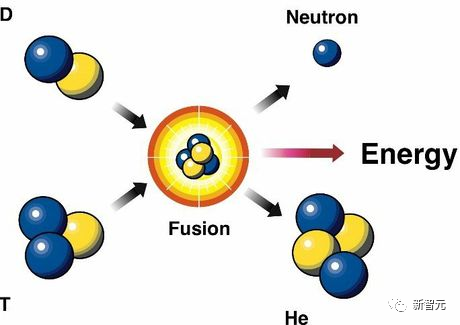
Fusion power plants operate similarly to fission plants, using heat from atomic reactions to boil water, create steam, drive turbines, and generate electricity. But creating the conditions for power generation in a fusion reactor while keeping energy consumption below energy production has remained a formidable challenge.
Fusion reactors typically use a hydrogen isotope called deuterium (hydrogen-2), which can be extracted from seawater. When subjected to extreme heat and pressure, electrons are forced away from deuterium atoms, creating plasma.
This plasma is an ultra-hot ionized gas that must be controlled with powerful magnetic fields, as its temperature can exceed 100 million degrees Celsius — ten times the core temperature of the sun.
Auxiliary heating systems raise temperatures to the levels required for fusion (150-300 million degrees Celsius), and electrified plasma particles collide and heat up. These conditions allow high-energy particles to overcome their natural electromagnetic repulsion when they collide, fusing them together and releasing enormous energy.
What are the key differences?
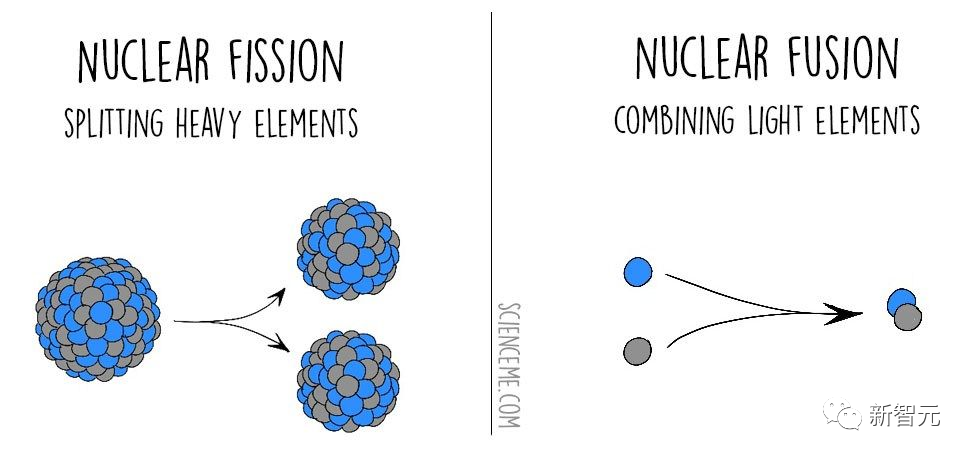
Although both nuclear fusion and fission harness atomic energy, there are several critical differences between the two processes:
- Nuclear fission releases energy when atoms split, while nuclear fusion releases energy when atoms combine;
- Fusion reactions release more energy than fission;
- Fusion does not produce harmful long-term radioactive waste as fission does;
- Fusion requires more energy to achieve.
In summary
Yes, today we need billions of dollars to boil 15-20 kettles of water.
Yes, nuclear fusion may still require decades of research and breakthroughs before it can truly power electrical plants.
But on a 60-year timescale, humanity has already made major breakthroughs.
For the future, we should allow ourselves greater imagination.
References:
- https://www.llnl.gov/news/national-ignition-facility-achieves-fusion-ignition
- https://nuclear.duke-energy.com/2021/05/27/fission-vs-fusion-whats-the-difference-6843001
- https://en.wikipedia.org/wiki/National_Ignition_Facility
More Exciting Content




Originating in Silicon Valley, BlueRun Ventures was established in 2005 as a venture capital firm focused on early-stage startups.
Currently, BlueRun Ventures manages multiple USD and RMB dual-currency funds in China, with assets under management exceeding RMB 15 billion, making it one of the largest early-stage funds domestically. The firm invests primarily at Pre-A and Series A stages, covering hard tech and innovative interaction, enterprise technology, new consumer, and healthcare sectors. It has cumulatively invested in over 150 startups, including Li Auto, Waterdrop, QingCloud, Guazi Used Cars, Qudian, Songguo Mobility, Ganji.com, Energy Monster, Yuntu Semiconductor, Machenike, Yunsheng Intelligent, Anxin Wangdun, and BioMap.
BlueRun Ventures has been ranked #1 on Zero2IPO's "China Top 30 Early-Stage Investment Institutions" and ChinaVenture's "China Best Early-Stage Venture Capital Institutions TOP30," and was named among Preqin's Top 10 global venture capital fund managers for sustained high returns.
Additionally, BlueRun Ventures has received consecutive annual awards from Forbes China, 36Kr, Cyzone, Caixin Media, CBNweekly, Jiemian, and other media organizations for honors including "China's Best Early-Stage Institution of the Year," "China's Top Venture Capital Firm," "Most Entrepreneur-Friendly Early-Stage Institution of the Year," and "Most Influential Early-Stage Institution of the Year."