Making Cars Intelligent Agents: Li Auto Unveils Next-Generation Autonomous Driving Architecture MindVLA | BlueRun Ventures Portfolio Headlines

MindVLA turns cars into dedicated chauffeurs — they understand what you say, see what's around them, and find their way anywhere!
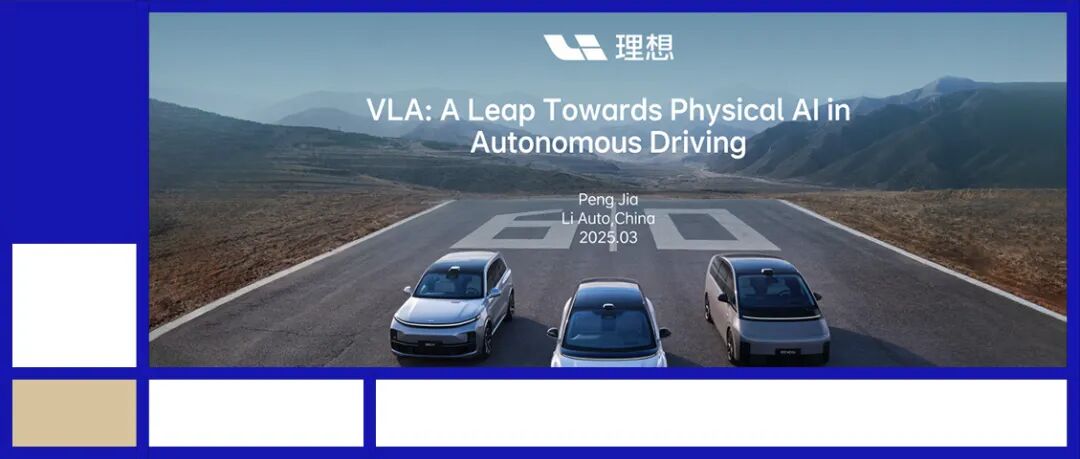
On March 18, 2025, Jia Peng, head of autonomous driving R&D at Li Auto, delivered a keynote speech at NVIDIA GTC 2025 titled "VLA: A Critical Step Toward Autonomous Driving Physical Agents," sharing Li Auto's latest thinking and progress on its next-generation autonomous driving technology, MindVLA.
Jia said: "MindVLA is a robotics foundation model that successfully integrates spatial intelligence, linguistic intelligence, and behavioral intelligence. Once the paradigm combining the physical and digital worlds is proven out, it has the potential to empower many more industries. MindVLA will transform cars from mere transportation tools into thoughtful, dedicated drivers that can understand, see, and find. We hope MindVLA can give vehicles human-like cognition and adaptability, turning them into thinking agents."
BlueRun Ventures was one of Li Auto's early investors and participated in five consecutive funding rounds. Congratulations to Li Auto on taking another step forward in AI exploration.
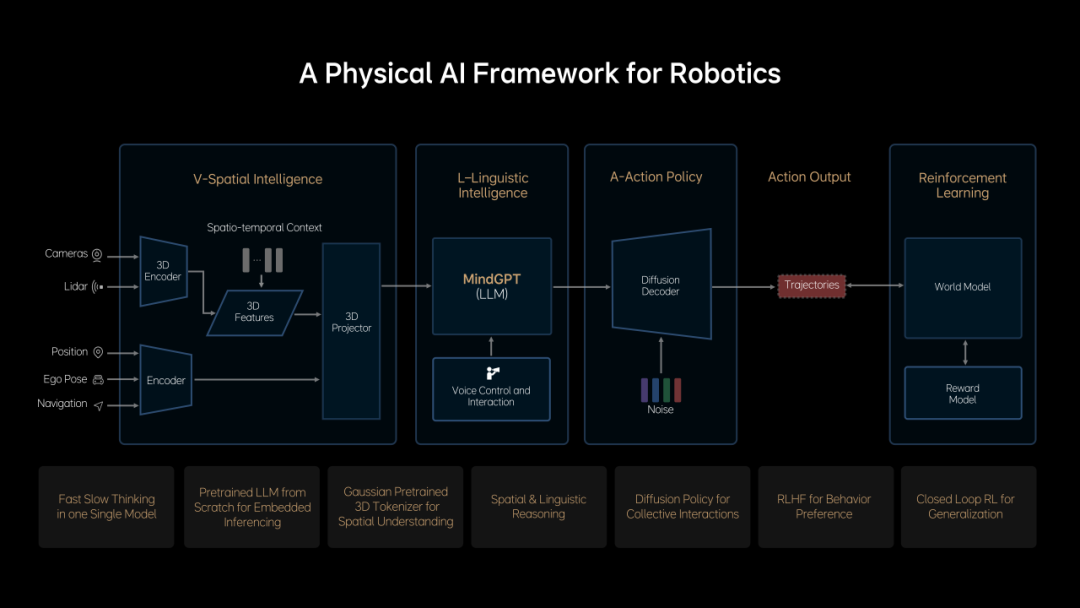
Building on its best practices with the end-to-end + VLM dual-system architecture and its sharp insights into frontier technologies, Li Auto developed its own VLA model — MindVLA. VLA represents a new paradigm in robotics foundation models, one that will give autonomous driving powerful 3D spatial understanding, logical reasoning, and behavior generation capabilities, enabling it to perceive, think, and adapt to its environment.
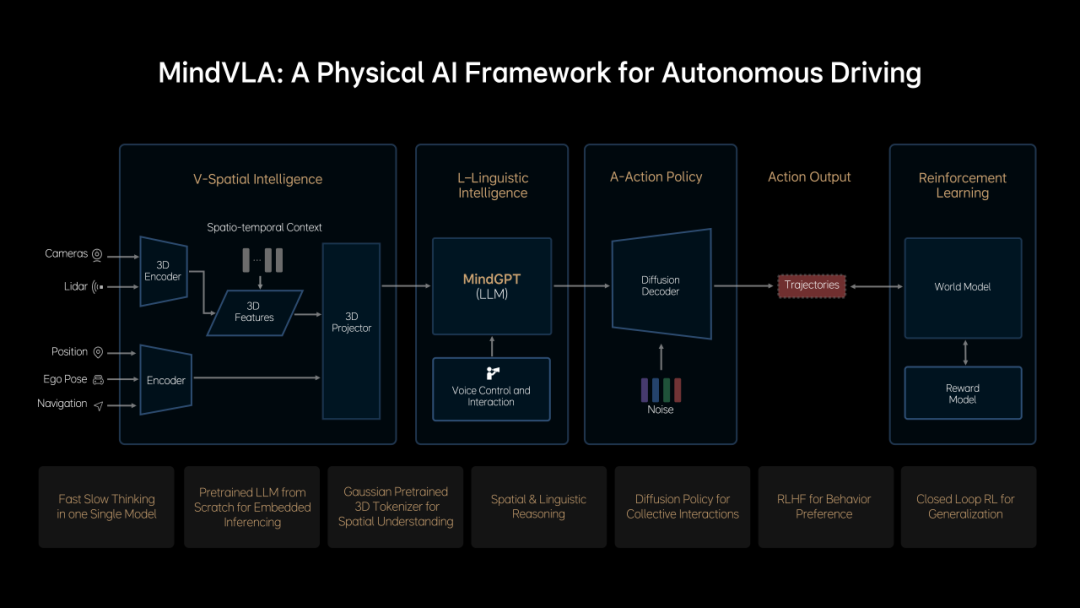
MindVLA is not a simple combination of end-to-end and VLM models — every module has been redesigned from scratch. The 3D spatial encoder works through the language model and integrates with logical reasoning to produce sound driving decisions, outputting a set of Action Tokens. These tokens encode the surrounding environment and the ego vehicle's driving behavior, which are then further optimized into the best possible driving trajectory through Diffusion. The entire inference process runs on the vehicle in real time.

MindVLA breaks from traditional autonomous driving technical frameworks by using 3D Gaussian as a rich intermediate representation — one that carries abundant semantic meaning and offers excellent multi-granularity, multi-scale 3D geometric expression. By leveraging massive amounts of data for self-supervised training, it significantly improves downstream task performance.
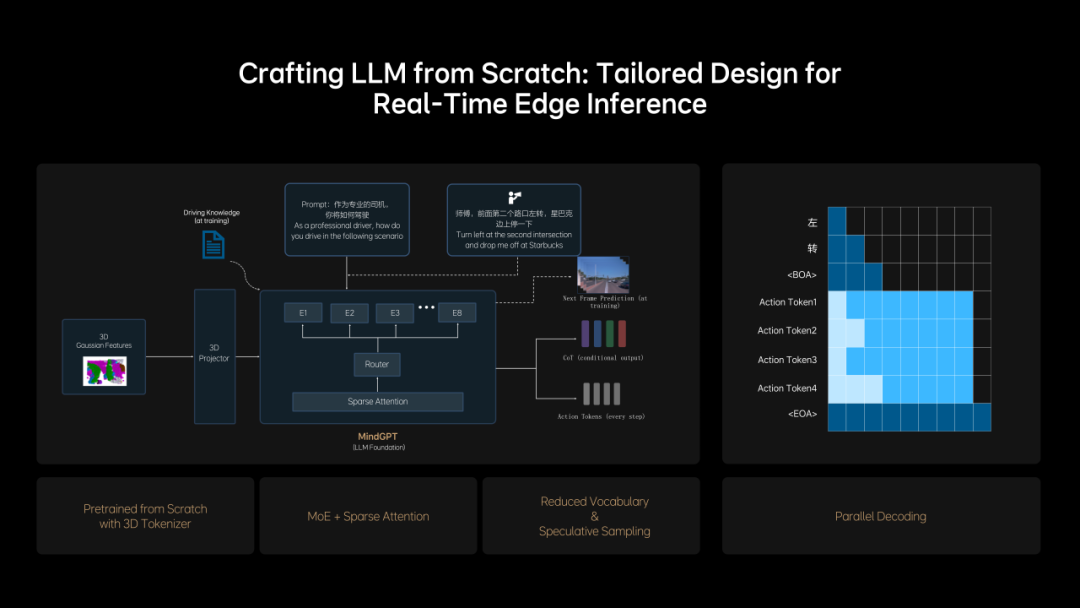
Li Auto designed and trained an LLM foundation model for MindVLA from the ground up, adopting a Mixture-of-Experts (MoE) architecture and introducing Sparse Attention to achieve model sparsification — ensuring that as model scale grows, on-device inference efficiency does not degrade. During foundation model training, Li Auto incorporated large amounts of 3D data to give the model 3D spatial understanding and reasoning capabilities. To further unlock the model's spatial intelligence, training tasks such as future-frame prediction generation and dense depth prediction were added.
While acquiring 3D spatial intelligence, the LLM foundation model also needed enhanced logical reasoning. Li Auto trained it to learn human thinking processes, integrating fast and slow thinking into a single model with autonomous switching between the two. To squeeze maximum performance from the NVIDIA Drive AGX, MindVLA employs a small vocabulary combined with speculative decoding, along with an innovative parallel decoding technique, to further boost real-time inference speed. With this, MindVLA achieves a balance between model parameter scale and real-time inference performance.
MindVLA uses Diffusion to decode Action Tokens into optimized trajectories, and through joint modeling of ego-vehicle behavior generation and other-vehicle trajectory prediction, improves its ability to negotiate complex traffic environments. Diffusion can also dynamically adjust generation results based on external conditions, such as style commands. To address Diffusion models' efficiency problems, MindVLA adopts an Ordinary Differential Equation sampler, enabling high-quality trajectory generation in just 2–3 steps. For certain long-tail scenarios, Li Auto built a human preference dataset and innovatively applied RLHF (Reinforcement Learning from Human Feedback) to fine-tune the model's sampling process, ultimately enabling MindVLA to learn from and align with human driving behavior, significantly raising its safety floor.
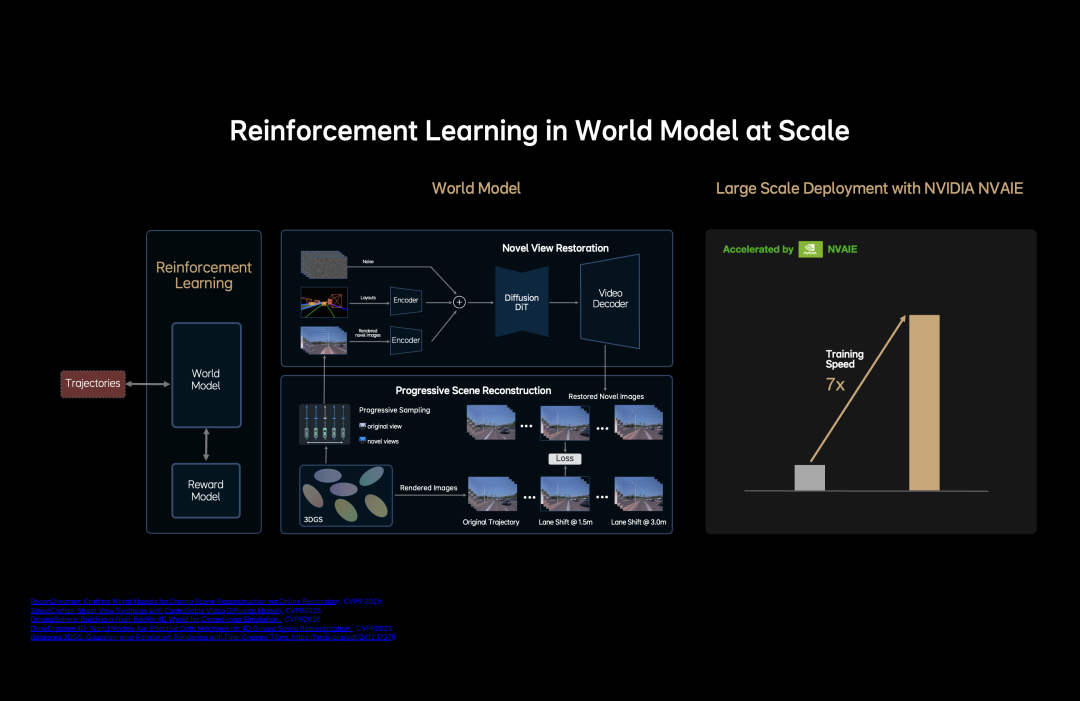
MindVLA is built on Li Auto's self-developed unified cloud world model combining reconstruction and generation, deeply fusing the 3D scene reconstruction capabilities of reconstruction models with the novel-view completion and unseen-view prediction capabilities of generative models, creating a simulation environment that approaches the real world. Drawing on technical积累 from world models and supported by ample compute resources, MindVLA achieves large-scale closed-loop reinforcement learning in simulated environments — truly learning from mistakes. Over the past year, Li Auto's autonomous driving team completed extensive engineering optimization of its world model, significantly improving the quality and efficiency of scene reconstruction and generation. One notable achievement was boosting 3D GS training speed by over 7x.
Through innovative pre-training and post-training methods, MindVLA achieves remarkable generalization capabilities and emergent properties, performing excellently not only in driving scenarios but also demonstrating adaptability and extensibility in indoor environments.

MindVLA will bring users entirely new product forms and experiences. A car empowered by MindVLA is a dedicated driver that can understand, see, and find. "Understand" means users can change the vehicle's route and behavior through voice commands. For example, when looking for a supermarket in an unfamiliar complex, a user can simply tell the Li Auto assistant: "Take me to the supermarket," and the vehicle will autonomously roam and find the destination without navigation information. While driving, users can also say things like "You're driving too fast" or "You should take the left road," and MindVLA will comprehend and execute these instructions.
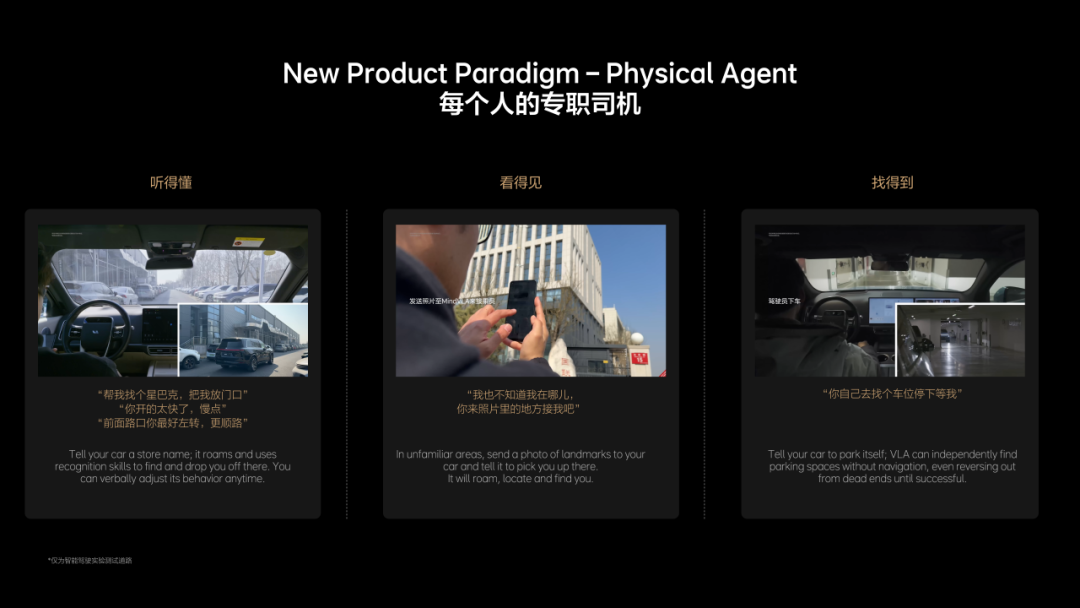
"See" means MindVLA possesses strong commonsense capabilities. It can not only recognize different store signs like Starbucks and KFC, but when users can't find their car in an unfamiliar location, they can send a photo of their surroundings to the vehicle, and a MindVLA-enabled car will search for the location in the photo and automatically come to the user.
"Find" means the vehicle can autonomously roam through parking garages, complexes, and public roads. A typical use case: when a user can't find a parking spot in a mall garage, they can simply tell the car: "Go find a spot and park." The vehicle will then use its strong spatial reasoning to search for a space on its own. Even if it hits a dead end, it will smoothly reverse and continue searching for a suitable spot. The entire process relies on no map or navigation data — only MindVLA's spatial understanding and logical reasoning.
In summary, for users, a MindVLA-enabled car is no longer just a driving tool, but an agent that can communicate with users and understand their intentions. For the automotive industry, just as the iPhone 4 redefined the phone, MindVLA will redefine autonomous driving. For the AI field, as vehicles represent the optimal carrier for physical AI, the paradigm of combining physical and digital worlds that emerges from this exploration has the potential to empower synergistic development across multiple industries.
While continuously pursuing technological innovation, Li Auto has also published numerous papers at top AI academic conferences and journals, contributing significantly to accelerating technological advancement. Going forward, Li Auto will continue to be driven by user value, persist in technological innovation, connect the physical and digital worlds, and become a global leader in artificial intelligence.

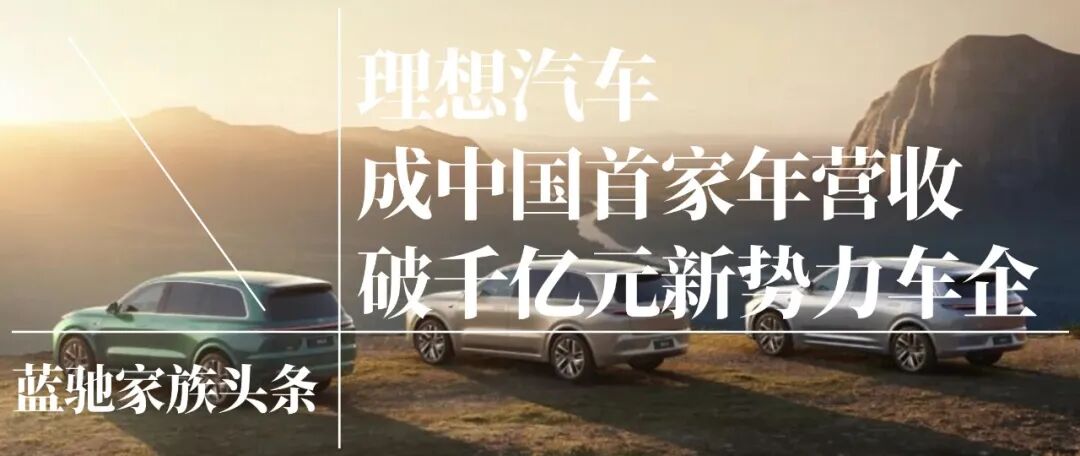
Li Auto Becomes China's First New-Force Automaker with Annual Revenue Exceeding 100 Billion Yuan | BlueRun Ventures Family Headlines
VITURE, Fresh Off $50 Million Raise, Says "AI and AR Will Eventually Converge Into a New Generation of Multimodal Devices" | BlueRun Ventures Family
Enough Talk About DeepSeek R1! Ten Founders Put Open-Source Models to the Test | BlueRun Ventures Perspectives
When Embodied Intelligence Meets Reality | The Road to AGI