BlueRun Ventures Headlines | Math Benchmarks Against the o1 Series, Search Evolves Again — Kimi's New Reasoning Model Expands the Boundaries of Intelligence With You

The boundaries of intelligence are constantly expanding.
A year ago, also in mid-November, Moonshot AI officially opened registration. Back then there was only the website kimi.ai — no "Kimi Smart Assistant" mobile app yet. In the year since, AI has spread at an unprecedented pace. Monthly Kimi users grew from tens of thousands to tens of millions, an astonishing roughly 1000x increase. Along the way, our understanding has been constantly refreshed, sometimes requiring 180-degree reversals. For instance, in the first half of the year AI still struggled with math; by the second half it could earn silver-medal level at Olympiad competitions and assist top mathematicians in cracking hard problems... The boundaries of intelligence keep expanding.
Today, we're introducing two new advances from Moonshot AI in reinforcement learning technology: k0-math, a next-generation mathematical reasoning model approaching OpenAI's o1 series level, and a completely new Kimi Exploration Edition introducing three major reasoning capabilities — search intent enhancement, source analysis, and chain-of-thought reasoning. BlueRun Ventures was an early investor in Moonshot AI and has continued to increase its support. Congratulations to Kimi on this breakthrough at its first birthday. We look forward to seeing Kimi continue pushing the boundaries of intelligence.

k0-math is Kimi's first reasoning-enhanced model, built on new reinforcement learning and chain-of-thought techniques. By simulating the human brain's process of thinking and reflection, it dramatically improves the ability to solve difficult math problems, helping users tackle more challenging mathematical tasks.
Let's look at k0-math's capabilities first. On multiple mathematical benchmark tests, k0-math's performance matches the two publicly available models in OpenAI's o1 series: o1-mini and o1-preview. On four math benchmarks covering middle school exams, college entrance exams, graduate entrance exams, and MATH (which includes introductory competition problems), the first-generation k0-math model outperformed both o1-mini and o1-preview.
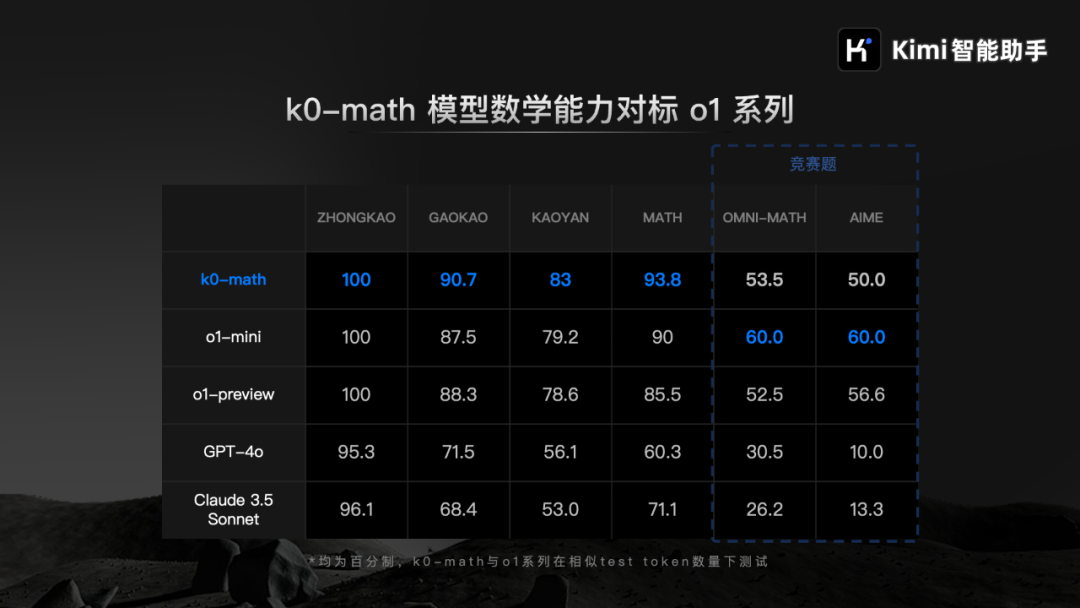
On MATH, the most widely used math capability benchmark in the industry, k0-math scored 93.8, surpassing o1-mini's 90 and o1-preview's 85.5. This k0-math result is second only to the yet-to-be-released full o1 model's score of 94.8.
On two more difficult competition-level math problem sets, OMNI-MATH and AIME, the first-generation k0-math model reached 90% and 83% respectively of o1-mini's top performance. Going forward, the k0-math model will continue iterating to improve its ability to solve harder problems, pushing the limits of mathematical model capabilities.
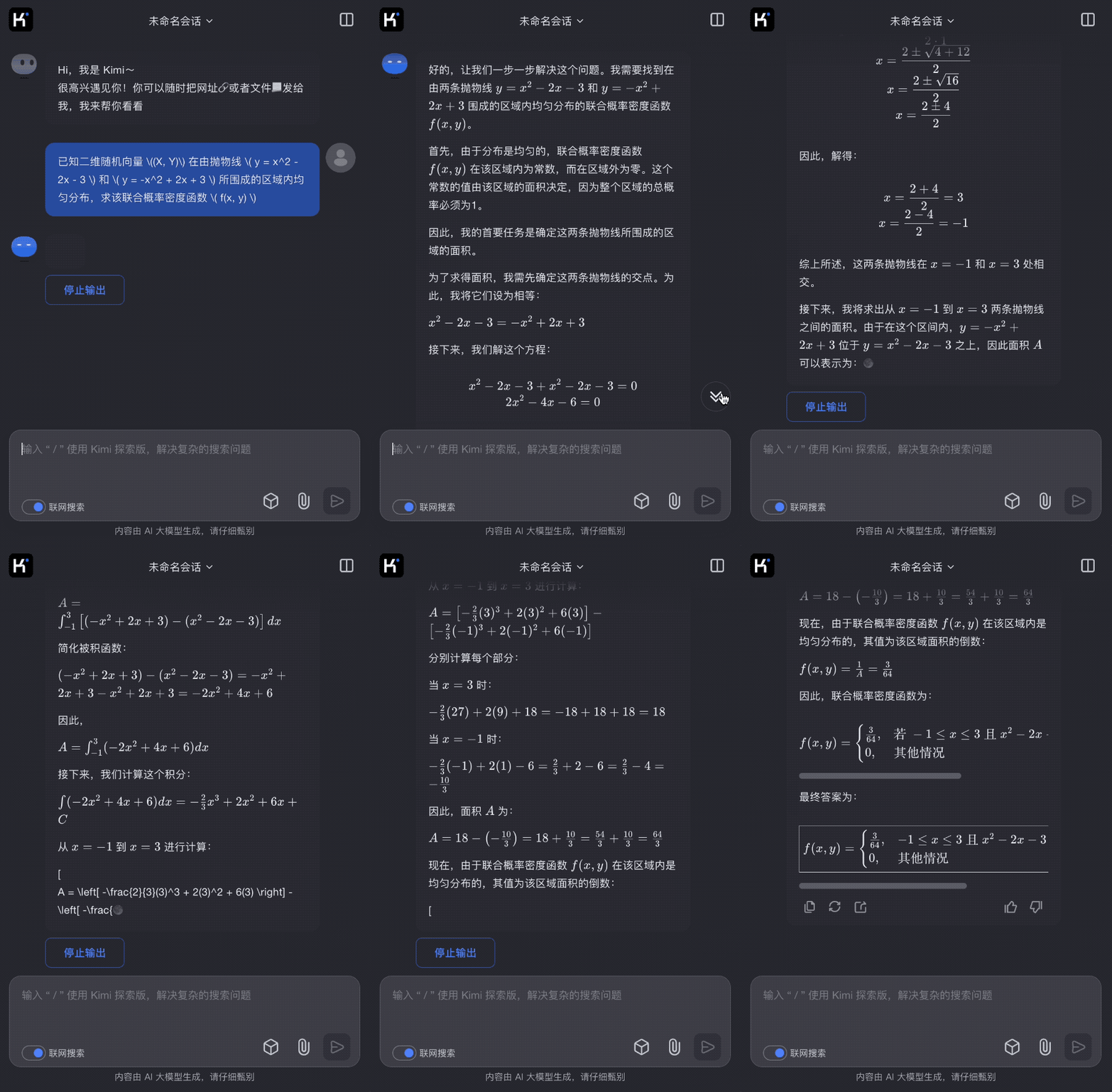
Where conventional models are designed to deliver answers as quickly as possible, k0-math takes a different approach — spending more time reasoning through problems, including thinking through and planning its approach, and when necessary reflecting on and improving its own problem-solving strategy to increase success rates. Let's start with a standard advanced math problem to warm up k0-math:
k0-math's problem-solving thought process often proves enlightening even to math experts. Take this AIME competition problem: through continuous exploration and trial-and-error, experiencing eight or nine failures, k0-math realized it had been using an overly complex approach, eventually arriving at the correct answer.

(Scroll up and down to view the complete exploration and reasoning process) However, it's worth noting that while k0-math excels at solving most difficult math problems, the current version cannot yet handle geometry problems that are hard to describe in LaTeX format.
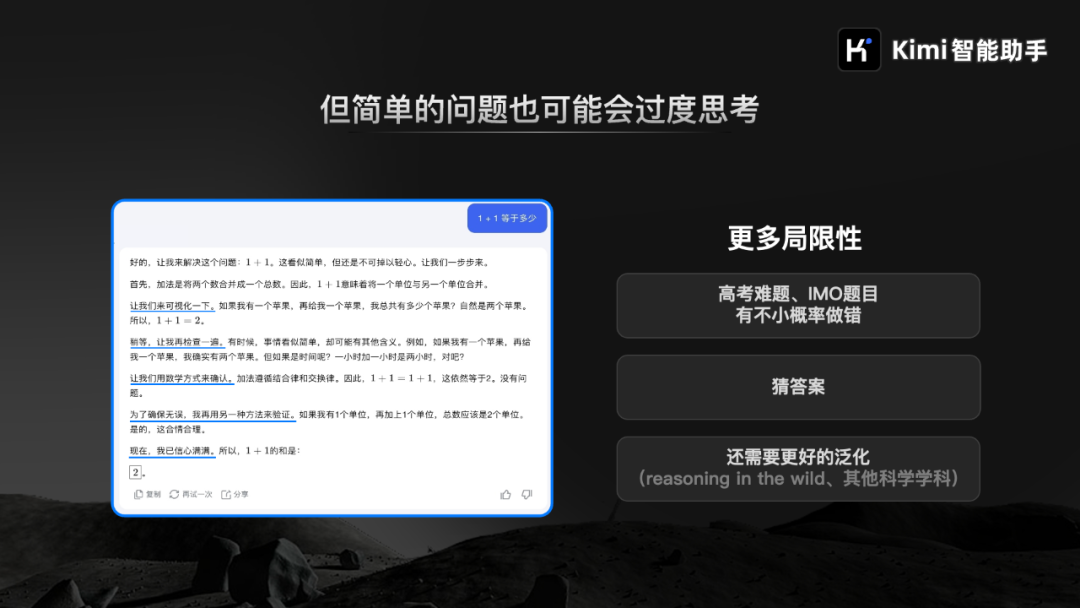
Additionally, there are limitations still to overcome: for overly simple math problems like "what's 1+1," k0-math may overthink; it still has a certain probability of getting hard college entrance exam problems and IMO questions wrong or guessing; and it needs better generalization to be deployed across more academic scenarios.
These limitations represent both opportunities and challenges, and are expected to be gradually addressed in the next phase of model iteration.

The reasoning capability improvements brought by this new reinforcement learning paradigm will also generalize to more everyday tasks. The Kimi Exploration Edition that launched in mid-October applies reasoning capabilities to AI search tasks, simulating human reasoning processes to multi-level decompose complex problems, execute deep searches, and reflectively improve results in real-time, helping users more efficiently complete complex search and research tasks.
The Kimi Exploration Edition searches 10 times more than the standard version, reading over 500 pages in a single search. On real-world difficult long-form search questions in information research and analysis scenarios, Kimi Exploration Edition demonstrates comprehensive advantages in answer accuracy and completeness, outperforming comparable products by at least 30% overall. Since its release, Kimi Exploration Edition has been embraced by programmers, scientists, consultants, investors, lawyers, and other professional users.
Recently, Kimi Exploration Edition has applied reinforcement learning technology to innovate the search experience, achieving breakthroughs in three major reasoning capabilities: intent enhancement, source analysis, and chain-of-thought reasoning.
Intent Enhancement: Kimi Exploration Edition can concretize abstract questions and fuzzy concepts, expanding users' true search intent.
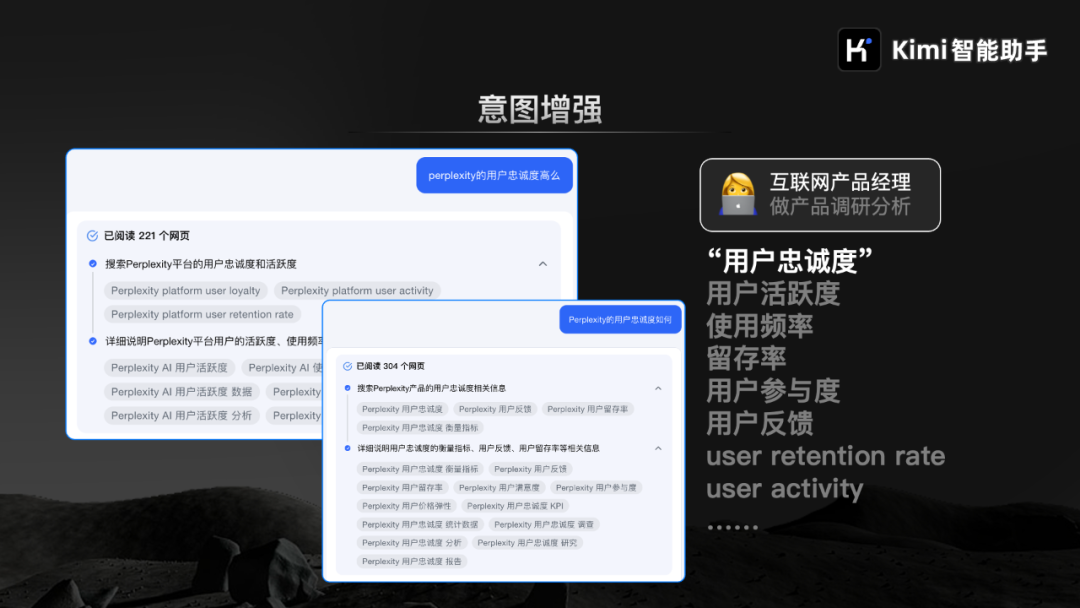
For example, when an internet product manager researches user loyalty for a product, Kimi Exploration Edition will reason that when users search for "loyalty," they're essentially looking for data analysis, then identify dimensions that can demonstrate loyalty, transforming this relatively vague and abstract concept into more concrete keywords like "activity level, retention rate, usage frequency, usage duration," and then leverage what machines do best — massive parallel searching — to find more comprehensive and accurate answers.
Source Analysis: Kimi Exploration Edition analyzes and filters more authoritative and reliable sources from large numbers of search results, providing traceable links in its answers that can locate specific source positions with paragraph-level precision, so every piece of information can be verified.
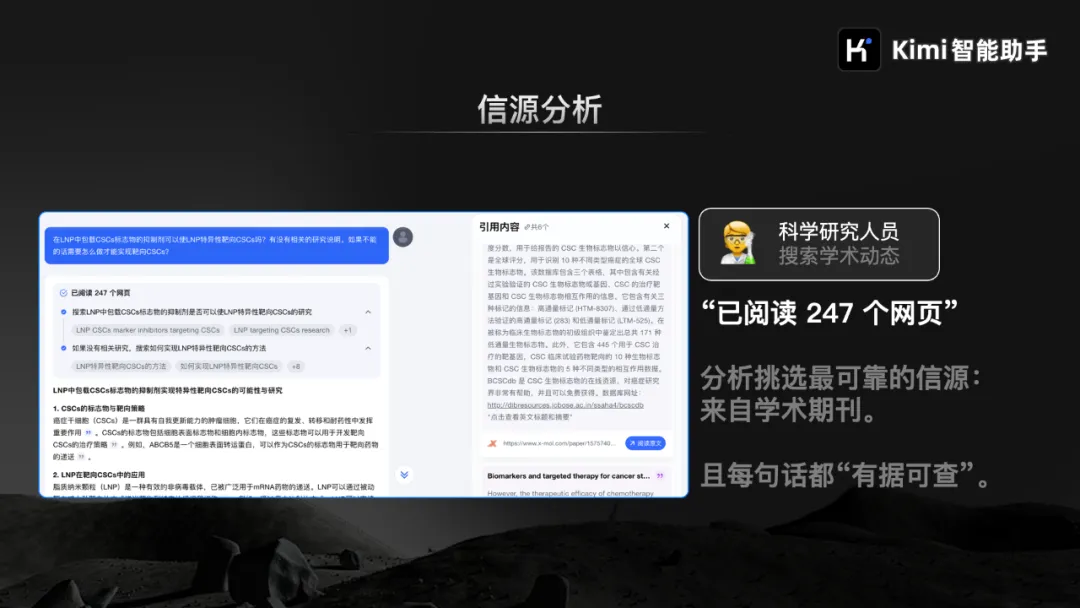
For example, when researchers look for the latest academic developments, Kimi Exploration Edition prioritizes the most recent academic journal content; when consultants investigate market population sizes, using Kimi Exploration Edition to find China's population breakdown by age group, Kimi filters for the most authoritative and latest census report information.
Chain-of-Thought: Kimi Exploration Edition can better leverage chain-of-thought reasoning to handle research questions about products, companies, and industries.
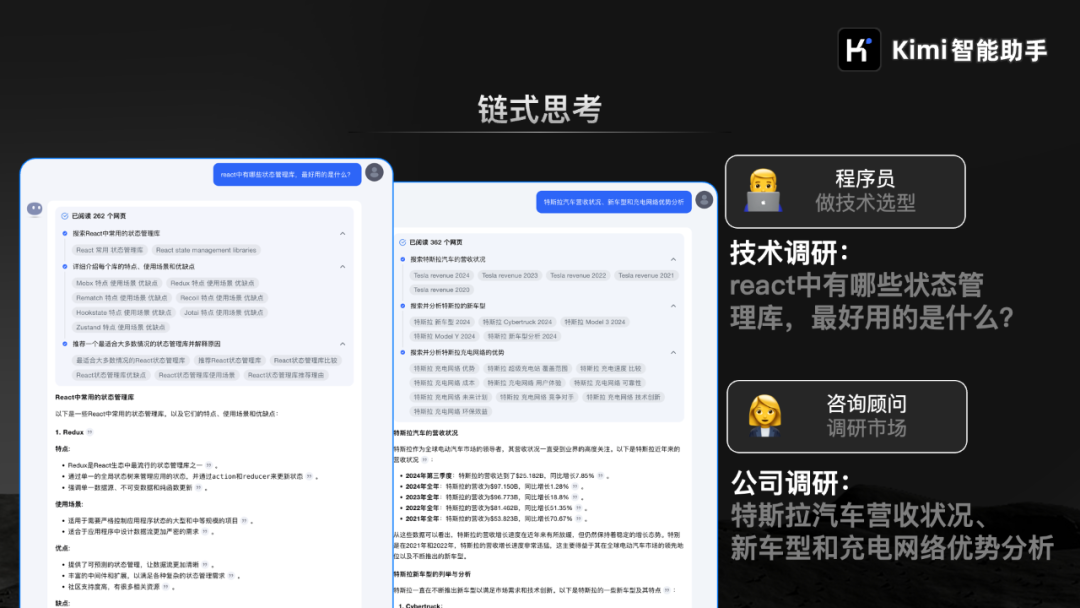
For example, when programmers are making technical decisions and want to know "what state management libraries are available in React, and which is best." Kimi first accurately decomposes the problem, finding what common React state management libraries exist, then searches for each library's pros and cons, use cases, and recommendations, finally analyzing and synthesizing all the high-quality information found to give recommendations for the most suitable state management library in different scenarios.

The AI field is currently undergoing a new round of paradigm shifts. New techniques based on reinforcement learning, synthetic data, and chain-of-thought can address the shortage of high-quality data, raising the ceiling for AI's reasoning capabilities and intelligence level across domains and scenarios. When AI possesses stronger reasoning capabilities, it means not only helping every user unlock more challenging work tasks in everyday activities like coding and search, but also creating opportunities to crack many unsolved problems in fundamental sciences like mathematics, physics, biology, and chemistry.
Going forward, the k0-math mathematical model and the more powerful Kimi Exploration Edition will be rolled out in batches on the Kimi web version (kimi.ai) and Kimi Smart Assistant APP, helping users solve more challenging mathematical and search research tasks.
Latest data shows that in October 2024, Kimi's monthly active users across all platforms — PC web, mobile APP, and mini-program — exceeded 36 million. In our view, beyond continuous technological transformation, the path to AGI is also a process of co-creation between Kimi and its users through products. We treat the Kimi product as a reinforcement learning environment, where new-generation models interact with users, enabling technology, product, and user experience to all continuously improve. We look forward to co-creating intelligence with more users.
By the way, were you one of the 1 in 36,000,000 who interacted with Kimi in October 2024? What are you using Kimi for?

 Galaxy Universal Completes 500 Million Yuan Strategic Funding Round | BlueRun Ventures Headlines
 A VC That Leads the Way Out of the Box | BlueRun Perspectives
 Are You the Hardcore Deep-Tech Entrepreneur BlueRun and Ant Group Are Looking For? | Registration Countdown