SRO! How Embodied Intelligence Tech Is Going Industrial, From the BlueRun Ventures Forum at the World Robot Conference

From the Lab to the Real World
On August 22, the 2024 World Robot Conference "General-Purpose Robotics and Embodied Intelligence Frontier Technology Industrialization Forum," organized by BlueRun Ventures, was successfully held at the Beijing Beiren Yichuang International Convention and Exhibition Center. Leading researchers from top universities and research institutions, industry players, prominent entrepreneurs, and top-tier investors gathered to discuss the path from academic research to industrial application for general-purpose robotics and embodied intelligence.
The 2024 World Robot Conference, co-hosted by the Chinese Institute of Electronics and the World Robot Cooperation Organization, is the largest and highest-profile premier event in the robotics field. BlueRun Ventures' forum on "General-Purpose Robotics and Embodied Intelligence Frontier Technology Industrialization" was the only forum at this year's conference initiated by a market-driven venture capital firm.
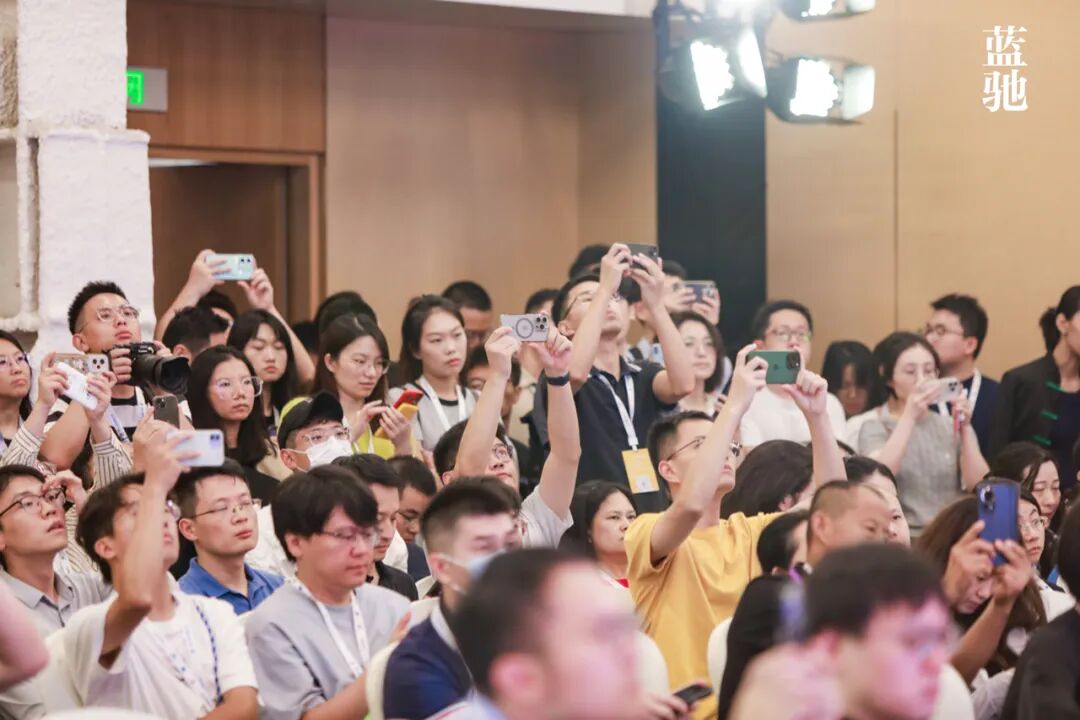
It was also the most attended and longest-standing forum of the day. With limited seating, a substantial number of listeners without seats stood for three full hours to hear cutting-edge academic and industry perspectives.
As an early-stage fund with the earliest investments and broadest portfolio in the robotics sector, BlueRun Ventures has spent years deeply embedded in the industry, supporting and witnessing the innovation and growth of quality companies including Gaussian Robotics, AgiBot, Galaxy Universal, Wanxun Technology, and Tian Cheng Technology, while accumulating deep insights and perspectives on the robotics industry. Through this forum, BlueRun Ventures aimed to bring additional entrepreneurial and investment perspectives to academia and industry.
Forum participants included: BlueRun Ventures partner Cao Wei; Dr. He Wang, Assistant Professor and PhD Advisor at Peking University's Frontiers Computing Research Center, Director of the PKU-Galaxy Universal Embodied Intelligence Joint Lab, and BAAI Scholar; Dr. Hao Dong, Boya Assistant Professor at Peking University's School of Computer Science, Director of the PKU Hyperplane Lab, and Director of the PKU-AgiBot Joint Lab; Dr. Xiaodan Liang, Associate Professor at Sun Yat-sen University and Dual-Appointed Researcher at Pengcheng Embodied Institute; Dr. Yaodong Yang, Assistant Professor and PhD Advisor at Peking University's Institute for Artificial Intelligence; Dr. Zheng Wang, Founder and CEO of Wanxun Technology; and Jishun Guo, Vice President of Joyson Electronics.
In his opening keynote on "General-Purpose Robotics & Embodied Intelligence Trends and Changes from an Investment Perspective," Cao Wei stated that BlueRun Ventures has consistently focused on innovative technologies and major industrial transformation trends in its deep cultivation of the robotics sector, having invested in over ten quality robotics innovation companies in the past eight years with total investment scale already reaching the billion-yuan level.
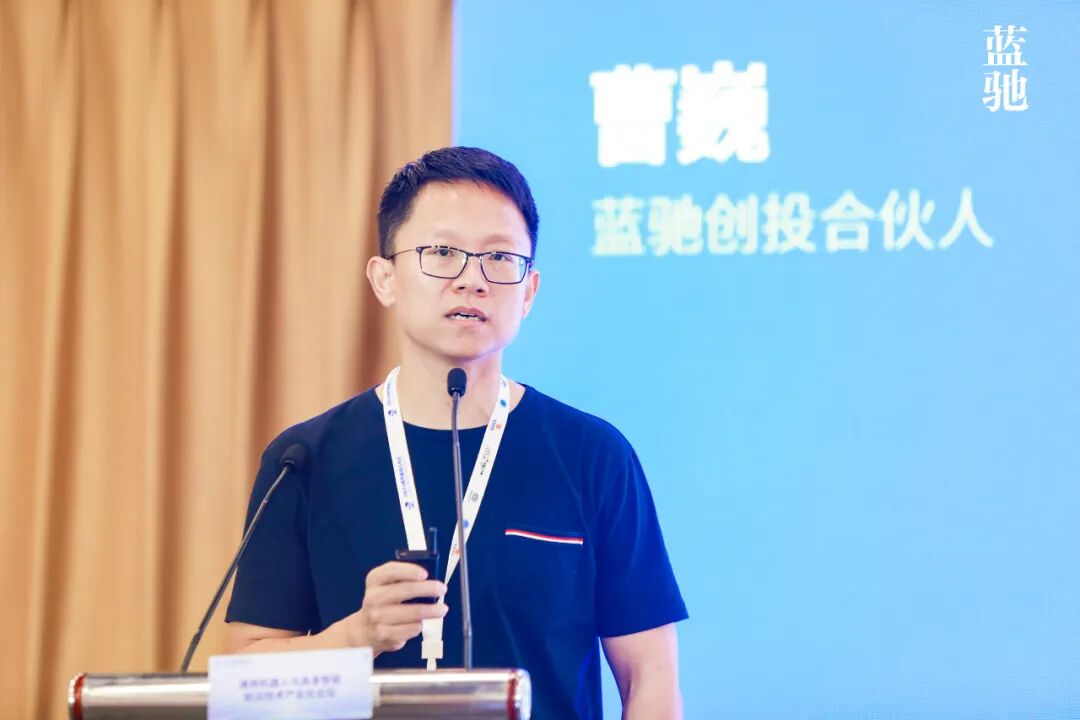
Cao Wei, Partner at BlueRun Ventures
Cao Wei noted that China's robotics industry is entering a new golden age. First, China possesses a complete industrial ecosystem to incubate and drive globally leading robotics companies. At the same time, rapid advances in underlying technologies are pushing forward robot capabilities and expanding application scenarios. More importantly, multimodal large models are empowering robots to enter a new era — with large model support, robots' task-processing capabilities are achieving comprehensive breakthroughs, opening up more application scenarios.
Through its continued deep engagement, BlueRun Ventures has recognized that general-purpose robot bodies are iterating rapidly and approaching commercial-grade levels. The pace of their deployment will be primarily determined by capability boundaries, scenarios, and task characteristics. B-side applications in simple scenarios with simple tasks are easier to land, while C-side applications impose higher requirements on robot safety, cost, interaction, and operational generalization capabilities. The market for general-purpose robots and humanoid robots is massive, but must follow the objective law of progressing from simple to complex, gradually unlocking robot capabilities step by step.
In his presentation on "Cross-Industry Applications of Embodied Large Model Robots," Dr. He Wang argued that compared to emphasizing robots' "humanoid" form, the concept of "general-purpose" is more fundamental — what the market truly demands is robots that are general-purpose across various scenarios and tasks. Galaxy Universal's first-generation embodied large model robot, Galbot, powered by multimodal large models and generalized embodied skills, can perform intelligent human-robot interaction and autonomously complete a series of generalized operations, with applications in automotive, retail, and other industries.
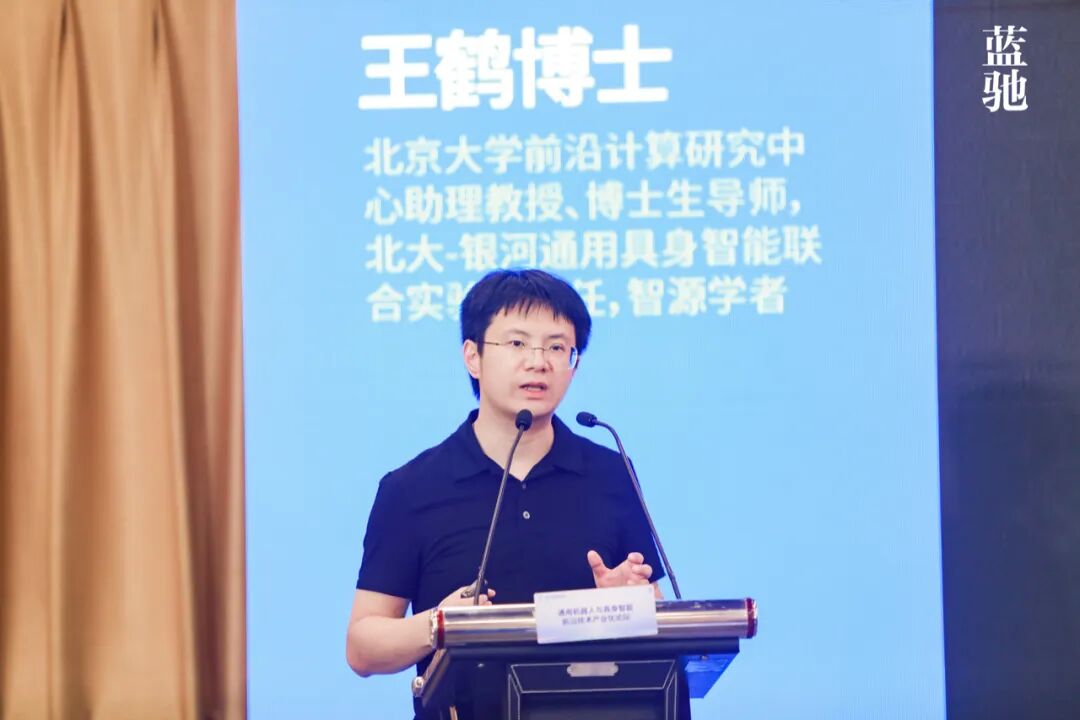
Dr. He Wang, Assistant Professor and PhD Advisor at Peking University's Frontiers Computing Research Center, Director of the PKU-Galaxy Universal Embodied Intelligence Joint Lab, BAAI Scholar
In "Embodied Intelligence Technology Trend Analysis," Dr. Hao Dong offered the following assessments based on frontier research: First, the technical approaches of startups and tech giants will quickly converge toward using both real-world and simulated data simultaneously. Meanwhile, end-to-end models represent a clear trend — without them, models cannot support increasingly complex future tasks. Real2Sim2Real overfitting to local tasks can improve deployment success rates. However, foundational physics simulation requires major breakthroughs to enhance the effectiveness of simulation-based learning and enable true real-world deployment. For the industry, open-source hardware and software will flourish in diversity, while simulation and real-data collection technologies will converge around several platforms, ushering in an era of technology democratization.
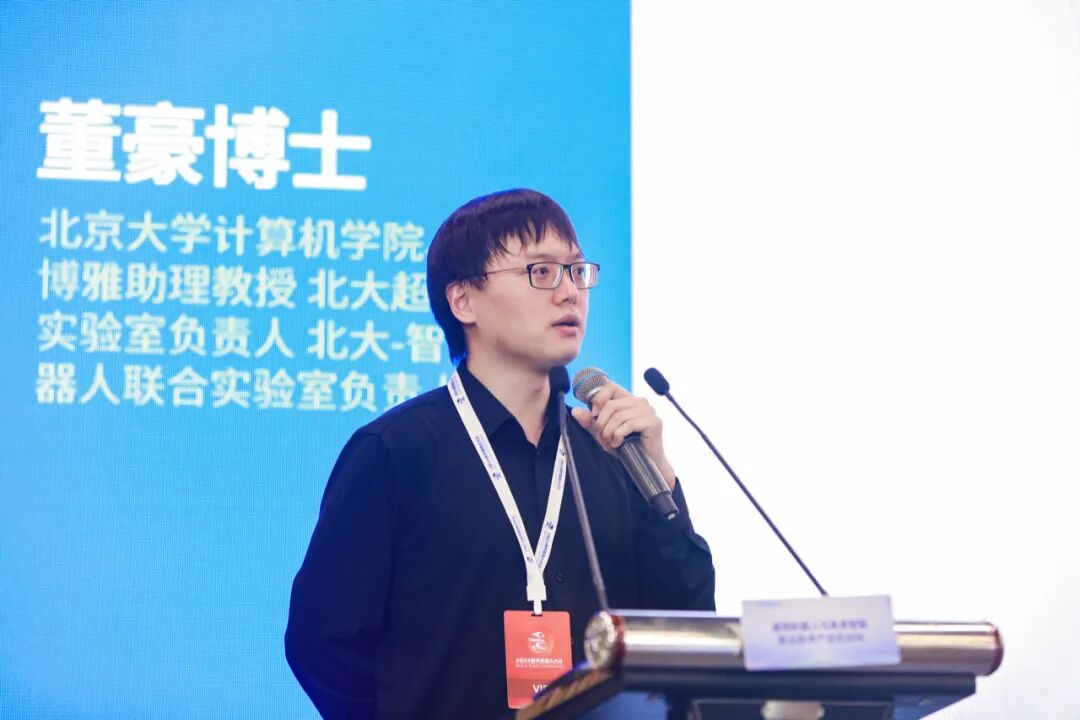
Dr. Hao Dong, Boya Assistant Professor at Peking University's School of Computer Science, Director of the PKU Hyperplane Lab, Director of the PKU-AgiBot Joint Lab
In her keynote on "From Multimodal Large Models to the Embodied Physical World," Dr. Xiaodan Liang proposed that existing models rely on internet data with weak spatial perception capabilities. The three essential elements of general embodied intelligence include: billion-scale unified data, high-fidelity simulation platforms, and multimodal embodied large models. Addressing current challenges, Pengcheng Embodied Institute has undertaken several initiatives: open-sourcing ARIO, the world's largest-scale dataset; the InfiniteWorld Simulator for robotics; the general navigation large model MapGPT; and PIVOT-R, the first world model for robotic manipulation.
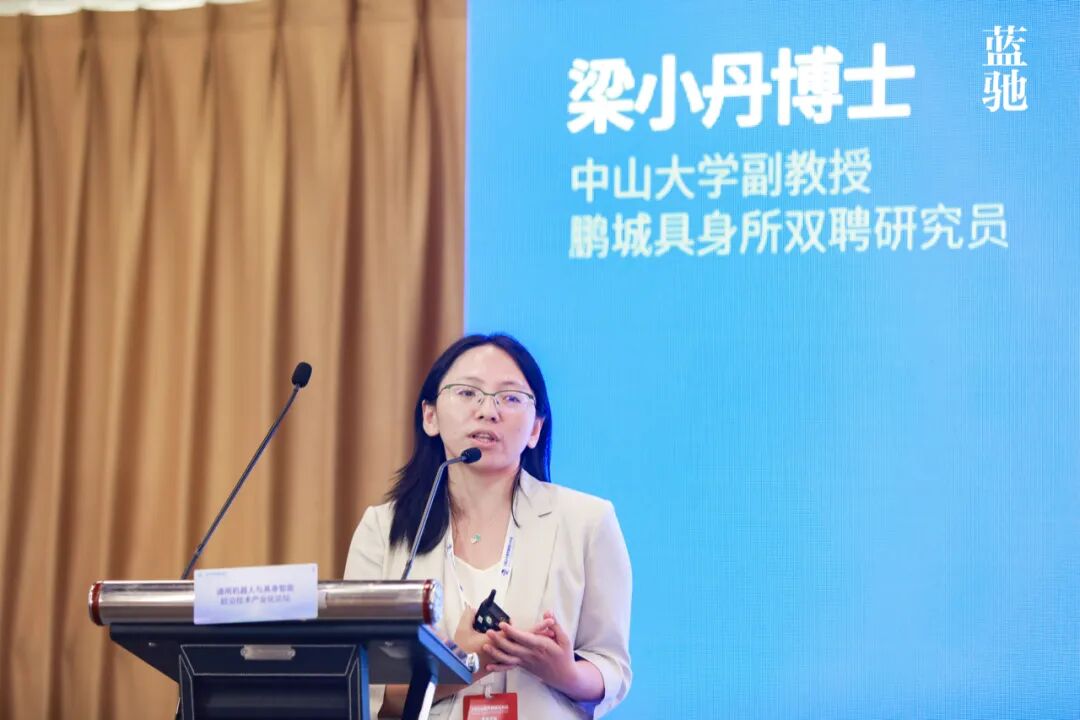
Dr. Xiaodan Liang, Associate Professor at Sun Yat-sen University, Dual-Appointed Researcher at Pengcheng Embodied Institute
In his presentation on "Trustworthy Dexterous Manipulation Based on Reinforcement Learning," Dr. Yaodong Yang stated that task capability is the key to embodied intelligence deployment. Currently, robots can only perform simple grasping — dexterous manipulation and tool use remain unrealized. Reinforcement learning, with its strong dexterity, generalization, and robustness, is emerging as the solution for dexterous manipulation. Applying reinforcement learning requires simulation-based training and real-to-sim-to-real transfer. To achieve generalization, effective reward function structures must first be designed to trigger reinforcement learning's Scaling Law; furthermore, research must advance on physics-feedback-based sim-to-real alignment techniques.
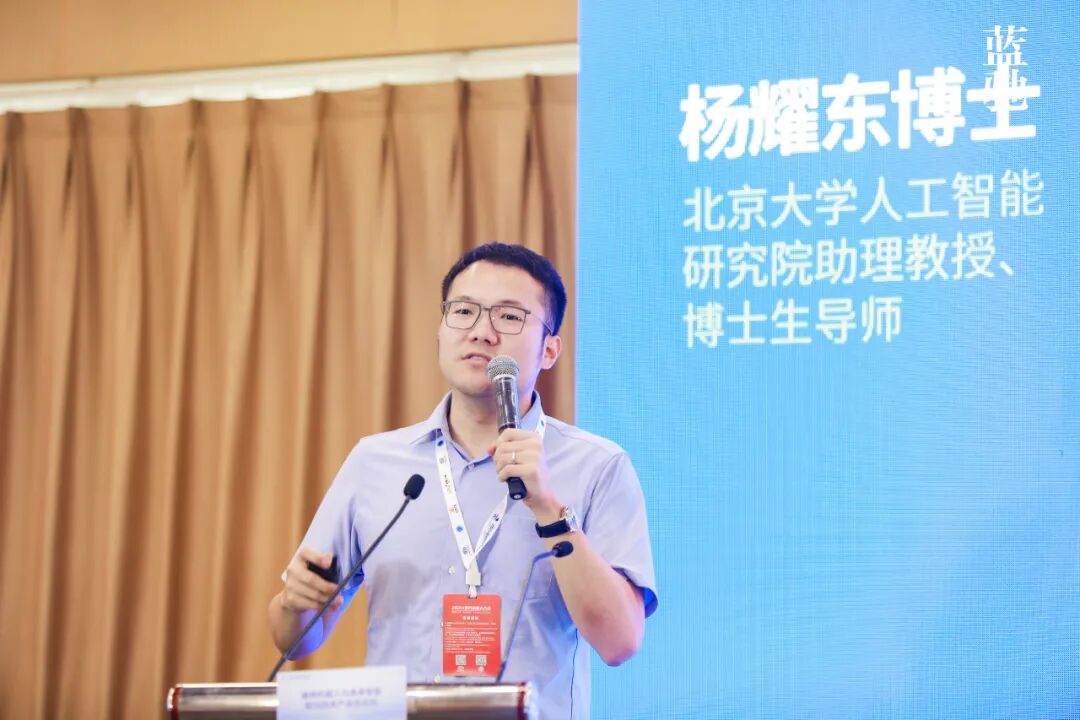
Dr. Yaodong Yang, Assistant Professor and PhD Advisor at Peking University's Institute for Artificial Intelligence
In the roundtable forum on "From Lab to Real World: Innovation and Industrialization of General-Purpose and Embodied Intelligence," Cao Wei served as moderator, joined by Dr. He Wang, Dr. Hao Dong, Dr. Zheng Wang (Founder and CEO of Wanxun Technology), and Jishun Guo (Vice President of Joyson Electronics).
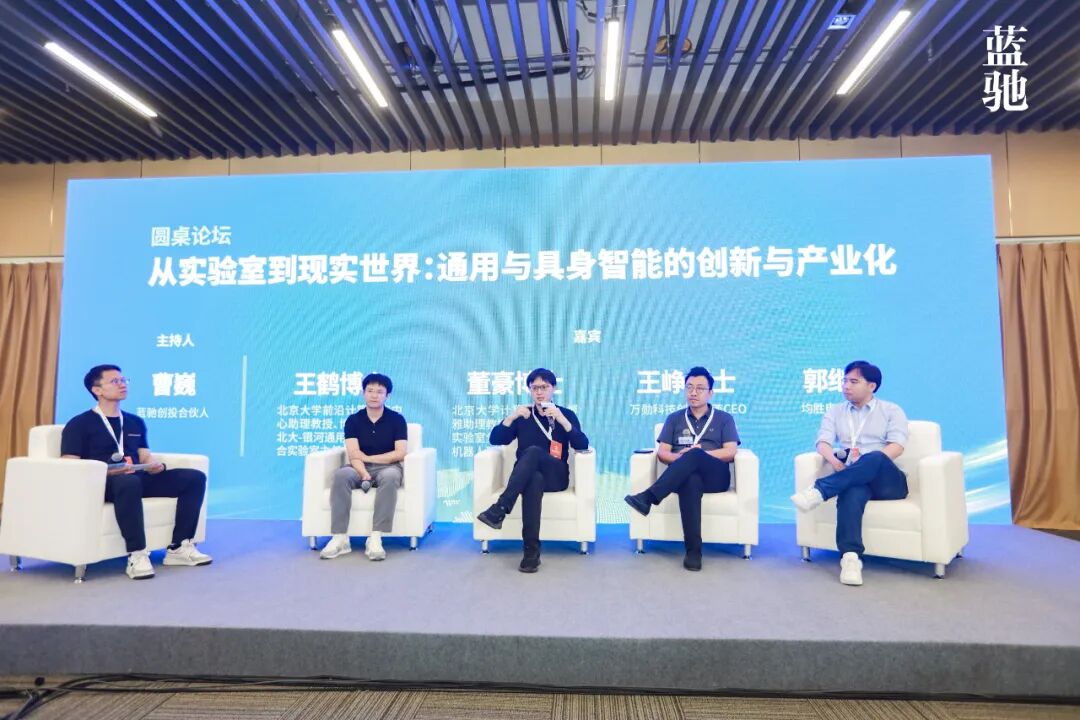
On technical breakthroughs, the embodied intelligence field has seen tremendous progress in recent years. Dr. He Wang believes that the body, data, brain, and cerebellum constitute the framework for general-purpose robots, with embodied intelligence based on synthetic data enabling brain-cerebellum integration as an important research direction. Dr. Hao Dong noted that industrial robots previously pursued absolute precision, but the arrival of the large model era has transformed hardware design thinking, with dexterity receiving greater emphasis. Dr. Zheng Wang observed that with overall robot body approaches converging,底层创新 at the motor joint level may present new opportunities.
On application deployment, Jishun Guo stated that current robot deployment in industry still faces issues with repeatability precision, production cycle timing, and stability that urgently need resolution. However, to address future labor shortages, the deployment of humanoid and semi-humanoid robots in industry is already imperative. From an industry perspective, Guo advised startups that "done is better than perfect" — quickly identifying suitable production lines and scenarios, refining production cycle timing and accuracy, and getting robots to genuinely begin solving critical human needs.
The roundtable also explored the hot industry topic of going global. Participants agreed that there is no generational gap between domestic and international general-purpose robotics and embodied intelligence technologies. What matters more going forward is how to achieve more efficient product deployment tailored to scenario demands. Consequently, Chinese robotics products possess strong advantages for overseas expansion — based on engineering talent dividends, validated product forms, and proven deployment cases, the future development of Chinese robots in international markets is highly promising.
BlueRun Ventures continues to focus on robotics entrepreneurs with long-term accumulation in underlying technologies and deep understanding of industry needs, helping them achieve the commercial closed loop from technology to product to sales. Going forward, BlueRun Ventures will continue leveraging its strengths cultivated through deep engagement in the general-purpose robotics and embodied intelligence industry, joining entrepreneurs in opening a new chapter for the robotics era.
"Compete upward, not downward; if you're going to do it, create something Chinese-made and globally leading." Cao Wei concluded that BlueRun Ventures will continue seeking and supporting change-makers who can redefine "robot," hoping to work alongside industry, academia, and research to create a new future for China's robotics industry.

Deerbo Secures Tens of Millions in Pre-A Funding, Specializing in Intelligent Robot Workstations for Heavy Industry | BlueRun Ventures

Jaren Semiconductor Completes Nearly 100 Million Yuan Pre-A Round, Establishes Strategic Partnership with Hangzhou Bank | BlueRun Ventures

How Can Chinese Companies Solve Brand Trust Issues When Going Global? | Buming · Globalization
[