BlueRun Ventures Family Headlines | Lingchu Intelligence's Psi R0: The First End-to-End Reinforcement Learning Embodied Model Emerges!

RL is the only solution for achieving closed-loop task completion in long-horizon dexterous manipulation.
Recently, Lingchu Intelligence unveiled Psi R0, the first end-to-end embodied model built entirely on reinforcement learning (RL). The model enables bimanual dexterous manipulation for complex operations, chaining multiple skills through mixed training to produce an agent capable of reasoning, thereby completing and closing the loop on long-horizon dexterous tasks. Moreover, Psi R0 achieves generalization across objects and scenes.
BlueRun Ventures led Lingchu Intelligence's first funding round. We congratulate Lingchu Intelligence on this breakthrough with the Psi R0 model and look forward to its broad prospects in real-world applications.
In the physical world, nearly 100% of human life scenarios involve grasping, rotating, pinching, touching, and other manipulations — and over 90% of these operations are long-horizon tasks requiring multi-skill fusion. Yet in today's embodied intelligence industry, efforts mostly remain confined to generalizing Pick and Place operations. Once tasks grow complex and extended, generalization and success rates drop sharply, making both difficult to achieve — this is precisely why embodied intelligence has remained stuck in demo form, unable to deploy in real-world scenarios! How robots can break through Pick and Place, move beyond teleoperation, and gain the ability to autonomously complete long-horizon dexterous operations to achieve truly human-like, scene-level task closure remains a critical challenge that embodied intelligence must solve.

In the real world, solving long-horizon tasks requires robots to use learning-based approaches. Currently, two mainstream technical paths exist: imitation learning (IL) and reinforcement learning (RL).
Pure imitation learning's generalization is limited by the diversity and quality of demonstrated behaviors. Additionally, long-horizon tasks involve many steps, making distribution shift more likely, which means IL achieves poor generalization performance on long-horizon tasks, with weak robustness as well.
The Psi R0 model, based on RL, uses massive simulated data to efficiently train a bimanual operation agent, and through a bidirectional training framework that chains multiple skills, becomes the first in the industry to complete long-horizon tasks in open environments, with strong generalization capability and high robustness. This skill training framework abstracts key information from object spatiotemporal trajectories to build universal objective functions, thereby solving the difficult problem of reward function design. In the post-training stage, alignment with a small amount of high-quality real-robot data further improves long-horizon task success rates. Beyond this, the transfer feasibility function in the bidirectional training framework plays an important role — it can fine-tune skills to improve chaining success rates and generalization, while also giving the model autonomous skill-switching ability, enabling it to rapidly adjust strategy when operations fail and ensuring high success rates.
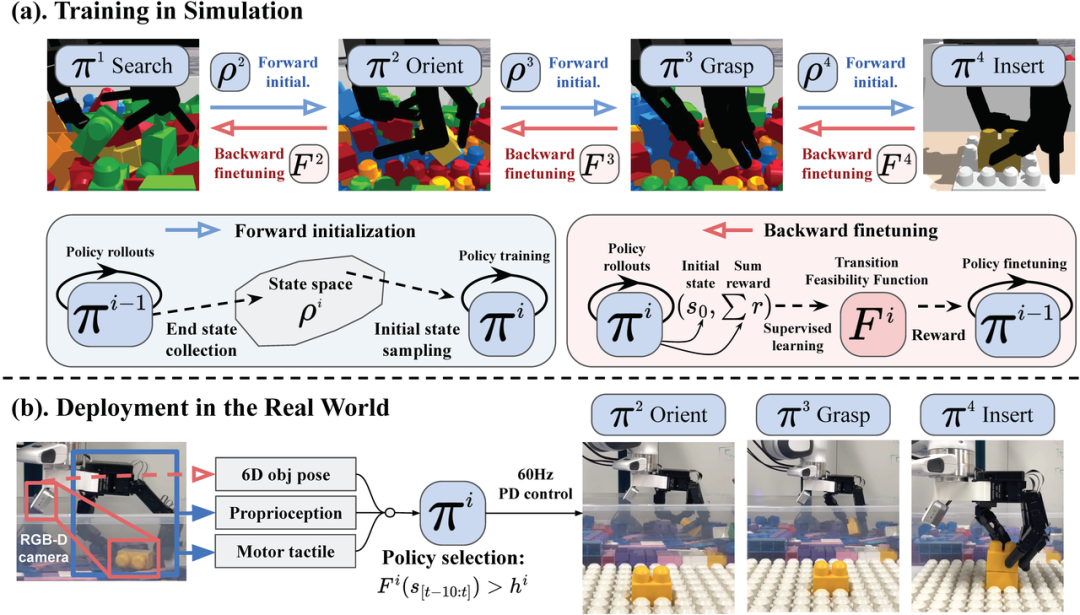
Sequential Dexterity: Chaining Dexterous Policies for Long-Horizon Manipulation
Yuanpei Chen, Chen Wang, Li Fei-Fei, C. Karen Liu*
The dexterity, high success rate, and generalization demonstrated by the Psi R0 model fully showcase its "brain" capabilities in task decomposition and planning, as well as its "cerebellum" capabilities in dexterous manipulation, generalization, and robustness. The birth of this model breaks through the core technical bottlenecks currently facing embodied robots in commercial application, opening up entirely new and broad prospects for the industry's future development, and is expected to lead embodied robots into a new stage of advancement.

Long-horizon dexterous manipulation scenarios are everywhere — from assembly lines in factories, to picking and packing in services, to cleaning and organizing in home environments.
The Psi R0 model's agent demonstrates strong real-world deployment capabilities. Take e-commerce as an example: product packing is a typical long-horizon task, requiring grasping, scanning, placing, and tying plastic bags across tens of thousands of products. Psi R0 can use dual dexterous hands to smoothly complete this entire sequence of actions (this series of actions can replace a complete workstation at the customer site), becoming the first embodied robot trained with reinforcement learning to complete long-horizon dexterous manipulation tasks.
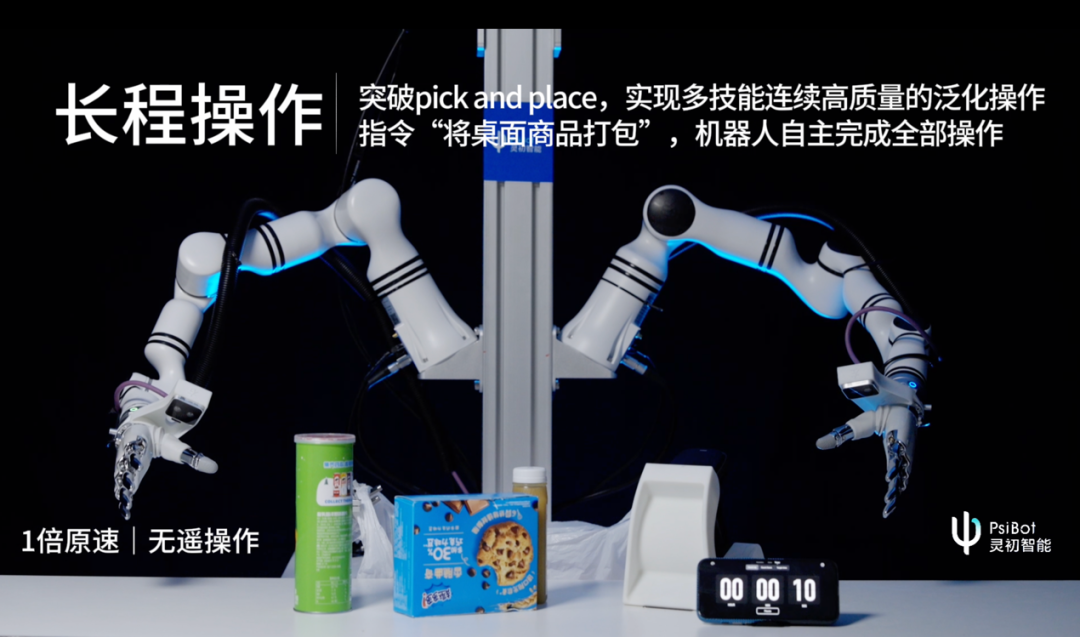
In the video, the robot system receives only the instruction "pack the objects on the table" — and behind this seemingly simple task lies Lingchu Intelligence's highly innovative end-to-end technical architecture at work. When the instruction is issued, the upper-level vision language model (VLM) analyzes the chaotically arranged products on the table and choreographs the operation sequence; the lower-level manipulation model breaks down sub-tasks for individual products, such as grasping, placing, scanning, and packing, which the agent executes in sequence.
For the grasping phase, facing randomly placed products of varying shapes, the model must possess high generalization capability to successfully grasp products one by one. The Pringles can shown in the video — Psi R0 achieved a 99%+ successful grasp rate with just 20 real-robot data points.
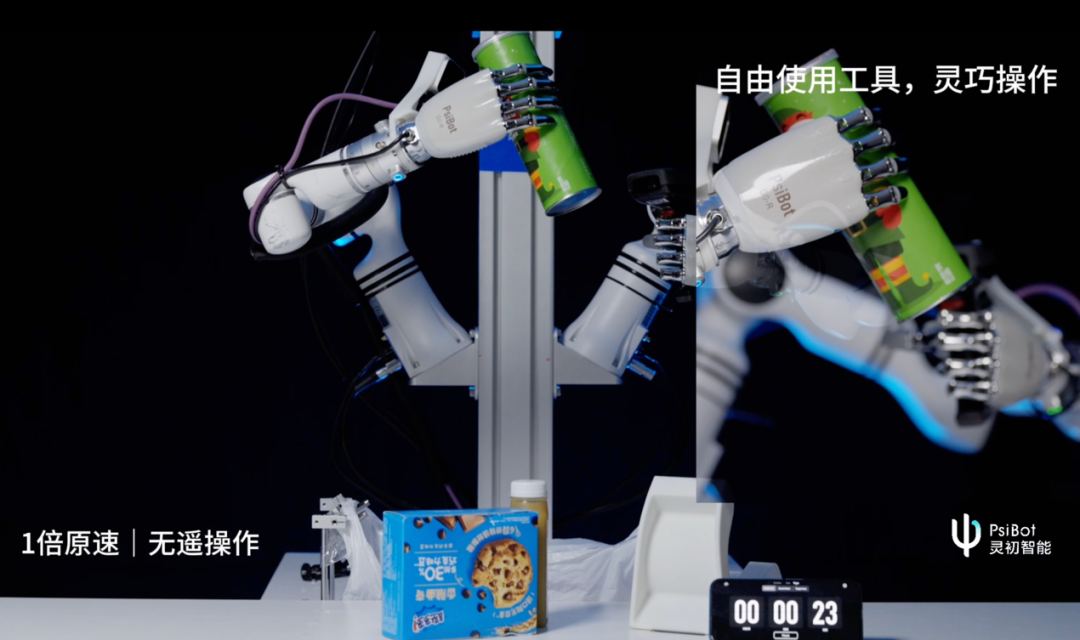
The scanning phase truly tests the robot's dexterous manipulation level, requiring both hands to coordinate their relative positions with high precision to ensure accurate alignment between the scanner and product barcode — any slight deviation could cause scanning failure. Here, the RL training strategy provides reliable real-time closed-loop control for the high-DOF complex system of dual arms and hands, ensuring precise and smooth scanning execution.
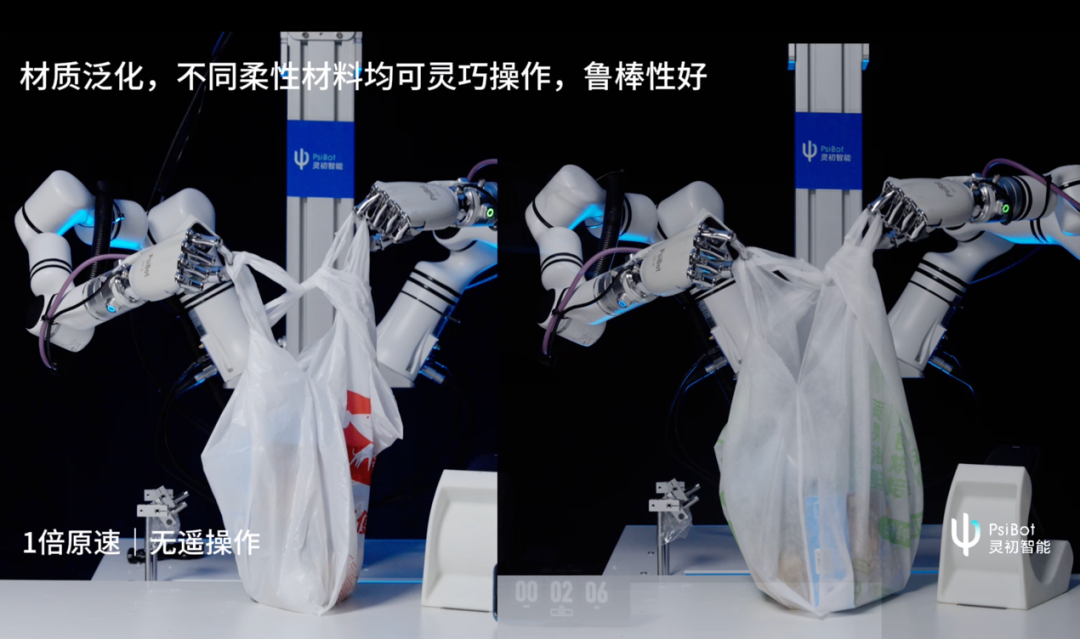
The packing phase requires bimanual coordination for dexterous manipulation of plastic bags. During dynamic packing, the bag's shape changes with each action, requiring real-time operational adjustments. To enhance the robot's adaptability to deformable objects, Psi R0 simulates various deformable object manipulation scenarios in simulation, combined with fine-tuning using real-robot data. Even when interrupted or disturbed, it can adaptively adjust strategy and resume packing actions.
Lingchu Intelligence's Psi R0 model represents the first step in the recursive growth of embodied intelligence. Embodied intelligence will follow a gradual evolution from simple to complex, from protection to coordination. In early stages, the cerebellum serves as the physical foundation for interacting with the real world — its design must incorporate domain knowledge, satisfy environmental constraints, and possess fault tolerance to support brain learning and optimization. The Psi R0 model leverages RL algorithms' exploratory advantages to support rapid cerebellum iteration, generating agents capable of long-horizon dexterous manipulation. Through dexterous manipulation, it turns the data flywheel, achieving closed-loop feedback from cerebellum Action to brain Cognition, driving optimization of brain cognitive capabilities, with continuous model iteration forming an embodied intelligence "neural circuit" of cerebellum coordination plus brain optimization, enabling the end-to-end model to gradually evolve from simple to complex, from protection to coordination.


What They Said at Shenzhen's Hottest AI Hardware Salon Last Week | Booming Hub Recap

BlueRun Ventures and Portfolio Companies Win Multiple Awards Including Most Influential Investment Institution of the Year

Zhongke Ruiyi Successfully Completes Series A+ Funding | BlueRun Family