Psi R1 from Lingchu AI Becomes First Embodied Intelligence Model to Achieve Vision-Language-Action Multimodal Coordination | BlueRun Ventures Portfolio Spotlight

Accelerating the Deployment of Embodied Robots in High-Value Scenarios
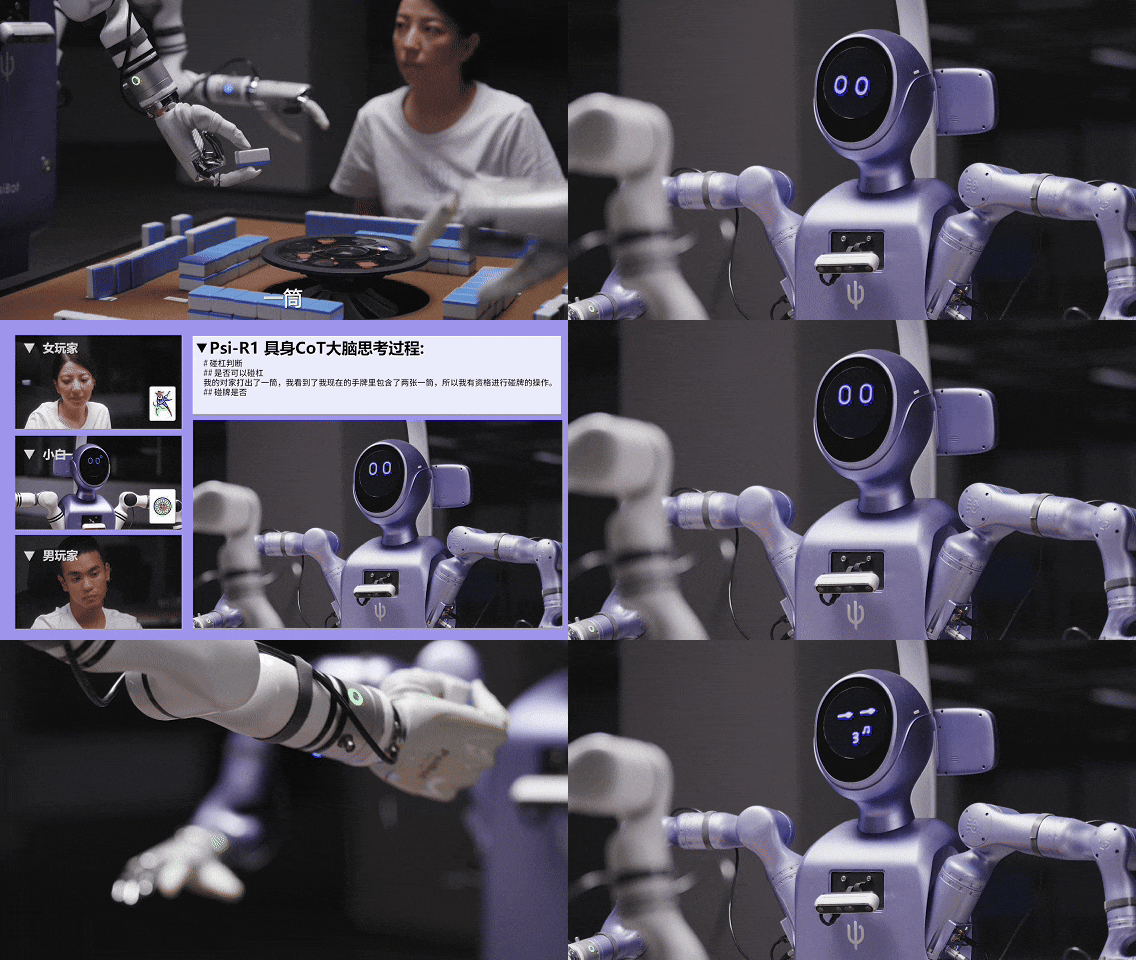
While most embodied robots are still focused on basic motor control — walking, running — Lingchu Intelligence's robot has already cracked long-horizon complex tasks in open environments, and is playing mahjong with humans.
BlueRun Ventures, as the lead investor in Lingchu Intelligence's first round, congratulates Lingchu Intelligence on the milestone breakthrough of its Psi R1 model, and looks forward to seeing it unlock greater value in real-world applications.
Mahjong, as a strategic game of imperfect information, demands exceptionally high randomness and interactivity, placing multidimensional requirements on robotic capabilities. First, the robot must understand mahjong rules to ensure all actions comply with gameplay. Second, it must formulate sound strategy — dynamically generating tactics based on hand composition, evolving board states, and opponent behavior to decide when to discard, call chi, pong, or kong — involving extensive human-robot and robot-robot interaction. Finally, the robot must execute millimeter-precision dexterous manipulation: drawing tiles, discarding, organizing hands. This poses enormous challenges for long-horizon task planning and fine motor skills.
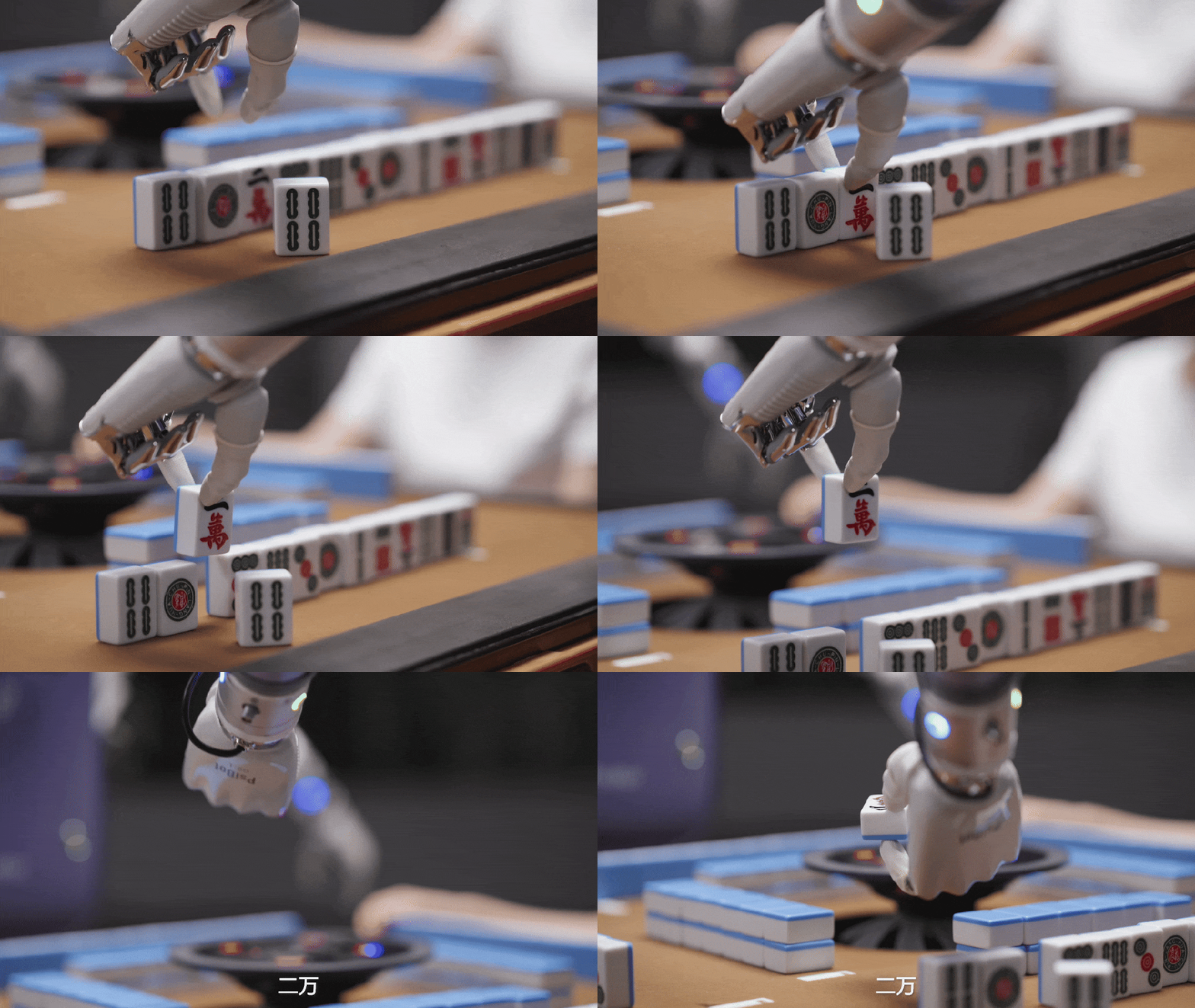
Robotic manipulation capability falls into three levels:
L1 | Object generalization grasping (Pick & Place), unable to perform complex operations or reasoning;
L2 | Human-like manipulation: medium wrap, precision disk, lateral pinch, tripod, lateral tripod, power sphere, etc. — but lacking cognitive decision chains, unable to process multimodal complex instructions;
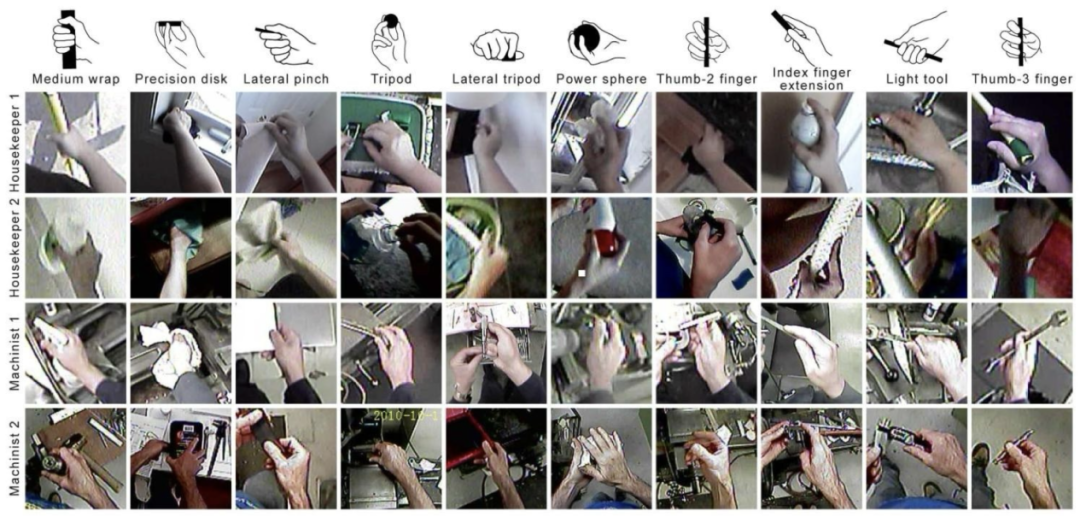
L3 | Autonomous reasoning system based on Chain of Action Thought (CoAT) framework, performing autonomous reasoning and decision-making in open environments to complete long-horizon complex operations.
Only with L3 long-horizon CoAT dexterous manipulation capability can a robot understand the world and transfer learned knowledge to new environments. The "national treasure" game of mahjong is a classic L3 challenge, and Lingchu Intelligence has answered it with its hierarchical end-to-end VLA + reinforcement learning algorithm model, Psi-R1.
Using mahjong as its proving ground, R1 demonstrates robotic long-horizon dexterous manipulation in open environments, achieving 30+ minutes of sustained CoAT ultra-long task duration, while validating triple compound interaction capabilities (human-robot, robot-robot, robot-environment interaction) — showcasing VLA's superior reasoning ability and RL's capacity to surpass human-level thinking and operation.
This breakthrough marks embodied intelligence's critical leap from single-action execution toward completing the closed loop of complex physical world perception, reasoning, and execution, providing a deployable technical paradigm for embodied intelligence to truly enter commercial scenarios.

In the mahjong demonstration video, Lingchu Intelligence's R1 model showcases a spectrum of capabilities from slow-brain to fast-brain processing.
Flipping tiles — no problem. Flipping a mahjong tile face-up is a highly dexterous operation that many novice players fail consistently. Lingchu Intelligence's dexterous hand solved the tactile-visual modality alignment challenge, achieving 100% accuracy in flipping tiles, demonstrating human-level fine manipulation capability.
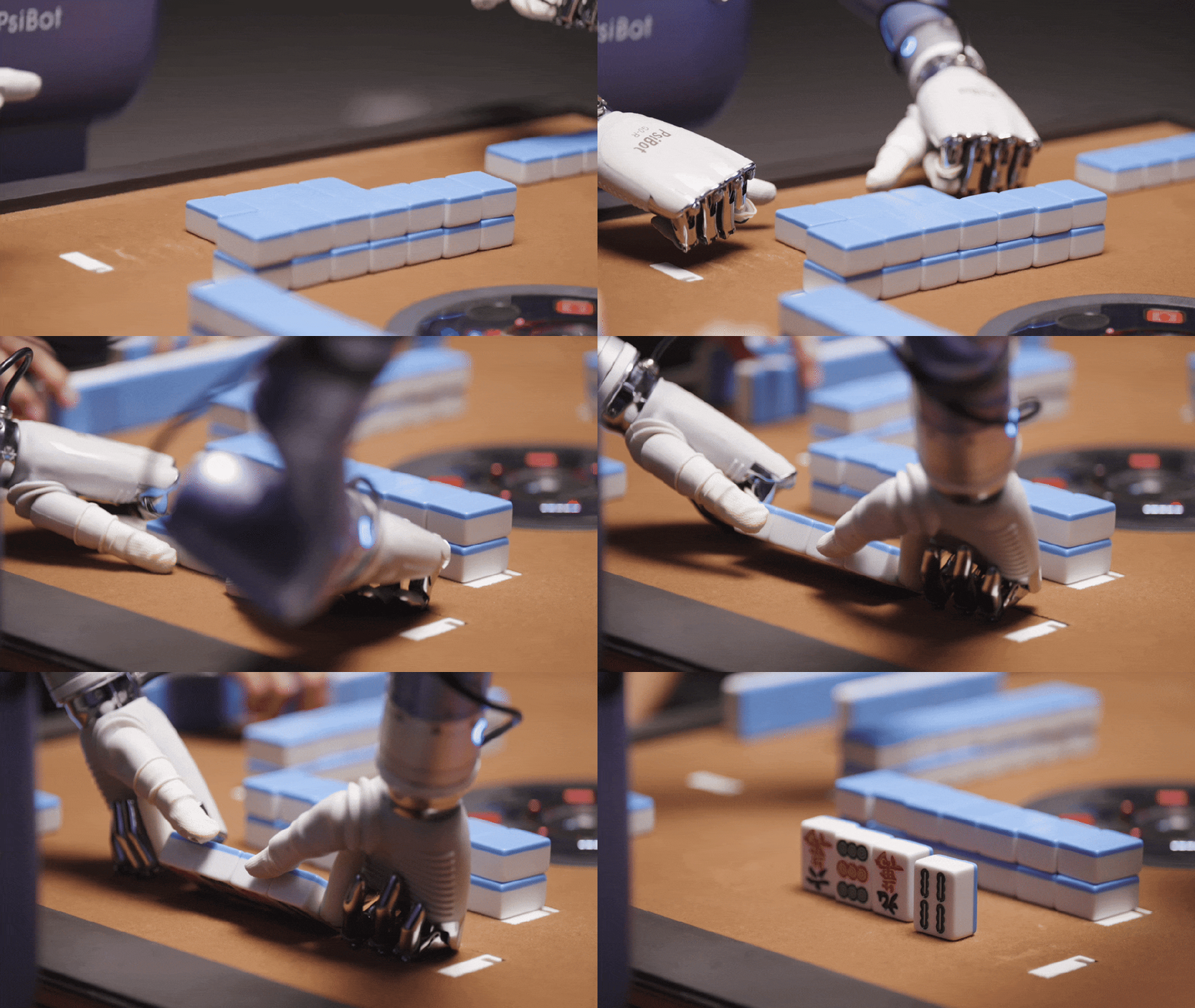
Pong and kong — I've got them. The robot can build game-state machines based on opponents' discards, autonomously constructing strategy chains for pong and kong calls, and executing these moves smoothly.

Tile counting — my strongest suit. Long-horizon planning is exceptionally difficult for embodied agents. The robot remembers every tile discarded by all players and dynamically plans its discards based on board state. Similar to AlphaGo, this is the powerful predictive capability brought by reinforcement learning, realized on an embodied agent through Lingchu Intelligence's VLA architecture.
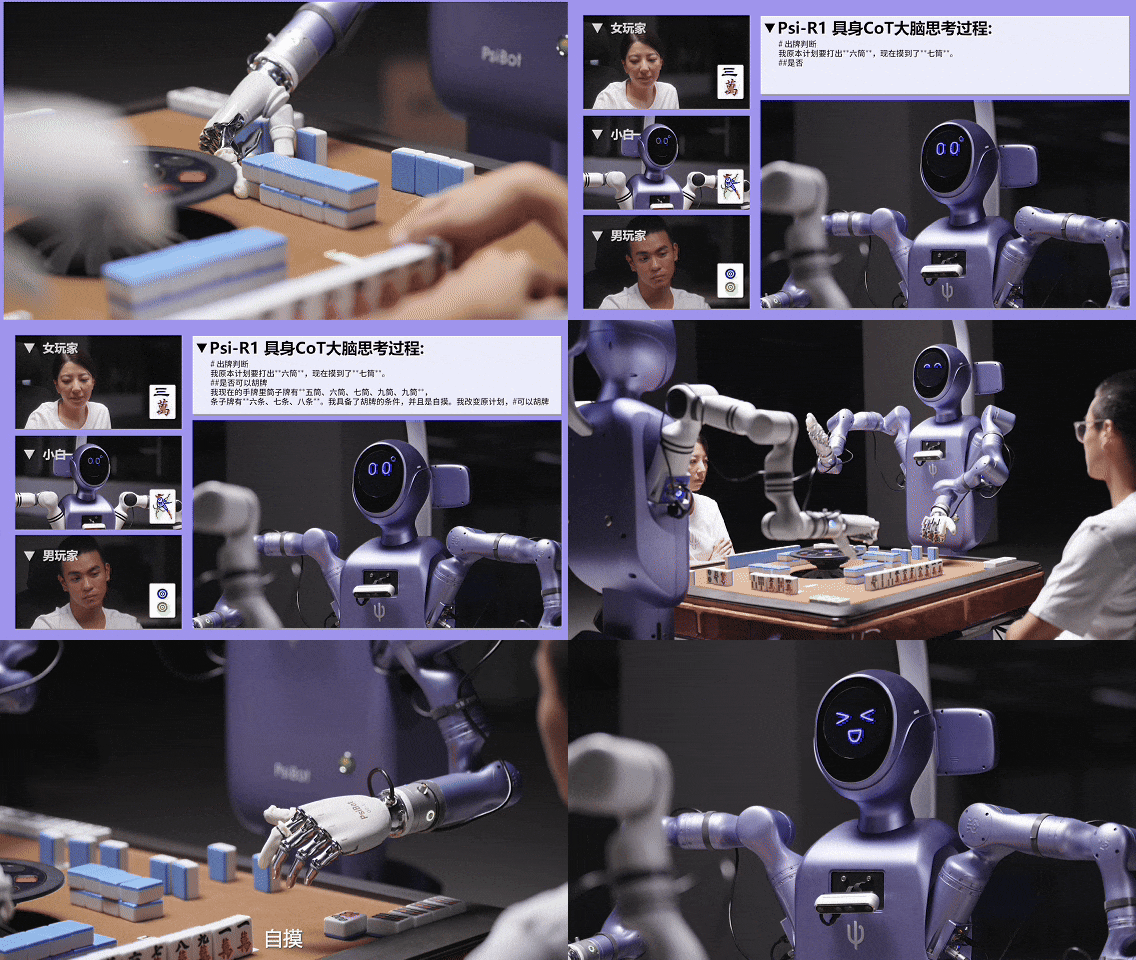
Teamwork — most reliable. Two robots coordinate to achieve multi-agent collaborative intelligence. Not just information sharing and "peeking" at each other's hands, but physically passing tiles between machines.
Since its founding in 2024, Lingchu Intelligence was the first to propose the hierarchical end-to-end fast-slow brain architecture — now an industry consensus (S1 fast brain: subconscious, intuition, motor control, rapid response; S2 slow brain: reasoning, planning, slow thinking, conscious, deliberate depth). Physical Intelligence (PI) upgraded from end-to-end architecture Pi-0 to hierarchical architecture Hi Robot; Figure AI released its hierarchical HELIX architecture in March; additionally, Google released Gemini Robotics at the end of March, and Nvidia released GR00T N1 in April — both hierarchical architectures.
However, as Nvidia's Senior Director of Robotics and University of Washington professor Dieter Fox notes, two core problems in the fast-slow brain architecture remain unsolved:
1. How to connect the fast and slow brains, achieving modality alignment between slow-brain planning and fast-brain operation;
2. How to break through the imitation learning bottleneck to train rich skills.

BlueRun Ventures believes that unlike VLA models such as Pi, Figure, and Gemini Robotics with their "action unidirectional decision" mechanism:
Input: multi-view images (RGB/D) + natural language instructions
Output: structured spatial information (e.g., 2D/3D coordinates, trajectory point sequences, grasp poses) — this VLA architecture can only complete visual-language level CoT and feedback loops.
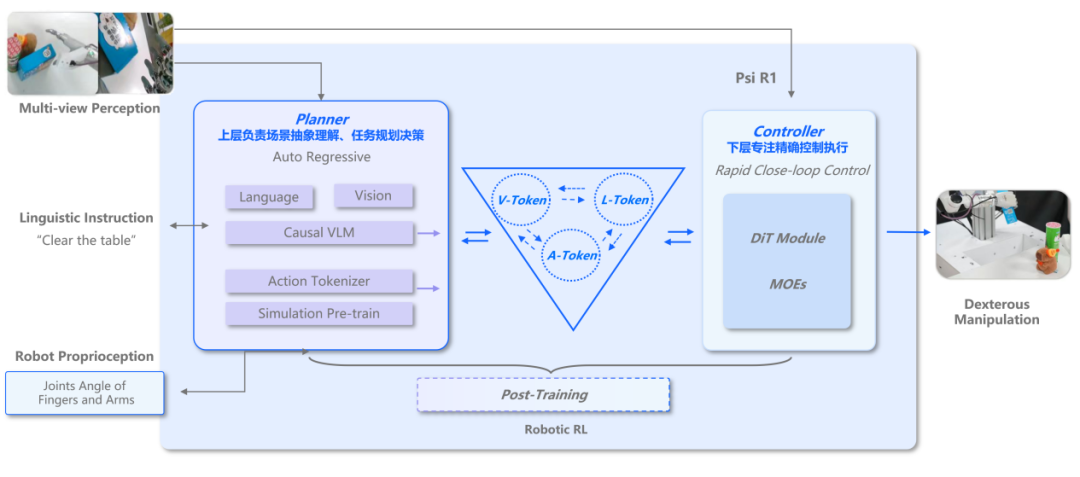
Lingchu Intelligence's R1 model introduces Action Tokenizer into its input, building the first VLA model supporting the full closed loop of "action perception - environment feedback - dynamic decision," achieving visual-language-action multimodal coordinated CoAT chain-of-thought for robotic operation.
Fast brain S1 focuses on manipulation:
Dexterous manipulation encompasses multiple forms: object mask-based grasping, trajectory-constrained manipulation (e.g., pulling zippers), tool-using skills generalization (e.g., scanning codes, using electric drills), high-dynamic manipulation (e.g., juggling). Lingchu Intelligence's RL algorithms support all these operation types.
Slow brain S2 focuses on reasoning and planning:
S1's operations, after tokenization, serve as input to the S2 slow brain, fusing with language and vision modalities. Based on a Causal VLM autoregressive architecture, it achieves multimodal-fused reasoning and task planning.
Fast and slow brains are implicitly connected through Action Tokenizer, trained end-to-end, collaborating to complete long-horizon dexterous manipulation tasks. The R1 model combines historical actions with current environmental states to understand the long-term effects of actions, avoiding repeated trial-and-error and action error accumulation, establishing causal chains between actions and environmental changes — solving the "decision myopia" problem of traditional VLMs lacking action history.
Lingchu R1 model has successfully validated VLA Test-Time Scaling for the first time
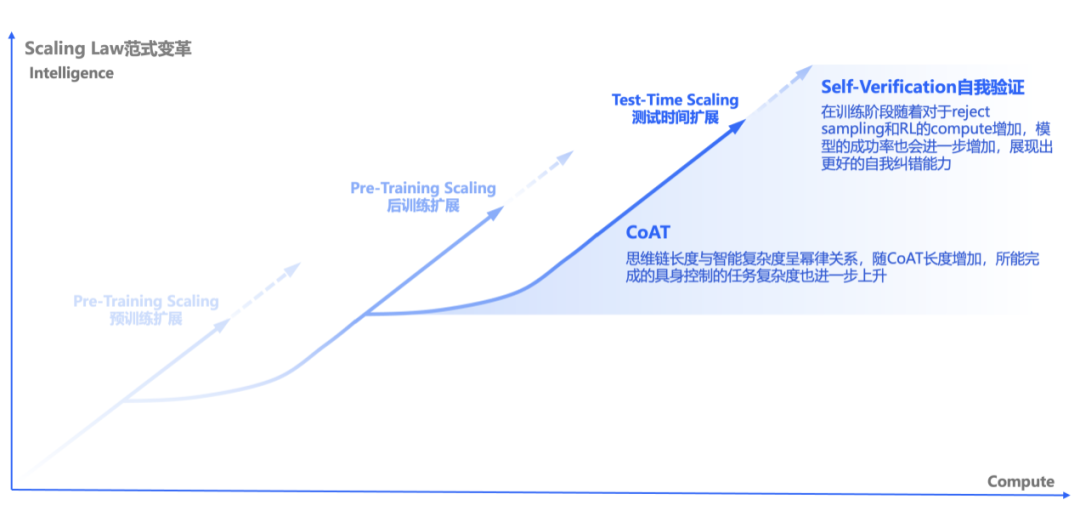
With unchanged model architecture, the RL reinforcement learning framework enables autonomous exploration and reasoning to solve complex problems through CoAT, generating Long horizon-CoAT with self-verification and reflection capabilities.
Self-verification: During training, as computational investment in reject sampling and RL increases, model success rates further improve, demonstrating stronger self-correction capability.
CoAT: Chain-of-thought length and intelligence complexity follow a power-law relationship — as CoAT length increases, the complexity of embodied control tasks that can be completed rises accordingly.

OpenAI co-founder Andrej Karpathy notes:
"In both child learning and deep learning, there are two main types of learning:
-
Imitation learning (watching and repeating, i.e., pretraining, supervised fine-tuning)
-
Reinforcement learning. AlphaGo's stunning achievement of defeating top human Go players was based on RL self-play, not imitating professional Go players.
RL-driven self-verification and reflection can surpass human cognitive limits. These emergent capabilities cannot be obtained through imitation learning, because the model's cognition differs from human annotators' cognition — humans would never know how to correctly annotate such solution strategies, or even what they should look like. These solution strategies must be discovered through the reinforcement learning process."
In July 2024, AlphaProof became the first AI algorithm to medal at the International Mathematical Olympiad, outperforming human-data-centric approaches. Its RL algorithm focused on continuous interaction with formal proof systems, enabling AlphaProof to explore mathematical possibilities beyond the scope of human formal proofs, thereby finding novel solutions to challenging problems.
Robots have also demonstrated powerful potential through RL. Both Boston Dynamics and Unitree robots have achieved joint movements surpassing human physical limits, such as 180-degree waist rotation, through RL.
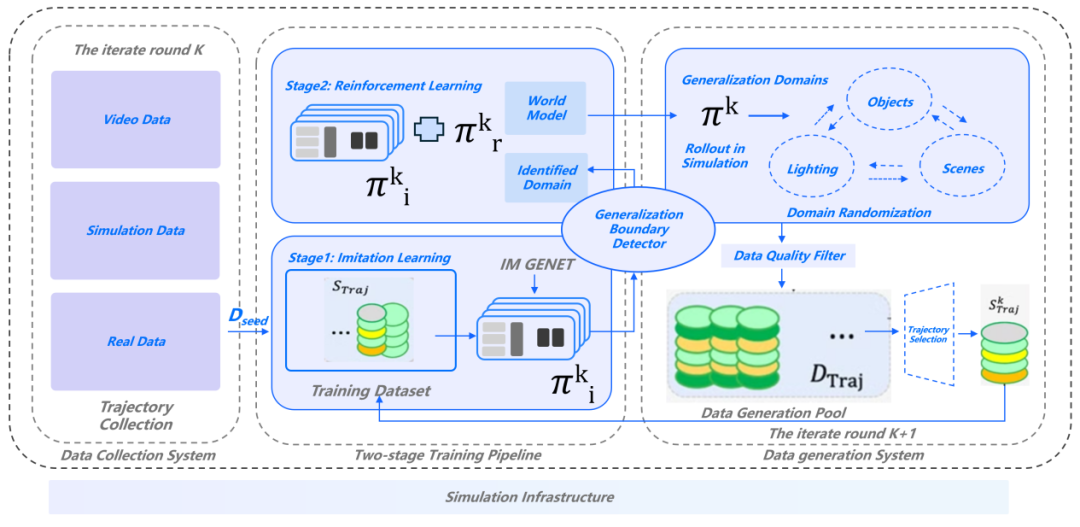
Lingchu Intelligence's consistent application of RL efficiently solves generalization and dexterous manipulation. On the fast-brain side, Lingchu Intelligence also possesses extensive Sim-to-Real reinforcement learning experience, enabling large-scale scaled-up skill training, pushing data efficiency to the extreme with RL to form a data flywheel. On the slow-brain side, RL drives dual breakthroughs in task success rates and CoAT length.

Lingchu Intelligence's R1 fast-slow brain system possesses L3 capability, enabling autonomous reasoning and decision-making in open environments to complete long-horizon complex operations. Its technology can be widely applied to:
General industry: incoming material inspection, finished product packaging, and other scenarios;
Retail logistics: picking, sorting, replenishment, packing, and other scenarios;
Consumer home: household services and collaboration.
Currently, Lingchu Intelligence has begun partnerships with industry-leading enterprises in manufacturing, supermarket retail, and cross-border logistics, deploying high-value commercial scenarios in stages — from general industry to general retail logistics, ultimately advancing toward home applications.


Multimodal DeepSeek arrives! Yaodong Yang's team collaborates with HKUST to release Align-DS-V, powering Lingchu DS-VLA alignment expansion | BlueRun Ventures Family Headlines

BlueRun Ventures Family Headlines | Lingchu Intelligence Psi R0, the first end-to-end reinforcement learning embodied model emerges!
Intelligence surging: BlueRun's AI portfolio companies launch new products again and again! | BlueRun Ventures Family Headlines
: When embodied intelligence enters reality | The path to AGI