Starbucks Founder: Culture Eats Strategy | BlueRun Ventures Share
"Make sure this is a company worth trusting."
How do you build a company that lasts a century? The most important thing is undoubtedly an unwavering commitment to mission, vision, and values. In the article we're sharing today, Starbucks founder Howard Schultz once again reiterates the importance of culture to a company. A great strategist or operational whiz is easy to find, he says, but if they don't respect the past, history, legacy, and tradition, a corrupted culture will ultimately devour strategy.
In late March, on yet another visit to China, Howard Schultz brought with him Oleato, a new coffee product he had developed, and a story.
Two years ago, he and his wife Sheri were vacationing in Sicily, Italy, and came to a place called Partanna — a town of just 8,000 people that also shares its name with an olive oil brand. The family business that produces Partanna olive oil had been in the trade for over 100 years, now in the hands of its fourth-generation heir, Tommaso Asaro. When the two first met, Schultz noticed Asaro had a "strange" habit — drinking a spoonful of olive oil every morning. Asaro explained that this tradition had been passed down for thousands of years and was good for the body — the town's residents' notably higher longevity seemed to bear this out.
"So I started trying it myself." At this point, Schultz displayed his characteristic humor once again. "As you can see, it definitely works — I still look old."
The "old man" Schultz is turning 71 soon. A Starbucks executive once said that in the hearts of Starbucks people, Schultz is practically a rock star. Some have not only read his books cover to cover but can practically recite them backwards. The reasons why may be found in The Starbucks Experience: Coffee, the People, and the Culture, published in 2014. Though the author had no shortage of criticisms about some of Starbucks' practices, and noted that the founder always loved talking about his and Starbucks' dreams and values — "all the same old talk" — he had to admit, "Schultz is genuine."
Schultz never shies away from "authenticity," no matter how awkward the situation: his impoverished origins and family torn apart by poverty; 242 rejections while fundraising in the early days and the helplessness he felt inside; the wrong turns Starbucks once took, the PR crises it weathered, even the moments when its values went off track — his sincerity and candor always resonate. As he often tells Starbucks people, "Authenticity and openness, even vulnerable exposure, are what make us human. Not a weakness, but a strength."
In 2023, Schultz stepped down from all positions at Starbucks, yet remains the irreplaceable "god" in the eyes of Starbucks employees. Internally, he's referred to with deference as "Mr. Huo" or affectionately as "Grandpa."
On March 22, at the 2024 Starbucks China Partner (Starbucks refers to employees as "partners") and Family Exchange, 1,000 employees on site eagerly expressed their gratitude, asked for photos, and chatted about everyday matters: one employee about to retire asked him "how to plan for retirement life"; another employee, mother of a 14-year-old boy, was torn between letting her child pursue hobbies or focus entirely on exam prep. Schultz told her, "As a father, I've made many mistakes, and one of them was putting too much pressure on my children instead of letting them walk their own path."
Starbucks is also Schultz's "child." He's getting old, but he wants Starbucks to keep pace with youth. In Starbucks' history, he has twice stepped away from active management — last year was the third time. When he "hands over," he completely lets go, because he doesn't want to be a shadow over his successor. But when Starbucks goes down the wrong path, he also "takes back" with resolve, stepping forward immediately to launch forceful reforms. Even when facing internal and external skepticism, he flatly stated "this decision is not up for discussion." In the end, he twice pulled the company back from the brink of crisis, transforming Starbucks from a small shop in Seattle that originally roasted and sold coffee beans into a global coffee chain giant with nearly 40,000 stores.
Howard Schultz has thus become a legendary entrepreneur widely sought after and praised.
He himself doesn't think much of it. In a conversation with Lu Xiongwen, Dean of Fudan University's School of Management, the latter asked him: "How does one become a visionary leader?" Schultz repeated the word "visionary" with something like disbelief, as if being handed a hat that didn't belong to him. "If I were visionary, then how could I have made mistakes on succession? And more than once?" But he tried to offer an answer. "If you say visionary" — he made air quotes — "then I would say, fear of failure is a tremendous motivator. We are not born successful, nor will we理所当然 remain successful, so we must remain humble and must get better every single day."
Especially in the current China market. Compared to when it first entered 25 years ago, Starbucks now faces entirely different challenges. Back then, people here only drank tea and knew nothing of coffee; now it has been forced into a melee involving thousands upon thousands of competitors — faster store expansion, more agile innovation races, more brutal price wars. Starbucks must run faster and invest more. Over the past year, Starbucks expanded at a rate of three new stores per day — previously that number was only 1.6; it established the Starbucks China Innovation and Technology Center in Shenzhen to further build its digital arsenal; and later, the Starbucks China Coffee Innovation Industrial Park went into production in Kunshan — Starbucks' largest productive investment outside the United States.
But one thing will not change. "We will not engage in discount wars or price wars," Schultz stated. "Starbucks strives to be a different kind of company, and will achieve this in the right way. I promise you (Starbucks employees), as long as we do this, we will succeed."
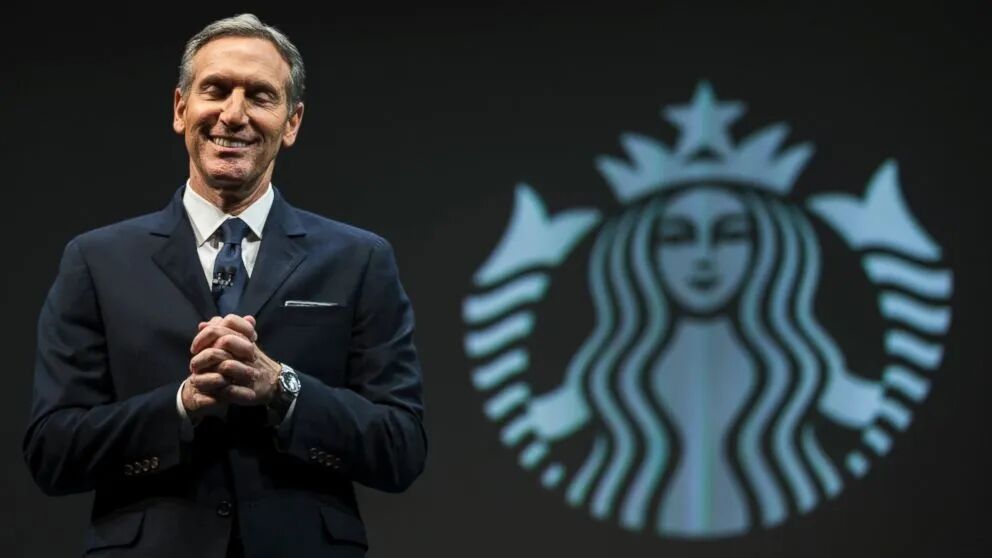
The following is Schultz's sharing, edited for length:
"I won't waste even a minute worrying about what competitors are doing"
Twenty-five years ago, Starbucks introduced coffee to the China market. You could say we created the coffee industry in China. Over roughly the past decade, many companies have followed Starbucks into this market. I've always believed competition is a good thing — it has given more people better job opportunities. But it also brings some problems. In the same coffee market, some products are sold at very low prices, so what's the difference between products? What distinguishes Starbucks from other companies? In fact, we've encountered similar challenges in other markets, including the United States.
Simply put, you must answer this question with humility in your heart — what is your core purpose and reason for being? Who are you? What do you stand for? Competition in the market is fierce. Our competitors are taking a different path. Starbucks is not like them. We don't engage in discount wars or price wars. What we do is build community, create human connection through high-quality coffee, and create an experience — in some ways, Starbucks could be called the world's first experiential brand. This is what we've always done, and what we will continue to hold to at our core.
But don't misunderstand — we must humbly listen to the market and cannot ignore the fact that customer preferences are changing. We will make sure to stay focused on competition and understand what competitors are doing, but we won't spend even a minute worrying about what competitors are doing. Instead, we will put 100% of our time into what we are doing and what we can control, ensuring that every day we are working hard to earn success. If we do this, all problems will naturally resolve themselves.
I believe that if we maintain a long-term orientation and continue to innovate at the frontier, the market will naturally make its choice. Competition has introduced coffee to millions upon millions of people. Over time, as customers learn more about coffee, they will want to trade up from low-end or discounted products. As long as we continue to earn the market's respect, they will choose to trade up to Starbucks. I am very confident that over time, Starbucks will continue to be the market leader.
"Culture eats strategy"
The reason we have succeeded in China and in over 80 countries and regions globally is all based on the trust we have built with our partners. Simply put, it's human spirit — that's what makes Starbucks what it is. It's not American, not Chinese, not Malaysian, not Japanese. It's a universal emotion. It's this culture that created this company. This is the secret of Starbucks' success.
To use an analogy, we're beginning to build a 100-story building. To build such a building, you must lay a foundation strong enough to support growth. Growth is seductive. It masks mistakes. You cannot rely on growth alone to develop a company. More importantly, you must continue to invest in corporate culture and values.
Many years ago, I said China would surpass the United States to become Starbucks' largest market. I think that goal can be achieved within the next five years. Yes, our goal is to drive massive growth in China business, but that's not what drives us. What truly drives us forward is that we're developing this company in the right way, letting partners feel that Starbucks is a different kind of company.
I understand that it's not easy for a company to maintain cultural standards while scaling. Culture and strategy — companies want to have their cake and eat it too. But one good lesson I've learned from the past is that you can find a great strategist or operational whiz (as a successor), but if they don't sufficiently respect the past, history, legacy, and tradition, you'll eventually find that: (corrupted) culture will devour strategy.
This will ultimately show up in the company's financial performance. Every time I've returned before, it was to make the company recognize this again: to survive and succeed in this constantly changing market, you must ensure that the foundation of this hundred-story building is strong enough.
So what I want to say is, Starbucks is not a perfect company. We've made many mistakes, but these mistakes have not been covered up. And whenever we make mistakes, we show vulnerability and honesty to our partners. Especially for young people, to build a great and enduring company, the most essential thing is to ensure this is a company worthy of trust, insisting on doing things the right way.
Over the past two years, we searched globally for Starbucks' next CEO. Hundreds expressed interest. We spent over a year finding the right candidate. For six months, we worked side by side. He received very systematic, comprehensive training.
Now he has taken office. Although the current market is a very difficult environment, he has the full support of the company and myself. I have full confidence in him and hope he succeeds. Now, I have left the Starbucks board and have no operational relationship with the company. Except sometimes they seek my opinion, and I give my advice. So — I don't want to speak in absolutes, but, I will not come back (to Starbucks).
"Fear of failure is a tremendous motivator"
Whenever someone like you calls me a "visionary" leader, I feel it's an overstatement. If I were a visionary leader, why did I make mistakes on succession before? And more than once? Clearly not.
I studied at a four-year college in Michigan and earned a liberal arts degree. No business degree, no business training whatsoever. So from my experience, "How does one become a visionary leader?" My answer will surprise you: fear of failure is a tremendous motivator.
Believe me, I never imagined building a company like Starbucks. Here's a secret: I had no money at the time. When I was raising funds for Starbucks, 242 people rejected me. My original business plan was to open 100 stores, but because I couldn't raise enough money — didn't even have enough money to reprint the prospectus — I directly used correction fluid to cross out 100 and change it to 75. Then later, suddenly, Starbucks achieved a certain degree of success, and more and more people became willing to invest.
Now in your eyes, I may have become a visionary leader, but actually I'm the same as you. I have ideas and dreams. More fortunately, I was surrounded by a group of outstanding people with more experience, more insight into human nature, and shared values. Looking back now, everything we did early on mattered. We decided very early on to build a different kind of company, to share the entrepreneurial journey with those who worked with us, to do it with grace and integrity, to do it in ways that met ethical standards and delivered excellent customer experience — all of this mattered. So if you say I'm a visionary leader, it's also because over the past 40 years, 5 million people have worked for Starbucks, and I stand on their shoulders.
"The worst thing is to take success for granted"
Now we must recognize that Starbucks faces competition in every market around the world, including of course China. We must get better every single day. We are not born successful, and people don't have to come to Starbucks today. When you achieve success, the worst thing that can happen is to start taking success for granted. So a very important lesson is — success is never a given. It must be earned through effort, and daily effort at that. We must fight for customers' favor. We must create demand and desire.
Innovation in business today must attempt to disrupt the market in a way that enhances brand equity. In my view, there is too much noise and competition in every industry now. Innovation is not about adding another flavor or another size, nor is it about extending existing products. Innovation today must be disruptive to lead the market.
Starbucks is in such a leading position, and will develop the market in a positive way, revolutionizing the entire industry. We are not a company focused on market research, not even a marketing-driven company. We don't spend much on marketing. For example, our latest launch of Oleato was not based on customer demand, nor was it an innovation derived from customer research. Who would have thought we'd pair olive oil with coffee? But yesterday (March 22, Oleato's first day on sale in China) was a record-breaking day. Countless customers lined up at stores, not just to try something new, but to enjoy themselves.
Of course, innovation inevitably involves risk. If it fails, I think what's important is to fail fast, move forward, and humbly show the market, "We tried something, it didn't work, we learned our lesson, now we're going to try something else." Expressing humility rather than arrogance to customers is very important.
"The prerequisite for success in life is finding your own path"
I have two children: my daughter is a social worker, my son is a journalist; one is 34, one is 38, but they are still going through these life questions (bread or dreams), still working hard to find their own paths.
As a father, I made many mistakes. I put a lot of pressure on them, hoping they would break through in academics or sports. Only later did I realize that what they needed was my help and guidance, not pressure. You know, parents always say: you must rely on yourself, you must succeed. But the key to this question is that you must find your own path.
You definitely don't want to be 35 or 40 years old one day and say to yourself, "I wish when I was young I had followed my inner voice and acted, but I held back." Try to follow your heart.
Of course, before you decide what you want to do, learn as much as possible from different industries, gain all kinds of experience, don't have to focus on just one thing. I've always told my children, if one day you really want to become an entrepreneur or founder, then become a sponge. When you work at a company, learn how the company operates, understand the organizational structure, understand how the company runs day to day, and absorb this knowledge.
For young people, maintaining intense curiosity about the world, understanding what's happening, seeking new inspiration is crucial. It may lead you to discover or reveal something unexpected. That's what happened to me in 1983 — I went to Italy, never realizing what I was doing, and simply because of my curiosity about what I saw in coffee shops, came up with the idea of building a company like Starbucks.
"I don't want to walk into Starbucks and find robots everywhere"
Be curious about what's happening in the world, but be careful not to spend all day on social media. That's actually another thing I want to say — overall, social media is not a good thing for the development of global society.
And now, we're in an "arms race" of artificial intelligence, with many people sprinting forward, so much capital being poured into AI R&D.
Next, what I say may be controversial. I hope artificial intelligence does not repeat the mistakes humans made with social media, because if it does, it could have significant impact on humanity. What worries me is that the speed at which governments around the world formulate regulations cannot keep up with the speed of AI development. This will make it difficult to ensure whether AI will become a major hidden danger in our lives in the future. This is a huge risk for the entire world, for all of humanity.
Now, as a company, Starbucks has begun researching and discussing: how should our company use artificial intelligence to improve efficiency and effectiveness? But the premise for doing so is that it cannot violate any privacy rights, nor will it do anything in any way that doesn't align with Starbucks brand values.
We must remain firm on the core purpose and reason for being as a company. For Starbucks, it's that we create a sense of belonging for customers and partners. I don't want to walk into Starbucks and see robots everywhere, see the integrity of the experience destroyed. The efficiency of artificial intelligence may bring wealth, but it may also bring a kind of experience that I don't endorse. For Starbucks, how to leverage the efficiency of artificial intelligence while maintaining belonging and experience — what is the fragile balance between the two? We are still in the early stages of this application. But I do worry about what massive capital investment in AI means for our future.



Originating in Silicon Valley, BlueRun Ventures was established in 2005 and is a venture capital firm focused on early-stage startups.
Currently, BlueRun Ventures manages multiple USD and RMB dual-currency funds in China, with assets under management exceeding RMB 15 billion, making it one of the largest early-stage funds domestically. Its investment stage focuses on Pre-A and Series A, covering technology, consumer, and healthcare sectors. It has cumulatively invested in nearly 200 startup companies, including Li Auto, Waterdrop, QingCloud, Guazi.com, Qudian, Ganji.com, Energy Monster, Gaussian Robotics, Songguo Mobility, Yuntu Semiconductor, Machenike, Yunsheng Intelligence, Anxin Network Shield, BioMap, and others.
BlueRun Ventures has been ranked first in Zero2IPO's "China's Top 30 Early-Stage Investment Institutions," first in ChinaVenture's "China's Best Early-Stage Venture Capital Institutions TOP30," and was named among Preqin's Top 10 venture capital fund managers globally for sustained high-return performance.
Additionally, BlueRun Ventures has for consecutive years received honors such as "China's Best Early-Stage Institution of the Year," "China's Top Venture Capital Institution," "Early-Stage Institution Most Welcomed by Entrepreneurs of the Year," and "Most Influential Early-Stage Institution of the Year" from media organizations including Forbes China, 36Kr, Cyzone, Caixin Media, CBNweekly, and Jiemian.