The Energy Revolution Has Crossed Its Inflection Point, but Has No Finish Line | BlueRun Ventures Perspective

Looking at industry shifts through a multi-dimensional lens to spot "fast opportunities in slow lanes."
New energy has long been a sector BlueRun Ventures firmly believes in, and the firm began gradually building its presence there as early as 2015. Recently, Jui Chan, managing partner at BlueRun Ventures, sat down with 36Kr for an exclusive interview, sharing the firm's investment style and approach in the new energy space. The following is an edited transcript:
"At the foundation of every technological revolution lies the discovery and application of a new generation of energy sources." This is how Jui Chan, managing partner at BlueRun Ventures, put it to 36Kr — and this very conviction is the main reason why BlueRun Ventures, widely recognized as a "hard-tech VC," began gradually positioning itself in the new energy sector starting in 2015.
"New energy can drive efficiency gains across multiple dimensions, ultimately transforming how commercial enterprises are organized and even how society as a whole operates." In Chan's view, economic growth, productivity gains, cultural accumulation, and social progress are all inextricably linked to the development and utilization of new energy sources. Humanity has already experienced three industrial revolutions, and nearly each one has brought earth-shaking changes to modern civilization.
Looking back to the 18th century, scientific revolutions, technological revolutions, and industrial revolutions have occurred roughly every hundred years, with each completed cycle giving way to a new one from theory to practice. The critical inflection point in each cycle has been the full development and utilization of new energy sources through science and technology. Newtonian mechanics (18th century), electromagnetism (19th century), and quantum mechanics (20th century) each propelled human history into the steam age, the electrical age, and the information age — corresponding respectively to the exploitation of steam power, electricity, and petroleum.
BlueRun Ventures believes that the present moment marks the inflection point of the next technological revolution. "Inflection point" means that while VC investment in new energy remains in a relatively early exploratory phase, it harbors massive opportunities that cannot be missed.
Investment in the energy sector demands imagination that extends far beyond the micro-level question of "how do commercial companies create wealth value?" It reaches further into "the iteration and practical application of scientific knowledge, the advancement of human civilization, the transformation of productive forces, the elevation of economic standards, the development of political systems, shifts in the international order..." — even touching on grand propositions concerning the fate of humanity as a whole.
Since entering the 21st century, humanity's exploration and exploitation of energy, along with breakthroughs in scientific and technological application, have gradually hit bottlenecks, transitioning from an incremental market to a stock market era. This in turn has forced countries worldwide to search for new outlets.
"The waves of technological revolution come one after another. New energy represents a critical strategic node at present. Though its early-stage growth may be very gradual, we cannot wait until the development curve steepens before entering."
So what will guide BlueRun Ventures, standing on the eve of a new technological revolution? What is its investment framework and logic? Which sub-sectors will it focus on in future new energy investments? And which key technologies does it believe will bring what kinds of change to humanity?
01 Patience and Ambition
On an extremely concise one-page deck, BlueRun summarizes its rationale for investing in new energy in a single sentence: The deep drivers of energy transition and the systemic opportunities created by vast industrial chains.
Breaking down "systemic opportunities," it is the convergence of momentum across three dimensions: demand, supply, and capital —
On the demand side, energy-intensive industries urgently need technological transformation through automation, intelligence, informatization, and digitization. On the supply side, China benefits from technological development and an engineer dividend, combined with deep accumulated expertise and a foundation for technological breakthroughs in energy supply and regulation. Finally, on the capital side, beyond the "3060 targets" making carbon peaking and carbon neutrality an unavoidable topic for all humanity, China's green finance policy system has entered a period of intensive development, which will guide and incentivize substantial capital to flow into green finance through market-based mechanisms.
With this, BlueRun distills its framework for new energy investment — vast in scope and dispersed in opportunity — into three layers of investment logic (see figure):
- Underlying technologies (including new materials, new processes, intelligent/automation technologies, data/regulation, chips)
- Mid-layer energy itself (production, storage, transmission/distribution, recycling)
- Upper-layer applications (mobility, industry, buildings/homes, IDC)
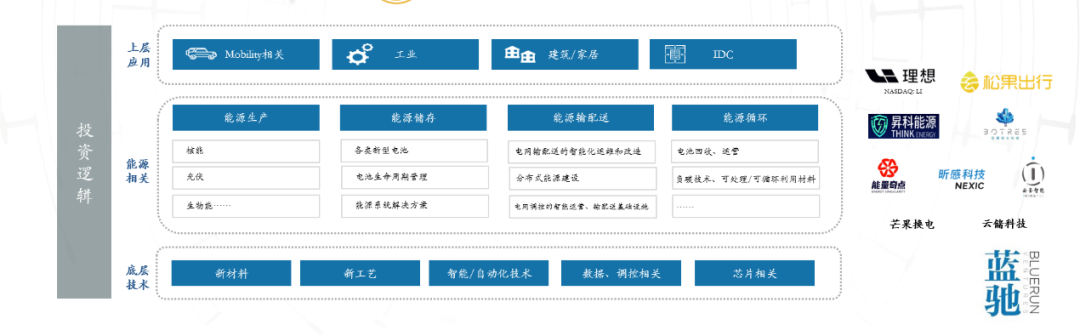
In practice, BlueRun's new energy portfolio is already distributed across every corner of this framework, including: new energy vehicle company Li Auto, new energy battery recycling solutions provider Borui Recycling, SiC power semiconductor company Xingan Technology, battery intelligence infrastructure platform Ascend Energy, digital energy management system Yunchu New Energy, and giant intelligent mining haul truck developer Yimo Intelligence, among others.
And within the portfolio list, we also found a company with "science fiction" overtones that in some sense represents BlueRun's "grand vision" in new energy: Energy Singularity.
Founded in 2021, Energy Singularity focuses primarily on controlled nuclear fusion. It was co-founded by multiple overseas-returned experts in theoretical physics, plasma physics, and high-temperature superconductivity, with the ultimate goal of achieving humanity's energy freedom. Controlled nuclear fusion, also known as artificial sun, produces fusion energy with numerous advantages: unlimited supply, economic viability, predictability, cleanliness, and safety. It represents the ultimate form of energy that humanity can master at our current level of scientific development.
"The proposition of an artificial sun is hard not to get excited about. Major countries, including our own, are concentrating resources on developing controlled nuclear fusion technology and attaching great importance to it. We're at the same starting line, and China has relative advantages. We believe that if it can be delivered according to plan, it will be an excellent investment target." The BlueRun team's decision to enter this space demonstrates the patience and ambition that are plainly visible in their new energy investments.
02 Capability and Taste
Although investment opportunities in new energy are numerous and fragmented, careful observation of BlueRun's existing project distribution reveals a discernible logic.
Having researched and entered the new energy space early, BlueRun has developed a distinctive approach through practice. Its invested projects can be summarized in three main directions: first, digital transformation integrating information technology; second, projects centered on new energy vehicles and mobility; and third, underlying new materials and new component processes.
In other words, the focus is on "the informatization and digitization of energy." BlueRun leverages its established strengths in "information technology" and its early foothold in the "electric vehicle domain" as foundational capabilities. Rather than blindly chasing hot trends, it seeks technology-driven, paradigm-shifting targets within the new energy sector.
Li Auto stands as BlueRun Ventures' most iconic project in new energy — "entered early, invested across 5 consecutive rounds, with increased commitment each time." Through its investment in Li Auto, BlueRun gradually built experience and understanding across the electric vehicle industry chain. They realized that future opportunities in the EV market would center on "range anxiety," and at its core, this meant batteries or how batteries are operated.
Around the theme of "full lifecycle battery management," BlueRun mapped out the entire closed-loop industry chain, from production to operation to maintenance, ultimately focusing on battery recycling, reuse, and utilization. In 2020, it invested in Borui Recycling, a player in the "energy circulation" sub-sector.
Borui Recycling primarily provides secondary utilization solutions for metal resources to the new energy, new materials, and resource recycling industries by establishing recycling processes to extract rare metals and enable high-end metal material recycling.
According to Tao Yeliao, the BlueRun investor who led the project: "When we invested in Borui Recycling in 2020, the used EV pricing market was quite chaotic, and the overall EV battery recycling market had not yet developed. But in our extensive communications with battery operators, we vaguely sensed that 'mining' would be a sector very worth paying attention to, because it indeed occupies the vast majority of battery costs."
In fact, traditional "solid waste and hazardous waste" recycling had long been subject to regional restrictions at the local level, with crude and conventional recycling methods. In recent years, market attention to this sector has risen sharply. The most notable marker has been the dozens-fold increase in lithium prices over the past two years. Major enterprises including CATL, electronics manufacturers, and OEMs have all recognized the tremendous value that battery recycling technology can create, placing it at top priority.
Unlike traditional recycling operators, Borui Recycling has leveraged decades of accumulated expertise to develop solutions better suited to battery material recycling, capable of regenerating over 90% of metals from spent batteries into battery-grade products and recovering over 20% of total vehicle value. Currently, numerous leading benchmark battery producers, EV companies, mining enterprises, battery recycling operators, and battery service companies have established deep partnerships with Borui Recycling. Moreover, Borui Recycling's business is not limited to the domestic market; it also provides solutions to a large number of global clients.
In "full lifecycle battery management," BlueRun has also invested in Ascend Energy. Unlike Borui Recycling, Ascend Energy primarily empowers charging, energy storage, and recycling applications through AI technology. Specifically, during battery usage, performance may be affected by factors such as duration of use and temperature fluctuations. Ascend Energy aims to monitor and detect battery conditions for the purpose of improving battery safety testing and establishing battery residual value assessment systems, providing intelligent safety operations services and comprehensive solutions.
Energy storage is another key focus area for BlueRun. In this赛道, they look toward the true pain points and future of storage, having invested in Yunchu New Energy. Chan explained to 36Kr that Yunchu has built a new paradigm for battery applications based on dynamic reconfigurable battery networks, grounded in a digital energy storage full lifecycle management system. It transforms traditional direct hard connections between batteries into program-controlled flexible connections, achieving intrinsic safety and efficiency improvements in battery systems. This enables system-level battery lifespan to equal single-cell lifespan, greatly enhancing storage system availability and improving storage system economics by over 30%. It solves the problem in traditional battery frameworks where a single battery failure renders the entire storage system unusable, dramatically improving the safety and economics of conventional energy storage and addressing the biggest pain point in past storage applications. The technologies involved span cloud computing, semiconductor materials, energy storage, and more, representing a massive innovation and advancement over traditional storage technologies. Currently, Yunchu New Energy has established deep partnerships with leading enterprises including China Huadian Group, China Three Gorges Corporation, China Mobile, and State Grid Corporation of China.
All of the above are potential projects with cross-disciplinary, hybrid characteristics that BlueRun has identified ahead of the market through its unique aesthetic framework.
03 Cross-Disciplinary and Cross-Boundary
The energy industry is inherently a trillion-dollar market, and many "behemoth" enterprises already exist within it. For both startups and VC investors, "opportunity" lies hidden in those cross-disciplinary, hybrid projects.
On the importance of team compositional capabilities, Chan has repeatedly emphasized this point. Investors focused on new energy today must understand technology, understand AI, understand energy, and understand industry — undoubtedly no small challenge.
The BlueRun team is composed almost entirely of science and engineering backgrounds. Faced with cross-disciplinary, cross-boundary projects, the team evaluates them through cross-group collaboration. Tao Yeliao noted: "For virtual power plant projects, we'll assess them together with colleagues from enterprise services. For hydrogen energy-related projects, we'll collaborate with colleagues covering industrials."
"Composite capabilities" are equally important for founders in the new energy industry, and this is what BlueRun favors.
"We want to invest in an entrepreneur, not just a scholar or academician. So we need founders who not only understand technology but also possess entrepreneurial spirit, who embody the characteristics that fit the entrepreneur label."
Moreover, "the energy industry supply chain is complex and lengthy, so founders must also possess strong resource integration capabilities to coordinate various issues that may arise upstream and downstream," Chan continued. "We often say hard tech, soft landing. Take battery recycling, for example. The founder must first prove that what you're doing is an indispensable 'value creation' link, then gain 'value' recognition from upstream and downstream enterprises, before having the opportunity to change traditional recycling methods."
Evidently, investment and entrepreneurship in new energy no longer follow the paradigms and playbooks of the mobile internet era. Yet we can see that a group of people who believe frontier technology will ultimately transform traditional industries are personally entering the new energy space, and industry transformation and disruption may occur within just three to five years.
"Traditional energy industries also need to embrace change. As investors, our advantage is being able to stand at an elevated vantage point, understanding the changes the industry is undergoing through a multi-dimensional,立体 industrial perspective, thereby discovering 'fast opportunities in slow tracks.'"
With cross-boundary vision and cross-disciplinary capabilities, BlueRun Ventures has established a uniquely advantaged position in the new energy赛道. Faced with the historic opportunity in new energy, BlueRun Ventures is well-capitalized and fully prepared.
Further Reading
- BlueRun Ventures ranks TOP2 in 36Kr's "Most LP-Recognized Early-Stage Investment Institution"
- Jui Chan, BlueRun Ventures: Investment volume will not decrease this year, concentrating on advantaged projects
- BlueRun Ventures: The golden age of tech investment has arrived, being a calm先行者 in era transformation and industrial innovation
- Missed BlueRun Demo Day with 4000+ project matchmaking attendees? What's the remedy?

BlueRun Ventures was established in Silicon Valley in 1998. BlueRun Ventures China was founded in 2005 and is a venture capital firm focused on early-stage startups.
Currently, BlueRun Ventures China manages multiple USD and RMB dual-currency funds, with assets under management exceeding RMB 15 billion, making it one of the largest early-stage funds in China. Its investment stage focuses on Pre-A and Series A, covering hard tech and innovative interaction, enterprise technology, new consumption, and healthcare. It has cumulatively invested in over 150 startups, including Li Auto, Waterdrop, QingCloud, Guazi Used Cars, Qudian, Songguo Mobility, Ganji.com, Energy Monster, Yuntu Semiconductor, Machenike, Cloud Saint Intelligence, Anxin Network Shield, and BioMap.
BlueRun Ventures has been ranked #1 in Zero2IPO's "China Top 30 Early-Stage Investment Institutions," #1 in ChinaVenture's "China Best Early-Stage Venture Capital Institutions TOP30," and named among Preqin's Top 10 Global VC Fund Managers for Sustained High Returns.
Additionally, BlueRun Ventures has for multiple consecutive years received honors from Forbes China, 36Kr, Cyzone, Caixin Media, CBNweekly, Jiemian, and other media institutions, including "China's Best Early-Stage Institution of the Year," "China's Top Venture Capital Firm," "Most Entrepreneur-Friendly Early-Stage Institution of the Year," and "Most Influential Early-Stage Institution of the Year."