A Conversation with VITURE's Gonglue Jiang: From Negative Demand to Indispensable — How We Became America's #1 AR Glasses | BlueRun Ventures Family Headlines

Getting users to put on the glasses — that's step one.

This article is republished with permission from LatePost (ID: postlate)
Authors: Jiahao Zhang, Wei Song
As the founder of an AR glasses company, Gonglue Jiang believes the first principle of building smart glasses is that users don't need glasses at all.
Smart glasses are a product that starts from negative territory — and that negative number is the price of LASIK surgery. "If you want users to put glasses back on," Jiang says, "the only way is to give them an offer they can't refuse."
VITURE chose gamers as its target users, and that irresistible offer — giving them a big screen they can carry anywhere, streaming console games on the subway or in a café.
VITURE is the fastest-growing startup in this industry. Founded in 2021, by the end of 2024, VITURE had cumulatively sold several hundred thousand AR glasses in the United States, starting at $459, securing the top position with over half the U.S. market share.
BlueRun Ventures was the sole investor in VITURE's Series A+ round and has continued to support the company since.
In the second half of last year, VITURE founder Gonglue Jiang first met Meituan co-founder Huiwen Wang. Wang said startups make two major mistakes: investing too many resources before product-market fit (PMF) is validated, and failing to pour in more resources quickly enough once PMF is achieved.
Soon after, Wang became an investor in VITURE's latest funding round. He described Jiang as someone capable of consolidating design, technology, product, and business skills into a single brain.
Jiang graduated from Beihang University's Industrial Design program and later studied interaction design at Harvard University — a discipline at the intersection of design and programming — becoming the first Asian student in that program. In appearance, he looks very much like a designer: tall and thin, with round glasses and a meticulously groomed beard.
After graduating from Harvard in 2012, Jiang joined Google, where he witnessed the birth and eventual failure of Google Glass, the progenitor of AR glasses. In 2017, he built Rokid's AR glasses team from scratch in Silicon Valley. In 2021, seeing the opportunity for consumer-grade AR glasses to take off, he returned to China and founded VITURE.
VITURE co-founder Emily says the foundation of a successful hardware company is that the founder must be a genius-level product manager. She believes Jiang is exactly that.
"Glasses are a product at the intersection of technology and humanity. Glasses are extremely small; buildings are extremely large. Designing a great pair of glasses is as difficult and as rewarding as creating an outstanding piece of architecture," Jiang says.
VITURE has won a series of design awards including the iF Design Award and the Red Dot Design Award. One of these awards recognized VITURE's accompanying neckband — they moved the computing unit and controller from the glasses to the neckband to reduce weight, rather than following other manufacturers in making a handheld "remote control."
To become the top AR glasses company in the U.S., VITURE assembled a team of just over a hundred people. Jiang believes in quality over quantity — if they can't find the right person, they'll keep waiting rather than hire someone subpar. Regarding R&D investment for startups, he says that if R&D fires a shotgun, there's massive waste; you need to choose the right path, like a sniper rifle penetrating with a single shot.
Since the 2012 launch of Google Glass, AR and VR have carried the expectation of becoming "the next computing platform," yet they never truly entered the mainstream, remaining expensive digital toys for years. In 2024, global AR+VR sales reached 10 million units — far from the 1 billion+ smartphones sold, and well below the 90 million smart watches. Jiang believes the industry's core problem is that no one uses these products, "If no one uses them, your industry is dead water. No amount of talk about ecosystem or software matters."
The Ray-Ban Meta, launched in late 2023, sold over 2 million units in its first year. Though it's a screenless glasses model that users mainly bought for style and photography, it ignited imagination around AI-integrated glasses. Beyond VITURE, companies including Rokid, XReal, Thunderbird Innovation (Leiniao), and Even Realities completed new funding rounds last year, with cumulative fundraising nearing 1 billion, and glasses products with integrated AI capabilities have been released one after another.
Those willing to bet on this industry believe glasses are the best hardware for AI — always online, operable hands-free. "I think the ultimate future is having only glasses as your single device, because it has the largest interface and the best mobility."
But Jiang makes clear that VITURE won't make products like Ray-Ban Meta, because that's a form factor easily crushed by tech giants. The only path for small companies is to make the right choices earlier than big companies.

LatePost: You were once a member of the Google Glass team. Google Glass launched in 2012, regarded as the progenitor of AR glasses, but Google eventually shut it down after several years. As someone who lived through it, why do you think it failed?
Gonglue Jiang: Google Glass was the classic case of holding a hammer and looking for nails — not a product built from real user needs.
The project was personally led by Sergey Brin, who wanted to create a tech product that looked cool when worn. But it had no use case. Google Glass focused on information notification; if glasses want to provide value through information notification, they need to be worn all day, but the Google Glass form factor wasn't suitable for all-day wear, and the high price meant users weren't willing to pay that much for notifications. From the outside it looked like Google Glass took a long time to fail, but internally it was essentially dead on arrival — when it first launched, most people at Google wore one; after a few months, almost no one did.
I believe building products ultimately needs to follow the Tao of nature. If you can't make users feel value, no amount of brand or resources will help.
LatePost: The classic Silicon Valley model. What legacy did Google Glass leave the industry?
Gonglue Jiang: Although Google Glass didn't achieve commercial success, I believe it was absolutely successful from the perspective of human technological development. It opened up the AR glasses track. Looking back, Google Glass at that point in time was breakthrough enough to integrate full-color display, photography, and voice dialogue in a lightweight all-in-one form — and many newly launched products still can't match this capability today.
LatePost: You joined when Google Glass was born. What was the most important thing you learned?
Gonglue Jiang: Everyone wants to build the most advanced weapon, but the right path might be using millet and rifles — an approach many might look down on.
I'll give an example. The new display technology the industry is currently exploring is waveguide, but what we currently use is BirdBath (coaxial empty waveguide, an optical technology that uses reflection principles to form images), which has drawn some criticism because many people see BirdBath as low-end, a technology to be eliminated.
Our core criterion for choosing technology is whether it can help us reach our ultimate goal. Waveguide has incomparable technical potential. Because BirdBath operates on a semi-transparent, semi-reflective principle, its external light transmittance is about 25%, while waveguide can reach 95% — it allows the lens to be completely transparent when not displaying, infinitely approaching the form of ordinary glasses, determining the upper limit of AR glasses' future. But waveguide is still maturing, currently with limitations in specific scenarios: low light efficiency, narrow field of view and low resolution, poor color and brightness uniformity, high price, and other core user experience defects. These characteristics determine that with current technology, BirdBath is more likely to find PMF, which is why the glasses solution with the highest shipment volume currently is BirdBath, not waveguide.
Precision judgment of the industry's future is like the scope on a sniper rifle — not too early, not too late, but just right. Our adoption of waveguide will be built on specific user scenarios, but that's still 3-5 years away. The core is still finding that PMF inflection point in the technology evolution process.
LatePost: After Google Glass, there were also star companies like Magic Leap. But why hasn't this market exploded after all these years?
Gonglue Jiang: The AR glasses industry carried too much expectation and imagination in its early days, departing from normal business logic. Too often it was building hammers and looking for nails, departing from the essential user need — why do you need a pair of glasses? What functions can this provide that phones, computers, watches, and headphones can't? And is this function truly a hard need?
Additionally, many AR companies chased sales volume with low or even negative gross margins, because R&D investment was huge, making them unsustainable. The robot vacuum industry is also competitive, but companies there generally have nearly 50% gross margins.
The same with VR. Quest 1 sold over 2 million units, Quest 2 sold 8 million, so people naturally assumed this market would have the same growth curve as smartphones — 100 million this year, 200 million next year, then 500 million, 1.5 billion. The market later proved this growth unsustainable. And from a more fundamental perspective, VR headsets are a subset of game consoles — a device you play in your living room. Xbox, PS5, and Switch combined sell over 30 million units annually, so VR's ceiling is roughly 10 million units; from a product attributes perspective, it doesn't have the growth curve of smartphones.
LatePost: The problem with VR headsets is obvious — they're too heavy.
Gonglue Jiang: The first thing in building a head-worn product is determining whether it's for all-day wear or scenario-based wear. For glasses in all-day wear scenarios, the ceiling is 40 grams; for scenario-based wear, the ceiling is 80 grams — this is a hard metric.
Based on this constraint, computing, communication, and battery life — these three are unlikely to all fit on the glasses, or the weight will be exceeded. So we created the neckband form factor, moving everything that doesn't absolutely need to be on the head down. VR headsets, with additional support points increasing friction on the forehead and back of the head, have a higher ceiling, but our calculations show they still can't exceed 250 grams.
LatePost: Vision Pro (650 grams) is much heavier than the 250 grams you mentioned. It has cumulatively sold over 500,000 units, below expectations.
Jiang Gonglue: Wear it for 40 minutes and your face starts hurting. I've seen a lot of people say that if Steve Jobs were still alive, he'd have torn the Vision Pro apart. Actually, Jobs said at a D3 conference that if someone could make something glasses-like where you put it on and see a 50-inch TV, that would be a magical product.
LatePost: But you said earlier that both Vision Pro and ChatGPT are epoch-making products.
Jiang Gonglue: Yes. Just like Google Glass's foundational significance for the industry, Vision Pro gave people that "being there" feeling for the first time. It pushed PPD (pixels per degree) above 40 — previous VR headsets were all 15-20. It proved how much PPD matters, delivering a completely different visual experience. That's epoch-making.
Vision Pro's most killer feature is spatial video. I believe spatial video will become an entirely new media format. Right now there aren't enough devices or content supporting it, so we built Immersive 3D based on visual AI models — real-time conversion that turns all existing content into 3D spatial video using AI. Future glasses will likely capture high-definition, panoramic 3D content directly, and when you play it back on the glasses, it'll feel like you're actually there.
From radio to black-and-white TV to color TV, we've been progressively simulating the real world. This was always going to happen.
LatePost: Vision Pro's main problem is that the cost of acquisition is too high. If you were Vision Pro's product manager, how would you improve it?
Jiang Gonglue: There are many mistakes that could have been avoided entirely. That front-facing screen that displays your eyes? Completely unnecessary. The cameras and sensors that capture your face? Ditch those too. To accommodate that eye-display screen, they made the housing from a single piece of heavy tempered glass — that can go too.
Remove all of that, and costs come down, weight drops, while the core experience stays unchanged.
LatePost: Is there industry consensus on what functions AR glasses should provide, what problems they should solve? Is everyone heading to the same destination?
Jiang Gonglue: This industry is like a dice cup rattling forward with lots of dice inside — much remains fuzzy because there are too many paths, too many variables. The five core elements of glasses — display, perception, interaction, computing, and communication — each are variables. Even within display alone, light introduces massive variables.
My personal view is that the ultimate form of glasses is a sufficiently large human-computer interface, even infinitely large.
From radio to television to PC to phone to tablet, these are fundamentally human-computer interaction devices — converting analog signals to digital signals for you. Why did we need laptops, phones, and tablets after desktops? Because we've always pursued larger interfaces and greater mobility, but these are inversely related. The more mobile, the smaller the interface. Glasses are most likely to finally solve this inverse relationship — achieving the largest interface plus the strongest mobility.
I think the ultimate future is where glasses alone are sufficient, because they offer the largest interface and the best mobility. But for a considerable period, they'll coexist with phones — maybe 10 to 20 years. So the core isn't about replacement, but about user choice. Whether we're building a product or making a choice, the principle we follow is dao fa zi ran — following the way of nature.
LatePost: Dao fa zi ran — how do you understand that?
Jiang Gonglue: Dao fa zi ran (from the Tao Te Ching). When you build a product, you must go with what's natural. Nature here means technological development and the evolution of human needs — you adapt to that, rather than deciding what you want. For example, wanting glasses to replace phones — that starting point itself violates dao fa zi ran.

LatePost: At the start, how did you determine PMF (Product Market Fit), and why did you choose gamers? Other companies in the industry like Thunderbird and MEIZU are focused on video viewing.
Jiang Gonglue: The five AR glasses technology stacks — display, perception, interaction, computing, and communication — we believed phase one was to first get display right: providing a larger, more immersive screen than phones in mobile scenarios.
With this understanding, we looked for which demographic valued this scenario most, and landed on gamers. Our core experience was "play console games anywhere, anytime with glasses," because this group has the strongest demand for a large, mobile screen and is most willing to pay.
I've always said internally that the first principle of building glasses is that users don't need glasses. Why should consumers bear the cost of wearing glasses? You need to give them an offer they can't refuse.
LatePost: But video viewing is the easiest choice — you just need screen mirroring. For gaming, you need to build lots of other supporting hardware.
Jiang Gonglue: Exactly. So we made the neckband for console streaming, the Magic Dock for Switch compatibility, and all the software above. On the surface it's different target demographics, but fundamentally it's different starting points and different technology chains.
What we want to sell users isn't AR glasses, but an experience they genuinely need that hasn't been satisfied yet.
LatePost: VITURE has cumulatively sold several hundred thousand units. For the user segment you've targeted, what's the ceiling?
Jiang Gonglue: Based on annual game console shipment volumes, our product ceiling is roughly 10-15 million units shipped.
Before we hit that ceiling with gamers, product iterations with significantly improved experience will cause demographic expansion. For example, when clarity and field of view reach certain thresholds, the experience surpasses your office monitor — while also offering privacy and low power consumption. Then the mobile office scenario becomes viable.
LatePost: Phase one is display. What's next — perception, how will you approach that?
Jiang Gonglue: Perception is more complex. We need to use cameras to calibrate the physical world and simulate three-dimensional interaction. For example, I can grab a water bottle because human eyes have spatial perception — photons reflecting off the bottle hit my retina, and my brain coordinates my hand to grasp it accurately. To perfectly merge virtual objects with the real world on glasses, cameras need to establish a coordinate system within the field of view, matching the display object's coordinate system with the real world's. The more stable and accurate the match, the less dizziness.
This is called Motion to Photon, or M2P. Motion is movement; photon is light. Whether VR or AR, the core is achieving low M2P latency. Humans perceive latency at 7 milliseconds — beyond that, the nervous system detects it, causing dizziness. Vision Pro achieves 12 milliseconds, which is already quite extreme.
LatePost: What's the most effective way to reduce M2P latency?
Jiang Gonglue: It's somewhat like how NVIDIA builds graphics cards — you need to bring various hardware components closer together. Much of the latency actually happens in the wiring; shorter wires mean lower latency.
Many people say Vision Pro is too heavy. If you can externalize the battery, why not externalize the computing unit too? But the problem is that wire. If computing goes external too, latency increases by at least 20 milliseconds. So the best form is local perception, local computing, local display — but this brings other problems.
LatePost: In building VITURE's products, what technology or experience are you most proud of?
Jiang Gonglue: It's the real-time 2D-to-3D conversion using local compute power on iPhone and Mac. It can turn content from YouTube, Netflix, and other platforms into 3D for real-time viewing, and also convert users' own photo albums into 3D — all without relying on any cloud computing, completed entirely with on-device local processing.
As the only AR brand invited to NVIDIA GTC, we demonstrated running AAA titles on an RTX 5090 while simultaneously running our 2D-to-3D model, achieving ultra-low latency real-time 2D-to-3D gaming. This was the most extreme challenge, and it astonished many senior AI engineers at NVIDIA.
This feature was first implemented on our iPhone SpaceWalker software. Without your own software, this kind of low-level AI functionality wouldn't be possible. In early 2023, we predicted iPhone would switch to Type-C and started interviewing iOS engineers. When the first Type-C iPhone launched that year, we had this software ready, creating product differentiation and a lead.
LatePost: What capability does this demonstrate?
Jiang Gonglue: Integrated innovation across software, hardware, and AI.
LatePost: Is developing such features high-investment? As a startup, how do you balance R&D investment and output?
Jiang Gonglue: If your R&D lacks clear direction, it's like firing buckshot — massive investment. But if you can clearly see a development path, it's like having a sniper rifle: one bullet penetrates. The R&D investment actually isn't that large.
LatePost: You said computing, communication, and battery life can't all be on the glasses because it gets too heavy. Your solution was creating a neckband, which won design's grand slam. How did you come up with putting the computing unit in a neckband? Why did it win so many awards?
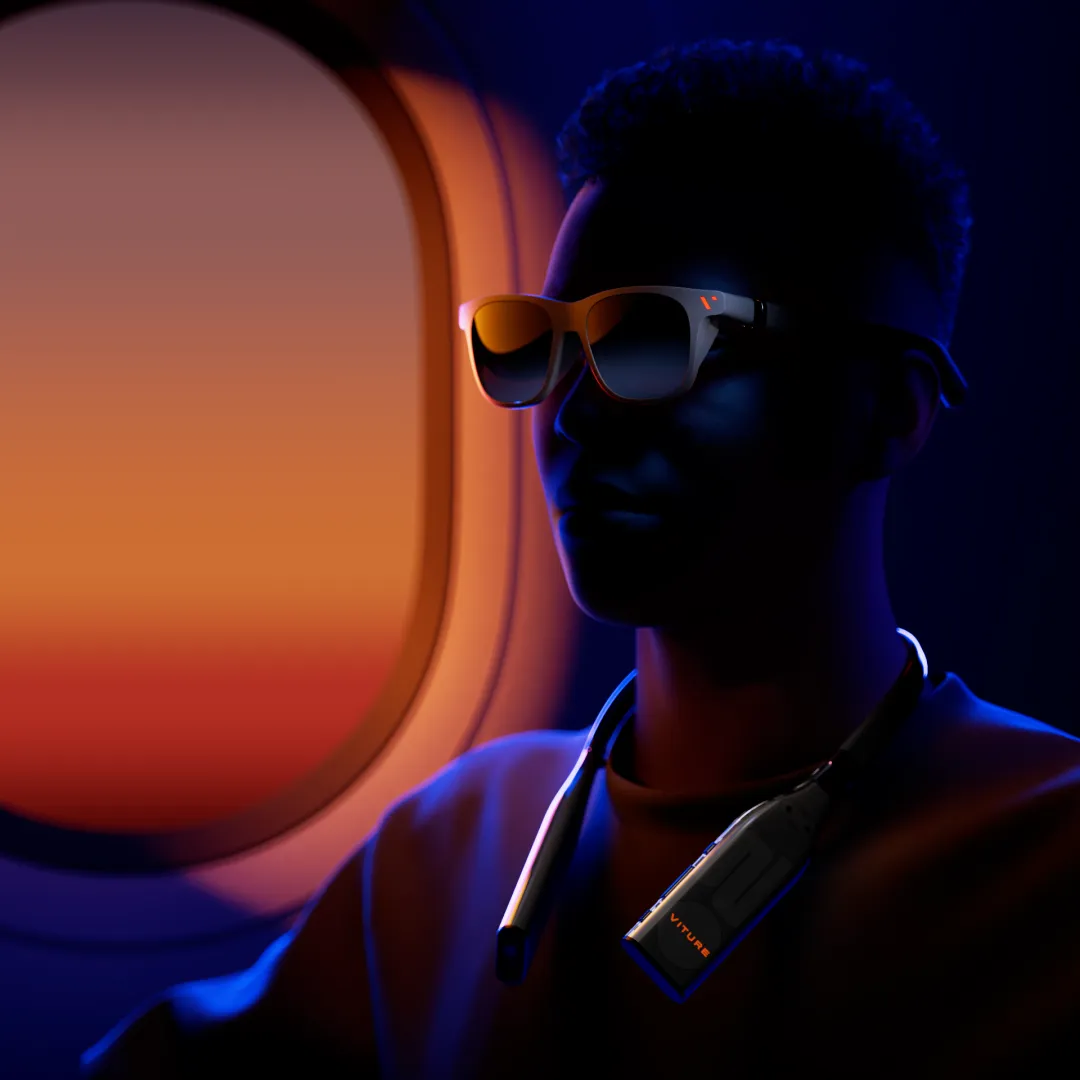
VITURE's neckband product, dubbed "the game console for your neck"
Jiang Gonglue: We were the first to put computing, communication, and battery weight into a neck-worn device — and this neckband is beautiful and comfortable to wear.
The design still follows dao fa zi ran. There are only five wearable positions on the human body: ring, watch, necklace, glasses, and earphones. Among these, the neck can bear the most weight. Women's neck jewelry is actually quite heavy — if women can wear that, men wearing a 160-gram neckband is certainly no problem.
Earphone development followed this pattern too. The first generation of wireless earphones were neckband-style, with wires connecting the earpieces to the neckband. True TWS (True Wireless Stereo) came later. How do you guarantee computing, communication, and battery life while keeping it feeling light and looking good? Only the neckband satisfies this. The form factor isn't hard to imagine, but executing it is far from simple.
LatePost: Are glasses plus neckband a transitional form? When will true all-in-one be possible?
Jiang Gonglue: Fundamentally, it's a math problem.
Our current glasses weigh 76 grams, which is already quite light — comfortable enough for situational wear. Our first-generation neckband was 195 grams; the second generation is 160 grams, with 10x computing performance and 50% better battery life. More power, less weight — the same logic as all consumer electronics. But it's still 160 grams. Only when that shrinks enough to fit inside the glasses will it truly be an all-in-one device. That path is still long.
LatePost: What have you done to reduce weight?
Jiang Gonglue: At this stage, weight is fundamentally about tradeoffs. Our tradeoff is not to over-pursue battery life — you can connect an external power bank, so the battery itself doesn't need to be so large.
Our first-generation neckband lasted about two hours; this one does three to four. We're clear that this isn't an all-day wearable. We're meeting situational wear needs.
LatePost: Have you innovated on materials? How much can materials and processes reduce weight?
Jiang Gonglue: People look at our glasses and sense a premium quality because we use magnesium-aluminum alloy, with an ultra-thin 0.7mm design to ensure strength while minimizing weight.
This material is expensive and difficult to work with. We use semi-solid die casting because pure solid-state casting can't achieve this thinness. After pressing, we use CNC (Computer Numerical Control) machining to cut the internal structures. Our hinges are titanium alloy, again for strength and lightness.
LatePost: You often describe your ideas and approaches with "dao fa zi ran" (the way follows nature). When did you come to understand this? Does it connect to your interest in architecture?
Jiang Gonglue: Very much so. The basic function of architecture is shelter, but beyond that, it enables more harmonious coexistence between people and nature — you find harmony through the interplay of light, shadow, and natural elements that architecture creates. Some renowned buildings, at different hours of the day or seasons of the year, let you experience distinct moods through how they reshape light, airflow, and space. These moods seem to embody the architect's vision of "dao fa zi ran" standing before that foundation.
Products are the same. Consumer electronics can possess spiritual attributes too — not by hiring a designer to wrap a pretty shell around it, but by conveying resonance through the product's essential value.
LatePost: For example, what's your favorite building in Beijing?
Jiang Gonglue: Yonghe Temple (Lama Temple). Its scale and mass, the solemn stillness it projects amid the bustling city — incomparable.
LatePost: I recall an architect saying that the best buildings are created under extremely constrained environmental conditions.
Jiang Gonglue: Yes. Building on barren land, you don't know where to begin. It must be based on, and integrated into, the surrounding environment. Products are the same — it's precisely because of constraints that you can create something sufficiently moving.
LatePost: Functional-artistic integration — do you think all consumer hardware must do this?
Jiang Gonglue: I believe wearables absolutely must. Like why people buy different clothes — not just for warmth or function, but as self-expression, to communicate who we are.
Wearables follow the same logic. Design carries enormous weight in their value, because compared to phones they're more externally visible. Especially glasses — whether or not someone needs vision correction, people want to express a better self through the glasses they wear.
LatePost: For glasses, is aesthetics the most important thing?
Jiang Gonglue: For most people, aesthetics is the first gate. Passing it doesn't guarantee a purchase, but if you don't pass it, you never get the chance.

LatePost: After VR and AR, AI glasses are hot again because Ray-Ban Meta sold over 2 million units. Some investors and practitioners now believe glasses are the best vehicle for AI. Do you believe this?
Jiang Gonglue: Glasses are definitely the best landing scenario for AI. The frequency and duration of people's daily AI interactions have reached a tipping point. Glasses offer two crucial characteristics: Always on and Hands off.
Glasses can also capture multi-dimensional data — eye movement, head movement, first-person video. Theoretically, this data can be acquired automatically and imperceptibly, all day, and it's personalized user data. Feeding this into AI would make it extraordinarily intelligent.
Conversely, AI provides huge reinforcement for glasses. What plagued the XR industry was interaction — now with large models, human-glasses interaction has become nearly natural. Previously users had to deconstruct their intent and translate it into mouse, keyboard, or touchscreen actions. Today, AI agents can directly understand human intent and deconstruct and execute on their own.
LatePost: For AI glasses to truly gain mass acceptance, what's the most essential function to achieve, and what's the biggest obstacle to overcome?
Jiang Gonglue: The first element is sufficiently personalized fashion. Glasses themselves are a product with massive SKU variety, mainly because different face shapes require different frames and styles. The tension between fashion's need for personalization and consumer electronics' need for mass production — resolving this tension is critical.
Second is product-market fit, and today that PMF means integration with AI. There are many details here — for example, seamless wake, where you don't need to pause between the wake word and intent. You say "Hey VITURE, order a coffee," and it executes directly.
But ultimately, users being willing to wear it and wear it for extended periods is what matters most. That's the foundation for AI to exercise its capabilities.
LatePost: What are the ceiling and floor of the smart glasses industry?
Jiang Gonglue: The ceiling in phase one is everyone who currently wears glasses.
LatePost: What if LASIK surgery becomes ubiquitous?
Jiang Gonglue: We've always said glasses are a product that starts from negative territory. The negative number is the price of femtosecond surgery. Many people spend tens of thousands to get rid of glasses. Now asking them to put glasses back on requires far more effort than a product starting from zero. We can't early on force non-glasses-wearers to wear them — that's extremely difficult.
LatePost: Mark Zuckerberg has said that people who don't wear glasses will wear AI glasses in the future.
Jiang Gonglue: To some degree this holds. When your content, social connections, and data all live in the glasses, then you truly have to wear them — the same logic as myopic people needing glasses.
LatePost: That's the ceiling. What's the floor?
Jiang Gonglue: The floor is heavy AI users. This group isn't small either. If we'd talked six months ago, maybe only a small subset used AI daily. Now it's become a national-level application.
LatePost: What's the must-have function for AI glasses? We previously interviewed an investor who felt that besides photography, translation would be another must-have. Do you agree?
Jiang Gonglue: Translation is a relatively low-frequency scenario, and requires both people to be wearing glasses. Using a mobile AI translation app is probably a simpler, lower-cost solution.
LatePost: What do you think the ultimate AI Agent interaction will look like? Some say it definitely won't be graphical UI, but rather something newer.
Jiang Gonglue: Human senses evolved naturally to interact with this world. Hands and mouth are outputs to the world; eyes and ears are inputs. So the solution is relatively simple — whatever aligns with human sensory characteristics.
LatePost: Why are glasses the ultimate solution, not brain-computer interfaces? Or screens on the eyeball?
Jiang Gonglue: The human brain is an extremely complex system. What you think, what you say, and what you ultimately execute may not be fully consistent, so brain-computer interfaces can't achieve complete accuracy.
Screens on the eyeball are an order of magnitude more difficult than AR, and they can't solve audio input and output either. So glasses are a near-ultimate form — they simultaneously and perfectly address vision and hearing, which together account for 94% of human sensory information acquisition.
LatePost: Why didn't you make a Ray-Ban Meta-style product? Do you think that's a product category where big tech will crush everyone else?
Jiang Gonglue: Ray-Ban Meta's success owes mostly to Ray-Ban's brand and distribution. It focuses on first-person perspective shooting, providing unique content supply for short video and social platforms while generating viral spread. If we only have product elements without these other elements, it's very hard to differentiate and succeed. Startups need to find potential future consensus that is currently non-consensus, and dig deep there — accumulating high enough barriers before consensus forms. Ray-Ban Meta is already consensus.
LatePost: If years from now, smart glasses still haven't made it, what do you think would be the reason?
Jiang Gonglue: To me this is like asking why 1+1 doesn't equal 2. The era of smart glasses will certainly arrive — it just needs an evolutionary process.

LatePost: You launched your crowdfunding campaign around April 2022, broke the platform's record, and became the US AR glasses market share leader in Q4 last year. Breaking through in the US is remarkable, and building brand mindshare probably isn't your core strength. What was your strategy?
Jiang Gonglue: The $3.1 million crowdfunding total was within our expectations. The previous record was Oculus at $2.4 million. We judged we could surpass it, but not by too much.
Using crowdfunding amount to prove PMF is one aspect. More importantly, in any industry's early stage, you need community for efficient iteration. The word "community" in the US isn't just tech circles — it's important throughout American society. Several of our US employees were originally our Kickstarter users. They supported our product during crowdfunding, believed in the company's vision, and thus personally joined this transformation.
Every user comment on Kickstarter during the crowdfunding period — I replied to all of them. I was immersed in the forums daily, communicating with users, gradually developing different product insights. Because a brand's greatest value is serving its users, being friends with users. To this day, I and the core team still make time to browse forums and reply to comments.
LatePost: What valuable comments did you see at the time?
Gonglue Jiang: There were many. For example, our neckband charging case came from user suggestions — it stores and charges at the same time. A lot of people wanted it, so we set a $3 million crowdfunding stretch goal, and if we hit it, we'd make it. After we did, the attach rate was very high. It proved that building products for users was the right path.
LatePost: What do you think is the most core factor for hardware consumer brands going global? What are the most common mistakes you see Chinese teams make?
Gonglue Jiang: The core is still whether PMF holds. Just like evolution in nature comes from mutation, and most mutations get eliminated — only the most vital, the ones that truly belong in that moment and environment, explode in growth and become the new paradigm.
Today, many hardware teams going global are already top performers, but success with innovative categories and products remains a low-probability event. AI Pin is a classic case where PMF didn't hold — it's hard to say what problem it solves, who should buy it, what value it provides.
LatePost: What products did people think had PMF at the time, but turned out not to?
Gonglue Jiang: Smart speakers count as one. Glasses purely for photography might count too — whether PMF holds is relative to people's expectations. At first everyone thought they'd be entry-level products, but later their inherent volume stayed niche.
LatePost: You've been relatively smooth in the US market. Coming back to the domestic market, what new challenges do you face? The domestic market is very competitive now, major platforms have strong bargaining power, and the environment is quite different from the US.
Gonglue Jiang: Domestic demand and purchase decisions are different. For example, VR is hard to achieve the same penetration in China as in Europe and America — one, there's no console culture, user awareness hasn't formed; two, time is fragmented, there's no living room gaming culture. Looking at AR, it's not constrained by time or space, so it's actually a better product form for the Chinese market.
LatePost: You previously said pricing in China should reference Xiaomi phones. The first-generation Xiaomi phone sold for 1,999 yuan, but you now sell at 3,499 yuan.
Gonglue Jiang: The industry hasn't reached that moment yet. When Xiaomi emerged, the phone industry had been developing for decades, but glasses are still very early — they need gradual development.
LatePost: Huiwen Wang invested in you in the second half of last year. What did you talk about when you met, and what important advice did he give you?
Gonglue Jiang: What impressed me most was him saying startups make two biggest mistakes: one, investing too many resources before PMF is established; two, not investing more resources quickly enough after PMF is established.
He also made an analogy: a company needs people who understand technology, product, design, and marketing. What determines the efficiency of this circle of people is actually the efficiency of communication between people. If you could gather people from all these functions into one brain, that organization's information exchange efficiency would be unmatched, higher than any other organization or company. He didn't say it explicitly, but his meaning was that he saw this possibility in me.
LatePost: What did he ask you?
Gonglue Jiang: He actually didn't ask many questions — mainly about some core optical technologies, how to build channels in the future. Unlike many other investors who open with soul-searching questions.
LatePost: What kind of soul-searching questions?
Gonglue Jiang: "What if the big tech companies copy you?"
I think this depends on when the paradigm emerges — the paradigm being when it's certain everyone will buy this. Before the paradigm appears, it's definitely the right choice for big companies to plan carefully before acting. What we need to do is accumulate enough before the paradigm emerges and we face big tech pressure.
LatePost: Meta said Ray-Ban Meta could sell 20 million units a year after launch. Does that count as a paradigm emerging?
Gonglue Jiang: First, I don't think it can sell 20 million — similar to my ceiling judgment on VR. Actually, the first-generation Ray-Ban Meta also failed, but they must have accumulated a lot of user data. For example, users spent most of their time taking photos with it, so for the second generation they made the photo function better.
LatePost: That's also scary for startups — big companies can fail, but they have data and resources to improve the next generation.
Gonglue Jiang: So startups need to make the right choices before big companies can judge through data.
LatePost: Is this related to startups having fewer resources? If you had more resources, could you do everything?
Gonglue Jiang: If I view a startup as a physics or math problem, my own solution definitely starts with the highest ROI — what you invest in to get the most back, there must be choices.
LatePost: You've experienced big companies and worked at startups. When you started your own company, what were three mistakes you told yourself never to make?
Gonglue Jiang: I think the most core is to clearly understand the underlying logic of what you're doing.
Second, when starting a company, think about the industry's endgame. Every industry has an endgame — for smartphones, it was roughly 2016-2017. Endgame means the era of new paradigm growth ends, and winners have formed dominant positive feedback loops. You need to see clearly what the process from now to endgame looks like to make the most correct moves. The arrival of AI has accelerated the endgame for smart glasses — I originally thought it would take 20 years.
Third, it's not about having many people, but having the right people. If we don't have the right person for a position, we'll choose to wait rather than settle for someone凑合. Early talent density and fit determine core competitiveness, ultimately reflected in product strength and industry leadership.
LatePost: As a designer, what are your management characteristics?
Gonglue Jiang: Both rational and emotional. I have strong curiosity about many things, thinking about underlying logic while paying attention to every detail of the business.
LatePost: How do startups recruit good enough talent? How do you attract excellent people to an industry that hasn't had much progress for ten years?
Gonglue Jiang: First, the company's vision must be meaningful and achievable step by step, so what we pursue is rewarding enough.
Second is growth — we judge our correctness by tripling every year, one order of magnitude every two years. VITURE has maintained 3x annual growth since founding. This growth doesn't come from traffic buying, but from transformative product power brought by technological innovation, plus word-of-mouth from users.
LatePost: Among China's new generation of tech companies, who has inspired you most?
Gonglue Jiang: DJI. It started in a niche market, but that didn't stop it from becoming a mass tech brand. Second, it achieved market dominance entirely through extreme pursuit of product and technology, and is one of the very few brands that truly broke into the US mainstream market. Third, its extremely high talent density.
LatePost: Why didn't you choose more established industries like automotive, architecture, phones, or fashion that could affect more people, instead choosing smart glasses — an industry that still needs long development and has extremely uncertain future?
Gonglue Jiang: Because I want to pursue the market with the greatest growth potential within my career span. Those markets you mentioned are large, but they're already存量 markets. I believe AR glasses are the biggest growth opportunity in consumer electronics over the next 20 to 30 years.
The resonance between heartbeats is something AI cannot replicate
LatePost: You said you believe in natural and mathematical laws, and what you want to do is design things based on human nature beyond physics and mathematics. For example?
Gonglue Jiang: I once helped a friend with a speaker. The core component was Nixie tubes — they were previously used to display time, very retro and beautiful. They've been discontinued globally, and remaining stock is very limited — only collectors in Ukraine and Russia still have them. My friend collected these globally and made them into clocks, but sales were quite limited.
He asked me to help design it. My approach was to combine its retro feel with music, while making the number display meaningful — simulating the frequency tuning display on antique radios. After the redesign, we sold it for $400 each, selling over $1 million in about a month until the Nixie tube stock ran out.
The story we gave this product was that a person's memories can be preserved in music — when the music of youth plays, those memory fragments float before your eyes. This is similar to what Apple talks about at the intersection of technology and liberal arts — what you want to create is experience, not function; the product is the vessel of experience.
LatePost: Some entrepreneurs have already divided into two camps regarding AI — one believes AI will eventually rule humanity; the other believes AI will grow together with humanity. Which camp are you in?
Gonglue Jiang: I think AI will always be a tool for humans, or integrate into society, but won't rule humanity.
Also, I think the hardest fortress for AI to breach is art. It creates through imitation, but it has no story, no body, no mortality. The reason we can be moved by art is because the artist's story might be your story — his brushstrokes and notes establish a resonance of heartbeats between two lives across time and space.
LatePost: What kind of resonance do you hope your glasses product creates with people?
Gonglue Jiang: The desire to explore is human instinct, just like that viral resignation letter: "The world is so big, I want to go see it."
When our glasses' interaction bandwidth can reach the upper limit of human senses, we can reshape the real world with digital technology. Our Immersive 3D feature is a small step toward this vision.
Since launch, this feature has received many moving posts. Recently a user posted that his father had just passed away. While sorting through belongings, he found an old hard drive filled with childhood photos and videos with his father. Every time he puts on VITURE glasses and uses the 2D-to-3D conversion technology to view them, he tears up — it's as if his young father is alive right before his eyes.
Broadening life's perception through technology — this is the meaning of our daily struggle.


BlueRun Family | VITURE, which completed a $50 million funding round, says: "AI and AR will eventually merge into a new generation of multimodal devices"

$200 million in sales in two years since founding, Viture tops Amazon's smart glasses category | BlueRun Family Headlines

AI Is Calling — Pick Up | BlueRun Ventures Is Hiring
When Embodied Intelligence Enters Reality | The Path to AGI