From VLA to ViLLA: AgiBot Unveils GO-1, Its First General-Purpose Embodied Foundation Model | BlueRun Ventures Portfolio Headlines

pioneered the Vision-Language-Latent-Action (ViLLA) architecture
AgiBot has unveiled its first general-purpose embodied foundation model — Genie Operator-1 (GO-1) — which introduces the groundbreaking Vision-Language-Latent-Action (ViLLA) architecture. The architecture combines a VLM (vision-language model) with MoE (mixture of experts): the VLM gains general scene perception and language understanding from massive internet image-text data; the Latent Planner within the MoE acquires general action comprehension from large-scale cross-embodiment and human manipulation videos; and the Action Expert within the MoE develops fine-grained action execution capabilities from millions of real-robot data points. These three components work in concert to enable learning from human videos and rapid few-shot generalization, lowering the barrier to embodied intelligence. The model has been successfully deployed across multiple AgiBot robot platforms, evolving continuously and pushing embodied intelligence to a new level.
BlueRun Ventures is an early investor in AgiBot and has participated in three consecutive funding rounds. In late 2024, AgiBot launched AgiBot World, a large-scale, high-quality real-robot dataset containing over 1 million trajectories across 217 tasks in five major scenarios. Building on AgiBot World, AgiBot is officially releasing its general-purpose embodied foundation model Genie Operator-1 (GO-1) today.
Research paper:
https://agibot-world.com/blog/agibot_go1.pdf

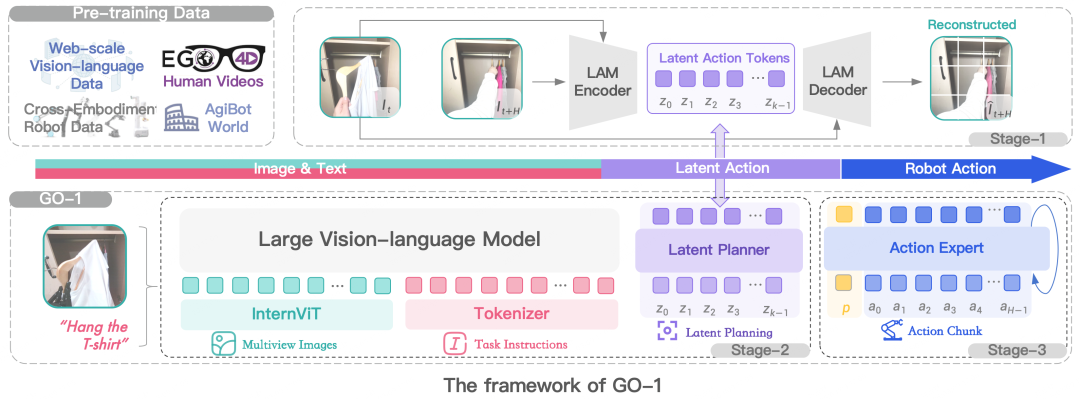
To effectively leverage the high-quality AgiBot World dataset alongside large-scale heterogeneous internet video data and enhance policy generalization, AgiBot proposes the innovative Vision-Language-Latent-Action (ViLLA) architecture. GO-1, as the first general-purpose embodied foundation model, is built on ViLLA. Compared to the Vision-Language-Action (VLA) architecture, ViLLA bridges the gap between image-text inputs and robot execution by predicting Latent Action Tokens. It demonstrates exceptional performance in real-world dexterous manipulation and long-horizon tasks, far surpassing existing open-source SOTA models.
The ViLLA architecture consists of a VLM (vision-language model) + MoE (mixture of experts). The VLM gains general scene perception and language understanding from massive internet image-text data. The Latent Planner within the MoE acquires general action comprehension from large-scale cross-embodiment and human manipulation data. The Action Expert within the MoE develops fine-grained action execution capabilities from millions of real-robot data points. During inference, the VLM, Latent Planner, and Action Expert collaborate as follows:
-
The VLM uses InternVL-2B to receive multimodal inputs including multi-view visual images, force feedback signals, and language instructions, performing general scene perception and instruction understanding;
-
The Latent Planner — a set of experts within the MoE — predicts Latent Action Tokens as a Chain of Planning (CoP) based on intermediate outputs from the VLM, enabling general action understanding and planning;
-
The Action Expert — another set of experts within the MoE — generates the final fine-grained action sequences based on intermediate VLM outputs and the Latent Action Tokens;
Below is a detailed introduction to the two key components within the MoE: the Latent Planner and Action Expert:
Mixture of Experts Component 1:
Latent Planner
Although AgiBot World is already the world's largest real-robot teleoperation dataset, the volume of such high-quality action-labeled real-robot data remains limited — far smaller than internet-scale datasets. To address this, we use Latent Actions to model implicit changes between current and historical frames, then predict these Latent Actions through the Latent Planner. This transfers real-world action knowledge from heterogeneous data sources to general manipulation tasks.
The Latent Action Model (LAM) is primarily used to obtain ground truth for Latent Actions between current and historical frames. It consists of an encoder and decoder:
- The encoder uses a Spatial-temporal Transformer with Causal Temporal Masks.
- The decoder uses a Spatial Transformer, taking the initial frame and discretized Latent Action Tokens as inputs.
- Latent Action Tokens are quantized via VQ-VAE.
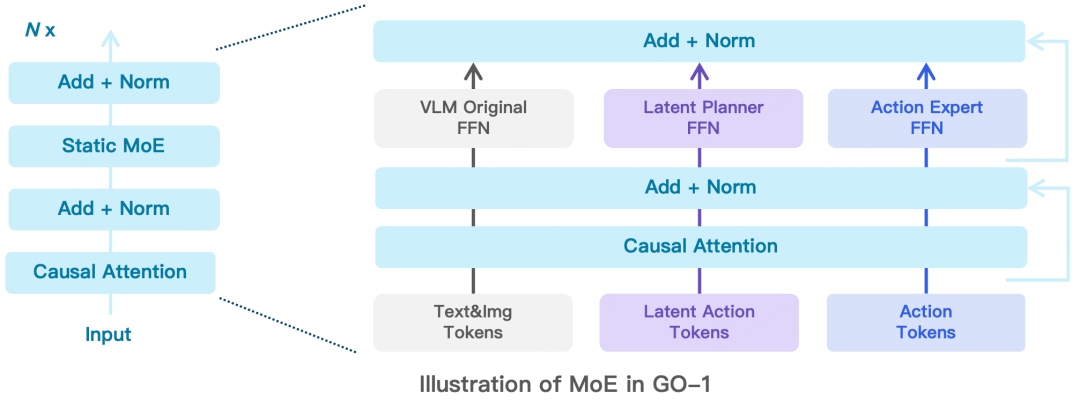
The Latent Planner is responsible for predicting these discrete Latent Action Tokens. It shares the same Transformer backbone as the VLM but uses two independent sets of FFNs (feed-forward networks) and Q/K/V/O (query, key, value, output) projection matrices. These experts progressively incorporate intermediate information from VLM outputs at each layer, supervised by Cross Entropy Loss.
Mixture of Experts Component 2:
Action Expert
To achieve high-frequency and dexterous manipulation, we introduce the Action Expert, which uses a Diffusion Model as its objective function to model the continuous distribution of low-level actions.
- The Action Expert's structural design resembles the Latent Planner: it shares the same Transformer backbone as the VLM but uses two independent sets of FFNs and Q/K/V/O projection matrices. It progressively regresses action sequences through a Denoising Process.
- The Action Expert integrates hierarchically with the VLM and Latent Planner, ensuring consistent information flow and collaborative optimization.
Experimental Results
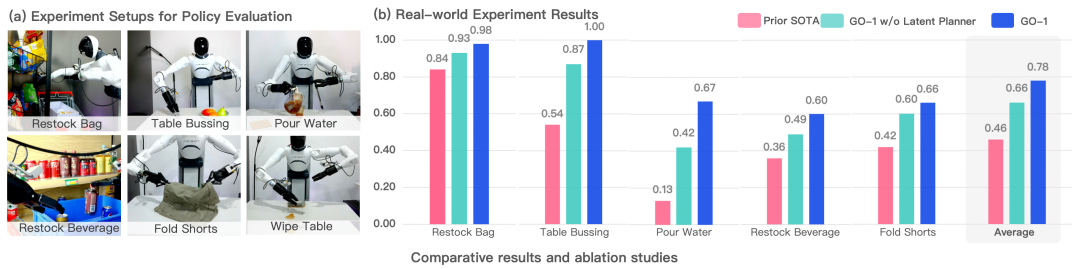
Using the innovative Vision-Language-Latent-Action (ViLLA) architecture, we tested GO-1 across five tasks of varying complexity. Compared to existing best-in-class models, GO-1 achieved substantially higher success rates, improving average success by 32% (46% → 78%). Performance was particularly strong on "Pour Water," "Table Bussing," and "Restock Beverage" tasks. We also independently validated the contribution of the Latent Planner within the ViLLA architecture, finding that adding the Latent Planner improved success rates by 12% (66% → 78%).
Leveraging human and multi-robot data, the GO-1 foundation model gives robots revolutionary learning capabilities, enabling generalization across diverse environments and objects, rapid adaptation to new tasks, and acquisition of new skills. It also supports deployment on different robot platforms for efficient real-world implementation, continuously evolving through actual use.
These characteristics can be summarized in four dimensions:
1. Learning from Human Videos: GO-1 can learn from internet videos and real human demonstrations, enhancing its understanding of human behavior to better serve people.
2. Rapid Few-Shot Generalization: GO-1 possesses strong generalization capabilities, enabling it to generalize to new scenarios and tasks with minimal data or even zero-shot, lowering the barrier to using embodied models and making post-training costs very low.
3. One Brain, Multiple Bodies: GO-1 is a general robot policy model capable of transferring across different robot morphologies, rapidly adapting to various platforms, and elevating collective intelligence.
4. Continuous Evolution: Paired with AgiBot's complete data feedback system, GO-1 continuously learns from real-world execution challenges, growing smarter with use.
The launch of AgiBot's general-purpose embodied foundation model GO-1 marks a rapid advance toward embodied intelligence that is generalized, open, and intelligent:
- From single tasks to multiple tasks: robots can execute diverse tasks across different scenarios without retraining for each new task.
- From closed environments to the open world: robots are no longer confined to laboratories but can adapt to variable real-world environments.
- From preset programs to instruction generalization: robots can understand natural language instructions and perform compositional reasoning based on semantics, rather than being limited to preset programs.
The GO-1 foundation model will accelerate the普及 of embodied intelligence. Robots will evolve from tools dependent on specific tasks toward autonomous agents with general intelligence, playing greater roles across commercial, industrial, and household domains — advancing toward a more generally capable intelligent future.

AgiBot Open-Sources Million-Scale Real-Robot Dataset! The ImageNet Moment for Embodied Intelligence Has Arrived! | BlueRun Ventures Portfolio Headlines
Enough Talk About DeepSeek R1! Ten Founders Share Their Open-Model Battle Tests | BlueRun Perspectives
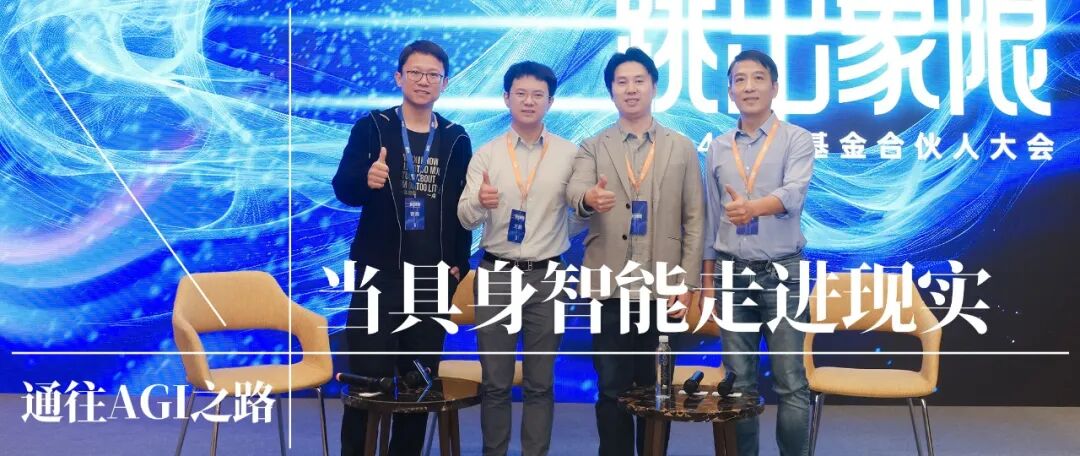
BlueRun Dialogues with Galaxy Universal, AgiBot, and Lingchu Intelligence: When Embodied Intelligence Enters Reality | The Road to AGI