BlueRun Ventures Leads Exclusive Investment in XR Brand VITURE's Nearly $10 Million Series A+ Round | BlueRun Ventures

Focused on User Experience Innovation
Consumer XR glasses brand VITURE recently closed a nearly $10 million Series A+ round, with BlueRun Ventures as the sole investor.
BlueRun Ventures stated: VITURE has an exceptional core team with solid foundational XR technology expertise and continuous innovation capabilities. Its debut product, VITURE One, was an industry first in leveraging a cloud computing framework to achieve the perfect combination of mobile portability and high-performance top-tier rendering on AR glasses, allowing users to play AAA games anytime, anywhere. VITURE's first product received widespread acclaim from users across North America, Europe, Japan, and other overseas markets immediately upon launch. We are very optimistic about the vast market space and prospects for overseas XR products, and look forward to the team continuously building products beloved by global users.
Founded in September 2021, VITURE positions its products as high-end consumer XR glasses, with content focused on AAA console gaming and immersive cinematic viewing.
In May 2022, VITURE's first-generation product VITURE One garnered over 5,000 backers and more than $3 million in oversubscribed funding on overseas crowdfunding platform Kickstarter, breaking Oculus's previous record of $2.4 million. By the end of 2022, VITURE received TIME magazine's Invention of the Year award, becoming the only consumer AR/VR brand to win the honor.
This April, VITURE completed delivery of all crowdfunding and pre-sale orders, and received three awards: the CES Innovation Award, iF Design Award, and Red Dot Award.
Regarding Apple's recently released MR headset, VITURE founder Gonglue Jiang commented: "The hardest part of the AR/VR industry is achieving the balance between wearability and spatial technology. These two are inherently contradictory — one requires the ultimate in lightness among all wearables, the other requires the ultimate in computing power among all electronic devices. Whether to push technology to the extreme and sacrifice product form, or to preserve form and incrementally add technology, represents two different paths, but all roads lead to the same destination: glasses-form spatial computing."
"Some areas are advantages for large companies (spatial technology R&D), others are advantages for startups (product innovation, rapid iteration). Identifying your own strengths and finding your own path is what creates maximum value for the industry and users."
On Apple Vision's design and battery life, Jiang assessed: "The first foundation of any wearable product is whether users are physiologically and psychologically willing to wear it, and can wear it for extended periods. The second foundation is whether the incremental content experience gained outweighs the cost of prolonged wear. For the two scenarios of movie viewing and gaming, VITURE delivers a lighter weight, longer battery life, higher PPD angular resolution, more complete content library, and more realistic environmental awareness. What Apple Vision is most worth anticipating is its future content ecosystem. It has opened a door for the industry, thoroughly bringing digital content and interaction methods into the 3D era."
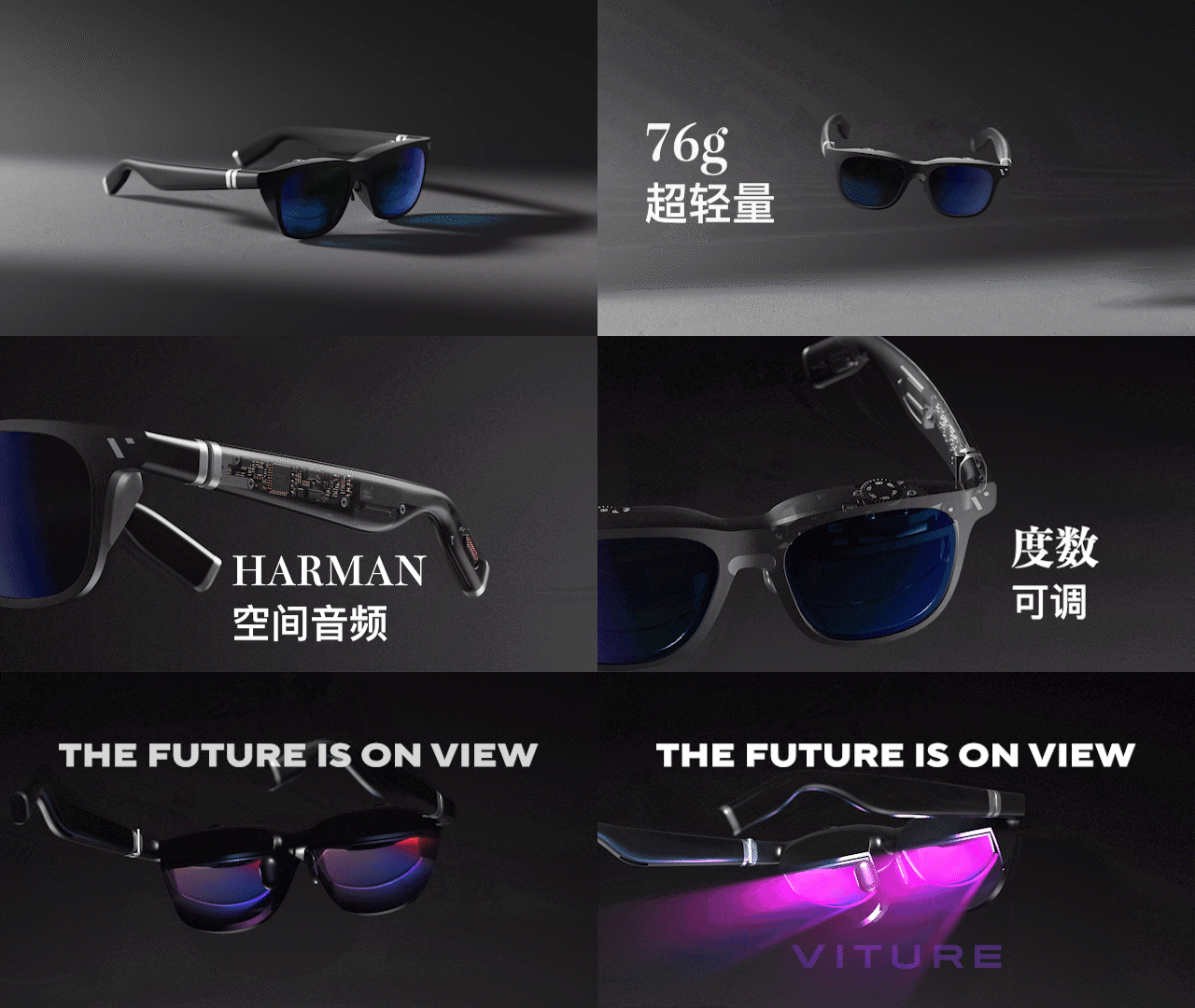
VITURE One
The metaverse concept exploded in 2021, and by 2022, "large-screen viewing" glasses based on Birdbath (BB) solutions began hitting the market. However, these suffered from vague scenario positioning, unclear pain points, limited phone compatibility, and inconvenient interactions.
In April 2022, VITURE pioneered a neck-worn computing unit based on TV chip architecture and operating system, using cloud computing technology to enable high-performance applications such as cloud gaming and cloud office work. TV chip architecture features low cost, strong audio-video decoding capabilities, landscape display, button-based interaction, and a mature content ecosystem — characteristics that perfectly match the display properties of BB glasses. Once introduced, this concept led the industry and made the BB glasses + TV box form factor standard across manufacturers. VITURE thus received TIME magazine's Invention of the Year award, demonstrating the team's extraordinary user insight, product definition, and technical implementation capabilities.
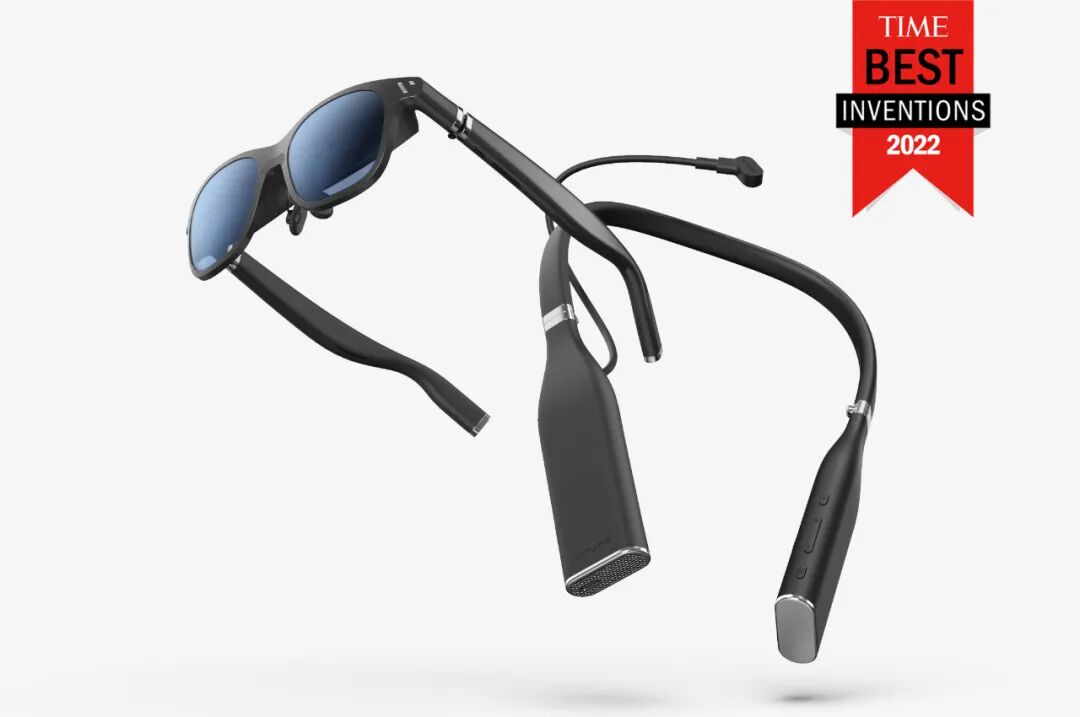
VITURE's neck-worn split design
Beyond this, VITURE One introduced multiple product innovations. Its magnetic attachment design replaced the previous USB-C plug-and-play format, enabling users to connect and detach quickly and easily.
To enhance flexibility in virtual reality interaction, VITURE One innovatively adopted electrochromic technology on the lenses, with light transmittance adjustable between 5-80%. This means consumers can flexibly switch between an "immersive cinema" and "bright reality." This design closely resembles the immersive and environmental viewing mode switching on Apple's recently released Vision Pro.
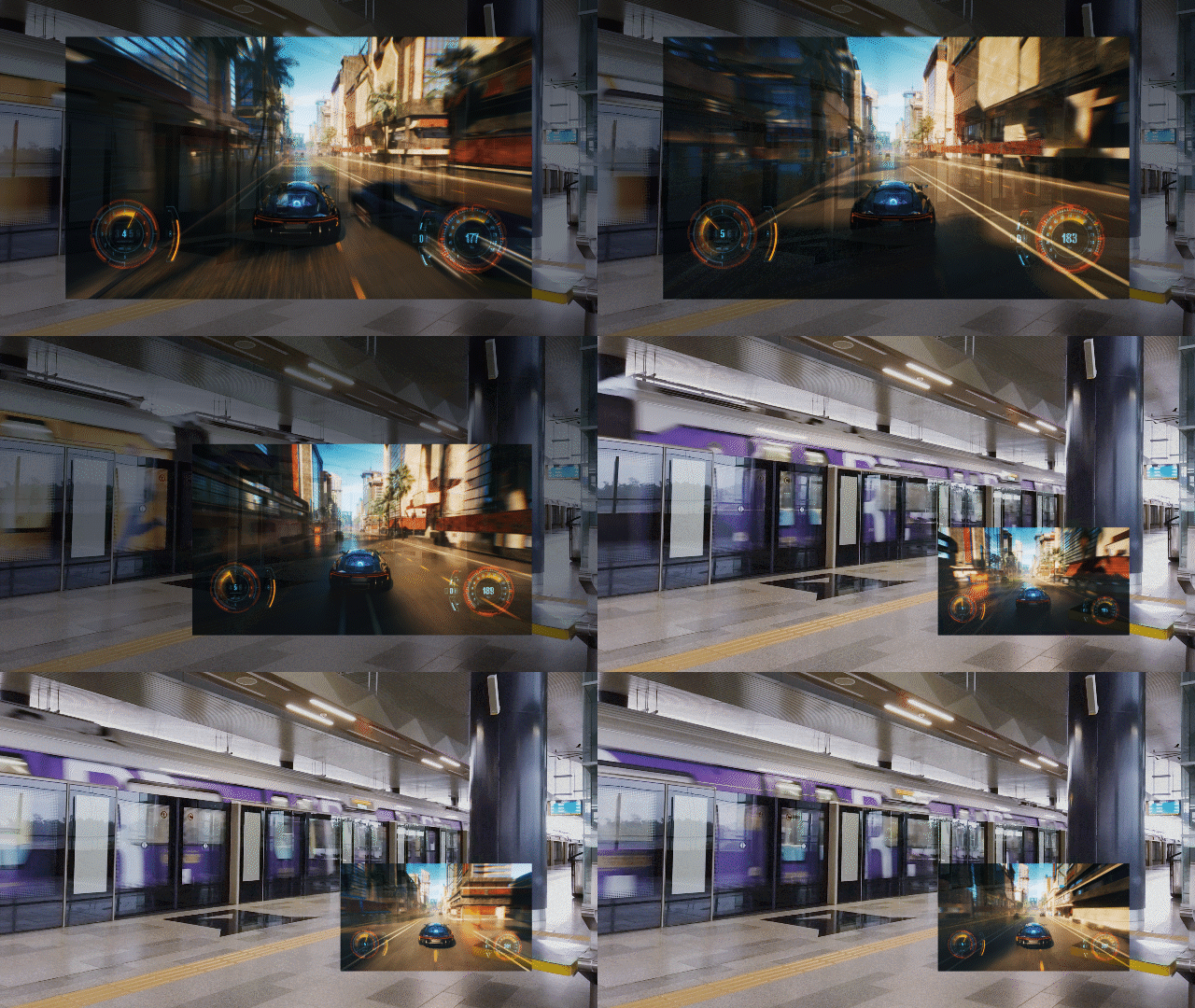
VITURE One's electrochromic technology supports switching between virtual and reality
The VITURE One frame is constructed from magnesium-aluminum and titanium alloys, maintaining a weight of 76g while ensuring excellent heat dissipation — below the over-80g average weight of AR glasses on the market.
VITURE One's neck ring runs a proprietary customized OS, with built-in apps for cloud gaming, cloud streaming, streaming media, and cloud office work, providing users with a rich mobile XR experience. Since product delivery this year, the VITURE One neck ring has received multiple OTA functional upgrades, allowing users to continuously gain richer content and functionality without perceptible interruption.
Beyond the neck ring, VITURE One was first to support various mainstream gaming handhelds such as Steam Deck and GPD, and designed and developed a mobile dock specifically adapted for Switch, supporting two-player co-op.
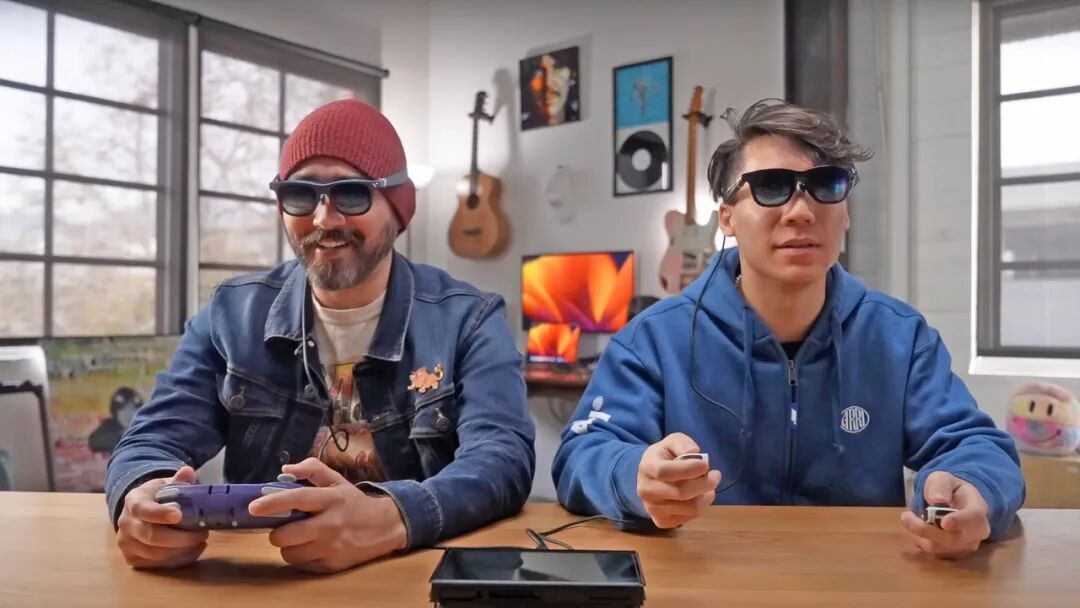
Currently, VITURE supports two-player XR gaming
For content ecosystem, VITURE has integrated multiple functional plugins designed by developers. For example, by calling 3D rendering APIs, users can experience 3D versions of PC games such as Assassin's Creed and Need for Speed on the glasses. At GDC (Game Developers Conference) held in San Francisco this March, VITURE's appearance and live demo attracted numerous game developers to line up for hands-on experience.
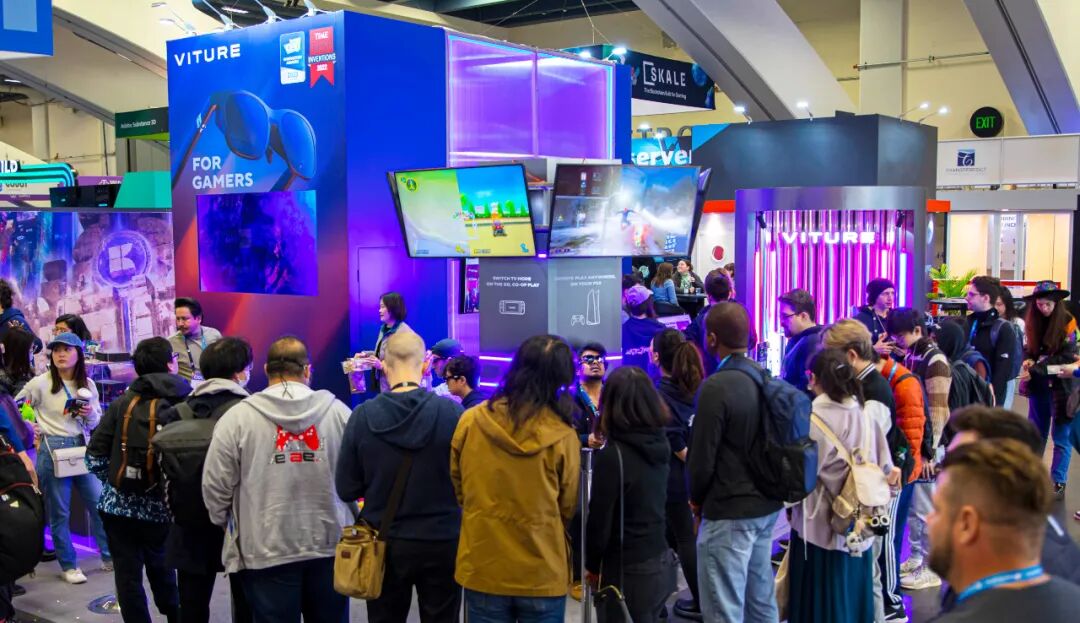
For marketing, VITURE currently acquires customers primarily through organic user promotion and word-of-mouth. On TikTok overseas, a single video gained 14 million views and 1.6 million likes without any paid promotion, and the brand has also received spontaneous promotion from overseas gaming influencers with millions of followers. As of today, VITURE One's Japan crowdfunding launch broke the platform's AR/VR industry historical record in less than two weeks — again proving VITURE's products possess strong organic user-driven viral potential.
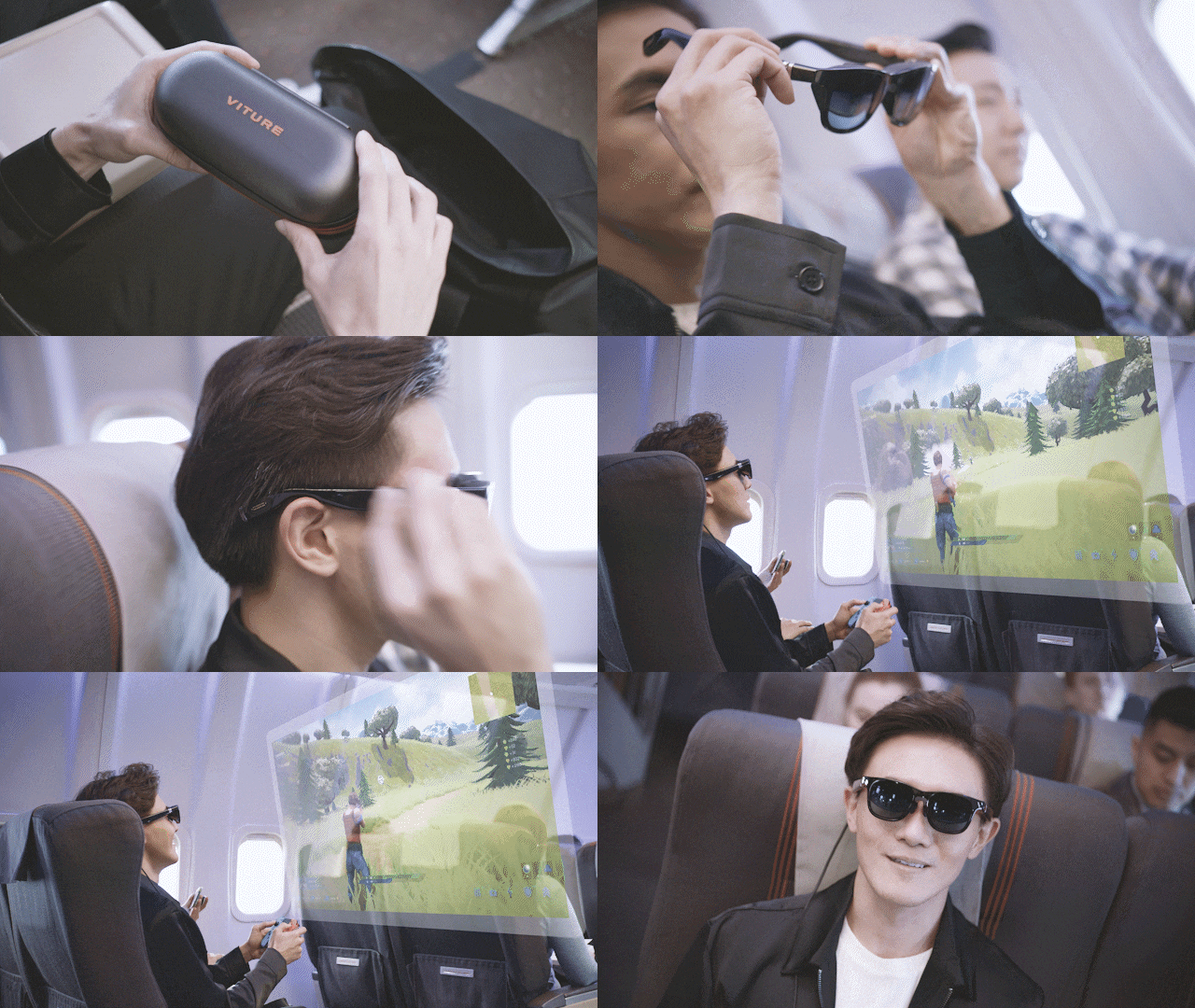
"Every manufacturer has its own characteristics, and ours is user experience innovation." After more than a year of market validation, VITURE founder and CEO Gonglue Jiang believes, "For us, regardless of what technology we use, user experience and solving users' real needs are what matter most. We need to find real pain points that XR technology can solve, which must exceed the cost users need to pay, which in turn must exceed the cost we need to pay, to create a positive cycle."
Jiang stated that following the Series A+ close, VITURE will focus on two directions: continuous innovation — "we will keep delivering richer, more stunning XR experiences and greater playability through OTA updates"; and mass production, enabling more users to enjoy the convenience and fun of XR. Jiang noted that currently measurable average daily usage time for VITURE One's neck ring is approximately 1.5-2 hours. "XR glasses fundamentally allow people to access high-quality digital content more immersively and conveniently — this is an irreversible natural selection."
For funding or partnership inquiries, please long-press the QR code below to add BlueRun Ventures' contact on WeChat and connect with us directly.

More Featured Content




Originating in Silicon Valley, BlueRun Ventures was established in 2005 and is a venture capital firm focused on early-stage startups.
Currently, BlueRun Ventures manages multiple USD and RMB dual-currency funds in China, with assets under management exceeding RMB 15 billion, making it one of the largest early-stage funds domestically. Its investment stage focuses on Pre-A and Series A rounds, covering hard tech and innovative interaction, enterprise technology, new consumer, and healthcare sectors. It has cumulatively invested in over 150 startup companies, including Li Auto, Waterdrop, QingCloud, Guazi.com, Qudian, Songguo Mobility, Ganji.com, Energy Monster, Yuntu Semiconductor, Machenike, CloudSaint Intelligence, Anxin Wangdun, and BioMap.
BlueRun Ventures has been ranked #1 on Zero2IPO's "China's Top 30 Early-Stage Investment Institutions," #1 on ChinaVenture's "China's Best Early-Stage Venture Capital Institutions TOP30," and named among Preqin's Top 10 venture capital fund managers globally for sustained high returns performance.
Additionally, BlueRun Ventures has for consecutive years received honors from Forbes China, 36Kr, Cyzone, Caixin Media, CBNweekly, Jiemian, and other media institutions, including "China's Best Early-Stage Institution of the Year," "China's Top Venture Capital Firm," "Most Entrepreneur-Friendly Early-Stage Institution of the Year," and "Most Influential Early-Stage Institution of the Year."