**Peng Zhihui: The "Wild Iron Man" Embarks on a New Adventure | by He Lan**

A Small Stretch, Within Reach
Until the moment he stepped on stage, Peng Zhihui still didn't know if today's product launch would be a disaster.
People call him many things — "Zhiyuanjun," a Bilibili Top 100 creator, a Huawei "Genius Youth." But right now, he's the co-founder and CTO of AgiBot, about to livestream the launch of the company's first humanoid robot product, "Expedition A1," under the glare of public attention.
It was almost a high-stakes gamble. Twenty minutes before the event, the team was still debugging frantically. He stood under blazing lights and delivered a 20-minute presentation before finally seeing a colleague below the stage flash an "OK" sign. Expedition A1 shuffled onstage with small, careful steps. Peng finally exhaled. It was the eighth month since he'd announced his venture. He'd taken a risk, and it had landed safely.
One year later to the day — August 18, 2024 — AgiBot held its second launch event. Two mature core products, Expedition A2 and Expedition A2-W. A pre-research product, Expedition A2-Max. And the open-source Lingxi series. Both Peng and AgiBot moved with far more confidence.
"Resolute in risk-taking" — this self-described introvert CTO pushes himself further this way. Choosing to livestream a first product launch, for instance. Or publicly declaring a "flag" to bring product costs down to 200,000 yuan. Robin Zeng, chairman of CATL, once hung these four characters in his office, meaning: once you've set your sights on a goal, dare to go all-in. "Sometimes if you don't stretch yourself to reach for challenging targets, you don't know what you're capable of," Peng says.
This may be exactly the entrepreneurial personality the general-purpose robotics track needs most right now. Rapid technological iteration. Competitors ranging from startups to tech giants. Full-factor competition from Day One. It's a battlefield where only hexagonal warriors — those strong across all dimensions — can make the finals. AgiBot has no choice but to "bet," building a startup with the bold, high-profile approach of a major corporation.
BlueRun Ventures has now invested in AgiBot across three consecutive rounds. Having tracked the robotics space for over eight years, we believe general-purpose robotics represents a "ultra-long cycle, ultra-large opportunity" track. The more entrepreneurs understand how difficult and lengthy this endeavor is, the more they should dare to invest across every dimension and position themselves at critical nodes in the ecosystem. What underpins this "dare" is full-stack team capability. AgiBot is precisely such a company, and we look forward to meeting more entrepreneurs like them.
Recently, Zhiyuanjun and Wei Cao, partner at BlueRun Ventures, joined the inaugural episode of Booming Talk, reflecting on a year and a half of entrepreneurship and discussing technical progress and market competition in general-purpose robotics. Manqi Cheng, deputy editor-in-chief of LatePost, moderated the conversation.
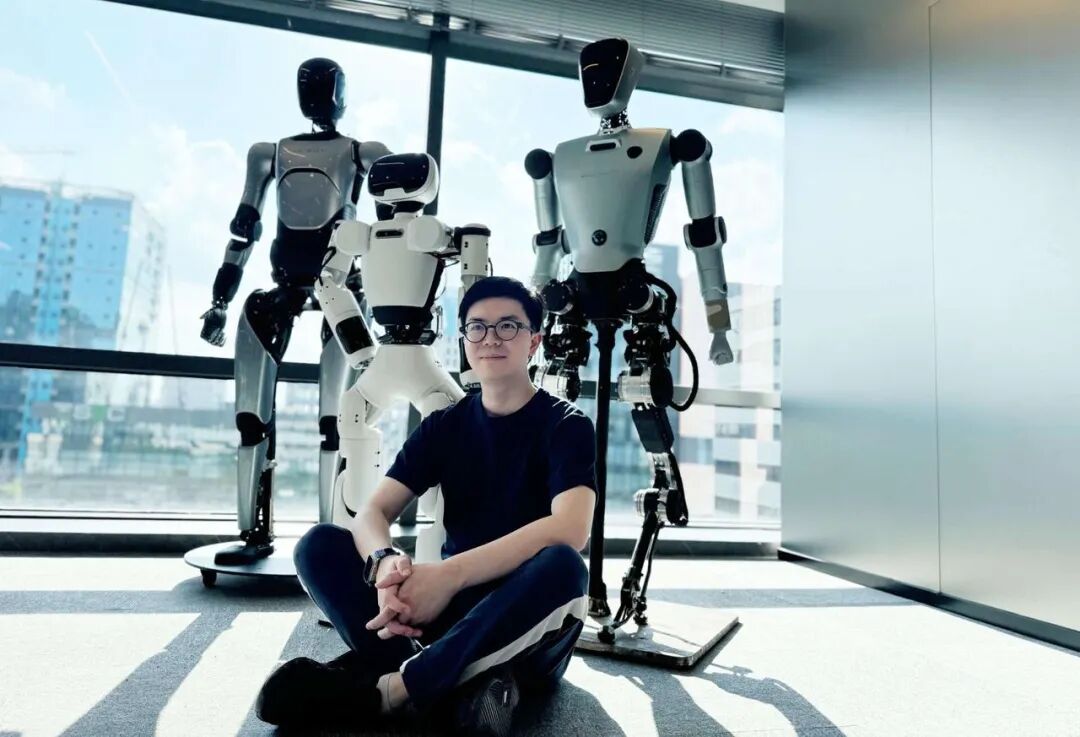
Zhiyuanjun at the Booming Talk event
Booming Talk is BlueRun Ventures' first interview livestream program. Going forward, we'll continue inviting booming entrepreneurs from the BlueRun family to converse, hoping to harness technology as a force against entropy in our times. Follow our podcast "创业有何蓝" (Chuangye You He Lan), and stay tuned for ongoing Booming Talk columns.

Below is an edited transcript of the livestream.

Manqi Cheng: AgiBot has the largest funding scale and highest valuation among comparable domestic companies. How did BlueRun and AgiBot first connect?
Wei Cao: Our team had been fans of Zhihui for a long time — we'd regularly follow his inventive DIY projects on Bilibili. Later, we heard through industry contacts that he might start a company. He hadn't even posted that announcement tweet yet, but we tried every avenue to understand the team's progress and added him on WeChat (laughs).
Peng Zhihui: Our strategy was quite different from what it is now. Early on, we preferred not to engage with too many investors. I felt it would be more effective to get the product and technology thinking clear first, then bring in resources later.
But Wei was special. The more I interacted with him, the more I realized he's a genuinely knowledgeable investor — he doesn't just look at our team from an investment angle, but often offers very professional advice on cutting-edge technology. I later learned he carries academic papers around to read. As someone technical, I deeply admire that. So Wei recognized very early that dexterous hands would be the core of embodied manipulation, and that tactile sensing would be the core of dexterous hands. Many people might think it's mechanical structure, but that's only one dimension.
Manqi Cheng: BlueRun had invested in some robotics companies before this. Did you come to this awareness through those prior investments?
Wei Cao: Yes. We understand robots as intelligent agents with several capability layers. Perception, for instance — traditional robots had very simple perception, but now it's becoming far richer. The cutting edge involves model-level integration of computer vision with tactile solutions based on dexterous hands. Because we have this technical framework and methodological thinking, we have awareness of interesting frontier directions and innovation points across capability dimensions.
Manqi Cheng: BlueRun has now invested in AgiBot across three consecutive rounds. What spark made BlueRun willing to double down repeatedly?
Wei Cao: It's definitely a process of continuous engagement, mutual understanding, and growing conviction. We visited AgiBot six times before investing, and they didn't find us bothersome (laughs).
At AgiBot's first product launch last year, competitors had also released products around the same time. I asked him if the pressure was so intense he couldn't sleep. Zhihui said it wasn't actually that stressful — when you're doing something you genuinely love, it becomes addictive. He wasn't losing sleep; he had no time to sleep, didn't want to sleep, because he had to make this thing work, and that made him happy.
BlueRun was probably among the earliest domestic institutions to invest at scale in robotics. We see this as an ultra-long cycle, ultra-large track. So when we find a team that loves this direction, we feel grounded — because their hunger for product innovation and technical iteration comes from within.
Manqi Cheng: I heard last year's launch preparation was extremely intense.
Peng Zhihui: It's not just me — our whole company is full of workaholics (laughs). That milestone was special: our product's first formal mass-production release, essentially our first formal exam. And we chose the most challenging format — livestream.
A month before the launch, we moved into the venue, sleeping on the floor and debugging through nights. Even so, 20 minutes before showtime we hadn't solved all the issues. I spoke on stage for 20 minutes before finally seeing a colleague below flash an "OK" gesture, and then the robot came onstage.
We later debriefed internally: was this level of intensity right? I think thorough planning is absolutely necessary, but sometimes if you don't stretch for challenging targets, you don't know your own limits. So-called luck favors the prepared.
**Manqi Cheng: That moment had real cinematic drama — the Optimus launch was similar. Let's go back to 2016. During your student years, you and classmates attempted a startup, also in humanoid robotics. How does that compare to this venture? Why did 2023 feel like the right time to revisit this?
Peng Zhihui: I didn't make it to WRC (World Robot Conference) this year, but I actually exhibited a robot there back in 2016. It wasn't the right timing then — too early. AI deep learning hadn't even begun.
Manqi Cheng: The Transformer paper was still two years away then.
Peng Zhihui: Right. So the big difference this time is seeing breakthroughs in embodied AI large models, rather than any sudden leap in the physical robot body itself.
Manqi Cheng: With this long-term orientation, how has what you want to build changed? And BlueRun — what's your long-term expectation for AgiBot?
Peng Zhihui: Like Bell, which invented the first telephone and transformed how humans communicate information. Our vision has always been written on the company wall: to be a transformative force in intelligent productivity, using intelligent machines to create unlimited productivity.
Wei Cao: The shift from specialized robots to general-purpose robots will be a major epochal leap. It's like how we moved from Ericsson and Nokia feature phones to Apple and Google smartphones. For good teams to capture long-term compounding effects, they must deeply accumulate their most core valuable capabilities.
People often talk about endgames. I think general-purpose robots are intertwined with human civilization itself — as long as humans exist, we'll create intelligent machines to help us. Maybe like Westworld, we'll clone ourselves, clone our consciousness, and transfer it to robots. So this opportunity is unlike anything we've seen before. From an investor's perspective, we're also re-examining what kind of enterprise this opportunity can ultimately produce.
Manqi Cheng: Zhiyuanjun's vision keywords are intelligence and unlimited productivity. Wei emphasizes generality — humanoid form may not be the final form, but generality matters greatly.
Peng Zhihui: Humanoid is probably one optional form within generality, and likely the ultimate form. Because the endgame still requires integrating into the same physical environment as humans, doing the same work as humans.

Manqi Cheng: At its second launch, AgiBot released five products — very unusual for a new company. Why so many products?
Peng Zhihui: First, a correction: these five aren't all mature products. The core ones are two — Expedition A2 and Expedition A2-W, which isn't actually that many. Expedition A2-Max is in a prophetic state, a preview of what's coming. The Lingxi series is more about open-source ecosystem, not products for sale.
People might say "startups need focus." I strongly agree, but focus doesn't mean simply reducing product lines. It's about identifying core value, then realizing that value through diversified products and technical paths. Focus should be systemic and deep, not merely superficial simplification.
Manqi Cheng: Of these two products, Expedition A2 is bipedal, Expedition A2-W is wheeled. How do you think about form factors?
Peng Zhihui: Bipedal is better suited for light human interaction — its human-like form enables guidance, reception, greeting, areas where large language models excel.
Wheeled forms are mainly for structured environments like factories, executing tasks where reliability, safety, and work efficiency requirements are much higher. In these scenarios, wheels are currently the optimal form, though we don't rule out future unification to bipedal once that technology matures.
Wei Cao: What truly creates value isn't robot form, but whether the robot can complete tasks in closed-loop under various disturbances.
Manqi Cheng: What's the difference between "closed-loop completion" and just "completion"?
Peng Zhihui: For example, what we call G1 in our launch — traditional automation can already achieve very high success rates and cycle times with open-loop products, at relatively low cost. But it lacks generalization. Slightly change the process, part type, or environment, and it struggles. Closed-loop means real-time strategy adjustment through environmental interaction — the strategy isn't pre-programmed in rules, but automatically adapts and generalizes.
Wei Cao: This environment includes the robot's internal environment — say, a loose gripper — and external disturbances — someone bumping into it. After interruption, can the robot perceive the problem in a closed-loop state, self-repair, and continue completing the task within its logic chain? This capability is crucial.
Manqi Cheng: Is this still quite difficult? For example, if a robot falls while walking, can it adjust itself?
Peng Zhihui: When will bipedal form reach truly practical standards? Ideally, walking without falling (like humans). Next best, getting up after falling. Third best, hardware not being too damaged after falling. We're advancing maturity in tiers. We're now close to the "get up after falling" stage. The next step requires fundamental breakthroughs in underlying technology — materials, control algorithms.
Manqi Cheng: The launch showed a humanoid robot working as a sales guide at a 4S dealership. Is this already being tested with real customers? What value can it create?
Peng Zhihui: Yes. Attention economy is still economy; emotional value is still value. It may not outperform human salespeople in specific task execution, but providing users with novelty matters. First, this scenario is relatively standardized and can generate sufficient order volume. Second, automotive manufacturing has very strong cost control capabilities. We can leverage their manufacturing experience to push our own costs down. We made a bold claim at last year's launch that we'd get costs under 200,000 RMB, and we're achieving that this year.
Manqi Cheng: That's for service scenarios. What about factories? What can your robots do there?
Peng Zhihui: Manufacturing is where we hope to focus investment going forward. Technology must match customer needs and customer ROI. We've summarized three scenario types — "PPT": Pick, Place, and Transfer.
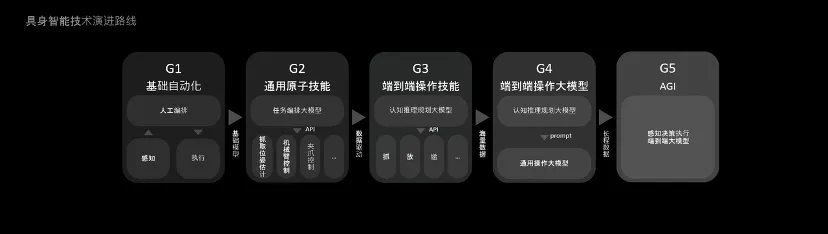
Manqi Cheng: Could you walk through the roadmap you presented at the launch?
Peng Zhihui: G1 is traditional automation with some closed-loop capability, but weak — more directive, programmatic fixed-trajectory programming. G2 is what we're currently doing: hand-designed vision algorithms combined with automatic control planning capabilities, with stronger AI introduced for some generalization improvement, but still not fully meeting customer needs.
So we hope to form a general-purpose framework — G3 end-to-end. One framework, data-driven, replacing hand-designed algorithms with data collection. This dramatically reduces costs and could potentially reach deployable generalization standards.
G4 involves deeper integration with LLM technology for some long-chain generalization capabilities. G5 is AGI, more of a guiding North Star. Currently, factory-deployed products are mainly G2, with G3 previews in progress.
Manqi Cheng: As an investor, how does BlueRun view this roadmap?
Wei Cao: As mentioned, general-purpose robotics is an ultra-long cycle, ultra-long track. Without phased milestones, obstacles emerge in communication with teams, customers, policymakers, and society at large. BlueRun began tracking autonomous driving around 2014. Even the most conservative deployment estimates then were five years. Looking back, seven years have passed and expectations still haven't been met. So understanding a technology's capability evolution and development stages, and advancing methodically, significantly reduces communication costs.

Manqi Cheng: AgiBot devotes greater R&D effort to software and intelligent systems development. Does this mean you believe software matters more than hardware?
Peng Zhihui: Not exactly — both are indispensable. The reason we invest more heavily in embodied intelligence is that the challenge is greater. Hardware will eventually modularize and standardize, relatively lowering barriers.
Manqi Cheng: That's quite a different view. Many believe software technology diffuses faster, while hardware requires accumulated engineering experience.
Peng Zhihui: Embodied intelligence essentially means the sum of all algorithms running on the robot. Algorithms carry substantial uncertainty — some are engineering problems, some are scientific problems, even mathematical problems. If a robot's value lies in what tasks it can ultimately complete, that depends on how intelligent the algorithms can become. With a sufficiently intelligent brain, even traditional robotic arms can accomplish many complex tasks.
Manqi Cheng: For humanoid robots, which aspects of software and hardware are engineering problems versus scientific problems?
Peng Zhihui: Hardware's scientific problems are fundamental breakthroughs in new materials, energy technology, and so on. Engineering problems are how to reduce manufacturing costs, improve reliability, and new configuration designs for the robot body itself.
For embodied intelligence, engineering problems are software infrastructure, algorithm frameworks, and infrastructure building. Scientific problems — looking at LLM development trends — we're trying to find a sufficiently simple, general, and generalizable framework, then invest in compute and scale to let scaling laws realize their potential. Embodied intelligence hasn't found clear scaling laws yet, but iteration speed is very fast, and I think we can see the trend.
I believe scaling laws are still in scientific-problem territory. For example, humans and animals have vastly higher sample efficiency than current AI systems because of what we call "world models." We continuously conduct reflective simulations in our brains, based on physical laws and experience, imagining how to adjust strategies to better achieve goals. World models haven't been fully proven or deployed yet, so they remain in scientific-problem territory.
Wei Cao: When robots enter homes, living spaces, and service scenarios in the future, underlying material innovation is crucial. Most robot hardware is currently iron — too heavy. If it falls at home, even a 1/1000 probability carries significant damage and risk. The market is now paying attention to material-side innovation.
Peng Zhihui: Right, we'll also experiment with materials and integrated mechanical design in the future.
Manqi Cheng: Are world models and scaling law in the same direction? Some argue scaling law isn't natural — it's big data, big compute, big samples — while humans and animals achieve intelligence with small samples.
Peng Zhihui: Humans formed over billions of years of evolution. Many capabilities may not correspond to software and algorithms, but rather to firmware固化 in DNA. And world models may be one path to achieving scaling laws — they're not entirely in conflict.
Manqi Cheng: AgiBot is simultaneously pursuing computer vision, imitation learning, and reinforcement learning. Why this choice?
Peng Zhihui: We're using all mainstream technical paths. Robots first need environmental perception input — computer vision based on traditional machine vision for perception and planning is foundational.
Imitation learning is like watching a standard answer, then quickly learning to master skills. It's very helpful for optimizing learning curves and improving learning efficiency.
Reinforcement learning is also crucial, more applicable for improving generalization. Especially in large language models, there's growing recognition that post-training's importance is continuously increasing, and may even exceed pre-training in the future.
Manqi Cheng: Are you personally managing all three of AgiBot's technical lines now? How can you pursue these different directions simultaneously?
Peng Zhihui: We've made a very full-stack layout. Reinforcement learning, for instance, heavily depends on body capabilities — a pure AI company might not be able to make corresponding technical arrangements. We've thought through the entire technical system clearly, knowing what stage each step should reach and what resources to invest.
Wei Cao: Analogous to autonomous driving — the car body form has been stable for years, with industry standards and "automotive-grade" specifications. So before software innovation, there was already stable consensus on hardware. But robots are in a stage of rapid hardware ecosystem iteration and flourishing form diversity. So robotics startup teams ideally need to understand hardware, software, algorithms, and data. If there's an obvious weak link, it's hard to integrate these rapidly changing dimensions.
Manqi Cheng: This new wave of humanoid robotics companies could indeed be full-stack companies from Day One. But many autonomous driving technology companies never had this opportunity, being positioned in intermediate links.
Wei Cao: You could say they had no opportunity, or that they didn't actively choose it. If you were building cars in 2015, there was opportunity to choose. The choice between building cars versus doing software reflects different understandings of the challenge and future of this endeavor, and where to anchor core capability building.
We've seen many excellent autonomous driving software teams. But their position in the value chain created limitations. Not owning hardware, unable to modify hardware, unable to access real-time hardware-collected data. So ecosystem position determined developmental constraints.
Manqi Cheng: So humanoid robotics companies could potentially become new chain leaders in the industry. On hardware, what does AgiBot self-develop?
Peng Zhihui: We have principles for deciding what to self-develop. If it's a key component providing core/differentiating competitive advantage, and no mature off-the-shelf solution exists on the market, then we absolutely must self-develop — we couldn't survive otherwise. Joints and dexterous hands, for example.
If core components already have mature market solutions, we may self-develop in phases, driven more by manufacturing control and cost reduction needs. For instance, perception algorithms have relatively mature solutions in autonomous driving, like BEV+Transformer. But long-term, robotic perception differs from automotive perception. To better adapt to such scenarios, we may phase in algorithm self-development.

Manqi Cheng: AgiBot hasn't been around long, but already has very dense funding, annual launches, its own factory, and a rich product line. There's a saying that AgiBot is building a startup with the approach of a large company. How do you both view this?
Peng Zhihui: The situation is indeed like this, but we're not trying to appear like a large company — this is simply the most suitable path. This is an emerging track and industry. We need to quickly capture market share, demonstrate technical strength and product vision, and can only go bold and high-profile. Small, tentative steps might never enter investors' and the public's field of view.
Wei Cao: Building general-purpose and humanoid robots is essentially building a complex system — possibly more complex than car-making. This determines that to be the best in the industry, team configuration needs such a foundation. Future competition among robotics companies, beyond startups, will include major players like domestic Xiaomi.
Peng Zhihui: For car companies, first, they have this capability because the entire tech stack is very similar to autonomous driving — this is also why Elon Musk's Optimus has gone smoothly. Second, they have motivation. Many manufacturing clients we now serve are new energy vehicle companies. If they can derive value and have the capability to do so, they'll likely choose to build it themselves.
Manqi Cheng: So you need to prepare early for competition with giants.
Wei Cao: Over the next three to five years, competition in the general-purpose and humanoid robot market will be competition among hexagonal warriors. Without strong team configuration, it's hard to reach the finals. Like car-making — when new forces first emerged, maybe fifteen or twenty competed, but those remaining are all hexagonal warriors, daring to invest across every dimension. The difficulty of this endeavor determines that you need to rapidly build team scale and capability systems.
Peng Zhihui: The facts bear this out. At last year's launch, our team was just a few dozen people. In just one year, we're now over three hundred. Daring to invest so many resources, expanding so fast, first comes from thinking very clearly, having clear landing rhythm points, and enabling customers to find core value.
Manqi Cheng: There are now many new robotics companies. What do you think will happen to them going forward?
Wei Cao: In many past competitions, only head companies survived. But I believe robotics track competition won't converge so quickly. For 5-10 years, it will be a state of ecological diversity with multiple participating entities.
However, the gap between head companies and mid-tier companies may gradually emerge over the next five years. Ultimately, how many robots you can deliver operating at scale in real scenarios determines your position in the industry.
Manqi Cheng: Right now, which has more bubble — language large models or humanoid robots?
Wei Cao: Investment volume in general-purpose and humanoid robots is probably only 1/5 to 1/10 of that in large models and foundation models — actually quite different.
Peng Zhihui: Humanoid robots truly deploying and landing means moving from current constrained scenarios to open environments, even to consumer scenarios. This is definitely a later stage than when large language models find real applications, or when autonomous driving truly achieves L4/L5. I think it's achievable within ten years.
Wei Cao: Robot landing will certainly proceed from simple scenarios to complex scenarios. For the most complex tasks in the most complex scenarios — say, a robot doing everything a nanny can do — I think at least 10 years.
Manqi Cheng: To reach that future, what specific challenges will arise along the way?
Peng Zhihui: One crucial thing is staying at the table before vision and goals are realized, having some staged outputs to sustain the team's continued progress — what we call "laying eggs along the journey."
Wei Cao: Over the next two to three years, robot body safety and cost issues will become increasingly prominent. Second is product definition — who can first create a good product that users will pay for, a volume hit product, within given technical supply constraints, will stand out. Third, talent depth and density are still relatively limited. While continuously attracting excellent talent, forming internal talent development systems is also a challenge.
Manqi Cheng: To what extent do you think costs need to drop further to be标志性地 called a hit product?
Peng Zhihui: I believe at this stage, cost isn't the decisive factor for hit products — what matters is what practical problems you can solve for customers. You still need to target the right scenario. As long as you can horizontally expand scenarios in the future with sufficient volume, cost reduction follows naturally. But finding the right scenario that matches your current technical maturity and can generate value — that requires clear thinking.
Manqi Cheng: How do you view overseas markets going forward?
Peng Zhihui: AgiBot aimed to be a global enterprise from the start, so we have some overseas presence, relatively more in Europe and North America. Going forward, we'll have some overseas partners who'll do secondary development for specific industries based on our bodies and solutions.
We also hope to form more talent and technology exchange cooperation with overseas markets. A considerable portion of core engineers at overseas general robotics companies are Chinese, and we're attracting this talent pool.
Wei Cao: In embodied intelligence, roughly 70% or more of the top overseas scholars and PhD students are Chinese or of Chinese descent. China's manufacturing comparative advantage is very clear. Traditional manufacturing upgrading,叠加 with data and intelligence — the market space and opportunity for future general-purpose and humanoid robot going overseas will also be very clear.

Manqi Cheng: "Zhiyuanjun" — many people knew and loved you before your创业. Did your Bilibili projects help with your later创业?
Peng Zhihui: From my own perspective, not much has changed. My biggest visible change to the public is probably my明显 higher video update delay frequency (laughs).创业 is essentially making my previous hobby my full-time job — what I did before is all helpful for what I'm doing now. I said on Weibo that I'd use social media as a window to record创业 life, and may continue doing so.
At this year's launch, we also announced the formation of X-Lab (Zhiyuanjun Lab), hoping that after mass production goes smoothly, we can invest some extra energy into more interesting exploration and innovation, sharing阶段性 outputs with everyone.
Manqi Cheng: From an investor's perspective observing a founding team and CTO, Wei, what's been his biggest change over the past year?
Wei Cao: Early on when communicating with Zhihui, I felt he was somewhat single-threaded — a tech bro, basically (laughs). But over this year-plus, Zhihui is less immersed in the geek state, more mature and open in碰撞 viewpoints and directions.
Peng Zhihui: I quite agree with that. When I did personal projects before, as long as I eventually made the thing work, that was enough. Now I consider more things. And before they were short-term small ideas; now it's a longer-term vision, with the need to translate it into actual strategy and executable plans.
I've shifted from single-threaded to multi-threaded operating system — there's a term called preemptive scheduling, dynamic adjustment. If something suddenly higher priority emerges, you immediately interrupt to do that, then return after finishing, maximizing time and efficiency utilization. But this requires strong focus to ensure you can still pick up the context.
Manqi Cheng: What's been your happiest moment in this year and a half?
Peng Zhihui: The diverse, cross-domain, young elite team we now have — everyone very capable, with very aligned values. Personally, many moments of joy come from verifying that an idea works, a technical solution is feasible, or a project关键节点 passes.
Wei Cao: The launch event made us very pleased. In just one year, the team had to build internal capabilities and also初步 polish products to present. We were somewhat worried, but watching the full launch, we felt quite gratified.
Manqi Cheng: Previously, documentary filmmaker Takeuchi Ryo filmed you and found you could do everything. You joked that you couldn't give birth. I want to ask again today — what can't you do?
Peng Zhihui: Probably not stop learning. Technology is progressing so fast in every aspect — every day could potentially be a historical inflection point.