"6th Future Healthcare 100" Roundtable: Investing in Future Healthcare — How to Nurture World-Class Innovative Enterprises?
VBData's "6th Future Healthcare 100 Conference" took "China Story" as its theme. During the heavyweight panel discussion, titled *Investing in Future Healthcare: How to Support the Emergence of World-Class Innovative Companies*, six investment firms gathered to debate how China can continue producing world-class innovators and lead at the global frontier.
VBData's "6th Future Healthcare 100 Conference" took "The China Story" as its theme. The trend summit covered three major sections: "Global Challenges and Future Healthcare," "The Soil for Innovation," and "In China for Global." During the heavyweight panel discussion, themed Investing in Future Healthcare: How to Support the Emergence of World-Class Innovative Companies, six investment firms gathered to discuss how China can continue to create world-class innovative enterprises that lead the world.
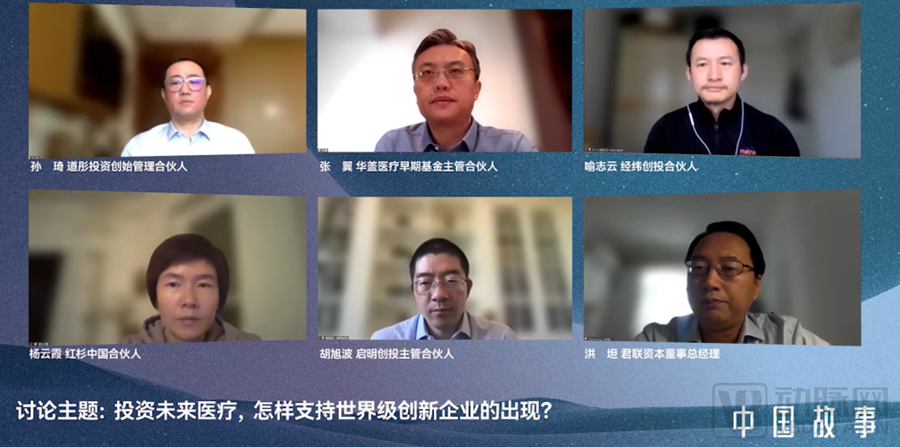
Moderator: Sun Qi, Founding Managing Partner, Dalton Venture
Guests: Hong Tan, Managing Director, Legend Capital; William Hu, Managing Partner, Qiming Venture Partners; Yang Yunxia, Partner, HSG; Yu Zhiyun, Partner, Matrix Partners China; Zhang Yi, Managing Partner, Huagai Healthcare Early-Stage Fund
World-class enterprises cannot be built overnight. They require integration into a globalized ecosystem, world-leading technological advantages, world-class talent teams, adaptation to global commercial culture, the courage to blaze new trails with accessible technology, and world-class commercial success. But at present, China still has far too few world-class innovative companies — which gives investment institutions tremendous motivation to support and help cultivate them.
Below is a transcript of the roundtable discussion:
Sun Qi (Founding Managing Partner, Dalton Venture): How can capital support the emergence of world-class innovative enterprises? Our experience over the past few years has been that sufficiently new technology brings sufficiently good returns. In 2020, we led the investment in Triastek. At the time, the technology was so innovative that some investors either couldn't understand it, or didn't believe that world-class innovative enterprises could grow from Chinese soil. But when the FDA formally approved its IND in January 2021, making it the world's second 3D-printed drug, the company had been preparing to raise 300 million yuan but ultimately received term sheets totaling over 2 billion.
We've always believed that China has the soil for innovation, and that soil is improving. The more hostile the international environment and the more volatile the capital markets, the more we must dare to invest in innovation. But how do we balance the risks and rewards of supporting world-class innovation? Is greater innovation always correlated with better returns? Today's panel is exceptionally strong, so let's hear from our distinguished guests. Before we dive in, I'd like to ask our five panelists to briefly introduce themselves and their firms, and to define world-class healthcare enterprises using three words or three dimensions.
Zhang Yi (Managing Partner, Huagai Healthcare Early-Stage Fund): The trend toward globalization is primarily about establishing ourselves within the global ecosystem — how do we organically combine China's advantages with the global ecosystem as a whole? Three elements matter here. First, ecosystem: it's not just about R&D, but also about global marketing networks and commercialization. Second, frontier: technological advancement must create clear, defined advantages in specific niche areas. Third, globalization: globalization is the foundation of being world-class. Not only must technology be globally scalable, but global commercialization must be achievable across different cultures.
Yu Zhiyun (Partner, Matrix Partners China): I studied chemistry myself. Matrix Partners China has been investing in healthcare for 14 years. If I had to use one dimension to define whether a company is a world-class innovator, I'd ask whether this company can achieve commercial success on a global scale in the future. To achieve global commercial success requires products with globally competitive innovation. As Sun just mentioned with Triastek — they're running clinical trials in the United States, and of the four 3D-printed drugs worldwide that have reached IND stage, they account for three. Additionally, I believe that with world-class innovative products, you must also have a world-class team capable of translating that innovation into commercial success.
Yang Yunxia (Partner, HSG): Innovation is a direction that investors pursue eternally. We feel two dimensions are particularly important. First, the courage to go first — to develop in uncharted territory. Second, the purpose of doing so must be problem-solving, so accessibility of a product and technology is crucial. Only when these two characteristics come together can we use innovative methods to create products that benefit ordinary people.
Hu Xubo (Managing Partner, Qiming Venture Partners): First, having what we call IP, or intellectual property, on a global scale. Among our portfolio companies, we've seen some with real potential — products that are genuinely eye-opening. At the recent ASCO oral presentations in the United States, six companies were mentioned, one of which was our portfolio company Origincell Therapeutics. Their data on one innovative target was quite stunning (at the 2022 ASCO Annual Meeting, they presented Phase I POLARIS clinical trial data for OriCAR-017 in relapsed/refractory multiple myeloma as an oral report).
Second, global sales and marketing capability — Mindray has done this very well. If 70-80% or more of your sales come from international markets, then you're truly a global company. Third, and actually more important and more difficult, is global talent, including at the management and executive levels. Some of our portfolio companies are already doing quite well. What I admire most is ByteDance — a young company that has built a systematic approach to recruiting international talent, which I think is exceptional. In the healthcare industry, some of our companies are also beginning to emerge, and I hope we can all learn from each other. That's my understanding of globalization.
Sun Qi: ByteDance has actually performed better in overseas markets than in China, so a globalized team is indeed a crucial core element. William just raised excellent points that I strongly agree with — for world-class enterprises, beyond the technology we typically focus on, commercialization must be globally deployed. This is a critical criterion. Now let's hear from our Legend Capital colleague Hong Tan.
Hong Tan (Managing Director, Legend Capital): Regarding world-class innovation, especially in healthcare, creating globally significant innovation is what everyone dreams of, but the difficulty is immense. From my perspective, first, world-class innovation requires disruptive technological IP — this is critical. Because our past approach has been to follow technologies that were already mature overseas. To truly achieve world-class innovation, the technology and IP must be disruptive. Second, you need sufficiently global clinical data with demonstrated clinical benefit — this is crucial. Third, the company must actually make money, because from a commercialization standpoint, world-class innovation requires global product commercialization.
Sun Qi: As we just discussed, clinical outcomes must be compared not just against yourself but against other treatment methods. If I'm treating with drugs and someone else is using devices with better outcomes, why insist on pharmaceuticals? So clinical outcomes are a critical standard. Everyone has spoken about innovation — from scientific theory to technology, technology to product, product to industry — a journey of at least ten-plus years, sometimes several decades. From this perspective, investing early and small is essential. Next, I'd like to invite Zhang Yi from Huagai Healthcare Early-Stage Fund to share. The low-hanging fruit has been mostly picked — is it time to jump for the higher-hanging fruit? How does Huagai promote cutting-edge technology implementation and the translation of scientific research?
Zhang Yi: When doing early-stage investment in China, reading trends is crucial. There are three trends: technology trends, industry trends, and policy trends. Policy trends are actually critical for Chinese early-stage companies. Right now, the state is supporting hard technology, particularly import-substituting "chokepoint" technologies, which present enormous opportunities for technology implementation.
Sun Qi: Policy trends, application prospects, and investing early and small — all three points are critical. We also know that Matrix Partners China's entrepreneur camp and Legend Capital's Enterprise Development Institute have strong reputations among founders for post-investment empowerment. What developmental momentum do world-class innovative enterprises need? How can we systematically and scenically empower innovative healthcare enterprises with capital support as the foundation?
Yu Zhiyun: We frequently encounter founders with scientific backgrounds. How do we help a good scientist become a good founder, a good entrepreneur? Because when they go on to build companies, they'll face not just product innovation challenges but a series of decisions, many of them commercial decisions rather than the black-and-white choices of science. Matrix Partners China has invested in over 600 early-stage projects, and we've indeed seen common needs across many early-stage companies. That's why we created the "Billion-Level Entrepreneur Camp." Our internal post-investment service team is more than twice the size of our investment team — fewer than 40 investment professionals, but roughly 90-plus people in post-investment services. These 90-plus people are all dedicated to empowering our early-stage portfolio companies, helping them become more well-rounded, and helping scientists and founders iteratively evolve into good entrepreneurs.
Hong Tan: Let me explain our value-added services at three levels. First, at the management level. Since Legend Capital's founding in 2001, our philosophy has always been about being proactive investors and proactively delivering value-added services. So we've always had a complete value-added service philosophy and system, establishing the Enterprise Development Institute. Whether in corporate culture, strategy, or management, we've developed a complete system encompassing teams, methodologies, case analyses from over 500 projects, management training for companies, and facilitating peer-to-peer exchange among enterprises.
Additionally, after establishing our healthcare fund, we've built specialized value-added services for the healthcare sector. The healthcare investment industry has changed enormously. Before 2015, it was mainly generic drug companies. After 2016, the industry moved toward innovation, investing in biotech companies, but still primarily me-too enterprises. As trends gradually adjusted in 2021, 2022 marked a new beginning — the previous me-too era will gradually shift toward world-class innovation. This means future value-added services must also evolve significantly. Because me-too innovation mostly drew entrepreneurs from industry, but true world-class innovation must draw from academia as the source of innovation. Scientists from academia who seek to transition to industry may face considerable challenges.
Second, what was originally cooperation between investors and innovative drug companies will gradually become ecosystem-based cooperation. No matter how good a product is, it's meaningless without clinical trials; no matter how good the clinical data, it's meaningless without commercialization. Ultimately, we must complete the entire value chain. To summarize, future innovation requires transformation at every step: from idea to IP, IP to IND, IND to NDA, NDA to commercialization — not a single step can be skipped. We're already seeing some innovative companies face major challenges, especially scientist-entrepreneurs transitioning to industry. Even many existing biotech companies face significant commercialization challenges at Phase II or III clinical trials. From industry to pharmaceutical commercialization — these are all core areas where we as a specialized healthcare fund can provide empowerment.
We're actively helping companies with recruiting and bringing in specialized talent. Beyond having a strong innovative edge, what's critical is having a complete system from drug R&D through manufacturing — no weak links allowed. That's precisely where we can quickly add value: connecting them with service-oriented CROs, industry-related pharma companies, and gradually establishing standardized processes for pharmaceutical enterprises.
Sun Qi: Junlian's empowerment has evolved from process-level support to upstream, source-level empowerment. What Mr. Hong just described — source-level empowerment all the way through process-level empowerment — creates a comprehensive, systematic approach. Very impressive. Given time constraints, let's move to our next topic. I'm an avid hiker myself; I've summited Uhuru Peak on Kilimanjaro, Africa's highest point at 5,995 meters. I've been thinking about how the world's highest peaks like Everest typically emerge from plateaus — you don't usually see a world's highest peak rising abruptly from flat plains.
I wonder if our guests would agree: world-class innovation rarely happens overnight. It usually starts from imitation, from following others. We need to spot entrepreneurs who reach for the stars while keeping their feet firmly on the ground. They won't settle for mere followership, but will pragmatically choose gradual progress while actively watching for opportunities to overtake — Huawei being a familiar example. Yet there are also cases like Tesla, with no international precedent or global success model to follow, leveraging its powerful halo and resource integration capabilities to aim directly for world-class innovation. I'd like to ask: which type of company do you prefer? And amid all this change, how do we identify the most important variable in investing?
Yang Yunxia: I think these two types of companies only differ superficially. What we see now are results. Tesla is a leader in new energy vehicles; Huawei, an early follower, has also become a leader. Healthcare is fundamentally hardcore technology investing. While business model innovation may offer some room for medical companies, what the industry values most is having that one killer advantage — a single patent with 20 years of protection can carry a company forward. So we're truly talking about hardcore technology investing; these technologies don't fall from the sky. In medical technology, from the earliest work mapping human anatomy — organs, tissues — to now decoding the entire human genetic code, this represents accumulated knowledge over hundreds or thousands of years. We understand the human body first, then find solutions. So all these technologies, in my view, are gradually accumulated.
True innovation doesn't come from nowhere; it's quantitative change finally reaching qualitative change. From this perspective, I believe any company with the opportunity to become a leader has first built up sufficient potential energy and momentum — when brought together one day, it seems to burst forth. As investors, on a curious platform like HSG, I think we have the opportunity to capture these bold, innovative, and thoughtful scientists and entrepreneurs. And to work alongside them, hoping to see more innovation coming from Chinese companies. Thank you.
Sun Qi: Mr. Hu, what do you think is the most important variable? Ms. Yang didn't address this, so I'd like your interpretation.
Hu Xubo: First, I very much agree with your view. Returning to the most important factor — when looking at how large and ambitious a company can become — I ultimately care deeply about how good their product is. I also look at culture, including whether the founder and team place product or service in a position of great importance. When chatting with a founder, if they speak eloquently about customer understanding, how to improve product details, how to make the product the best it can be — that matters a lot to me.
Sun Qi: Product is the litmus test; everything ultimately converges on a blockbuster product, and healthcare is no exception. Next question: what sub-sectors is your firm currently most focused on and investing in? How do you time and pace healthcare asset allocation?
Hu Xubo: Over the past year-plus, the secondary market adjustment had several core causes. First, investment had become overheated in the short term. Second, companies with no revenue, still in clinical stages, were going public. Before IPO, these companies painted very strong commercialization futures, but undoubtedly we've found it's not that easy. So investors experienced significant psychological落差 — especially secondary market investors, who generally operate on shorter horizons than VC investors looking five to ten years out. Some emotions are being released.
Fundamentally, does the innovative drug industry, including innovative devices, have long-term competitiveness? I believe absolutely yes. We're already the world's second-largest market. China's innovative capabilities have improved substantially over the past decade — from pure generics, to beginning some innovation, to now gradually seeing companies with potential for global innovation. Over roughly the past two years, quite a few Chinese companies have begun licensing out products to global pharma companies — all positive signals. Some companies, especially those with potential to go global, have IP, intellectual property, and products that are competitive on a global scale. Such companies, I feel, will ultimately see value回归.
So at this point, I at least believe people don't need to be so pessimistic. When good investment opportunities arise, I think we can still actively deploy, because primary market valuations have come down considerably compared to the same period last year. Truly good companies are worth positioning for.
We're still quite interested in innovative therapies — CAR-T, gene therapy, and so on. Second, in devices, we still believe Chinese innovative devices have strong potential, including diagnostics within devices. Third, opportunities related to local market and new healthcare service models in China, especially commercially-driven healthcare opportunities.
Sun Qi: Everyone now sees domestic healthcare innovators accelerating their overseas expansion, driven by factors including domestic centralized procurement pressure. What are the new opportunities and challenges behind this acceleration? On one hand there are opportunities, but with today's turbulent international political environment, has this added uncertainty to going global? Beyond product and technology, are market access and distribution channels globally also a challenge for Chinese companies?
Hong Tan: For Chinese products now, on one hand, as Chinese innovation improves, overseas capability is increasing. On the other hand, challenges are substantial — the FDA has been sending signals recently. To summarize: the future is in global for global. If you're doing global innovation, running MRCTs (multi-regional clinical trials), and generating sufficiently convincing data, you can access developed markets in Europe and America. If your innovation is limited to China and you lack MRCT capability, then I'd suggest in China for emerging markets.
Yu Zhiyun: I think going global is now imperative for these companies — it's no longer a multiple-choice question but a must-answer one. But going global involves many team-related issues, execution issues, cultural issues. So when we talked about world-class innovation, we mentioned needing a world-class team to match. In fact, the company that has done this best is Legend Biotech — I think it has, in a sense, blazed a trail for Chinese companies looking to go global. First, you need to find a major pharma partner; without that, as a startup trying to navigate overseas markets alone, it's extremely difficult. Second, you need your own world-class team, and then partner with a major pharma company — that's when your probability of success is highest.
Sun Qi: Regarding world-class innovation, I have two views. First, we investment institutions ourselves need to continuously build our own knowledge and innovative capabilities. To empower companies, we first need potential energy ourselves to convert into empowerment. So world-class innovation requires both courage from investment institutions and, more importantly, strong resource allocation capabilities, including financial strength. Funds generally invest within their risk control capabilities, yet world-class innovation also means high risk — this demands we strengthen our own construction. We also very much look forward to more policy tilt and support from the state for our venture capital institutions. Second, we need innovative consciousness built on capability. Reform is government's responsibility; innovation is our companies' responsibility; and supporting innovation — especially world-class innovative companies — is the mission of us frontline investment institutions. We all know: what does competition depend on? Either your costs are lower than others', or you have what others don't — newer technology than others. We're now seeing rising comprehensive business costs: labor, environmental, energy, and land costs. The cost advantage that powered Made in China's global surge is gradually eroding, while our technology advantage is not yet fully established. Meanwhile, globalization faces challenges, and we are highly dependent on external demand. Without innovation, without reform, China won't escape its current predicament. How to break through? Let's work on it together. I've been very glad to exchange and learn with our guests today, and we look forward to offline exchanges as well. Thank you all!
Further Reading
●Dalton Venture Family | Women's and Children's Healthcare Brand "Noah Medical" Acquired by New World Group
●Dalton Venture Family | China's First 3D-Printed Drug Product: Triastek's T19 Receives NMPA IND Approval
●Dalton Venture Family | Xuanyu Medical Closes 100 Million Yuan Series A, Enrolls First Patient in Atrial Fibrillation PFA Ablation Trial
●Dalton Venture Family | Hanno ECMO System Conducts 10+ Clinical Trials
●Dalton Venture Family | World's First 200W Blue Laser Surgical Device Enters Clinical Use; Lanji Medical Secures Two NMPA Class III Certificates in Five Months
-
Dalton Venture Family | Triastek's 3D-Printed Blockbuster Drug Receives FDA IND Clearance
-
Dalton Venture Insight | Pharma Industry 4.0: 3D Printing Opens a New Era of Intelligent Drug Manufacturing
-
Dalton Venture Family | Juventas Cell Therapy Doses First Patient with Self-Developed BCMA CAR-T, Completing Core R&D-to-Commercialization Chain