Survival of the Fittest | Dalton Venture 2022 Annual Partners Meeting (Part 2)
Deep post-investment management has always been one of Dalton Venture's distinguishing strengths. How does that post-investment support ultimately translate into portfolio company growth?

Deep post-investment management has long been a signature strength of Dalton Venture. So how does that post-investment work ultimately translate into portfolio company growth?
On December 21, 2022, Dalton Venture held its 2022 Annual Partners Meeting in Shanghai. Dalton Venture founding partner Michael Mao and director Lin Zhencheng shared perspectives from strategic, tactical, and case-study angles. Even in a capital winter, it's possible to nurture quality projects that raise multiple rounds within a single year!

Below are highlights from Dalton Venture founding partner Michael Mao:
Part 1: Four Systems Supporting Investment and Deep Post-Investment Management
We've always believed that post-investment management isn't about completing a prescribed, standardized set of actions. It's about genuinely helping portfolio companies grow in all dimensions — driving value creation from a strategic perspective and accelerating their rapid development. Building a complete post-investment management system requires a full operational framework that starts from the investment itself.
How do you build a post-investment system that's genuinely valuable, forceful, and capable of helping portfolio companies grow quickly? We summarize it in four dimensions.
First, deep industry research. As a specialized healthcare investment firm, Dalton builds ecosystem layouts around key verticals and industrial technologies. Based on this industry ecosystem, we conduct comprehensive research that guides our entire investment and post-investment management system.
Second, policy understanding and foresight. Many of the areas Dalton focuses on today — medical devices, innovative medical technologies — are in "chokepoint" domains that need to be broken through. At this juncture, policy support plays a crucial role in industry development. Beyond market demand orientation, a deeper principle guides our investments: national need. The country's requirements are highly instructive for our overall investment behavior.
Third, industrial background. Dalton's core team all come from industry. This industrial background brings deep resource advantages. How to convert industrial advantages into investment advantages is something we take very seriously and think deeply about in our post-investment management.
Fourth, post-investment management itself. Dalton has always insisted on being not just value discoverers, but more importantly value creators — working alongside portfolio companies to create greater value. It's precisely because of our deep research into entire industries and academic verticals, our understanding of policy, and our industrial ecosystem support that we're able to form a valuable post-investment management system. When projects encounter difficulties in post-investment management, they have access to more ideas, more resources, and better concepts to help them overcome challenges, avoid pitfalls that similar companies have fallen into, and grow rapidly.
Part 2: Understanding the Investment Opportunity in ECMO

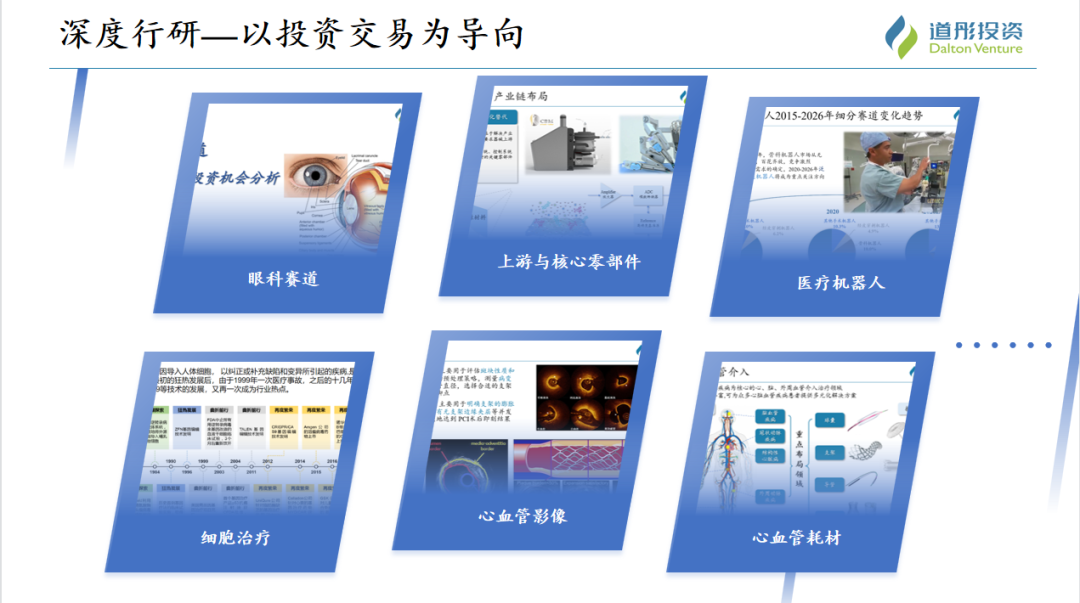
Industry research oriented toward investment decisions is our starting point. Research in key verticals determines our investment and post-investment behavior. Cardiovascular and cerebrovascular diseases seriously threaten public health and have long attracted significant capital attention. Many sub-verticals in this space have already been deeply cultivated by investors. We've been continuously searching for and positioning Dalton's opportunities, and next we'll share how we understood the investment opportunity in ECMO (extracorporeal membrane oxygenation).
First, massive market potential. Before ECMO gained attention due to the pandemic in 2020, the 2019 China Cardiovascular Health Report noted that heart failure-related indications already exceeded ten million. Yet ECMO in China was previously confined to tertiary hospitals — roughly five hundred institutions with fewer than ten thousand procedures annually. Although the overall volume was still small, demand was highly inelastic. ECMO represents the most advanced level of critical care rescue, playing an enormous role in end-stage resuscitation and left heart failure treatment.
After the 2020 pandemic, ECMO attracted attention at the national level. We also saw that in overseas markets — Europe, Germany — ECMO was already well-applied beyond left heart failure rescue, including in emergency transport, pediatrics, and end-stage respiratory disease. Essentially every general hospital with such capabilities was equipped with ECMO. For the China market, future total demand could be even larger.
Second, ECMO's technological barriers. The core components and raw materials involved in ECMO have very high barriers. The system is complex and relies on global industrial supply chains. Previously, these high-tech machines were almost entirely produced by foreign companies, with foreign machines dominating China's market share. For our country, this is a direction that needs to be broken through — the domestic substitution space is enormous.
Third, cost. Beyond technological barriers and physician training, another critical issue is cost. Previously, ECMO consumables were extremely expensive, making patient rescue costs very high and thus greatly limiting application. Reducing costs through domestic substitution is also an urgent need.
From a market competition perspective, we also observed that compared to crowded tracks like valves and balloons, most domestic ECMO system manufacturers were still in early stages.
So what can we do when investing in such a project? Beyond deep industry research, policy foresight and forward thinking are also crucial. Chokepoint technology issues are problems that China will need to solve over the next five, ten, or even more years. Additionally, the unprecedented national attention on grassroots healthcare and ICU construction and allocation was validated by subsequent policy releases.
While adhering to vertical logic, we also need to get market timing right. In the early pandemic period of 2020, Guangdong Province had already begun developing ECMO-related technical standards, establishing the possibility of domestic production. Without these standards, subsequent type testing and clinical trials couldn't proceed. Later, national policies successively introduced more refined requirements for ICU construction and allocation, further opening ECMO's market space.
Another important factor in Dalton's ability to seize the ECMO opportunity is our industrial background. Years of industrial background bring not just high market sensitivity, but also access to first-hand deal flow.
Another dimension is our entire post-investment management system. Because of our deep understanding of industry policy and industrial ecosystem building, when we reach the post-investment management stage, our philosophy is very clear: we must be a good "co-pilot." Our role is helping companies with refined operations, connecting quality resources, and determining capital strategy. From investment through post-investment management, connected from beginning to end, this ultimately forms a system construction.

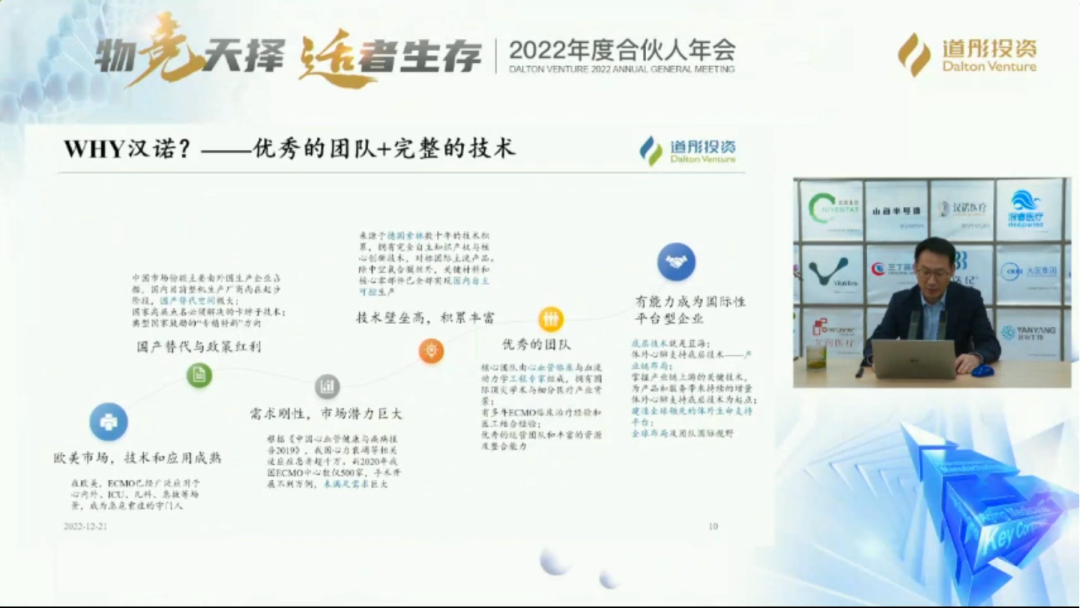
"In the ECMO field, we invested in an excellent company, Hanuo Medical. Through deep industry research, we identified the investment opportunity; through forward-looking understanding of national policy, we found certainty within uncertainty; we dared to be first, dared to invest against consensus, dared to make decisions, and laid out in this sub-vertical. Also drawing on our deep industry resources, we identified the best company in the vertical, then provided deep post-investment empowerment, accompanying and supporting the company's growth."
Below are highlights from Dalton Venture director Lin Zhencheng:
Today, Mr. Sun very systematically introduced Dalton's overall strategy and investment strategy, and Mr. Mao also introduced our investment and post-investment tactics from the tactical level. Now I'll combine the specific case of Hanuo Medical to discuss how our investment team tightly works around our strategy and tactics.
Shenzhen Hanuo Medical is an extracorporeal life support-focused medical device R&D company we invested in in 2021. Its first product is the well-known fully self-developed ECMO equipment, consumables, and system.
When the pandemic began in early 2020, our team very acutely sensed that it might bring potential investment opportunities. In March, we noticed the ECMO equipment used to rescue Li Wenliang, but our internal discussion at the time felt this vertical's market was too small. However, in the following months, the two best domestic cardiac surgery specialty hospitals respectively recommended ECMO to us, again drawing our high attention. We then arranged very deep industry research internally, ultimately forming a consensus to lay out in this sub-vertical.
We believed the pandemic exposed the absence of domestic ECMO technology. National leadership attached great importance to emergency critical care and grassroots healthcare, with very strong determination to solve chokepoint technology issues; meanwhile, a series of import substitution policies would strongly support such high-tech development.
For our fund, we need to dare to be first, to get ahead of policy, and invest in some non-consensus technologies. Mr. Mao just mentioned some particularly important policies. For example, in March 2020, Guangdong convened a special meeting of the Key Laboratory of Extracorporeal Circulation Enterprises to research ECMO technical standards — this was the first national-level special meeting. Then in May, the National Development and Reform Commission and National Health Commission released the Public Health Emergency Treatment Capacity Building Plan, explicitly for the first time calling for strengthened ICU construction, explicitly requiring each province to build 1-3 major epidemic treatment bases with ECMO equipment as standard configuration. Then on November 17 this year, at a State Council joint prevention and control mechanism press conference, the National Health Commission again emphasized "continuously strengthening designated hospital construction, ICU beds should be configured to 10% of total beds, with 1 ECMO per 10 beds." This means China's existing 60,000-70,000 ICU beds imply 6,000-7,000 units of ECMO equipment demand; beyond this, there's also potential market growth from the future national target of 10 ICU beds per 100,000 people and corresponding ECMO allocation. At this point at the policy level, ECMO's market capacity was completely opened up, validating our policy research and market foresight for this sub-vertical at that time.
Why did we firmly invest in Hanuo Medical? Beyond the market issues just mentioned, we also analyzed from other dimensions.
First, as we just discussed, although the near-term market isn't very large, demand is highly inelastic with enormous growth potential. In severe cardiopulmonary failure, cardiac arrest, and other patient emergencies, it can play a key role, representing the most advanced critical care rescue level.
Second, after studying the European and American markets, we saw that ECMO is already very mature both technologically and in application, already widely used in ICU, pediatrics, emergency, and other scenarios.
Third, current China market supply is completely monopolized by foreign giants such as Maquet, Medtronic, and Sorin — China's own domestic equipment is at zero, meaning the domestic substitution space is very large.
During the pandemic, ECMO equipment and consumables were basically in short supply and out of stock. National leadership attached high importance to this, specifically calling for solving this chokepoint issue. This is also a very typical "specialized, refined, distinctive, innovative" direction project.
Fourth, the founding team not only has very comprehensive, long-term product technology and medical-engineering integration accumulation, but also possesses excellent operational capabilities and rich resources and integration capabilities.
Fifth, drawing on the team's international vision and background, and based on the team's grasp of key underlying technologies and supply chains upstream in the industrial chain, the company is fully capable of taking extracorporeal cardiopulmonary support underlying technology as a starting point to build a global, leading extracorporeal life support platform enterprise.
We're honored to have the opportunity to accompany such a passionate, excellent founding team in growing together. We're full of confidence in this enterprise and this team's future!
The Hanuo Medical project is a very typical case for us: through the team's deep industry research, we identified the investment opportunity; through our forward-looking interpretation and understanding of national policy, we laid out technology that the country needs, not just what the market needs; we found certainty within uncertainty, dared to invest against consensus; drawing on our deep industry and industrial resources, we locked onto our target enterprise, provided deep post-investment empowerment, and achieved what is currently a stage of success.
Our investment team will adhere to the investment tactic of "think, see, do," tightly working around the fund's established strategic strategy to do well in our project investments.