Two rounds in six months: Datong Capital continues to double down as Gestalt Technology closes a 420 million yuan angel+ round | Datong Family --- Gestalt Technology (格式塔科技) has completed a 420 million yuan angel+ financing round, with existing investor Datong Capital (道彤资本) leading the round. This marks Datong's second consecutive investment in the company within six months, following its participation in Gestalt's angel round earlier this year.

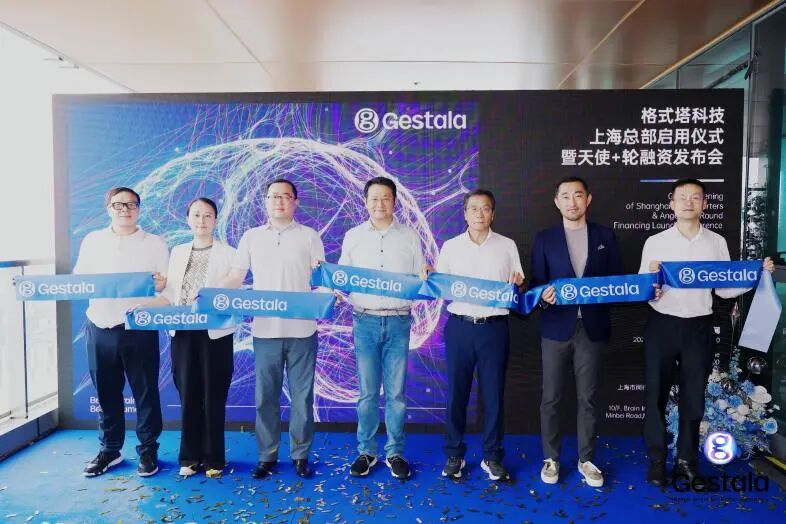
On July 3, 2026, **Gestala**, a **Daotong Family portfolio company** and China's first company focused on ultrasound-based brain-computer interfaces, announced the completion of a **420 million RMB angel+ funding round**, while simultaneously holding an inauguration ceremony for its Shanghai headquarters — establishing a dual-headquarters strategic layout across "Chengdu + Shanghai".

Background
On July 3, 2026, Gestala, a Dalton Venture portfolio company and China's first company dedicated to ultrasonic brain-computer interfaces (BCI), announced the completion of a 420 million RMB angel+ round, alongside the inauguration of its Shanghai headquarters — establishing a dual-headquarters strategy spanning "Chengdu + Shanghai."
Dalton Venture participated as a co-lead investor in Gestala's angel round in March 2026, making it one of the company's earliest backers. Combined with the 150 million RMB angel round completed in March, Gestala's total funding has reached 570 million RMB, making it one of the fastest-growing early-stage companies in China's BCI sector.
This round was led by Meridian Capital, with participation from C Capital, HSG, Lens Technology, China Electronics Health Fund, Sinovation Ventures, Shanghai Lingang Science and Technology Investment Management Co., Ltd., Fudan Furong Capital, and Guotai Venture Capital. Dalton Venture, Yunshi Capital, Qingsong Capital, and Gobi Partners, as existing investors, continued to invest above their pro-rata rights.
Technology Pathway:
The Breakthrough Path of Ultrasonic Brain-Computer Interfaces
Gestala's choice of ultrasonic BCI stems from a deep understanding of the brain's nature. Invasive BCIs rely on local electrodes that can only record "point-like signals," unable to capture whole-brain coordination mechanisms. Yet the brain's complex functions depend on cross-regional "neural circuit" collaboration — the brain is an entity where "the whole is greater than the sum of its parts," a core tenet of Gestalt psychology.
Compared to traditional electrical invasive approaches, the ultrasonic pathway offers distinctive advantages: non-invasiveness, whole-brain "read-write" capability, and multi-target neural circuit modulation. It transcends physical modality limitations, achieving an optimal balance between invasiveness, spatial resolution, and penetration depth — one of the few write modalities capable of precisely and non-invasively reaching deep brain regions. This technological approach shows broad promise in treating chronic pain, depression, Alzheimer's, Parkinson's disease, stroke rehabilitation, and other major conditions, while also opening new possibilities for deep AI-brain interaction in the future.
Chengdu + Shanghai Dual-Headquarters Synergy
Additionally, Gestala's Shanghai headquarters was officially unveiled today in Minhang District's "Brain Intelligence Hub." As a key future-industry cluster for brain-computer interfaces that Shanghai is cultivating, the Brain Intelligence Hub brings together cutting-edge innovation forces. Gestala is not only among the first enterprises to join the park, but also the first headquarters-level institution to commence formal operations.
With this, the company has formally established its "Chengdu + Shanghai" dual-headquarters synergy. At the end of June this year, its global headquarters and the world's first ultrasonic BCI super-factory Phase I were completed and put into operation at Chengdu Tianfu International Bio-Town, with total floor area exceeding 16,000 square meters. The facility houses a full-chain sci-tech industry platform integrating basic research, animal experiments, precision R&D, standardized production, and clinical translation. Equipped with Class 10,000 cleanrooms, ESD electronic assembly workshops, and specialized laboratories spanning ultrasound, NeuroAI, biochemistry, and animal experiments, the factory's capacity can support 2–3 years of research prototypes and medical device batch delivery.
In terms of functional division, the Chengdu global headquarters is positioned as the R&D and production center, responsible for core ultrasonic BCI technology development, clinical translation, and device manufacturing; the Shanghai headquarters is positioned as the NeuroAI Innovation Center, focusing on AI brain foundation model R&D and global innovation resource integration, building a bridge connecting global brain science and artificial intelligence. As Peng Lei put it: "If the Chengdu global headquarters carries the mission of bringing ultrasonic BCI from laboratory to industrialization, then the Shanghai headquarters carries the exploration of moving from brain data to brain intelligence."
Dalton Venture:
Firmly Bullish on the Long-Term Direction of Brain Science and Brain-Computer Interfaces
As one of Gestala's first investors and a co-lead of its angel round, Dalton Venture was invited to attend this funding announcement and Shanghai headquarters inauguration. At the event, Dalton Venture Founding Managing Partner Sun Qi shared the firm's long-term thinking on brain science, BCI, and the trends of future intelligence.
For Dalton Venture, investing in Gestala was not merely backing an innovative company, but a firm vote of confidence in the long-term direction of brain science and brain-computer interfaces. In recent years, BCI has achieved continuous breakthroughs, with encouraging progress in motor reconstruction, language recovery, and visual reconstruction. At the same time, Dalton Venture is even more focused on the profound significance of this technology for understanding the brain and advancing the life sciences.
Sun Qi said at the event: "Humans have landed on the moon, and we're training AI to understand the world. But to this day, we still know shockingly little about our own brains. Brain-computer interfaces are exploring humanity's last unknown continent."
In his view, BCI is not merely a medical technology, but an important foundational technology connecting the life sciences and future intelligence. As artificial intelligence continues to evolve, more and more researchers are turning their attention back to the brain — currently the most efficient information processing system known. Brain-computer interfaces, brain-inspired intelligence, and artificial intelligence are not competing with each other, but rather exploring the same question from different paths: where does intelligence actually come from.
As one of Gestala's earliest investors, Dalton Venture has continued to pay close attention to and accompany the company throughout its development. From completing its first funding round, to the completion of its global headquarters and super-factory, to the formal inauguration of its Shanghai headquarters — each leap forward has affirmed the team's long-term commitment to original innovation and its solid execution capability. Going forward, Dalton Venture will continue to deeply accompany Gestala's growth, working alongside more outstanding entrepreneurs to jointly drive continuous breakthroughs and long-term development in brain science and brain-computer interface technology.


ID: daltonventure
Long-press to follow
Recommended Reading