On Day 5 of Brain-Computer Interface Treatment, a Depression Patient Brought a Lollipop... This Disruptive Therapy Could Win Approval Within a Year | Daotong Family

Minhang District Media Center has launched the "**Go, to the Lab**" series, going behind the scenes at Minhang's frontline research facilities to explore breakthrough technologies. This installment visits **a DaoTong portfolio company — KoSyne NeuroTech**.

Background
Minhang District Media Center has launched the "Go to the Lab" series, venturing into the district's frontline research facilities to explore cutting-edge technological breakthroughs. This installment features KoSyne NeuroTech, a Dalton portfolio company.
The following is reprinted from the official WeChat account of "Today's Minhang."
In the Year of the Horse, as all things renew and innovation surges, science and technology take the lead. Minhang District Media Center has launched the "Go to the Lab" series, venturing into the district's frontline research facilities to explore cutting-edge technological breakthroughs. How do scientific and technological achievements transform into new quality productive forces? Let us witness it together —
Depression, often called "the common cold of the mind," is far from being cured by simply "taking a pill." Traditional therapies are slow to take effect, require long courses of treatment, and have limited efficacy rates — a single course often stretches over weeks or even months, a prolonged ordeal for patients and their families alike. What if there were a therapy that could compress the treatment cycle from 6–8 weeks down to just 5 days, with an efficacy rate as high as 80%–90%?
This is no fantasy. In Minhang, a "spatiotemporally precise" neuromodulation therapy based on brain-computer interface technology is moving from the laboratory to the clinic. Patients need only receive intervention five times daily, ten minutes each session, and within days, the gloom weighing on their hearts quietly lifts.
"We witnessed with our own eyes a person transform from deeply despondent to radiant with life."
Ximing Wang, co-founder of KoSyne NeuroTech, still vividly recalls the impact of their first clinical patient. She was a woman in her forties, who after more than half a year of medication remained mired in moderate-to-severe depression. In the first days of treatment, like many patients, she was silent, negative, and resistant to interaction.
The miracle quietly unfolded on the fourth day of treatment. "That day, we became famous throughout the entire hospital. She suddenly combed her hair, washed it, and came to treatment wearing lipstick." Wang recalls the surprise of that moment. "When treatment ended on the fifth day, she gave a lollipop to a colleague on our team. Only later did we learn that she had also cleaned her house, which hadn't been tidied in six months."
This sweet gift was the greatest encouragement for the entire team. Follow-ups at 2, 4, and 6 weeks showed the patient's depression scores continuing to decline, her mental state steadily improving.
During the clinical trial, Wang witnessed countless such "small rebirths": students preparing for exams, lovers recovering from breakups, men grappling with midlife crises. A mere five days of treatment became a key, unlocking the door to new lives for them.
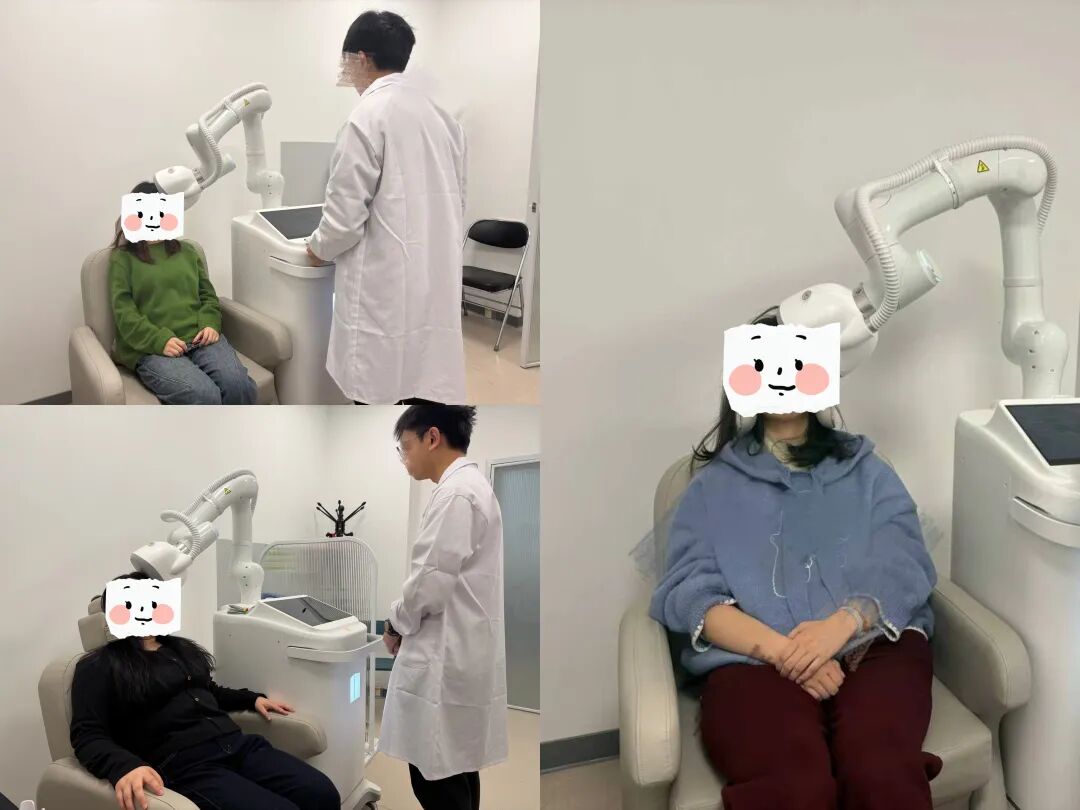
A patient showing improvement after treatment
Data from over ten clinical cases confirm the technology's breakthrough: traditional neuromodulation therapies hover around 40% efficacy. In preclinical experiments, this new technology achieved 70% efficacy after five days of treatment, and at 6-week follow-up, the efficacy rate reached 90%, with most patients having returned to normal levels.
"We're not trying to displace traditional therapies, but to give patients a 'first choice' — try this non-invasive, rapid, and precise treatment first. If it doesn't work, other options remain." Wang revealed that the treatment system has been submitted to the national innovative medical device pathway, with approval expected within a year. At that point, depression patients will be able to book this rapid treatment at multiple mental health centers nationwide.
"We hope it will become a 'first-line therapy' for depression treatment."
Inside KoSyne NeuroTech's laboratory, several R&D personnel are gathered around a prototype integrating EEG acquisition, MRI analysis, and magnetic stimulation equipment, making final adjustments. These prototypes are about to be shipped to mental health centers across the country — they are the next-generation brain-computer interface transcranial magnetic stimulation (TMS) neuronavigation systems.
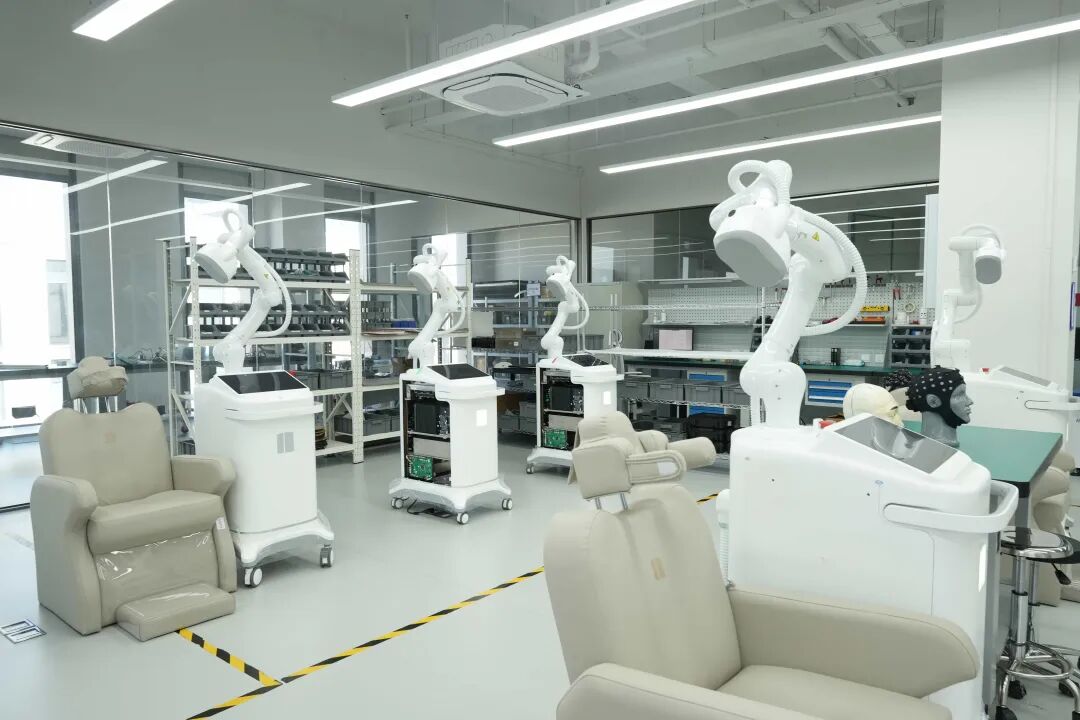
Traditional physical treatments for depression typically focus on a single location on the brain's surface. Therapists must hold a coil and manually probe the patient's scalp, searching and positioning by hand — not only inefficient, but also dependent on experience, making it difficult to guarantee precise stimulation. Hence it is often described as "using a key to open a lock, but only knowing the general vicinity of the lock."
"Compared to traditional therapies that only stimulate the 'superficial brain,' we want to precisely activate the 'deep brain' regions deeply associated with depression." Wang, founder of KoSyne, explains that the core breakthrough lies in the system's deep integration of functional magnetic resonance imaging, structured-light 3D cameras, electromagnetic field simulation, collaborative robotic arm automation control, and TMS, forming a unique computational model: by calculating the functional connectivity between a patient's superficial and deep brain regions, it identifies the optimal stimulation point.
Before formal treatment, doctors import the patient's MRI data into the system, which automatically performs calculations to ultimately lock onto the optimal stimulation point in the brain. Through electric field simulation and precise computation, it ensures that stimulation accurately targets the intended location. "Stimulating here can efficiently activate deep brain regions closely tied to emotional regulation," Wang affirms, pointing to a red dot marked on the 3D brain image on screen.
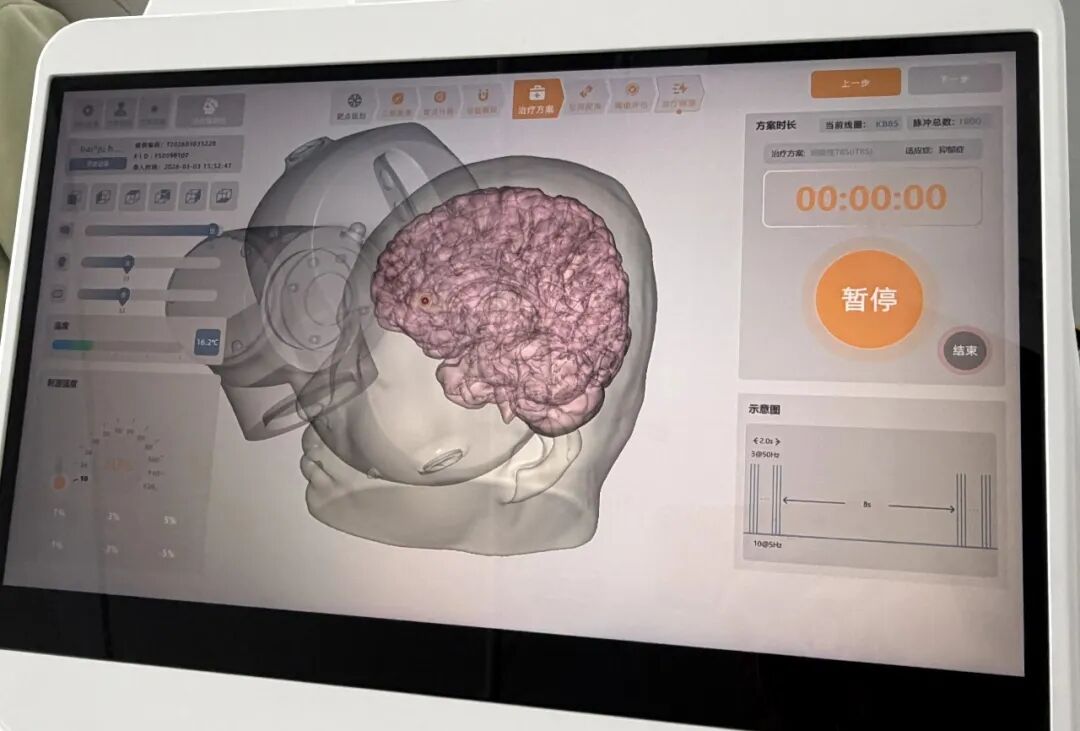
The system calculates the optimal stimulation point
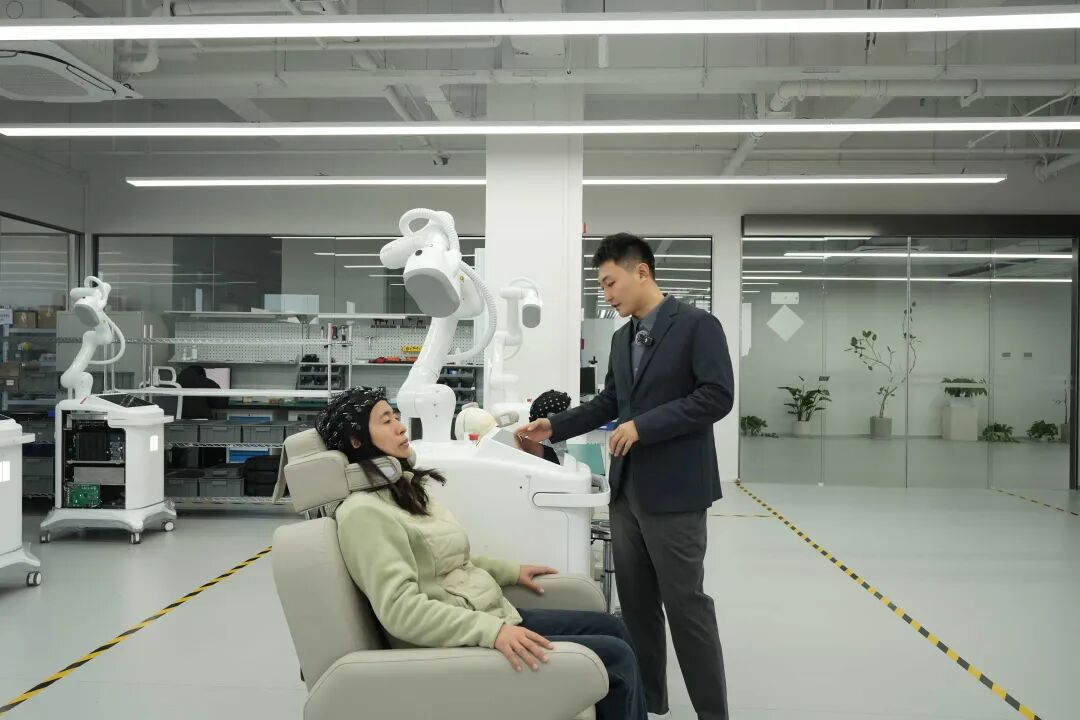
A subject undergoing simulated treatment
"The essence of depression neuromodulation lies in spatiotemporal dual-dimension precision intervention." MRI provides spatial coordinates, clarifying "where to stimulate," and its efficacy has been clinically validated. But human emotions fluctuate dynamically; if the temporal dimension is introduced on this foundation, treatment outcomes can achieve further breakthroughs.
Wang told reporters that the team is now tackling the next-generation product: capturing patients' real-time EEG signals through an EEG cap, locking in the temporal coordinate of treatment, and precisely determining "when stimulation is most effective." Clinical studies show that delivering pulse stimulation when patients are in relatively low emotional states yields far superior results compared to when they are emotionally elevated. "Spatial precision plus temporal precision — efficacy and treatment duration could be disrupted once again."
"In the future, treating mental illness may be as convenient as treating a 'cold.'"
Outstanding clinical data stems from its unique R&D model.
Located in the Caohejing Zhuanqiao Tech Oasis in Minhang, the laboratory is less than 3 kilometers from both the Shanghai Mental Health Center (Minhang Campus) and Shanghai Jiao Tong University. "This means our engineers can take questions and knock on the doors of clinicians and scholars at any time, having in-depth face-to-face exchanges." Wang says, "Every function you see on this system was refined through the process from research to clinic. For the camera and robotic arm configuration alone, we tried over 30 schemes before selecting the optimal one."

Caohejing Zhuanqiao Tech Oasis
Doctors' puzzles and patients' pain points can rapidly be transformed into R&D projects; new technologies from the laboratory can also be validated and receive feedback in clinical settings at the earliest opportunity. This tight linkage of "research–clinic–product" forms a rapidly driving innovation flywheel, enabling their product to iterate quickly over just 17 months.
And the team's exploration doesn't stop there. Therapies and devices for adolescent depression, obsessive-compulsive disorder, ADHD (attention deficit hyperactivity disorder), and Alzheimer's disease are already in development or clinical exploration. A transcranial focused ultrasound system for the next generation of non-invasive brain-computer interfaces is also being intensively debugged. In the second half of this year, they will also launch a home-oriented miniaturized device targeting depression, anxiety, insomnia, and other conditions.
"We hope that in 3 to 5 years, people will find relieving depressive moods as convenient as seeing a doctor for a 'cold,'" Wang envisions. "At grassroots community hospitals, an ordinary doctor can operate this device and complete a rapid, non-invasive treatment for a patient."

Reporter: Mingshan Su; Video: Mingshan Su, Yubin Shen (intern); Review: Kenbo Liu, Yubin Fang. Please indicate source as Today's Minhang Official WeChat.


ID: daltonventure
Long press to follow
Recommended Reading