Into the Dalton Family | Exclusive Interview with BioChuang: Pioneering the EDP Technology Platform to Produce High-Performance Chinese "Membranes" --- Walking into the Dalton Family | Exclusive Interview with BioChuang: First-in-Class EDP Technology Platform, Producing High-Performance Chinese "Membranes"

World's First Electrochemical Deposition (EDP) Technology Platform

Inside a Dalton Venture Portfolio Company
Family Insights
Bioactive tissue membranes are functional films used for tissue isolation, repair, replacement, and regeneration. Currently, two mainstream manufacturing approaches dominate: decellularized tissue matrices and electrospinning. But both suffer from critical limitations — uncontrollable fine structures, high costs, difficulty removing harmful substances, and low production efficiency.
Jiangsu BioChuang Biotechnology Co., Ltd. (hereafter "BioChuang"), a Dalton Venture portfolio company, is dedicated to the R&D and commercial translation of high-end bio-tissue engineering membranes and derived medical devices. Building on over ten years of specialized expertise and research from the team of Academician Changsheng Liu at East China University of Science and Technology, BioChuang has pioneered an "electrochemical deposition" (EDP) technology platform. By regulating the electrostatic field to drive molecular assembly at the electrode surface, it achieves multi-scale biomimetic precision control and rapid, efficient fabrication of bioactive tissue membranes.
Recently, BioChuang founder Haoqi Tan shared his entrepreneurial journey in an exclusive interview.
01
The Seed of Tech Transfer
Sprouted During Graduate School
Dr. Haoqi Tan graduated from East China University of Science and Technology, where he studied under Academician Changsheng Liu and Professor Xue Qu. During his research, he noticed that his group produced abundant scientific output every year, yet most of it remained trapped at the paper and patent stage — quality research buried in the process.
The 2022 China Patent Survey Report shows that Chinese universities achieved a 16.9% implementation rate for invention patents, with only 3.9% reaching commercialization. In the United States, university patent conversion rates hit 50%. China's tech transfer gap with developed nations remains substantial. Academician Liu took this seriously and encouraged students to pursue work that advances commercial translation, transforming innovations into products that genuinely benefit people. But freshly minted PhD Haoqi Tan had no idea how to turn research into products. So he chose to learn at a company first, joining Shanghai Haohai Biological Technology (stock code: 06826.HK, 688366.SH) to build knowledge across the tech transfer chain. A seed — the desire to advance commercial translation — took root in his mind, gathering strength, waiting to bloom.
In 2021, the Suzhou Shanghai University Innovation Center (hereafter "the Center") was established. Opportunity, once lost, does not return; momentum, once missed, cannot be recaptured. Haoqi Tan knew it was time to act. He resigned from his position at the listed company and joined the Center — an innovation incubation platform focused on high-end biomaterials — bringing his accumulated experience to lead tech transfer efforts and foster multi-faceted collaboration between the Center and Haohai. Simultaneously, he became CEO of BioChuang, using the company as the vehicle for commercial translation work. Today, Haoqi Tan lives out his original mission of improving research commercialization through concrete action.
02
Building the EDP Platform
Efficiently Manufacturing Customized Bioactive Tissue Membranes
Accidents can shatter fixed assumptions — and often spark innovation. During the interview, Haoqi Tan noted that the idea of using electrochemical deposition to fabricate biological membranes came from precisely such an "accident."
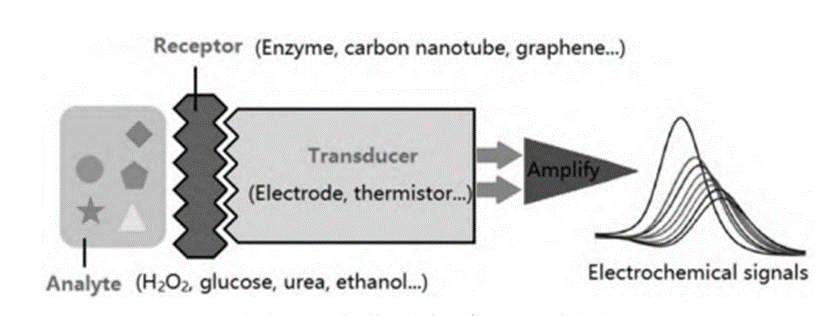
Figure: Electrochemical sensor schematic[1]
"While working on an electrochemical sensor project in the group, we accidentally discovered that the deposited film on the electrode surface could be directly peeled off. That led us to explore applying electrochemical deposition to biomaterial fabrication."
Drawing on research from Academician Changsheng Liu's team and other scientific collaborators, and after a decade of technical breakthroughs, BioChuang internationally pioneered the "electrochemical deposition" (EDP) technology platform. By regulating the electric field to drive molecular self-assembly at the electrode surface, it achieves multi-scale biomimetic precision control — from nanometers to micrometers to macroscopic scales — with rapid, efficient fabrication of bioactive tissue membranes.
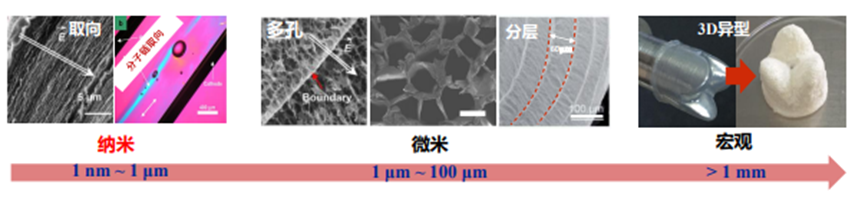
By adjusting deposition solution formulations and special electrode processing, BioChuang can also control membrane thickness, pore structure, mechanical properties, and degradation timelines — meeting personalized, customized demands for bioactive tissue membranes.
Currently, two main manufacturing methods dominate the market: decellularized tissue matrices and electrospinning. Decellularized matrices suffer from poor plasticity and risks of residual cells, which can easily trigger immune reactions in patients during clinical use. Electrospinning requires lengthy preparation times and offers limited structural control.
Compared to conventional methods, BioChuang's electrochemical deposition (EDP) achieves membrane fabrication efficiency more than 10 times higher, completing bioactive tissue membrane preparation in just over ten minutes.
"After we prepare the solution and insert the electrode, collagen molecules gradually accumulate on the electrode once current is applied. In 15 minutes, we can peel off a collagen membrane. With electrospinning, it might take over ten hours to produce a single sheet."
Additionally, BioChuang's membrane raw material is collagen. Research shows collagen membranes offer excellent biocompatibility, low antigenicity, low cytotoxicity, and hemostatic properties[2]. Compared to decellularized membranes, BioChuang's collagen membranes offer greater clinical safety.
03
Building a Local Team
Breaking Free from Raw Material Constraints
"There's a massive chasm between excellent research and products with genuine clinical value."
Chitosan (CTS) offers good biocompatibility, film-forming capability, anti-thrombogenic properties, spinnability, wound-healing promotion, and non-toxicity. In recent years, CTS has found broad applications in antibacterial treatments, wound healing acceleration, drug-controlled release, artificial kidney membranes, and diabetic foot ulcer treatment[3].
The research group had studied chitosan membranes for years, but during commercial translation discovered a critical flaw: chitosan membranes easily triggered inflammatory reactions in clinical applications with significant side effects. The high-risk profile of chitosan for in vivo use redirected the team toward collagen — a material with superior biological safety.
But at the company's founding, sourcing high-purity raw materials plagued Haoqi Tan.
For a long time, Japan has been universally recognized as the collagen giant, commanding over half the global market share. With domestic collagen supply falling short, and to ensure normal R&D progress, Haoqi Tan reluctantly turned to imported collagen as a last resort.
However, imported raw materials featured long lead times and high prices. BioChuang constantly sought solutions to break free from collagen import dependency and overcome this bottleneck.
Since October 2022, BioChuang began recruiting core technical personnel to build a local team focused on collagen materials. This July, BioChuang announced successful trial production of its self-developed Type I neo-natal high-activity collagen raw material. Its in-house collagen demonstrates stronger activity, higher purity, better safety, and superior transparency after dissolution — reaching internationally leading standards. While maintaining collagen's natural activity and structure, its solution (6 mg/mL) now achieves light transmittance above 95%, providing solid support for subsequent R&D and manufacturing of controllable electrochemical bioactive tissue membranes, particularly for corneal products.
BioChuang's self-developed collagen not only reduces manufacturing costs for its products but also breaks the international monopoly "membrane" curse.
04
Targeting High-Potential Growth Markets
Unlocking More Clinical Applications Through Product Characteristics
Currently, targeting China's two rapidly growing markets — alveolar bone repair and diseased cornea repair — BioChuang has aimed its first products at the oral bone tissue guided regeneration membrane (E-Gide) and artificial cornea (E-Col).
Leveraging the asymmetric structure of its fabricated collagen membranes — porous and loose on one side, dense on the other — BioChuang developed the E-Gide oral bone tissue guided regeneration membrane. The porous side enhances bone mineralization activity to promote osteogenesis, while the dense side's mechanical barrier blocks the fastest-growing gingival epithelial cells and faster-growing gingival connective tissue cells from contacting the bone defect zone. This creates a relatively enclosed space and conditions for bone defect healing, suitable for oral surgical repair involving implant placement, periodontal disease, orthodontics, cleft lip and palate, and other conditions requiring bone augmentation.
Additionally, BioChuang uses its self-developed high-purity collagen to produce high-transparency collagen membranes that meet the demanding light transmittance requirements for artificial corneas, leading to the development of its artificial cornea product.
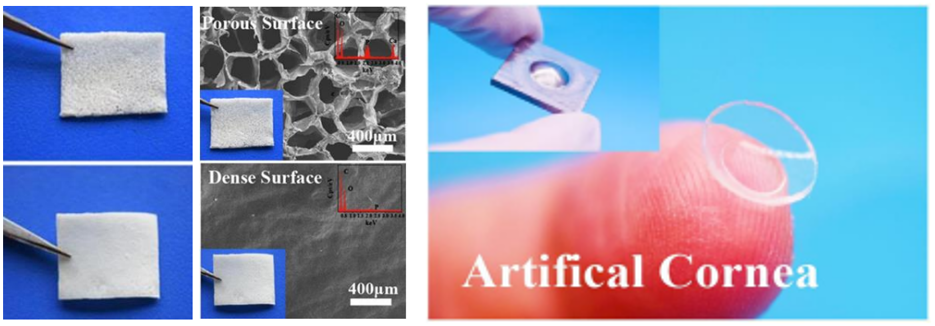
Figure: BioChuang Products
(Left: Oral bone tissue guided regeneration membrane; Right: High-transparency customizable artificial cornea)
When asked about future product development plans, Haoqi Tan responded: "Collagen membranes have numerous in vivo applications. Going forward, through our electrochemical deposition EDP technology platform, we'll explore customized R&D and manufacturing for pelvic floor repair membranes, heart valves, and certain tubular repair membranes — getting products to clinical use faster and better."
BioChuang recently completed an angel+ funding round led by Jiasheng Venture Capital with follow-on investment from Christine, which will accelerate development of its existing product pipeline.
References:
[1] Ren Biwen, Wang Lin. Research progress on application of nanomaterials in electrochemical sensors[J]. Guangdong Chemical Industry, 2023, 50(13): 65-66+61.
[2] Chen Runxin, He Wenpeng, Lin Qiang, et al. Research and application progress of guided bone regeneration membranes[J]. Guangdong Chemical Industry, 2022, 49(02): 53-55+76.
[3] Chen Hongye, Li Yongfeng, Yu Lin, et al. Effect of blending modification on properties of chitosan sustained-release membrane[J]. New Chemical Materials, 2015, 43(3): 167-172.

ID: daltonventure
Long press to follow
Recommended Reading