The worse the market gets, the more GPs want LPs to have the guts to deploy capital.
GPs need to buckle down and get the work done — happily.
From August 2 to 4, 2022, the 16th China Fund Partners Summit and 2022 Yangzhou Equity Investment Summit, co-hosted by Zero2IPO and PEDaily, was held in Yangzhou. The event gathered over 200 high-quality LPs — including prominent FOFs, government guidance funds, insurance capital, wealthy families, and VC/PE institutions — representing trillions of investable capital, to share the latest developments in China's LP market and explore equity investment paths in the new economy.
Dalton Venture Founding Managing Partner Sun Qi was invited to participate in the roundtable discussion "The Mutual Selection of LPs and GPs."
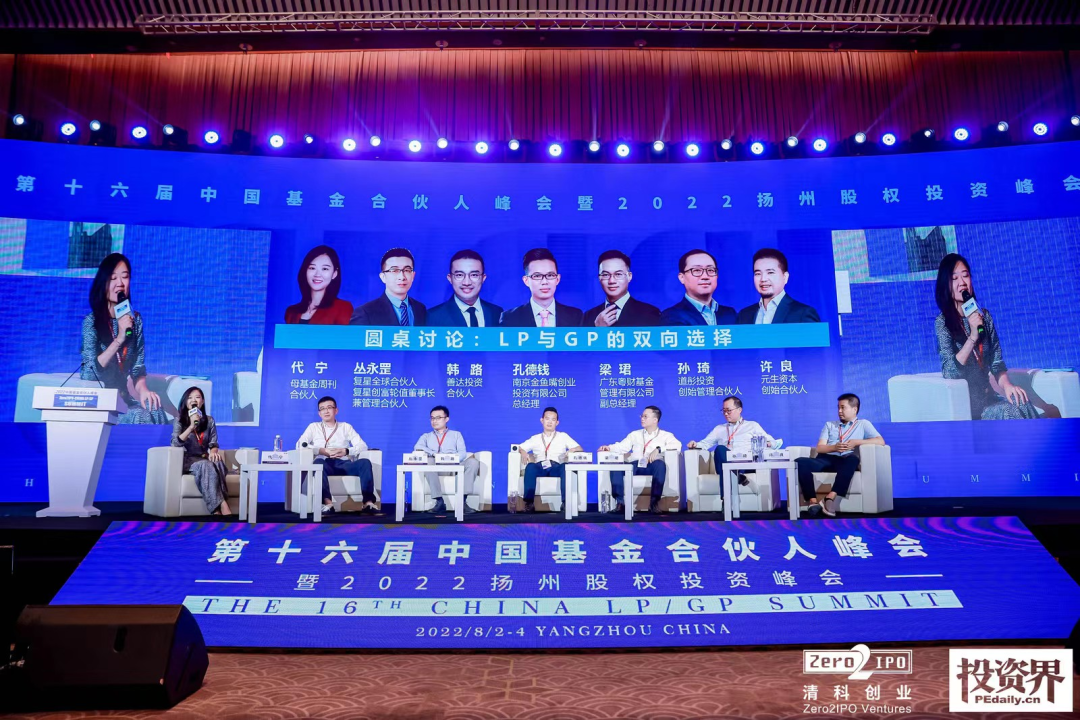
Moderator: Dai Ning, Partner at FOF Weekly
Panelists:
- Cong Yonggang, Global Partner at Fosun, Rotating Chairman and Managing Partner at Fosun Capital
- Han Lu, Partner at Shanda Investment
- Kong Deqian, General Manager of Nanjing Jinyuzui Venture Capital Co., Ltd.
- Liang Jun, Deputy General Manager of Guangdong Yuecai Fund Management Co., Ltd.
- Sun Qi, Founding Managing Partner at Dalton Venture
- Xu Liang, Founding Partner at YuanSheng Ventures
The following is a transcript of the roundtable discussion, compiled by PEDaily (ID: pedaily2012):
Dai Ning: I'm honored to have been invited by Zero2IPO to participate in this summit. As a comprehensive service platform for GPs and LPs, we'd like to leave the floor to our guests for professional sharing. Please introduce yourselves and your institutions.
Cong Yonggang: Fosun Capital is Fosun's primary private equity investment platform. Fosun has been around for 30 years, and Fosun Capital for 15. We currently focus on full-cycle equity investments from early stage to Pre-IPO, with assets under management of approximately 50 billion RMB. We mainly invest in four sectors: new materials and intelligent manufacturing, digital economy and consumer, healthcare, and next-generation information technology. We call ourselves an EVC (Ecosystem VC) investment platform. Unlike typical CVCs, which rely on a single industry, Fosun has diversified businesses spanning healthcare, intelligent manufacturing, and other sectors, enabling us to build strong industrial ecosystems and synergies.
Han Lu: Shanda Investment is a private fund headquartered in Shanghai. Our identity is somewhat unique — we operate both as a GP and as a manager of direct investment industrial funds, with approximately 13 billion RMB in scale. We mainly focus on electronic information, new energy, semiconductors, and new materials.
In recent years, due to our industrial and fund partnerships in Japan and South Korea, our direct investment approach has gradually moved into industries. We've brought in numerous high-tech Japanese and Korean companies — including those in semiconductors, optical films, and related fields — to invest in China.
Additionally, we've strengthened partnerships with listed companies, taking stakes in multiple listed companies through private placements and agreement-based transfers, and controlling one A-share listed company. This is how we've approached direct investment in recent years.
Second, we're also an LP with our own FOF, managing over 10 billion RMB focused on manufacturing. We've established extensive partnerships with many top-tier fund managers in the market, while also managing numerous local government guidance funds on a entrusted basis.
Kong Deqian: Thank you very much to Zero2IPO for the invitation. Let me introduce Jinyuzui Venture Capital — this is the state-owned investment platform of Jianye District, Nanjing. Many GPs have visited Jianye District, which features the Jinyuzui Fund Block. The total fund scale in this block now approaches 400 billion RMB.
Why doesn't our company name include "Jianye"? That's what's special about us. We're essentially a state-owned fund management platform, yet we wanted to adopt market-oriented operational mechanisms, so you won't see "Jianye" in our name. This morning's list release — why didn't you see any Jianye-related funds on the rankings? Actually, we're everywhere. Southeast Fund and CCB Beijing on that list both manage Jianye industrial funds, with market-oriented institutions serving as fund managers while we act as executive partners. Our funds seem absent, yet we're omnipresent.
Our first-phase industrial FOF has invested in over 20 GPs, and we're also an LP in 5Y Capital, Source Code Capital, and other institutions. We just established a 2 billion RMB industrial FOF with CCB Beijing, and we have an angel-focused FOF currently operating, having invested in angel institutions such as Meridian Capital.
We've created a fund block in Jianye District — essentially a fund cluster — and built upon that an ecosystem serving GPs through the full lifecycle of fundraising, investing, managing, and exiting. Our policies for funds are quite generous. For instance, our tax rebates differ from elsewhere. While many places offer competitive rebate ratios, we let GPs decide from which year to apply the tax rebate preferential policies. This is why we've been able to attract nearly 400 billion RMB to register in Nanjing's Jianye District in a relatively short time.
We also offer substantial support regarding physical space. All spaces are state-controlled, with 3 million square meters of space in core commercial areas available to attract excellent fund management companies. We've also established a roadshow platform for matching industrial capital with projects — Jinyuzui Daily Roadshow — which hosts daily events ranging from dozens to hundreds of participants, covering primary market and even primary-plus market activities. GPs can also roadshow there to connect with LPs, and funds seeking financing or exit opportunities can present as well.
If you want to raise funds, the management company can provide capital, the fund block can provide policies, and the roadshow can provide projects — basically covering the full lifecycle demands of GPs. Welcome to visit Nanjing's Jianye District.
Liang Jun: Yuecai Fund is the only institution here from the Pearl River Delta. We're a wholly-owned fund company under Guangdong Yuecai Holdings Group. Established in 2015, we're now the province's largest platform for undertaking government investment funds. We manage two 10-billion-level FOFs: the Guangdong Industrial Development Fund established in 2018, and the Guangdong Integrated Circuit Fund established in 2020. Currently, these two FOFs have been leveraged to nearly 80 billion RMB through direct investments and sub-fund investments.
On the industrial fund side, we've formed 49 billion RMB in investment scale, with approximately 40 billion RMB actually contributed and 43-45 billion RMB invested in projects. Yuecai Fund operates as both LP and GP. Why this approach? Actually, Guangdong's government investment fund management model and positioning differ somewhat from the national fund models in the Yangtze River Delta and other regions. Guangdong's provincial industrial funds emphasize direct investment, industrial guidance, and industrial layout as primary, while also using sub-fund investments to leverage social capital and drive overall industrial development — though the latter is secondary. Guangdong has never had a complete, pure sub-fund FOF.
Over the years, Yuecai Fund has followed government requirements to operate as both LP and GP, conducting both direct investments and sub-fund investments, fulfilling policy objectives while also pursuing certain investment returns.
Currently, we've invested in over 300 projects, cultivating approximately 60 national "Little Giant" and provincial "Specialized, Refined, Unique, and Innovative" enterprises. Additionally, we're advancing the second phase of our two major FOFs, while exploring how to fulfill government mandates — how to maximize policy effectiveness while also pursuing economic returns.
Sun Qi: Hello everyone. Dalton Venture was founded in 2015 as a professional fund focused on early and mid-stage healthcare investments.
I'm very grateful to Zero2IPO for building this platform and bringing major LPs from the Yangtze River Delta and Pearl River Delta to join us. Let me share three characteristics of Dalton: First, outstanding performance. Particularly strong DPI. The current market is tough — it's not the era of storytelling from ten years ago, but a time to compete on performance. Second, Dalton has strong incubation capabilities and industry resources. In the market, especially in healthcare investing, the primary and secondary markets have fluctuated considerably over the past year. In a volatile market, the most effective anti-disturbance measure is having the ability to incubate projects yourself. Going forward, I believe incubation capability will become an increasingly important GP capability — invest more when markets are good and valuations normal, and focus more on incubation when markets deviate.
Third, Dalton has very strong industry resources, but having resources isn't enough — you need to be skilled at using them. We have very strong capabilities in synergy and resource integration. Our LP partners have all been very gracious, saying they want this and that and everything — which is indeed the无奈 reality facing state-backed and government LPs in China today. But the only thing you can change is yourself. So as a GP, you need to build internal strength and find ways to adapt to the current fundraising environment. How to adapt? Study hard and diligently develop your ability to integrate and coordinate resources.
Xu Liang: We established our fund in 2015. Before YuanSheng Ventures, we spent seven years at Tencent managing Tencent's M&A investment department, investing in 300 companies with approximately 100 billion RMB total. Since founding YuanSheng Ventures, we've deployed over 10 billion RMB so far. We're a dollar fund focused on growth stage and RMB fund focused on early stage.
We mainly invest in three directions: First, consumer — we've invested in Xiaohongshu, Bananain, and ChaYanYueSe; second, enterprise services — Full Truck Alliance, Beisen, ZKH, and Taimei; third, hard tech — 4Paradigm, Infervision, Bluepha, and QCraft.
We also have three characteristics: First, YuanSheng Ventures is a fund that lets LPs sleep soundly at night. We adhere to a boutique fund strategy with relatively few investments — each fund only invests in 10-15 companies, aiming for higher success rates. Second, our approach uses systematic team-based methods to deconstruct entrepreneurs as individuals, including their team's organizational capabilities, combined with industry expert judgments, to form our investment decisions. Third, overall, we're a relatively disciplined fund, exercising restraint on valuations and other aspects. So each fund's performance has been relatively stable so far, without particularly large fluctuations.
Dai Ning: Today's six guests come from different ecosystems in the industry — platform service providers, LPs, and GPs. In terms of attributes, we have both market-oriented institutions and government guidance fund institutions. From your different perspectives and identities, how do you view the current changes in the equity market overall, especially amid the current environment of COVID叠加 economic conditions and international局势? In this trend, what opportunities can you identify?
Cong Yonggang: The past year has indeed seen enormous changes. I'll look at this from several dimensions: In terms of overall market capital supply, the US dollar — which has been a very important capital source in China's equity market — has substantially reduced its participation in the capital markets. Difficulty in dollar fundraising is a widespread experience. This means that in China, whether for top-tier GPs or newcomers, most energy will still go toward raising RMB.
RMB capital in the market mainly flows toward A-shares, leading various institutions to不约而同 increase their overall allocation to hard tech sectors such as semiconductors and intelligent manufacturing. That's one aspect.
The second is the evolution of guidance fund thinking. Government guidance funds are actually a very important participant in RMB investment, with strong industrial investment attraction demands. All GPs have不约而同 deepened one thing: their own investment attraction capabilities or industrial capabilities. Top GPs now prominently emphasize industrial value and industrial ecosystem capabilities — something that wasn't so emphasized in recent years. In the past, people talked about brand and track record; now they're talking about integration and ecosystem. This is closely related to market conditions.
Fosun has been a pioneer in this regard. Since its founding in the 1990s, "dual-wheel drive" — combining industrial operations with industrial investment — has been our core philosophy. Using an industrial ecosystem to empower investments isn't something that happens simply by "connecting the dots." "Connection" is just a concept; merely knowing people isn't enough. The critical point is aligning shared interests. Fosun Capital can create mutual benefits for other industries and external partners through the Fosun system, aligning incentives at both the value level and the human motivation level.
Fosun Capital has just over 100 employees, with fewer than 90 frontline investment professionals. But we're fighting with all 80,000 Fosun Group employees — every employee can refer projects to us, everyone can provide technical validation during due diligence, everyone can help portfolio companies with post-investment empowerment. All these contributions are tracked in Fosun's investment management digital system, and when a project exits, every contributing employee receives an appropriate share of the carry.
From an EVC perspective, how should we actually operate, and how should we structure our organization? Compared to recent years, investment hotspots were relatively clear-cut — mobile internet was one of the main threads, radiating outward to big data, AI, new consumption, and so on. Since last year, when most institutions shifted their investment focus back to technology and smart manufacturing, everyone discovered that these broad mega-tracks have fragmented into countless niche specialized fields. The leading or top-three company in each niche might already be a company valued at several billion or even over ten billion RMB. The difficulty of deploying capital is increasing. Precisely in times like these, we GPs should fight as organized units rather than as lone heroes. How to get everyone to fight more precisely and flexibly at the organizational level — this is one of the things LPs should pay most attention to when evaluating GPs in the coming decade.
Dai Ning: Anything to add, Mr. Han?
Han Lu: A few observations on this year's equity investment market, drawing from our dual role as both LP and GP. First, funding remains very tight. Many of the funds of funds we manage have been redirected to support direct investment funds.
Whether direct investment or funds of funds, roughly 70% traces back to state-backed capital when you look through the structure — including government guidance funds, fiscal capital, and state-owned enterprise funds. National data probably shows a similar ratio; this is the broad trend. Why are many LPs tight on capital this year? Looking at government revenue systems: first, government bond financing is being controlled at the national level, so their financing capacity is somewhat constrained.
Additionally, on the revenue side, land-related income historically accounted for the largest share, but most private real estate companies are now in trouble. So this revenue stream has declined. Moreover, tax revenue from private enterprises underperformed expectations during the pandemic, creating considerable pressure on the overall revenue side. On the expenditure side, pandemic prevention spending continues to increase, leaving many state-backed funding pools very tight this year.
Second, from conversations with industry peers, most institutions have slowed their investment pace. First, because of tight capital, GPs are more cautious deploying from existing funds. Second, this relates to the asset side. The overall macro environment has changed significantly — great power competition, Taiwan Strait tensions, and other international conditions are constantly shifting.
Additionally, secondary market volatility has been extreme. Whether it's fluctuations in Chinese concept stocks, Hong Kong stocks, or the normalization of IPO price breaks and lock-up expiration price breaks in A-shares — secondary market volatility also forces institutions to face great uncertainty in valuation. So the second noticeable change this year is that everyone has clearly slowed their investment pace. One institution I know simply stopped investing before October this year; they wanted to see how the pandemic situation developed overall, since recurrence has become the new normal, and they were considering how the pandemic might affect the real economy and private enterprises. This indeed reflects a quite realistic situation.
Of course, this in turn raises higher demands on GPs, including research teams. We have a research department dedicated to macro research. Given major changes in the international situation, including secondary market shifts, many previous analytical models may no longer apply. Many industries used to be cyclical, with periodic price fluctuations. Now, under pandemic influence, price and cyclical trends in many industries show very different characteristics from before. So we've also done top-down comprehensive industry reviews for several sectors we cover extensively, analyzing future trajectory development, price transmission across industry chains, and profitability changes — for instance, in new energy, semiconductors, and other tracks — focusing on differentiated opportunities to guide our investment views for at least the next three to five years. This is what we're focusing on now.
Dai Ning: Mr. Han shared more from the macro environment perspective. Mr. Kong, as a government capital provider, would you like to weigh in?
Kong Deqian: Micro-level conditions certainly have representativeness — it's harder to get LP money, investment pace is slowing, these are all reflected at the micro level. If you want to get LP money, you need to see what LPs are doing. You need to pay attention to what LPs did in the first half of the year.
What we did in the first half of the year reveals some changes between LPs and GPs. First, we raised our second industrial fund of funds. Second, we partnered with Nanjing Innovation Investment Group to establish Nanjing's first S-fund. Third, we landed Hillhouse's 4 billion RMB carbon neutrality fund in Jianye District, Nanjing.
Specifically: first, fund of funds efforts continue, showing our confidence in and demand for this market. At the same time, I experienced the shift from LP to GP — it still takes enormous effort to raise capital; everyone is struggling.
Second, why create an S-fund? We also see the liquidity problem in primary markets, and the question of how to exit from our first fund — we have our own headaches too, so we need to get moving to solve our own problems. These solutions are all closely tied to GPs.
Third, Hillhouse landing in our district shows we haven't slowed our investment pace. A fourth point: in the first half of the year, our company established two direct investment funds, meaning LPs are gradually doing GP work too — we need to diversify. Why raise direct investment funds? Here's a number: in 2021, I met with 300 GPs, but in the first half of this year, probably didn't reach triple digits — that's a dramatic drop. So we need to do some things ourselves. Actually, these four things are quite representative. Though it's difficult now and market conditions are poor, if LPs are working this hard, I think GPs should work even harder.
Dai Ning: Thank you, Mr. Kong, for setting an example for us GPs. From Mr. Kong's remarks, I get one message: GPs here must fill up every LP's schedule, constantly visiting them, or else they'll become GPs themselves. Now, Mr. Liang.
Liang Jun: I'd like to examine the changes from several dimensions. First, looking at the historical evolution of China's private equity industry, overall acceleration came after 2013–2014, alongside fiscal and tax reform of the revenue-sharing system and reforms to government investment and financing. Governments emphasized investment, scale, and production, so they played the leading role in investment attraction. They used funds as leverage. Now, as government implicit debt, land finance, and land-based financial mechanisms gradually change, governments are also considering fiscal capacity when allocating resources. With tighter finances, how to more precisely deliver targeted support to industries and build up their own advantageous industries.
So some changes starting this year: first, some government funds aren't purely doing investment to attract social institutions, but are getting directly involved themselves. According to their own industrial positioning, they're using major projects as anchors to build industrial clusters. Governments increasingly want a leading fund to coordinate with them on investment attraction work — this is a model change.
That's why both Mr. Kong and Mr. Han mentioned that we used to be LPs, but now are increasingly getting directly involved through direct investment to help governments achieve certain policy objectives.
I personally expect that after Q3, with overall government fiscal tightening, more guidance funds may need to solve the majority of their funding through fundraising. Also, many previously established government funds at various levels won't be able to make capital calls, or their fund sizes will be constrained — this is a capital volume issue.
Third, government guidance funds will accelerate moving downmarket. Previously it was provincial and municipal levels, with some district-level funds. Now, because fund income has dropped dramatically, they're using funds for industrial investment attraction to achieve goals of strengthening industry at the city, district, and provincial levels. So going forward, we'll see more funds下沉, with even county and district levels potentially establishing funds.
This will create one positive effect: previously we raised capital concentrated within our region; going forward, we'll see more cross-regional government funding channels for funds. An integrated circuit fund invested in three sub-funds, with 70–80% government capital in each — but this government capital wasn't limited to Guangdong Province, it came from the Yangtze River Delta or Beijing-Tianjin-Hebei region. I personally expect this channel to open further, with more places allocating to top institutions' industrial funds to achieve industrial investment attraction. The fund doesn't necessarily need to be registered locally, but they hope to use fund mechanisms to reach technology companies for investment attraction, and also attract expansion projects to locate locally.
On the management side, I think requirements are getting higher across the board — no exceptions. Whether government investment institutions or market-based fund managers, once you take government guidance fund or state capital money, it will be traced through, and you must demonstrate the fund's policy attributes, fulfilling the mission of industrial revitalization and upgrading.
So for market-based funds managing government funds, management difficulty and requirements will increase. You can't purely meet minimum requirements, i.e., just fulfilling reinvestment obligations. Throughout the process, governments will continuously raise requirements — for example, what can you bring to the locality, what clustering effects can you create for industrial layout. If you just look at the agreement, it's certainly not this direct. From the LP-GP perspective, GPs definitely need to better serve government investment funds. Given China's national conditions, this is what can sustain as an important funding source.
Dai Ning: Mr. Liang gave us a good direction — government guidance funds are also continuously iterating and upgrading, able to better support fund managers' investments in better ways. Now, Mr. Sun, please share some in-depth thoughts on this topic.
Sun Qi: Actually there are three questions: how to view 2022? What changes have occurred? And what trends are emerging?
Everyone certainly has deep impressions of 2022 — a year full of uncertainty. Against this backdrop, there's a new requirement for GP capabilities. Beyond the abilities to raise, invest, manage, and exit, a critical capability is understanding policy, reading the big picture, and getting the timing right. If you can get the timing right and read the big picture, you may have more从容 and richer choices.
Take Dalton Venture as an example. We anticipated last year that this year's market would likely be colder. Last year we accelerated follow-on rounds, completing follow-on totals equivalent to our total fund size that year, telling founders to hurry up — next year the market will be cold. Second, we exited six and a half projects last year, four complete exits and two partial exits. Try to exit从容 at a satisfactory price this year — very difficult.
Getting the big picture right makes your investments more从容; you won't worry about whether your "children" will run out of funding. Mr. Kong said if LPs are working this hard, shouldn't GPs work even harder? Our headquarters is in Shanghai. I left Shanghai on March 22, before the lockdown. During that period, I was constantly looking at projects, flying to 11 cities, issuing six term sheets. Beyond having the will, having the capability is crucial. Getting these things right last year meant no exit pressure this year, your "children" have all raised money and can continue investing on their own.
Let me share a few shifts we're seeing. First, overall sentiment this year: foreign capital is largely sitting on the sidelines, with the exception of capital from the Middle East, Hong Kong, and Singapore. Second, from a financial investment perspective, private capital has broadly slowed, though state-backed investment has decelerated somewhat less; the slowdown is more pronounced in later-stage rounds. Third, speaking to our healthcare track — after three or four years of capital flooding in, whatever could be cracked open by sheer force of money has already been cracked open.
This year in medtech hard tech, people are gravitating toward sub-sectors closer to monetization and commercialization. It's no longer about showing off how "hard" your tech is just to feel worthy of raising funding. I feel this especially acutely in the Bay Area — our Pearl River Delta compatriots are particularly pragmatic, favoring projects with a clearer path to commercialization.
Overall, pharma is relatively cooler this year, while devices are hotter. You need deep water for big fish; small fish suffer most in shallow water. Pharma is a capital-devouring beast — it requires relatively massive funding.
Xu Liang: Let me add a few personal observations. At the most granular level, the biggest change this year is that GPs' quality of life has improved to some degree. I remember when the market was scorching hot in 2021, basically every term sheet was sent out in the early morning hours, every project was a mad scramble.
This year is noticeably better — you can actually take your time evaluating projects. But the pressure on another front has intensified significantly. As the market cooled, there are far fewer LP "daddies" behind you, or their demands have grown substantially. So the center of gravity in life and work has shifted accordingly. That's the feeling at the most personal level.
Second, looking at the overall market — our coverage is relatively broad, though we invest in relatively few companies. Across China, with the exception of new energy, the secondary market has plummeted for all to see. Many industries have lost valuation benchmarks; what an IPO will ultimately be worth is anyone's guess. Where people used to invest based on trends and momentum, it's now become much more scattered, point-based investing. Our own sense is that 2023 may actually be a good time to invest. In the areas we look at, for consumer and enterprise services, any project that survived the pandemic cycle — its business model and team are likely seed candidates that can scale.
In perpetually hot sectors like various AI applications, autonomous driving, and a range of new tech domains, the teams still daring to start companies this year — we think this cohort should produce some very promising seedlings. Because raising money is so difficult now; those coming out of major tech companies or research labs — these two waves represent excellent investment opportunities for the next couple years.
One final deeper observation: in this overall environment, the demands on GPs are extraordinarily high, intensely competitive. It used to be that being a good investor covered about 80% of what you needed; that became maybe a third or half the job. The more important work is how to make good matches between the diverse needs of different LPs and forge mutually beneficial relationships. I think this is a tremendous test for all GPs. When I left Tencent to start a fund, I thought VC meant no management headaches, nothing this complicated. Now I realize it's identical to being a portfolio company — startups have to raise money, manage well, allocate capital to the right places. The bar keeps rising.
Sun Qi: Let me add one thing. True hard tech — projects that genuinely solve clinical pain points — remains extremely resilient. A project Dalton Venture invested in last December, Shenzhen Hanno, raised two rounds in the first half of this year, with valuation increasing several-fold: one round from Mindray, one from Shenzhen Capital Group, both top-tier institutions. In this year's market, doing two financing rounds in six months with multiple valuation step-ups — this shows that hard tech enterprises with genuinely solid technology remain very resilient.
Dai Ning: Having listened to everyone's sharing on the first topic, as a service provider I deeply respect all of you. Regardless of where the industry stands, everyone is still earnestly doing the work, digging deep in their own domains to uncover real value.
Turning to our second topic — from the hard work of both GPs and LPs, we can see the industry is quite competitive. But this competition is healthy and positive; it pushes every participant toward higher quality.
So what are the most valuable qualities for excellent GPs and LPs in the current environment, and how do they differ from before? What are the new requirements? What qualities should GPs cultivate to adapt to the market?
Xu Liang: A crucial quality for GPs is to demand more of themselves with an entrepreneur's mindset, not just the traditional investor orientation. It's not enough to satisfy LPs' various demands in your investments. You also need to ensure you can invest in good companies, deliver strong DPI, and leverage the broader ecosystem — how LP resources can serve portfolio companies, how portfolio companies can create resources for LPs, such as local registration or subsidiary establishment.
Overall, GPs are becoming increasingly competitive, with ever-higher demands on comprehensive capabilities — in some ways approaching the requirements of a startup CEO. This is the core competency GPs need to compete and survive in the market going forward.
Sun Qi: Let me speak to the LP qualities I hope for. The more depressed the market, the more GPs hope LPs dare to pull the trigger. Funds launched at secondary market highs have seen terrible NAV performance; funds launched at lows tend to generate better returns. We want to launch at lows, and at lows, we hope LPs have the courage to commit.
Second, I hope LPs dare to make independent judgments, to think for themselves, to construct differentiated portfolios. Every LP has LPs behind them; those LPs see the same GPs. If your allocation mirrors everyone else's, where is your own value, your own space? That's a real question.
Third, when GPs fundraise, what we most hope for are cornerstone LPs. We hope more LPs can commit first, and in that process, the simplest communication is best — whether you have money or not, what concerns you have, whether you think you can invest in us — just say it directly, simply. That's better for everyone.
Speaking as a GP, I think the most important GP capability is finding your "wife" — LP is short for "laopo" [wife]. In finding a wife, you must find the one most suitable for you. Your strengths should be what she most admires; what she expects should be what you can deliver. Otherwise life together will be painful. The ideal is love at first sight, then lifelong companionship.
How do we view these LP demands? I think they're perfectly normal — whoever gives money gets to speak. What matters is your attitude in meeting them. If you're wallowing in self-pity and lack capability, better look inward. These demands must be met, so you might as well do the work joyfully.
Liang Jun: I don't think there's any absolute good or bad GP. The hard qualifications are largely similar across the board — team, sector, track record.
From our perspective, we look more at GP team and organizational culture, because this is a living organism. A GP type well-suited to this phase may see its investment model, management model become ill-suited in the next.
So we value GPs' learning capacity more — whether it's a learning-oriented, research-oriented organization, whether its organizational vitality and culture have common ground with ours. In partnership, can we share values that benefit our overall industrial layout?
Kong Deqian: Let me share thoughts on both GPs and LP. I think being a GP is like life itself — when circumstances change, your mindset must adjust. This is the first thing all GPs must do: get your mindset right, adapt to changes rather than complain. This is foundational; if you can't adjust, you're in trouble.
A few suggestions for GPs. First, build out your research team. The past year or two have taught us many lessons, all paid for in real money that may never come back. Only by strengthening research can you establish an unassailable position in the market and anticipate changes earliest. For example, Hillhouse established a climate change team, with one sub-direction in synthetic biology — very hot this past year. Their investment director for this direction called me as soon as Shanghai's lockdown lifted, saying he had nowhere to go, could he come to Nanjing? I said he could come, but hotels wouldn't take him. He arrived at my company, and in our office area we pulled together 800 square meters for a shared office, with desks and amenities all set up, same as employees, using all public facilities. From there he met with everyone in Nanjing — since he couldn't travel around, the responsibility fell on us. As LPs, we should have this kind of commitment.
That same day we connected him with synthetic biology companies, professors from Nanjing Tech University's synthetic biology academy and CAS academician teams. He communicated with academic professors — he was very clear on what gets published in Science. Second, he had thorough command of the entire ecosystem from early-stage to mature companies.
He discussed something quite profound. There are some cultured meat companies — I asked his take on this market. He critiqued every product, very aligned with my own impressions. To research cultured meat, he'd bought every company's product on e-commerce platforms, taste-tested them continuously, and gained eight kilograms. This shows that an investment manager at an institution must push research to this depth — you may truly capture opportunities amid change. Second, I suggest all GPs properly staff their exit teams. This was previously undervalued; IRR looked fine, but now both GPs and LPs want DPI, want exits. We invested in one institution with excellent performance, a hundred-billion-level company, with nearly 20% equity in it. Even slight reduction moves the stock price, regulators come asking questions — so exit teams must be built out. This is among LPs' top concerns when committing capital.
Conversely, as LPs we know how hard it is to be a GP now. Everyone complains LPs want everything. Actually for our Jianye District fund of funds, we're somewhat different. Our first industry fund of funds had no reinvestment requirements, no reinvestment demands, only financial returns. The second fund of funds added some reinvestment requirements, but they're among the lowest nationwide, with the most flexible policies. Eight characters capture our LP philosophy: "No disturbance unless needed; responsive to every request."
Dai Ning: I think on one hand, after seeing so many GPs, LPs have offered heartfelt advice. At the same time, a good LP — fund characteristics determine certain demands, but will also provide support and care for GPs from various angles.
Han Lu: I've noticed some patterns. When the two GPs spoke about LPs, their language was relatively humble, expressing hopes and expectations.
LPs have very clear views on GPs — several requirements, several suggestions — you can still see this year's broader trend. We're relatively better off since we have both GP and LP businesses. Speaking from our GP perspective, let me address a few critical LP points. In this market, one quality that used to be basic but is now excellent: contractual integrity. Most sizable funds call capital in tranches; failure to contribute on schedule does real damage to GPs. State-owned LPs comprise a large share of GP capital; they have their own management methods and requirements, many contributing subsequently only after others have paid in first. So one small non-contribution can prevent a fund from calling much of its committed capital. Even replacing one LP triggers cumbersome internal processes for many other LPs. So this is the most basic requirement: manage your cash flow well, plan properly for capital allocated to long-term equity investment.
Second, LPs need to be clear about their core objectives. Mr. Kong explicitly stated his goal is financial returns — he was upfront about that. Some capital sources prioritize industrial landing, even tying concessions to specific local investment targets. Others, like certain family offices, hope to use the fund to access more industrial resources and help their family businesses become more financially oriented. Everyone has shared needs and individual priorities. LPs must articulate their core objectives and communicate openly with GPs so both sides can properly assess fit. The Asset Management Association of China now requires five-year fund terms; it used to be ten years or more. Calling it marriage isn't an exaggeration — with today's fast pace, plenty of marriages don't even last five years. Given how long you'll be working together, premarital communication and alignment on fundamentals really is necessary.
Once objectives are clear, LPs can plan their cash flow more rationally instead of spreading investments around like scattered pepper. By committing to well-matched managers for the long term, they actually achieve greater cash flow flexibility. These are things LPs need to think more about now.
As LPs, we also expect GPs to think more comprehensively about the macro environment. First, GPs need to categorize and structure their LP base. Each LP's priorities differ significantly. Without proper segmentation, fund management becomes extremely difficult — you can't please everyone, and you'll always have dissatisfied LPs questioning you, which is painful. What we're doing now is internally tagging and separating financial investors from those focused on industrial landing, grouping similar LPs in the same fund.
Previously GPs evaluated deals by studying technology, financials, and legal matters. Now two additional dimensions are essential. One is judgment of the overall macro trend — many industries are heavily shaped by the international environment and national policy direction. Everyone must research and assess top-down. That's why we established a research department, led by a PhD from the Chinese Academy of Social Sciences, to study national policy and industrial trends. We organize research seminars every two months to capture these macro forces from the bottom up. Primary market investing is increasingly influenced by secondary markets — it's quite possible for primary returns to get eaten up in the secondary market. We've also devoted substantial research effort to studying public markets. This is something PE investors especially cannot avoid going forward.
We've invested in many listed companies' private placements because our research showed these leading companies were actually cheaper in the secondary market than in the primary market — better investment opportunities. For GPs, in an environment of increasing certainty, we're iterating on our past research methods, doing more top-level research oriented toward public markets and macro trends.
Cong Yonggang: This really is like what my colleagues said — the LP-GP relationship is like husband and wife. A fund typically lasts seven or eight years. The "seven-year itch" is often the first real point of marital tension. Get past the "seven-year itch" and you get re-up commitments. Since it's a marriage, neither side can make unlimited concessions to the other — the relationship won't survive.
We mustn't forget the first principle of being a GP: making money. If you lose money, nothing else matters. You can do recruitment beautifully, but if the investment fails, government officials will be held accountable for life. So the first principle remains building strong profitability, measured by DPI. If a fund has been at it six or seven years and DPI hasn't hit 1, that's concerning. GPs need sound organizational structure and incentive systems. Don't fixate on management fees. Any GP where only partners get carry while frontline investment managers don't is in a dangerous position — that incentive structure can't align the whole team to make money for LPs.
Then there's how GPs build their research capabilities. I have another role: Executive Dean of Fosun Global Industry Research Institute. We started practicing this quite early because Fosun has securities brokers within its ecosystem, which handle macro research. Fosun has five BGs (business groups), each with its own BG Research Institute built on industrial practice, handling industry research. The investment team handles sector research. So Fosun Industry Research Institute, working with Fosun Capital, integrates three capabilities — macro research, industry research, and sector research — plus external think tanks from research institutions. This forms the research-driven investment foundation that gives us conviction as a frontline GP.
Second, GPs need to provide comprehensive service to LPs like enterprise service companies do. For governments, that means helping with investment attraction and recruitment. For listed companies and industrial capital, that means industrial integration, synergy, even assisting with M&A and introducing companies along their supply chains. Some governments ask Fosun to help with acquisitions — historically Fosun has executed quite a few excellent M&A deals. We also help governments achieve investment attraction through acquisitions. I think all of this is very reasonable and needs to be systematized. We often say fundraising is the CEO's top priority because these commitments require real resources. It's not something the fundraising team can just shout slogans about, getting LPs excited with high expectations, only for mutual resentment to build over the seven or eight years of marriage. That doesn't work.
So LPs need balance among returns, brand, and various objectives. GPs also need to know what they can actually deliver and not overpromise. When Fosun says we can empower listed companies, it's because we've acquired listed companies — this is how we actually do it. We don't boast about things we can't do, claiming we'll boost market cap, revenue, or profits by specific amounts. Historically, with government guidance funds we've taken, we've completed all required reinvestment obligations, with many guidance funds even exceeding their reinvestment targets. (The reinvestment definition needs early communication — it doesn't necessarily mean direct investment, it could mean recruitment. This needs to be transparent and clarified upfront.) So honest, open, mutually respectful premarital communication can build the long-term trust that sustains the seven or eight years of marriage, leading to repeated commitments, continuity, even extending the marriage to its golden anniversary.
Dai Ning: Thank you to all the speakers for sharing. My takeaway comes down to three points. First, do well what you're fundamentally supposed to do — stay focused. Second, while doing the basics, continuously adapt to industry trends and iterate. Third, in this industry, whatever your role or status, we need mutual understanding and包容 rather than pulling against each other — that's everyone's aspiration for this industry and the work we do.
Yangzhou is quite hot, and with the stage lights today, our speakers have been roasting up here. Under this heat, we keep iterating and growing. I believe the light will always guide us forward. Thank you to all the speakers, and thank you everyone for today's wonderful sharing.
Source: PEDaily
Further Reading
-Dalton Venture Family | Ourun Digital's CyberRay receives NMPA approval!
-
Dalton Venture Family | NovoRegen MedTech named one of APAC's top 20 most innovative companies
-
Dalton Venture Family | Women's and children's healthcare brand Noah Medical acquired by New World Group
-
Dalton Venture Family | China's first 3D-printed drug product: Triastek's T19 receives NMPA IND approval
-
Dalton Venture Family | Xuanyu Medical closes 100-million-yuan Series A; enrolls first patient in atrial fibrillation PFA ablation trial
●Dalton Venture Family | Hanno's ECMO complete system has completed over 10 clinical trials
●Dalton Venture Family | World's first 200W blue laser surgical device successfully applied in clinical practice; Blue Laser Medical secures two NMPA Class III certificates in five months
●Dalton Venture Family | Triastek's 3D-printed blockbuster drug receives FDA clinical trial (IND) approval
●Dalton Venture Insight | Pharma Industry 4.0 era begins: 3D printing ushers in a new age of intelligent pharmaceutical manufacturing
●Dalton Venture Family | He Yuan Bio's self-developed BCMA CAR-T drug completes first patient dosing; core R&D-to-commercialization chain takes shape