Dalton Venture's Sun Qi: Unlocking a New Era of Industrial Biotechnology with the Power of "Life Derives All Things," Embracing China's Golden Decade of Biomanufacturing | Dalton Insights
Bio-manufacturing: The "Next Decade" of the Global Industrial Landscape

Background
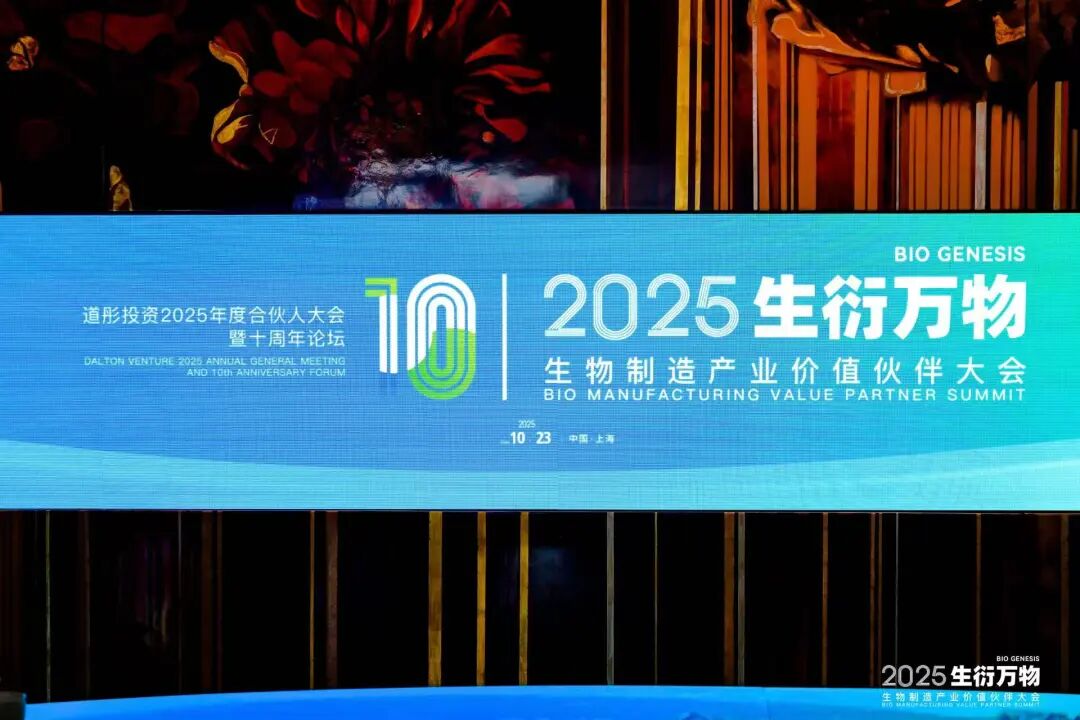
On October 23, 2025, the "Sheng Yan Wan Wu | Bio-Manufacturing Industry Value Partners Conference" — co-hosted by Dalton Venture and OPM Biosciences [688293] — was held in Shanghai. As one of the earliest investment firms to systematically deploy capital in China's bio-manufacturing sector, Dalton Venture formally launched Shanghai's first bio-manufacturing industry fund at the conference, alongside the inaugural "Bio-Manufacturing Industry Value Partners" alliance, injecting "dual-engine momentum" into the industry's development. In his opening address, Dalton Venture founding and managing partner Qi Sun offered a sweeping analysis of bio-manufacturing's historical significance and growth opportunities through three lenses — civilization's evolution, global strategic positioning, and industrial collaboration — while unveiling Dalton's strategic roadmap for the sector.
The following is the full text of Mr. Sun's address, edited for clarity and focused on key insights, shared with industry colleagues.
A Civilizational Lens on "The New Craft of Creation"
Looking back across the arc of civilization, the history of human development is fundamentally a history of manufacturing's evolution. From stone and bronze, to steam and electricity, to silicon chips — each revolution in how we make things has propelled civilizational leaps forward.
Yet since 2000, the traditional petrochemical-dependent path of chemical synthesis has nearly reached its limits. Conventional chemical synthesis has produced virtually no new molecules or materials; the potential of existing pathways has been largely exhausted. Society is waiting for a new manufacturing paradigm.
Synthetic biology and bio-manufacturing have emerged to answer this historical need. They offer entirely new methods for creating novel molecules and materials, while bio-manufacturing specifically shoulders the task of translating scientific breakthroughs into large-scale industrial production.
If "synthetic biology" emphasizes the "synthetic" — driven more by laboratory strain engineering — then "bio-manufacturing" emphasizes the "manufacturing," grounded in industrial production pathways and market demand, thereby realizing the scientific value of front-end lab research. It represents industrialization at scale:
The former solves "can we synthesize it"; the latter answers "can we manufacture it at scale." The two are complementary, together opening the door to "rebuilding the manufacturing system through living systems."
This means we have the opportunity to produce previously unimaginable molecules and materials at lower cost and greater speed; to address challenges in energy, climate, and health through greener, more sustainable means; and even to carve out entirely new industrial continents beyond the boundaries of chemicals, food, pharmaceuticals, and materials. Just as agricultural civilization launched the era of settlement and industrial civilization launched the era of machines, bio-manufacturing is now opening a "new craft era" through the power of "Sheng Yan Wan Wu" — life generating all things.
Bio-Manufacturing: The "Next Decade" of Global Industrial Competition
Today, global attention to bio-manufacturing has far surpassed the laboratory level, ascending to national strategic priority. The United States, the EU, and Japan all treat it as a next-generation strategic industrial capability. The United States, for instance, has proposed investing at least $15 billion over the next five years through the National Security Commission on Emerging Biotechnology to maintain American leadership; the EU, through its Bioeconomy Strategy, has positioned bio-manufacturing at the core of green transition and strategic autonomy; Japan has elevated its Bioeconomy Strategy to a pillar of future industry, with phased investments of hundreds of billions of yen driving bio-manufacturing innovation and industrialization.
In Asia, bio-manufacturing is showing equally strong momentum. India's bioeconomy grew 16-fold over the past decade (2014–2024); Singapore has built a highly integrated R&D and manufacturing ecosystem anchored by Tuas Biomedical Park and Biopolis.
China is also rising rapidly. Since 2022, the Party Central Committee and the State Council have designated bio-manufacturing as a priority development area. The 2025 Government Work Report classified bio-manufacturing alongside quantum technology, embodied AI, and 6G as "future industries" — with bio-manufacturing ranked first among the four, underscoring its strategic weight. The State-owned Assets Supervision and Administration Commission has positioned SDIC as the "chain leader" enterprise, and President Xi Jinping has issued direct instructions emphasizing the construction of a national resource recycling and reuse platform to improve the quality of the national economic cycle.
China holds three major advantages: two-thirds of global bio-fermentation capacity, a vast reservoir of engineers and industrial talent, and a complete upstream-downstream industrial chain. This means we are not merely participants — we have the opportunity to become rule-shapers. If the past decade was "the decade of Chinese innovative drugs," the next decade may well be "the decade of Chinese bio-manufacturing."
Collaborative Construction: Driving the Industry Toward Maturity
Dalton Venture has always believed that bio-manufacturing is not an isolated scientific breakthrough, but a society-wide systems engineering project — one that will transform supply chain structures, optimize energy systems, reshape economic models, and even redefine humanity's relationship with nature.
Grounded in this understanding, Dalton is committed to building cross-boundary collaboration platforms with industry partners, using open cooperation to break down resource barriers and drive the industry from technological breakthrough toward scaled deployment.
Two Milestones
Today's conference carries a special mission with dual significance:
First, the Dalton Venture Bio-Manufacturing Industry Fund — also Shanghai's first bio-manufacturing industry fund — is formally launching here. Shanghai itself is the birthplace of Chinese bio-manufacturing: the country's first synthetic biology key laboratory, first synthetic biology scientific alliance, and first synthetic biology professional committee were all born here. In this context, OPM Biosciences and Dalton Venture co-launched this fund, adopting a "C (industry champion) + VC (professional investment firm)" dual-engine model. It combines OPM's industrial strengths in cell culture media, Dalton's experience in early-stage healthcare and synthetic biology investing, and our deep understanding of Shanghai's ecosystem to integrate resources from enterprises, universities, and research institutes, driving key technological breakthroughs and corporate growth. Its mission: to help Shanghai build China's first innovative high-end bio-manufacturing cluster.
Second, the "Bio-Manufacturing Industry Value Partners" alliance is also setting sail today. Inaugural members include seven partners spanning capital, enterprise, universities, and research institutes: OPM Biosciences, Meihua Bio, Novo Holdings, East China University of Science and Technology, Jiangnan University, Shanghai Synthetic Biology Innovation Center, and Dalton Venture. The alliance aims to connect the collaborative chains of technology, capital, markets, and talent, forming cross-boundary synergies to accelerate industrialization.
The industry fund serves as the "engine" driving industrial development; the alliance serves as the "connector" linking ecosystem resources. Together they constitute the dual-engine momentum powering the "Sheng Yan Wan Wu" vision.
Here, I express sincere gratitude to our partners for their vision and support — it is precisely this trust and strategic resolve that gives Shanghai the opportunity to pioneer a truly future-oriented industry fund model for the nation.
"Sheng Yan Wan Wu" is not only the theme of this conference, but a shared vision among industry partners: may we rebuild the manufacturing system through living systems, may all things be renewed through bio-manufacturing, and may we benefit society in more sustainable, intelligent, and beautiful ways.
Dalton Venture stands ready at this historical starting point with all partners — to build together, create together, and share together, jointly welcoming the golden decade of Chinese bio-manufacturing.
Thank you all!


ID: daltonventure
Long press to follow
Recommended Reading