How Does Dalton Venture Precisely Capture Investment Growth Opportunities by Focusing on Cardiovascular Disease Diagnosis, Treatment, and Management? | Dalton Insights

For decades, cardiovascular disease has been considered the "leading killer" threatening global human health and longevity, with mortality rates reaching 5% among patients over 65. As population aging accelerates and lifestyles shift, the prevalence of chronic heart conditions is rising markedly — spurring waves of innovation across cardiovascular device segments to address persistent treatment pain points and improve diagnostic and therapeutic efficiency and safety.

Background
For a long time, cardiovascular disease has been considered the "number one killer" threatening global human health and longevity, with mortality rates reaching 5% among patients over 65. As population aging intensifies and lifestyles shift, the prevalence of chronic heart disease is rising markedly, sparking waves of innovation across cardiovascular device sub-sectors — addressing traditional treatment pain points and improving diagnostic and therapeutic efficiency and safety.
In medical investment, the high incidence of cardiovascular disease combined with technological breakthroughs in innovative medical devices is creating enormous investment opportunities. Innovation has become the core driver of cardiovascular medical device development, amplified by dual tailwinds of policy support and market demand. Cardiovascular innovative medical devices are now a high-priority focus for the investment community. Against this backdrop, how can investors precisely capture these opportunities?
Recently, at the Cardiovascular Industry-Research Innovation Forum of the 2025 Future Healthcare Top 100 Exhibition hosted by VBData, Dalton Venture partner Sam Lin delivered a keynote speech titled Investment Opportunities in Innovative Cardiovascular Medical Devices, offering an in-depth analysis of opportunities in the cardiovascular device sector from the perspectives of Dalton's investment focus, evolving investment approach, and investment logic.

Sam Lin, Partner, Dalton Venture
The following is based on conference transcript notes:
01
Focusing on Domestic Substitution and Structural Innovation,
With Attention to Platform Development Potential and Internationalization Capability
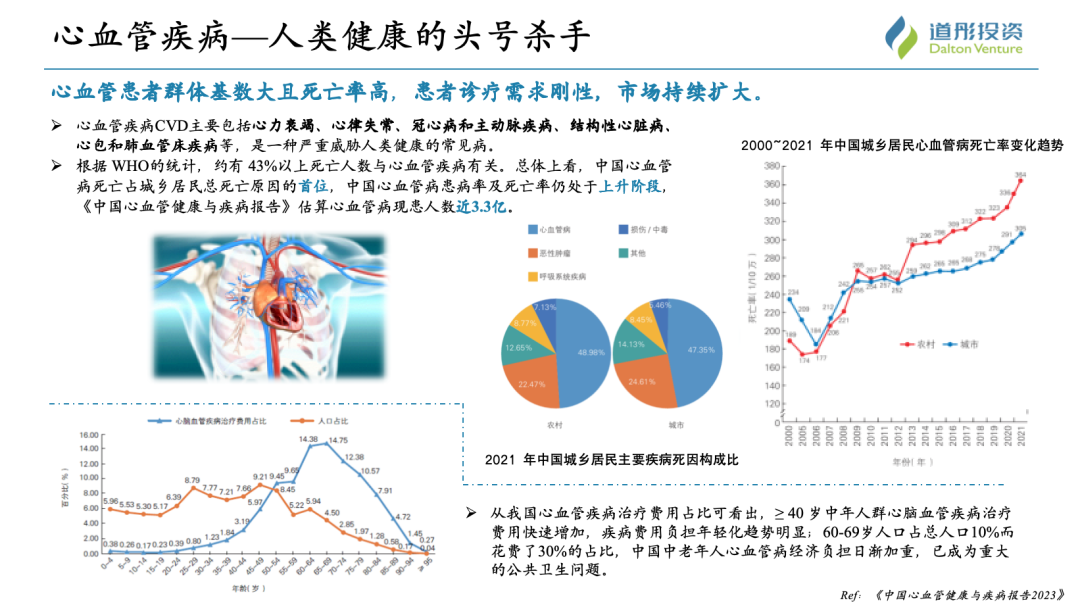
Lin noted that the cardiovascular industry is one of the most important tracks in the broader healthcare sector. Dalton Venture focuses on early-stage investments in medical and healthcare industries, with cardiovascular being one of its priority areas. Currently, cardiovascular disease has become the top threat to human health, with mortality rates remaining high globally and in China — nearly half of all disease-related deaths in China are linked to cardiovascular conditions.
In recent years, cardiovascular disease incidence has risen rapidly, with the trend more pronounced in rural areas. China's patient population now exceeds 300 million, with increasingly heavy medical expenditure burdens. Notably, cardiovascular treatment costs spike after age 40; the 60–69 age group comprises 10% of the total population but consumes approximately 30% of medical resources. As such, with ongoing healthcare cost control policies, cardiovascular disease among middle-aged and elderly populations has become a major public health and economic challenge requiring urgent attention.
The cardiovascular device market has already surpassed 100 billion RMB, expanding at a compound annual growth rate of 17.3%, demonstrating strong growth potential. Dalton Venture focuses on the following directions:
First, Dalton Venture maintains long-term attention to "domestic substitution" as a central theme, given that much innovation still originates abroad, with numerous innovative technologies undergoing a localization evolution from overseas sources. Taking the coronary artery track as an example: its global market has reached nearly $50 billion, while domestic substitution in China has already exceeded 50%, breaking the foreign monopoly.
By contrast, domestic penetration in structural heart disease (valves, occluders, etc.) remains relatively low, though certain sub-tracks are accelerating substitution — PFA and ECMO technologies, for instance, have seen significant breakthroughs, with some companies approaching 50% market share. Barriers remain, but this also means vast room for innovation.
Under the wave of domestic substitution, changes in disease patterns have created phasing shifts in investment focus. From PCI development in 2000–2010, to the rapid rise of electrophysiology in 2010–2020, to the sustained increase in heart failure incidence in recent years — heart failure is becoming a new investment hotspot.
In medical device investment, centralized procurement policy is an unavoidable variable. While it poses challenges to the industry, from a medium- to long-term perspective, the policy favors leading and innovative companies with strong cost control capabilities and platform-based and internationalization potential. The industry may well nurture domestic champions comparable to Medtronic or Johnson & Johnson. Therefore, Dalton Venture pays particular attention to whether companies possess multi-product synergistic platform development potential, as well as strategic vision and capability for international expansion.
02
Finding Innovation Opportunities Across Diagnosis, Treatment, and Management
Lin summarized Dalton's cardiovascular investment logic into three key stages — diagnosis, treatment, and management — and explores where "innovation" creates opportunities within this framework.
■ 1. Innovative Diagnosis: Lowering the Learning Curve with Commercial Viability
In precision diagnosis, imaging technologies continue iterating, with IVUS, OCT, ICE, CT-FFR and others already in broad clinical use. However, these technologies face bottlenecks in adoption: operational complexity and steep physician learning curves constrain their penetration into primary care markets.
Dalton Venture particularly focuses on "technology accessibility" — whether a product has commercial potential and can truly reach and serve grassroots medical institutions. Beyond evaluating how technologies support top specialists, Dalton seeks directions that can empower primary care physicians, promoting procedural techniques, technologies, and supporting equipment to下沉 into primary care scenarios and advance equitable healthcare access. For example, one Dalton portfolio company developed products with self-developed core components to ensure supply chain security and cost control, combined with AI technology to significantly reduce dependence on physician expertise, streamline operations, and adapt to secondary, primary, and even county-level hospitals — with potential for broad coverage.
■ 2. Innovative Treatment: Materials Breakthroughs and Scenario Downward Extension
In the treatment stage, materials innovation is critical. Taking valves as an example, polymer materials can not only reduce manufacturing costs but also significantly extend service life, meeting urgent clinical needs.
The same applies in mechanical circulatory support (MCS), where artificial heart-related membrane materials face both supply chain security and innovation challenges.
Dalton invested in China's first ECMO manufacturer, which achieved device miniaturization based on Medtronic's original product design, significantly enhancing adaptability to primary care scenarios. As a latecomer, it possesses advantages in device form factor optimization that earlier entrants cannot easily replicate. Such technical strengths effectively expand application boundaries, demonstrating particular value in China's emergency medicine and medical transport scenarios. Given the uneven distribution of medical resources in China, transport scenarios hold significant clinical importance; through miniaturization and integration, complex medical equipment can substantially lower technical barriers for operators, thereby driving advanced treatment methods deeper into the broader primary care system. Dalton Venture is optimistic about such innovation directions, expecting technological progress to improve accessibility to quality medical technology so more patients can access and afford advanced treatment options.
Moreover, even in relatively mature PCI stent and balloon catheter domains, numerous innovation opportunities remain — biodegradable materials, drug carriers, and release mechanisms, among others. Innovation is endless; only through continuous innovation can companies find new ways to survive in an intensely competitive market.
■ 3. Innovative Management: Chronic Disease Monitoring and Patient Awareness
The chronic disease nature of cardiovascular conditions makes "post-operative management" equally critical. In August 2024, Ipsos conducted a sample survey across six countries among people under 65, with 6,000 total respondents. The data showed surprisingly limited awareness of heart failure: shortness of breath, chest pain, and fatigue are the most representative symptoms, yet only 40% of people knew this; 40% incorrectly believed heart failure means the heart stops beating, and 33% mistakenly conflated heart attack, cardiac arrest, and heart failure.
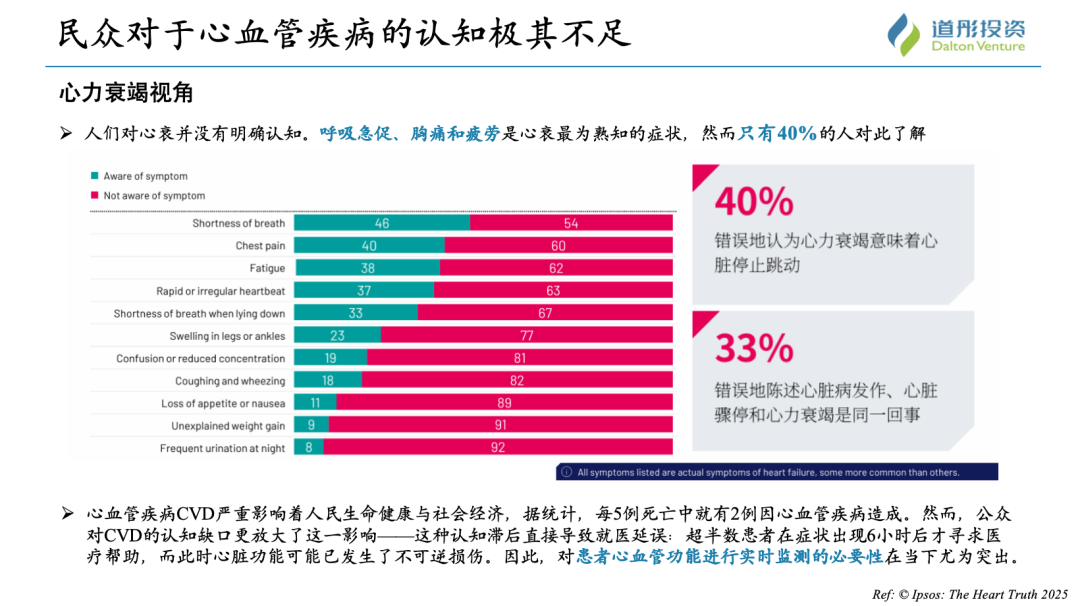
This awareness gap directly delays medical seeking. Over half of patients wait more than six hours after symptom onset before seeking medical help, by which time irreversible cardiac damage has occurred and the optimal intervention window has been missed. Therefore, remote real-time monitoring and chronic disease management have become key focus areas for Dalton. For example, Dalton invested in an innovative device integrating treatment and monitoring functions, enabling real-time intraoperative left atrial pressure monitoring and post-operative remote monitoring to assist physicians in intervening before heart failure deterioration, significantly reducing hospitalization and mortality rates.
Lin noted that Dalton Venture has made deep deployments across the cardiovascular sector, covering PFA, RDN, ECMO, and a range of diagnostic, therapeutic, and management innovative medical devices. Going forward, Dalton will continue to cultivate this space, looking forward to partnering with more companies possessing technological breakthroughs and clinical application value.


ID: daltonventure
Long press to follow
Recommended Reading