Mycowave Medical Completes Tens of Millions of RMB Angel Round, with Dalton Venture as Sole Investor, Expanding Non-Invasive Neuromodulation for Home and Diversified Scenarios | Dalton News

Recently, emerging neuromodulation company **MicroVention Medical Technology (Shanghai) Co., Ltd.** (abbreviated as "MicroVention Medical") announced the completion of a tens-of-millions-of-yuan angel funding round. The round was **exclusively invested by Dalton Venture**, marking the company's first external financing since its establishment in 2024.

Background
Recently, Maikev (Shanghai) Medical Technology Co., Ltd. ("Maikev Medical"), an emerging player in the neuromodulation space, announced the completion of a tens-of-millions RMB angel round — its first external funding since its founding in 2024. The round was exclusively led by Dalton Venture.
The proceeds will primarily fund the indication expansion, multi-center clinical trials, and domestic and international market deployment of its core product — a wearable nerve stimulator — accelerating the commercialization of non-invasive brain-computer interface (BCI) technology in neuromodulation.

01
Policy and Demand as Dual Engines: Non-Invasive Technology Unlocks a "Trillion-RMB Blue Ocean"
As global population aging intensifies and brain science research advances, neuromodulation has emerged as one of the central arenas of medical innovation. As a key application direction of BCI, neuromodulation uses electrical, magnetic, optical, and ultrasonic methods to precisely regulate neural signals, offering revolutionary treatments for high-incidence neurological conditions including essential tremor, Parkinson's disease, epilepsy, depression, and insomnia.
In this evolution, non-invasive technology — with its superior safety and convenience — is leading the industry's mainstream trajectory. As the technology matures, neuromodulation is accelerating its break from the constraints of "niche surgical treatment" toward "mass-accessible home therapy," inaugurating a new cycle of neuroscience commercialization.
On the policy front, BCI has been elevated to a national strategic emerging industry. In 2025, BCI was explicitly included in China's 15th Five-Year Plan as a priority development sector, becoming one of six future industries and new economic growth engines. In July of the same year, the Ministry of Industry and Information Technology and six other ministries jointly issued the Implementation Opinions on Promoting the Innovative Development of the Brain-Computer Interface Industry, setting a target for non-implantable devices to achieve mass production iteration by 2027. Shanghai also released a special action plan encouraging non-invasive technology applications in rehabilitation training and neurological disease treatment, with supporting policies across multiple regions constructing a comprehensive industrial support system.
On the demand side, accelerating population aging is continuously expanding the patient population for brain diseases. Data shows that by 2050, China's population aged 65 and above is projected to reach 30% of the total population. The overall incidence of essential tremor is 0.9%, surging to 4.6% among those over 65. Idiopathic Parkinson's disease currently affects 3 million patients, with projections of 5 million by 2030. Insomnia patients exceed 300 million, with over 10 million new cases annually. Depression incidence ranges from 3% to 5%, with 95 million existing patients. In the essential tremor and Parkinson's disease segments alone, China's treatment market reached 6.1 billion RMB in 2023 and is projected to grow to 9.4 billion RMB by 2029 — representing substantial market potential.
Today, non-invasive neuromodulation technology offers advantages including shorter development pathways, broader application scenarios, and higher safety profiles, effectively addressing pain points in traditional treatment approaches. For example, a significant population of essential tremor and Parkinson's patients exists in a clinical "gray zone" where drug efficacy is insufficient yet surgical indications have not been met. Non-invasive neuromodulation provides an entirely new solution to this clinical dilemma, opening up a trillion-RMB market space.
02
Two Decades of Industry Accumulation and Deep "Industry-Academia-Medicine-Engineering" Integration Building Core Competitive Moats
Maikev Medical's rapid rise stems from its deep industrial heritage and cross-disciplinary innovative DNA.
Founder and CEO Fen Chen has spent over two decades in neuromodulation, witnessing the entire arc of China's functional neurosurgery from nascent stages to substantial scale. She brings profound clinical insight, technical understanding, and industrial vision. Through long-term industry practice, she has not only precisely grasped clinical needs and technology development trends, but also accumulated full-chain operational experience spanning technology R&D translation, academic promotion, market channel construction, and industrial ecosystem collaboration.
The founding team centered around Fen Chen brings together senior talent across BCI, neurology, and commercial operations, forming a composite advantage of medical-engineering crossover and industry-academia-research integration. The team understands clinical practice, technology, markets, and operations — possessing closed-loop capabilities from cutting-edge technology incubation, product commercialization, to scaled deployment. This comprehensive accumulation spanning academia, technology, industry, and markets enables the company to deeply perceive clinical pain points, efficiently connect industry resources, and precisely layout long-term strategy, establishing an irreplaceable industrial foundation for sustained deep cultivation of the non-invasive neuromodulation track.
The company has assembled a top-tier R&D team spanning medicine, algorithms, electronics, mechanical engineering, and artificial intelligence, collaborating with leading Shanghai-based university research forces and establishing close partnerships with multiple top-tier domestic medical institutions. This creates a full-chain collaboration model of deep "industry-academia-medicine-engineering" integration, ensuring seamless connection from technology R&D, clinical validation, to commercial deployment.
Maikev Medical has completed R&D and production layouts in Shanghai and Suzhou. In 2025, the company was successively honored with Gusu Entrepreneurship Leading Talent Team and Taicang Entrepreneurship Leading Talent Team awards, recognizing its exceptional team and development potential.
03
Full-Chain Technology Breakthroughs, Building a Diversified Product Matrix
With medical-engineering integration at its core, Maikev Medical has developed a completely original and proprietary technology pathway, forming a diversified product matrix anchored by wearable nerve stimulators, covering transcutaneous vagus nerve stimulation systems and wearable multi-modal physiological parameter monitoring systems.
Its core product — the wearable nerve stimulator — has demonstrated remarkable clinical outcomes: in the first essential tremor (ET) patient treated, Fahn-Tolosa tremor rating scale scores dropped from 54 to 26 after a 40-minute session, representing a 51% symptom improvement rate — clinically significant and substantially exceeding early data from comparable industry products.
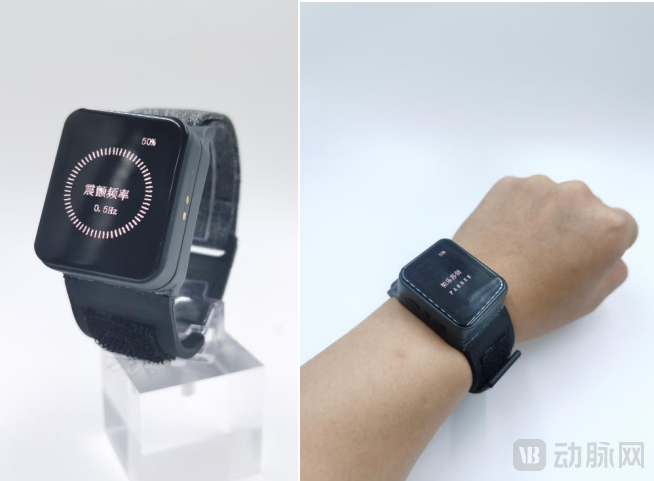
Maikev Medical's self-developed wearable nerve stimulation wristband
This product is China's first wearable nerve stimulation product to explicitly list essential tremor and idiopathic Parkinson's disease as indications and intended uses. It requires no additional installation or operation before treatment, is adapted to Chinese usage habits, and combines cost advantages with clinical efficacy — filling a domestic market gap.
The product has now initiated multi-center registration clinical trials, with product registration certification expected in the second half of 2026. On the profit model, the company adopts a "device + consumables" approach, combining near-term profitability with long-term development potential.
Beyond this, the company is systematically deploying high-growth innovation pipelines around its autonomous neuromodulation platform, gradually building a cross-indication, cross-scenario non-invasive neurotechnology product ecosystem.
The Transcutaneous Vagus Nerve Stimulation System (TVNS) features multi-indication expansion capabilities. By modulating key pathways in the central neural network, it can address multiple high-incidence chronic disease domains including sleep disorders, depression, migraine, epilepsy, heart failure, and weight management. This product possesses a platform advantage of "one core technology, multiple disease replication," opening trillion-RMB market space in neurology and mental health for the company.
The Wearable Multi-Modal Physiological Parameter Monitoring System combines real-time monitoring with AI algorithm-based early warning, achieving epileptic seizure risk assessment and continuous objective data collection — filling long-undermet clinical needs. Simultaneously, this product enables the company to build neural data assets and algorithm model iteration capabilities, forming a long-term technical moat of "hardware + algorithms + data network."
Meanwhile, the company is advancing additional innovation pipelines including the tibial nerve stimulation system, continuously extending into more neurological disease domains.
Through an integrated layout of "neuromodulation hardware + physiological signal monitoring + algorithm models + data closed loop," the company is upgrading from a product-driven enterprise to a neurotechnology platform enterprise, forming a long-term strategic path of multi-product synergistic volume growth, multi-indication stacked growth, and data-driven moat reinforcement.
04
Capital Empowerment: Targeting Global Leadership in Non-Invasive Neuromodulation
Dalton Venture's exclusive investment in this round represents both recognition of Maikev Medical's core team, technical strength, and product clinical value, and injects powerful momentum into the company's subsequent development. As a specialized investment institution focused on healthcare and life sciences, Dalton Venture has deep roots in medical devices, innovative drugs, embodied intelligence, and other tracks. This deployment also demonstrates capital's long-term optimism for non-invasive neuromodulation as a premium sector.
Fen Chen, Founder of Maikev Medical, stated: "Neuromodulation is one of the most clinically valuable application directions in the BCI field. This collaboration with Dalton Venture will help the company accelerate clinical trials and indication expansion for core products, driving earlier clinical deployment to benefit more neurological disease patients. Going forward, the company will continue to deeply cultivate non-invasive neuromodulation technology, developing more high-efficacy, high-adaptability innovative products, committed to becoming a leader in non-invasive neuromodulation products."
Lincheng Lin, Partner at Dalton Venture, stated: "Maikev Medical possesses a top-tier team combining both R&D strength and commercialization capability, achieving full-chain breakthroughs from core technology to product deployment. The core product's clinical data is impressive, with exceptionally strong market capabilities and the potential to become an industry leader. Dalton Venture will leverage its industrial resources and capital advantages to comprehensively support Maikev Medical's R&D and commercialization processes, looking forward to working with the company to drive innovative development of non-invasive BCI technology."
END


ID: daltonventure
Long press to follow
** R e c o m m e n d e d R e a d i n g **