Racing to Compete in the Trillion-Dollar Blue Ocean of Bio-Manufacturing, Heart Capital's Bio-Manufacturing Fund Injects Strong Patient Capital into the Industry
Dalton Venture launched Shanghai's first bio-manufacturing industry fund, injecting strong patient capital into the sector.

Background
Recently, the front page of Liberation Daily published an article titled "Accelerating the Race in the Trillion-Dollar Blue Ocean of Bio-manufacturing," followed by a piece from "Shanghai Sci-Tech" titled "Shanghai's 'First-Mover' Layout for New Tracks: Accelerating the Race in the Trillion-Dollar Blue Ocean of Bio-manufacturing | Decoding Shanghai's Future Industries." Both focused on bio-manufacturing as one of the future industries. Shanghai's first bio-manufacturing industrial fund, launched by Dalton Venture, has injected strong patient capital into this sector and received prominent attention in the articles.
Sun Qi, Founding Managing Partner of Dalton Venture, stated: "The industrialization of bio-manufacturing is a systematic endeavor that requires 'patient capital' and 'long-term partners' to explore together. We hope to combine scientific research achievements with industrial needs in an open, collaborative manner to form a sustainable innovation ecosystem."
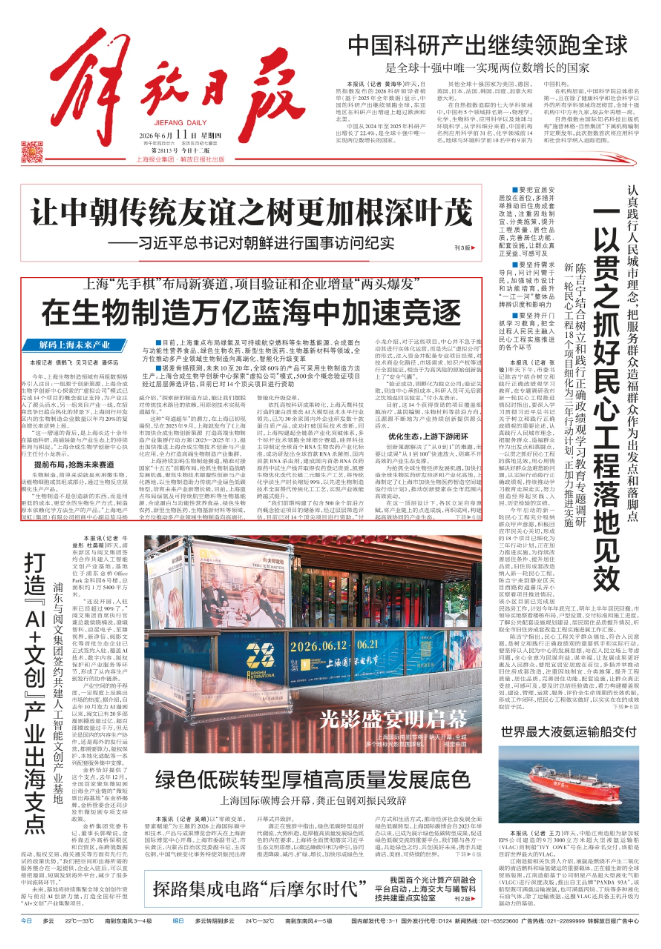
The following is reprinted from "Shanghai Sci-Tech"
This year, two sets of data from Shanghai's bio-manufacturing sector have been particularly striking: one stems from innovation sourcing — the "virtual company" model explored by the Shanghai Innovation Center for Synthetic Biology has completed concept verification support for 14 projects, injecting source vitality into the industry. The other comes from the industrial front line: against a backdrop of increasingly fierce investment competition, the number of bio-manufacturing enterprises in Shanghai's Minhang Development Zone has risen against the trend at a compound annual growth rate of 20%.
"Behind this growth rate is Shanghai's sustained layout and accumulation in basic scientific research, high-end equipment, and industrial ecology over more than a decade," said Fu Xiaolong, Executive Director of the Shanghai Innovation Center for Synthetic Biology.
Early Layout, Racing Ahead in Future Tracks
Bio-manufacturing, simply put, is the use of microorganisms, animal and plant cells, or their components to produce products at scale through biological reactions.
"Bio-manufacturing isn't about creating something new, but rather using lower-cost, safer biological production methods to manufacture products that previously relied on chemical processes," said Ma Yangwei, Deputy Director of the Investment Center at Shanghai Land Minhong (Group) Co., Ltd. "Exploring new manufacturing methods allows us to break free from dependence on traditional technical pathways and achieve corner overtaking through original technology."
This potential for "corner overtaking" is already beginning to emerge in Shanghai. As early as September 2023, Shanghai released the Action Plan for Accelerating Synthetic Biology Innovation Sourcing and Building a High-End Bio-manufacturing Industry Cluster in Shanghai (2023–2025), proposing to accelerate the innovation and industrial application of synthetic biology technology in Shanghai and fully build a high-end bio-manufacturing industry cluster.
Shanghai has continued to increase its bet on the bio-manufacturing track, precisely aligning with the national "15th Five-Year Plan" forward-looking layout, seizing strategic development opportunities in bio-manufacturing, focusing on disruptive biotech innovation and industrialization, using bio-manufacturing to assist the green and low-carbon transformation of traditional industries, and cultivating new growth poles for future industries. Currently, Shanghai is focusing on key areas such as green hydrogen and sustainable aviation fuel and other bio-based energy sources, synthetic proteins and functional nutritional foods, green biological pesticides, new biopharmaceuticals, and bio-based new materials, comprehensively promoting the high-end, intelligent upgrade and transformation of bio-manufacturing across multiple industrial sectors.
Relying on the transformation of university scientific research achievements, Shanghai Tianwu Technology has built a protein vertical AI large model with industry-leading technical capabilities, which has developed dozens of protein products for over 30 domestic and international enterprises, successfully breaking international technology monopolies. At the same time, Shanghai has built a full-chain industrialization breakthrough system, with multiple benchmark technologies leading global niche tracks. Siyi Technology led the formulation of the world's first RNA bio-pesticide industrialization standard, successfully developed the world's first RNA fungicide and China's first RNA insecticide, built China's first RNA pesticide technical intermediate pilot production line, and obtained pesticide registration qualifications. Cathay Biotech optimized and iterated its long-chain dicarboxylic acid production process, shortening traditional chemical production time by 99%, comprehensively replacing traditional chemical processes with advanced bio-manufacturing technology, and achieving a leap in industrial efficiency.
"We previously built a reserve library containing over 500 frontier direction concept verification projects. After layer-by-layer screening and evaluation, we have currently funded 14 top projects," Fu Xiaolong introduced. For these projects, the center is not in a rush to push them toward entity-based operations. Instead, it first uses a "virtual company" format, injecting funds and assigning professional project managers to comprehensively verify technical commercialization pathways, market demand, and intellectual property — equivalent to installing an "airbag" for high-risk original innovation.
"If verification succeeds, they are incubated as independent companies; if verification fails, the center bears the cost, and researchers can return to the lab without worries," Fu Xiaolong stated.
Currently, these 14 funded projects cover frontier directions including cell therapy, gene editing, and biomaterials, continuously providing source vitality for sustained industrial innovation.
Optimizing the Ecosystem, Closing the Loop from Upstream to Downstream
Innovation sourcing solves the "from 0 to 1" challenge, but to rapidly scale results "from 1 to 100" requires efficient industrial ecosystem support.
To seize opportunities in the global bio-economy and accelerate the building of a global hub for biopharmaceutical R&D and industrialization, Shanghai formulated the Action Plan for Accelerating the Construction of Biopharmaceutical Intelligent Manufacturing Space in Shanghai, promoting the efficient flow of innovation elements across the city.
Under this top-level design, each district leverages its own endowments to connect points on the industrial chain into lines, and then weave lines into networks, building an efficiently coordinated industrial ecosystem.
The development journey of Shanghai Celliver Biotechnology Co., Ltd. is a vivid illustration of cross-regional coordination. In 2013, Celliver Biotech was established in Zhangjiang, deeply cultivating the field of liver regeneration and treatment, with over 100 domestic and international patents. In 2025, the company built the world's first clinical registration and industrialization base for hepatic progenitor cell injection in Minhang Development Zone.
Facing the global medical challenge of decompensated cirrhosis treatment, Celliver Biotech achieved a world-class technological breakthrough. "We were the first internationally to break through the scientific and technical challenges of hepatocyte regeneration in vitro," introduced Yin Yonghong, Executive Deputy General Manager of Celliver Biotech. Previously, cirrhosis was considered irreversible in the industry, with liver transplantation as the only treatment path.
Celliver Biotech's technology completely broke this deadlock. The transformation of this innovative achievement benefited from the city's coordinated industrial model, allowing scientific research results to rapidly advance to clinical application. Currently, phase one clinical data shows that all enrolled patients have experienced varying degrees of liver function improvement, with efficacy and safety preliminarily verified.
There's also Shanghai Puwell Biotechnology Co., Ltd., which focuses on the R&D and production of recombinant proteins, ELISA kits, and other biological reagents — an indispensable "toolkit" provider upstream in the industrial chain. Its first Asia-Pacific integrated R&D, production, and logistics center settled in Minhang, precisely because of the cluster advantage where "you can find partners right outside your door."
"Shanghai's advantage lies in its mature biopharmaceutical industrial ecosystem; this agglomeration effect provides fertile soil for bio-manufacturing," said Zhao Xiaoli, Project Manager at Shanghai Puwell Biotech. Here, upstream reagent suppliers and downstream innovative pharmaceutical companies are within close reach, greatly shortening R&D iteration cycles and reducing comprehensive costs.
From upstream reagents, to midstream R&D, to downstream production and clinical application, an interconnected, synergistically innovative industrial loop is rapidly taking shape.
Connecting Globally, Leveraging the "Five Centers"
The steady development of bio-manufacturing relies on the advantages of Shanghai's "five centers" construction. Beyond the deep empowerment of the science and innovation center, the financial, trade, and shipping centers are also helping enterprises go further.
As a domestic leading enterprise in the diagnostic enzyme raw materials niche, Lanyuan Biotech has been rooted in Shanghai for over 20 years, developing more than 50 diagnostic reagent enzymes covering the vast majority of biochemical diagnostic reagent projects.
Facing the trend of the industry climbing toward higher value chains, Yang Wujian, General Manager of Lanyuan Biotech, has a clear understanding: "Shanghai's future in bio-manufacturing does not lie in competing with inland cities on costs, but rather in leveraging Shanghai's international genes to build an export gateway connecting to global markets."
In his view, Shanghai should not be content with merely being a domestic "leader," but should use its international metropolis foundation to benchmark against global bio-manufacturing industry highlands. As an international shipping and trade center, Shanghai's customs clearance efficiency and professional talent reserves provide strong support for enterprises entering international markets. Currently, approximately one-third of Lanyuan Biotech's business comes from exports, with products sold to international markets including the United States, Europe, South Korea, and India.
Behind the rise of numerous enterprises like Lanyuan Biotech, the support of the international financial center is indispensable. Shanghai is focusing on building a "capital + ecosystem" dual-wheel drive model. In October 2025, Shanghai's first bio-manufacturing industrial fund was officially launched, injecting strong patient capital into this industry.
This fund, with a total scale of 1 billion yuan, was co-launched by Dalton Venture and OPM Biosciences, adopting a "C (industrial chain leader) + VC (professional investment institution)" dual-wheel drive model. It has passed the selection process of Shanghai International Capital Corporation to become a sub-fund of Shanghai's Pilot Industry Mother Fund. The fund aims to integrate resources from enterprises, universities, and research institutes to promote exploration of key technologies and enterprise growth.
Sun Qi, Founding Managing Partner of Dalton Venture, stated: "The industrialization of bio-manufacturing is a systematic endeavor that requires 'patient capital' and 'long-term partners' to explore together. We hope to combine scientific research achievements with industrial needs in an open, collaborative manner to form a sustainable innovation ecosystem."
According to McKinsey & Company predictions, in the next 10 to 20 years, 60% of global products could be produced using bio-manufacturing methods, creating approximately $4 trillion in economic value. Data from the Ministry of Industry and Information Technology also shows that China's bio-manufacturing industry scale is approaching the trillion-yuan threshold.
From the "virtual company" that breaks through transformation bottlenecks, to the efficiently coordinated industrial ecosystem, to the introduction of patient financial capital, Shanghai is using a comprehensive set of moves to accelerate its race in the trillion-dollar blue ocean of bio-manufacturing.
Source: Liberation Daily, Dongjing
Authors: Ju Hefei, Pan Huaiyuan
Editor: Shi