Evotrex raises over 200 million yuan in funding, first smart RV model to begin mass production in early 2027 | Unity Ventures portfolio news

Order volume continues to climb, significantly beating expectations, with multiple industry partnership deals materializing.
Unity Ventures' angel-round portfolio company Squirrel Dynamics recently closed a Series A funding round exceeding RMB 200 million, with investors including Yuanhe Puhua, Yuanhe Houwang, HouXue Capital, GSR United Capital, Tiantang Silicon Valley, Thundersoft, Guangyuan Hesheng Fund, Butong Capital, Shenqi Capital, Huoshui Capital, and Chunjia Capital — a mix of strategic industrial capital and specialized financial institutions.
The proceeds will focus on full vehicle-level validation and R&D testing of the Evotrex-PG5, accelerating production line setup and capacity expansion to ensure the 2027 mass delivery target is met.
Founded in 2023, Squirrel Dynamics is a deep-tech startup focused on the R&D, manufacturing, and global operation of outdoor electrification and intelligent products. Its brand Evotrex leverages proprietary integrated vehicle power generation and storage technology to serve the global outdoor mobility market, providing off-grid living solutions for a new generation of consumers, driving the electrification, intelligentization, and energy autonomy of the RV industry.
Previously, the company officially unveiled its first product, the Evotrex-PG5, at CES 2026. Positioned as an intelligent range-extended travel trailer, it emphasizes energy self-sufficiency in off-grid scenarios, with a starting price of $120,000.
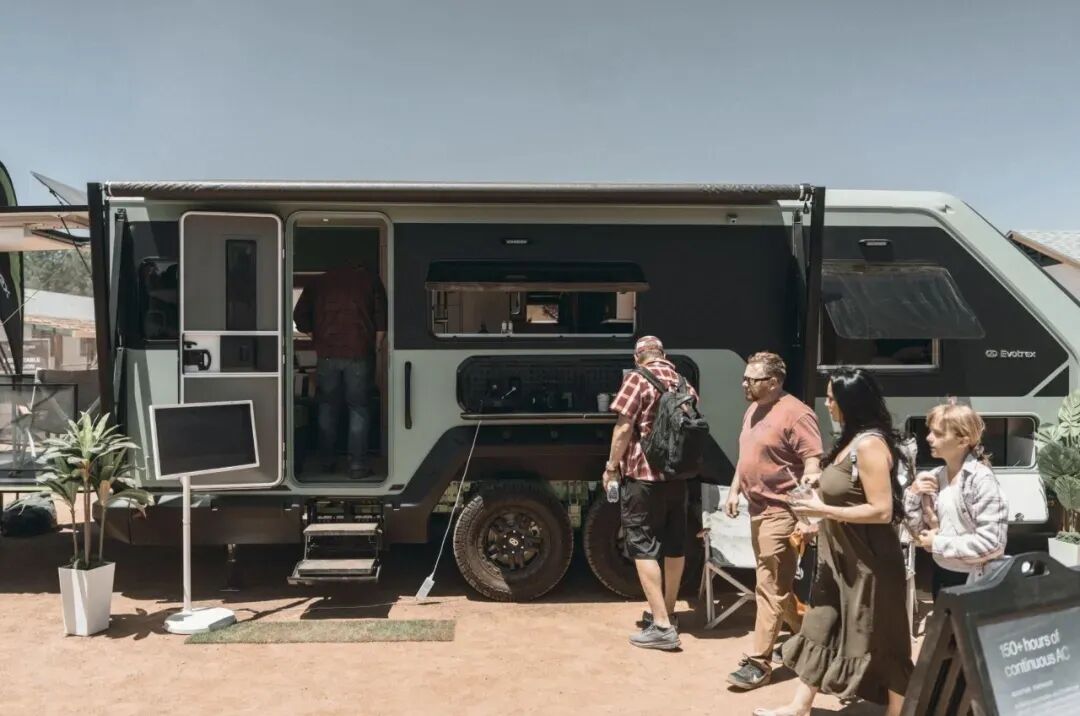
Squirrel Dynamics' first product, the Evotrex-PG5
The electrification window for the RV industry is opening. This is a global market adding hundreds of thousands of units annually, with an installed base exceeding 14 million vehicles. As diverse demand surges for outdoor living, long-distance road trips, mobile offices, outdoor commerce, and emergency energy storage, electric travel trailers with autonomous power generation, large-capacity energy storage, and intelligent energy management have emerged as a new growth opportunity in mobility tech — one combining near-term execution certainty with long-term expansion potential.
According to official data from Squirrel Dynamics, Evotrex-PG5 pre-orders have substantially exceeded expectations, with the top-tier Premium model priced at $159,990 accounting for 90% of orders. Demand among North American outdoor enthusiasts is robust, with the customer base already expanding well beyond pure EV owners; mass-market acceptance is significantly higher than anticipated, concentrated primarily among outdoor sports enthusiasts aged 30 to 45, spanning skiing, surfing, off-roading, and other niche segments.
Traditional RV electrical systems rely heavily on campground hookups, with factory-standard configurations typically offering only 2–3 kWh of capacity. Even with aftermarket battery additions, expansion space is extremely limited. This means that once away from a campground, the RV's power supply cannot sustain continuous operation of high-draw appliances like air conditioning, water heaters, and kitchen equipment — making extended off-grid stays virtually impossible.
Squirrel Dynamics' technical approach breaks from the single-minded pursuit of "more battery capacity." It adopts the range-extended architecture already thoroughly validated in China's passenger vehicle market. The PG5 features a 75-liter fuel tank paired with a 43 kWh battery pack; its range extender achieves thermal efficiency exceeding 40%, generating over 3 kWh per liter of fuel for approximately 270 kWh of usable electricity total. This configuration enables the vehicle to support normal residential power consumption for a family of four for several days to over a week without campground access.
In driving scenarios, the PG5's motor system provides auxiliary power when being towed, addressing the industry-wide problem of severe range degradation when electric pickups pull trailers; the range extender can also charge the tow vehicle while driving, effectively creating a "fuel-generate-charge" closed loop.
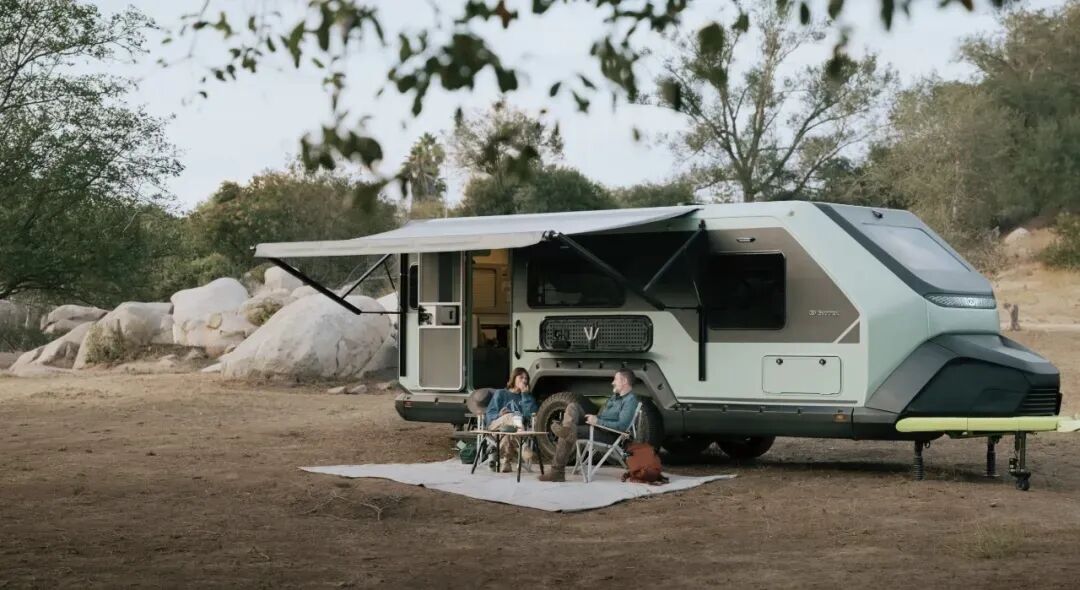
A complete system reimagined from energy production to living experience
In static scenarios, the PG5 functions more as an integrated mobile energy platform combining onboard power generation, large-capacity storage, and full-domain intelligent energy management than as a conventional living trailer. Beyond recreational camping and remote work-from-home applications, it has potential to extend into commercial use cases such as mobile food trucks, retail vehicles, and scenic tour shuttles, and can even serve as a residential energy storage unit providing reverse power supply to homes.
The PG5 has now launched comprehensive all-scenario reliability validation, with testing covering towing range, energy management systems, driving stability, braking safety, body structural durability, water immersion and rain exposure, and multi-country compliance certification under extreme conditions — ensuring stable output of the range-extended power system in real-world complex environments and laying a quality foundation for scaled mass production.
Energy capability is the chassis; what users perceive as product strength manifests more in living experience and intelligent interaction. On the intelligence front, the PG5 integrates control modules for electric awnings, running boards, and tailgates, and includes a Starlink satellite interface enabling stable connectivity even in remote areas without ground base station coverage. Addressing the characteristic long-term parking patterns of RVs, the PG5 also features home energy storage functionality, supplying power to residences through cable connection.
In the interior space where user interaction is most frequent, Squirrel Dynamics has added modular removable dining table seating, a 72-inch integrated in-vehicle cinema, a rear terrace system with enclosed insect screening, and multiple custom interior themes based on genuine feedback from reservation holders. The team plans to roll out the complete product update package to all reservation holders in the second half of 2026, with a visual configuration platform going live before mass production that allows users to independently combine vehicle functions and interior packages.
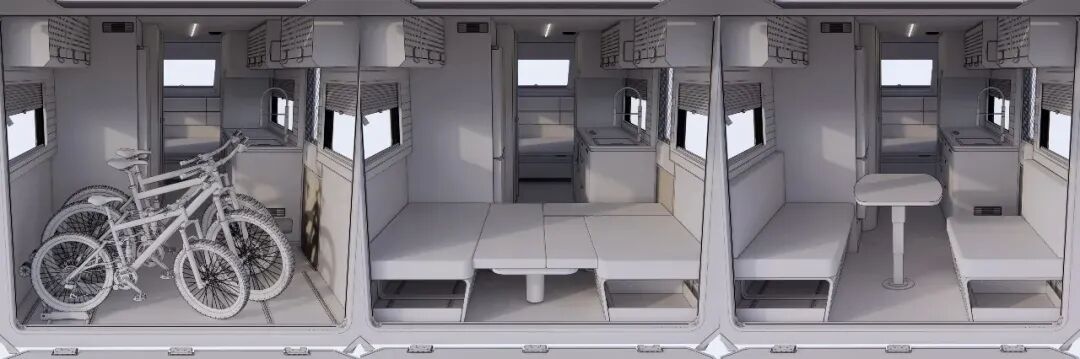
Evotrex-PG5 interior modular design renderings
Squirrel Dynamics' positioning of the Evotrex-PG5, in other words, is not "an electrified RV with better specs" but a complete system reimagined from energy production through living experience.
From recreational camping and remote work to outdoor commercial operations and emergency backup power, it runs on the road, parks in the wilderness, and serves as a configurable living unit — fulfilling core user demands for mobility freedom, energy autonomy, and all-scenario connectivity.
Squirrel Dynamics' product roadmap follows a platform logic. The debut PG5 is positioned at the premium tier to establish brand technical credibility and validate market pricing power; subsequent offerings will maintain core experience consistency while adjusting configurations and materials for more accessible versions covering broader consumer segments. The team anticipates that once platform deployment is complete, the pace of subsequent product development and launch will accelerate markedly.
"In the past, traditional RV products were heavily homogenized and dealers held the power. When we came to the table with pre-sale orders, the dynamic shifted," said Xiao Ang, founder and CEO of Squirrel Dynamics, in an interview with Hard Kr. Currently, with order volumes continuing to climb and substantially exceeding internal forecasts, and multiple industrial partnership意向 materializing, capacity expansion has become one of the team's most urgent priorities.
Going forward, the company also plans to build out a complete U.S.-based service network covering product planning, delivery, and full-lifecycle maintenance to support subsequent batch delivery requirements.
The following is an edited excerpt from Hard Kr's interview with Xiao Ang, founder and CEO of Squirrel Dynamics:

The bottleneck around off-grid energy self-sufficiency in RVs is widely acknowledged in the industry. What was the underlying rationale for choosing a range-extended solution over a large-battery pure-electric approach for the PG5?
Xiao Ang: The core pain point for RVs isn't "having electricity" but "having electricity continuously," and the ceiling on pure-electric solutions is obvious — it solves the power problem when parked, but not energy self-sufficiency across the RV's full lifecycle.
We broke it down into three usage scenarios. The parked scenario is just one; the other two are idle scenarios and driving scenarios, where pure-electric approaches are inherently constrained.
In the parked scenario, 270 kWh means a family of four can live in the wild for a full week with air conditioning, water heater, and kitchen appliances running continuously, with energy to spare — you don't need to count every kilowatt, don't need to turn this off or that off to save power. That's "uncompromised experience." The North American market is extremely sensitive to this; their usage habit is 24-hour air conditioning, so if a product only offers "enough" power, to the user it's "not enough."
The idle scenario is something many overlook. RVs sit idle 80% of the time — a structural problem the industry has long faced, asset underutilization. We turned the entire vehicle into a home energy storage unit; plug it in with a cable and it feeds power back to the house. This functionality has clear market demand in North America, where extreme weather events are increasingly frequent, grid stability is poor, and home backup power is a necessity.
The driving scenario is the biggest structural flaw of pure-electric approaches. Electric pickups losing 60% to 70% of range when towing is an industry-wide problem, not because the battery isn't large enough but because the aerodynamic drag and load of towing create physical losses that cannot be solved by adding battery capacity. We added drive motors to the trailer side to provide auxiliary power, substantially reducing range degradation; meanwhile the range extender generates power continuously while driving, maintaining the 43 kWh large battery at full charge, and when stopped it can charge the tow vehicle in reverse.
The PG5 is targeting mass delivery in 2027. From prototype to scaled production at thousands of units annually, what are the biggest engineering challenges?
Xiao Ang: The fundamental tension is balancing the market's high delivery expectations against our standards for product durability and reliability — which is why we are directing a major portion of this funding round toward comprehensive vehicle testing and validation.
Our product integrates wire-controlled chassis power, range-extended generation systems, energy storage and inversion, passenger-vehicle-grade vehicle structure, interior, and intelligent systems — the complexity even exceeds that of a range-extended passenger vehicle. The traditional RV industry has long relied on manual modification, lacking standardized automotive-grade mass production systems.
The first challenge is full-dimension reliability validation. North American FMVSS safety, EPA emissions, lithium thermal runaway protection, long-distance towing durability, and full-spectrum high-low temperature environmental testing — hundreds of mandatory standards, any one of which, if failed and requiring redesign, will extend the mass production timeline. We don't want to compress validation to chase industry delivery rhythms; we'd rather invest more capital and time to complete full-process testing under extreme conditions, eliminating quality risks at the source before batch delivery.
The second challenge is deep cross-domain supply chain coordination. Our range-extended solution serially connects fuel power generation, towing assistance, bidirectional charging, and home reverse power supply across four modules, requiring simultaneous integration of completely distinct supply chain systems from new energy vehicles, RV interiors, and consumer electronics — aligning them all to automotive-grade quality standards and ramping volume in stable coordination, with磨合 cycles far longer than single-category hardware.
The third is parallel execution of export compliance and scaled production line deployment. North America has extensive certification categories for RV safety, lithium batteries, and gas systems; full compliance filings must be completed before batch production. Meanwhile global pre-orders have far exceeded expectations, so we are building high-standard production lines, establishing stable supply chains to achieve the annual-thousand-unit ramp, while continuously iterating the full-vehicle durability testing system — both tracks must advance without compromise.
Many players in the industry prioritize rushing to delivery at the expense of long-term reliability, but we believe that user and channel reputation is the foundation of brand survival. A substantial portion of this round's proceeds going into full-scenario vehicle validation is about maintaining quality and reliability baselines while accelerating capacity expansion — this is the root of our long-term differentiation from other brands in the space.
Source: Hard Kr
Author: Huang Nan