Qiming Portfolio | UBTECH Achieves World's First Multi-Robot, Multi-Scenario, Multi-Task Humanoid Collaborative Training

UBTECH has developed a novel BrainNet software architecture for humanoid robots and designed an Internet of Humanoids (IoH) as a smart connectivity hub, offering a viable path for the software and hardware implementation of collective intelligence.

Swipe Left for the English Version
Recently, UBTECH (09880.HK), a Qiming Venture Partners portfolio company, conducted the world's first multi-robot, multi-scenario, multi-task collaborative training for humanoid robots at ZEEKR's 5G Smart Factory, exploring a general-purpose humanoid robot swarm operation solution for multi-task industrial scenarios and advancing humanoid robots from single-machine autonomy toward swarm intelligence.
01/
Swarm Intelligence
The Cognitive Revolution Driving Large-Scale Humanoid Robot Deployment
Production-line-level tasks in industrial scenarios pose entirely new tests and challenges for multi-robot collaborative operations among humanoid robots. Developing swarm intelligence technology for humanoid robots is an essential path toward large-scale deployment in industrial settings.
In this training exercise, UBTECH introduced swarm intelligence technology into humanoid robots for the first time, enabling multi-robot collaborative operations. Using humanoid robot clusters as physical platforms, the company explored advanced embodied intelligence evolved through dense interaction between collective behavior and external physical environments. To this end, UBTECH innovatively proposed BrainNet, a software architecture for humanoid robot swarm intelligence, and designed the Internet of Humanoids (IoH), a smart connected hub for humanoid robots, providing a reference path for the software and hardware implementation of swarm intelligence.
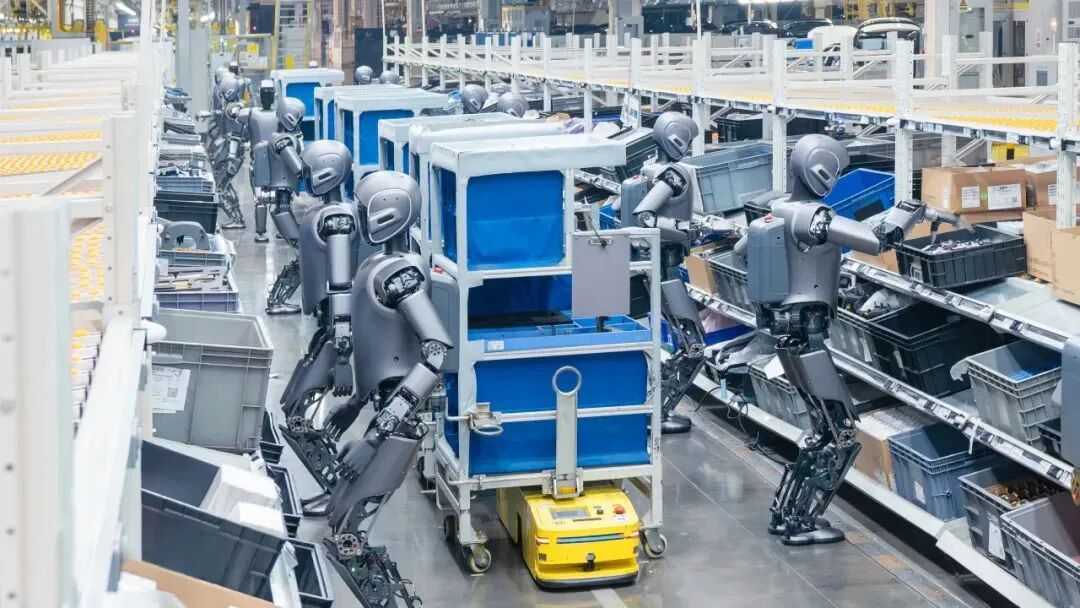
UBTECH industrial humanoid robots conducting collaborative training with "swarm intelligence" at ZEEKR's 5G Smart Factory
For humanoid robot swarm collaboration scenarios, UBTECH's BrainNet architecture flexibly links cloud-collaborative reasoning nodes and skill nodes, forming a swarm-level super-brain and smart cerebellum that redefine the "big brain / small brain" paradigm for humanoid robots. The super-brain, built on a multimodal embodied reasoning large model, focuses on breakthroughs in intelligent hybrid decision-making technology to enable high-dimensional decisions for complex production-line-level tasks. The smart cerebellum, based on Transformer models, innovatively develops cross-domain fused perception technology and multi-robot coordinated control technology, supporting parallel distributed learning across multiple robots to accelerate skill generation and transfer. These breakthroughs extend the task scope from single humanoid robots to production-line-level flexible requirements completed through multi-robot collaboration, not only advancing multi-dimensional, multi-scenario swarm intelligence but also laying a solid foundation for efficient collaboration among humanoid robots in complex industrial environments, opening the path toward advanced evolution in smart manufacturing.
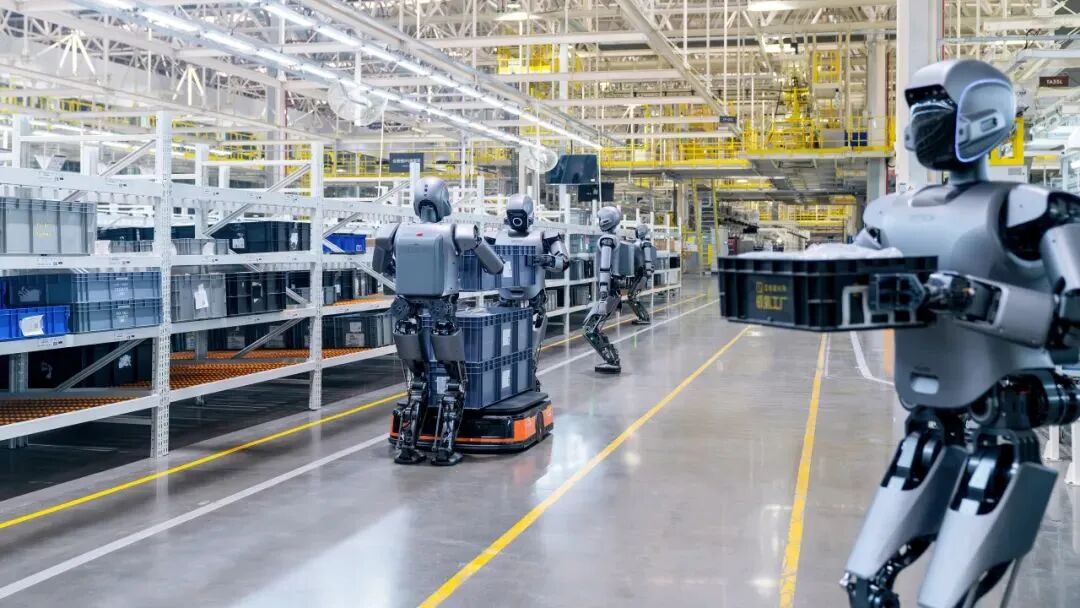
Dozens of UBTECH industrial humanoid robots Walker S1 collaboratively transporting large, heavy containers
Driven by the high-dimensional decision-making demands of complex production-line-level tasks, UBTECH developed the world's first humanoid robot multimodal reasoning large model as the core engine of the super-brain, enabling the BrainNet architecture to achieve continuous self-evolution and thereby unleash swarm intelligence. This reasoning large model is based on DeepSeek-R1 deep reasoning technology, leveraging its powerful data processing and intelligent decision-making capabilities to give humanoid robots commonsense reasoning abilities akin to humans, supporting efficient decomposition, scheduling, and coordination of complex tasks across multiple humanoid robots.
The UBTECH humanoid robot multimodal reasoning large model is trained and fine-tuned on hundreds of millions of high-quality industrial data points accumulated through Walker S series frontline training tasks at multiple automotive factories, with multimodal capabilities added, and uses RAG (Retrieval-Augmented Generation) technology to rapidly train specialized work types, significantly improving robots' decision-making and generalization capabilities across various workstations, providing strong support for large-scale deployment of humanoid robots in industrial scenarios.
Looking ahead, in complex scenarios, swarm intelligence — through dynamic interaction and coordination among distributed individual units — will give rise to global intelligence that transcends single-unit capabilities, helping humanoid robots make efficient decisions and self-optimize adaptively, breaking through large-scale commercial applications across scenarios and tasks. This breakthrough not only provides a reference paradigm for large-scale deployment of humanoid robots in smart manufacturing but will also advance new industrialization's paradigm leap from "semi-flexible manufacturing" to "fully flexible intelligent manufacturing."
02/
Multi-Robot, Multi-Scenario, Multi-Task Collaborative Operations
Factory Training Enters Next Phase
This year, UBTECH's industrial humanoid robots entered Training 2.0, with dozens of humanoid robots applying "swarm intelligence" technology in collaborative training at ZEEKR's 5G Smart Factory. Inside the factory, these Walker S1 robots are distributed across multiple complex scenarios including the final assembly workshop, SPS instrument area, quality inspection area, and door assembly area, successfully achieving collaborative sorting, collaborative transportation, and precision assembly among other multi-task collaborative operations.
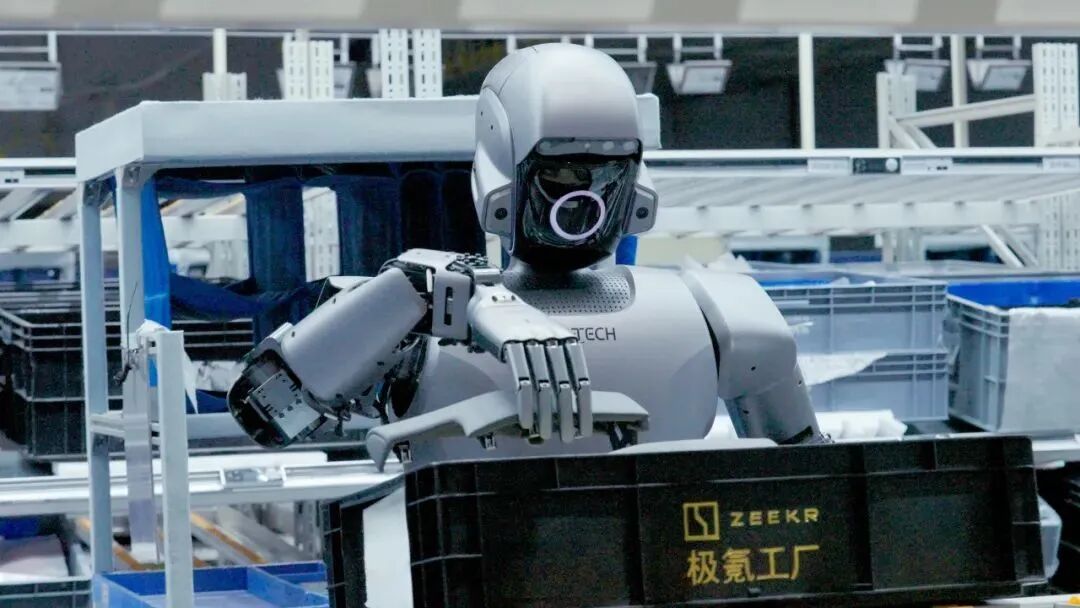
UBTECH industrial humanoid robot Walker S1 innovatively applies cross-domain pure visual perception technology and intelligent hybrid decision-making technology for collaborative sorting
In the collaborative sorting phase, UBTECH's industrial humanoid robot Walker S1 innovatively applied cross-domain pure visual perception technology and intelligent hybrid decision-making technology. Through cross-domain pure visual perception technology, it achieves continuous cross-domain perception and tracking of dynamic targets, with robot swarms collaboratively building global maps and enabling "group-built, group-shared" functionality. Meanwhile, based on the intelligent hybrid decision-making technology of the multimodal reasoning large model, combined with semantic VSLAM navigation and dexterous manipulation requirements, it dynamically allocates task division between the cloud brain and local brain, achieving edge-cloud integrated swarm intelligence decision-making.
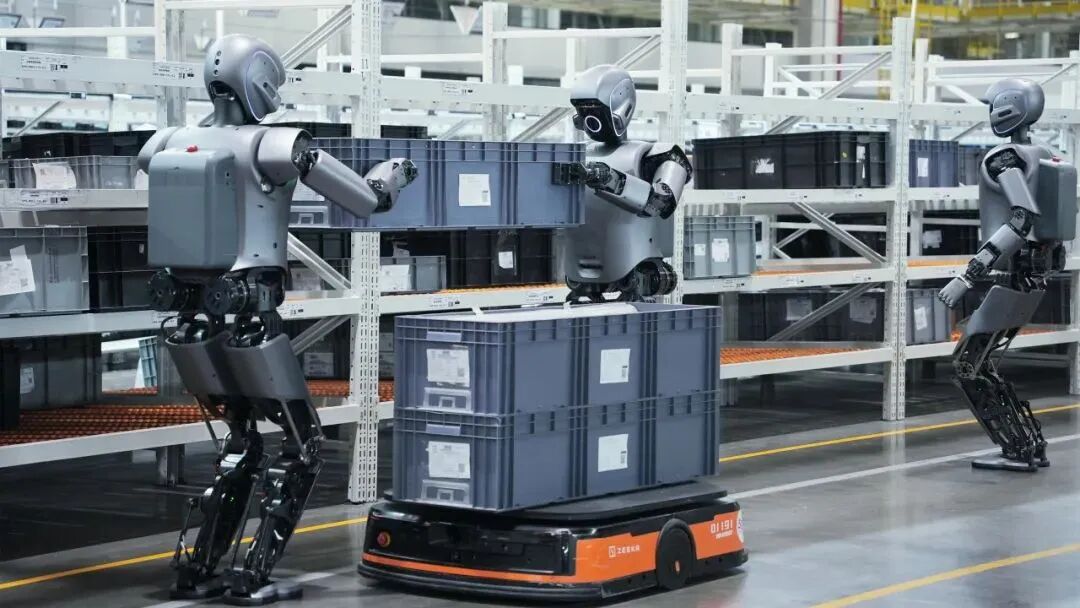
Dozens of UBTECH industrial humanoid robots Walker S1 collaboratively transporting large, heavy containers
In collaborative transportation scenarios, humanoid robots face numerous challenges when collaboratively transporting large, heavy, and oversized workpieces, such as uneven load distribution, complex motion trajectories, and dynamic environmental adaptation. UBTECH built a joint planning and control system through multi-robot coordinated control technology, achieving coordinated trajectory planning, load identification, and compliant control across multiple robots, ensuring that robots can dynamically adjust posture and force during transportation, significantly improving stability when transporting oversized and heavy workpieces.
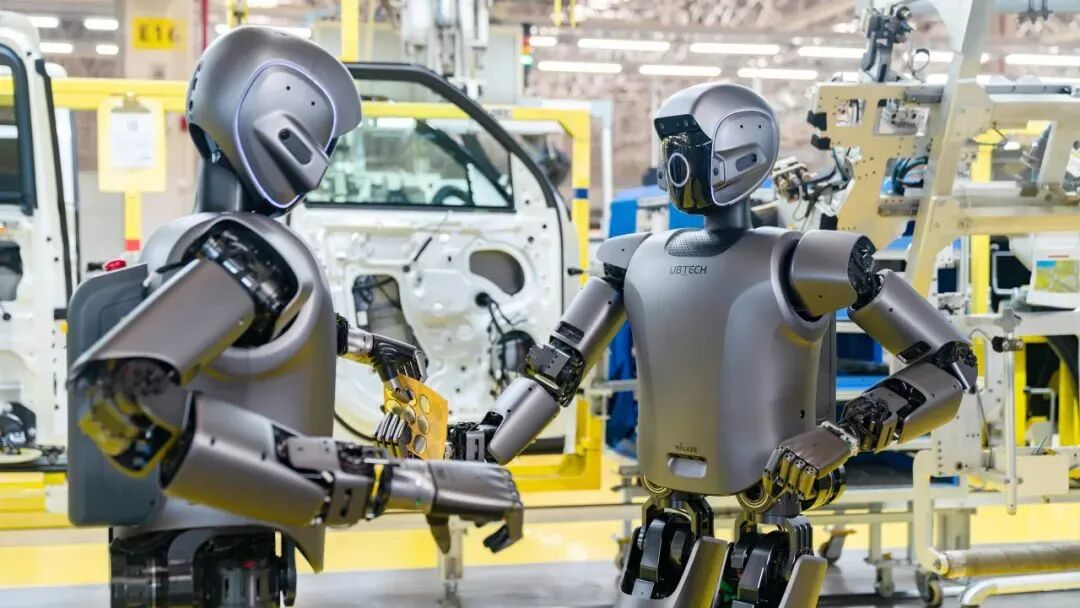
UBTECH industrial humanoid robot Walker S1 performing soft object dexterous manipulation tasks at ZEEKR's 5G Smart Factory
In precision assembly scenarios, Walker S1 demonstrated its exceptional capabilities in soft object dexterous manipulation. Facing small, easily deformable soft film objects, Walker S1 dynamically adjusted grasping force and posture through high-precision perception and adaptive control technology, ensuring the film objects remained undamaged and properly aligned during assembly. This technology highlights the flexibility and reliability of UBTECH's humanoid robots' tactile five-finger dexterous hands in complex industrial scenarios.
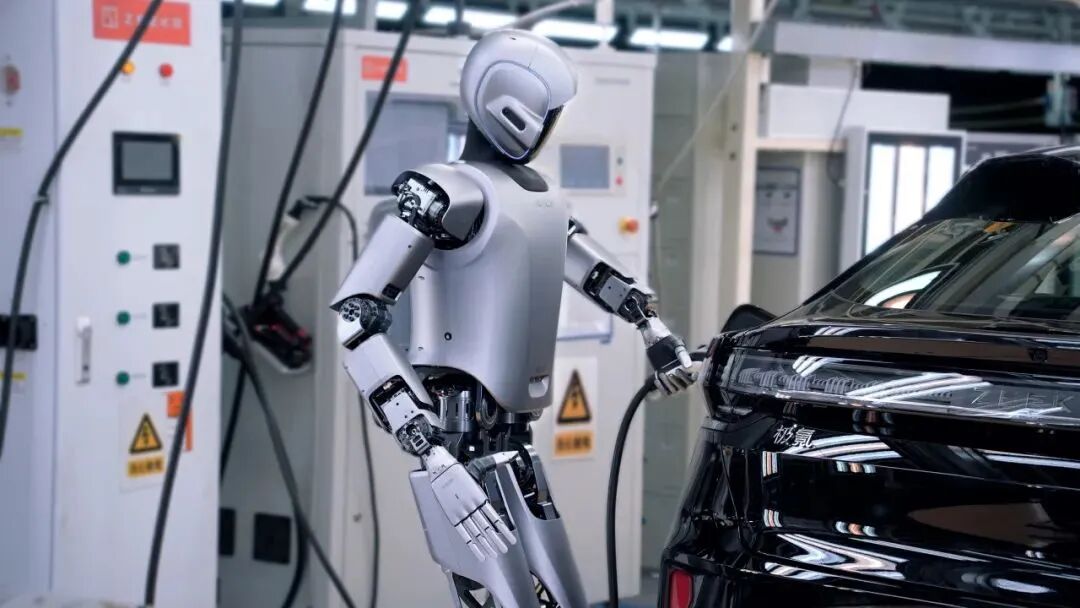
UBTECH industrial humanoid robot Walker S1 completing precision operation quality inspection tasks
Additionally, Walker S1 combines vision-based global initial alignment with force-sensing reinforcement learning-based secondary alignment technology to complete precision operation quality inspection tasks.
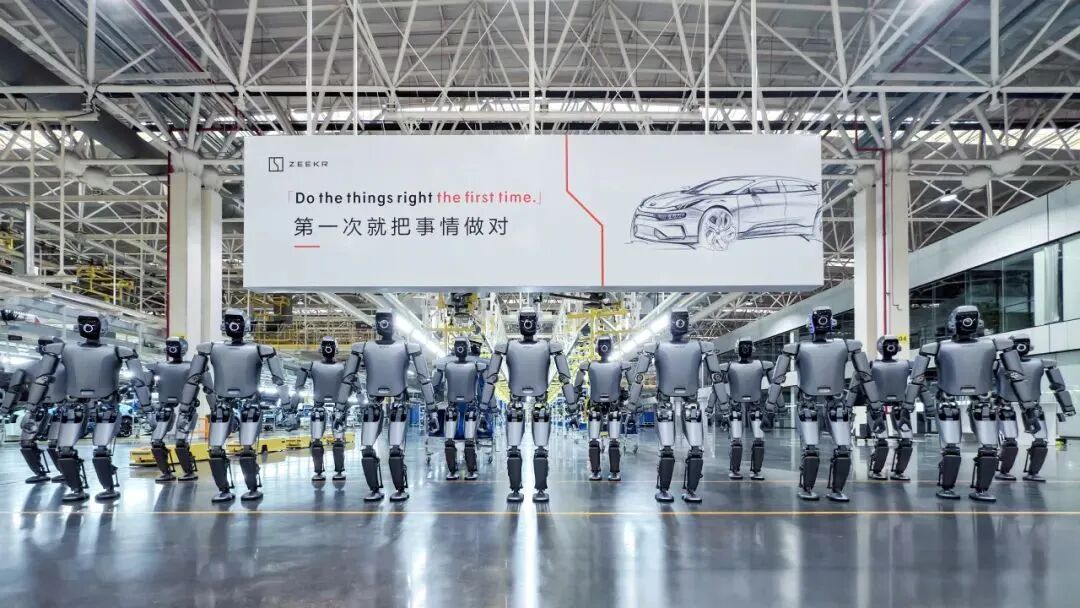
UBTECH industrial humanoid robot swarm entering ZEEKR's 5G Smart Factory for training
Currently, UBTECH has established partnerships with multiple industry leaders including Dongfeng Liuzhou Motor, Geely Auto, FAW-Volkswagen Qingdao Branch, Audi-FAW, BYD, BAIC Group, Foxconn, and SF Express. Its self-developed industrial humanoid robot Walker S series has successfully entered the most automotive factories globally and completed Phase 1 single-machine autonomous intelligent training. With the launch of Training 2.0, UBTECH will accelerate product and technology iteration through data accumulation and model training from multi-robot collaborative training. Beyond Geely Auto, UBTECH will expand to additional partner factories, comprehensively advancing the deployment of multi-robot collaborative training and further deepening large-scale application of humanoid robots in industrial scenarios.
Unleashing Swarm Intelligence: UBTECH Pioneers the World's First Multi-Humanoid Robot Collaborative Training in Multi-Task, Multi-Scenario Settings at ZEEKR
Advancing In-Factory Training
Multi-Robot, Multi-Scenario, Multi-Task Collaboration
At ZEEKR's 5G Intelligent Factory, UBTECH's Walker S1 humanoid robots have completed the world's first collaborative practical training program involving multiple humanoid robots operating across diverse tasks and scenarios. The robots successfully executed coordinated operations including collaborative handling, collaborative assembly, and precision sorting — demonstrating seamless multi-robot collaboration in complex industrial environments.
During training, the Walker S1 robots deployed distributed embodied intelligence to coordinate task allocation and motion planning in real time. They synchronized their actions to complete high-precision collaborative handling of large components, with each robot dynamically adjusting its force and posture based on real-time feedback from its counterparts. This ensured safe, stable transport of heavy and irregularly shaped loads. In collaborative assembly tasks, the robots achieved tight synchronization, with one holding a component steady while another fastened or connected parts, successfully completing precision assembly of complex structures. For precision sorting, the robots leveraged visual perception and reasoning capabilities to identify, classify, and distribute various components across different workstations — significantly boosting production-line efficiency.
This multi-robot, multi-scenario, multi-task collaborative training validates the technical feasibility of Swarm Intelligence in industrial settings and establishes a replicable, scalable deployment model for humanoid robot clusters in intelligent manufacturing.
From Single-Agent Autonomy to Swarm Intelligence
UBTECH's humanoid robots have already achieved large-scale, multi-scenario, multi-task training at automotive factories including NIO and Dongfeng Liuzhou. Now, through multi-robot collaborative training at ZEEKR's 5G Intelligent Factory, UBTECH is driving a paradigm shift from single-agent embodied intelligence to Swarm Intelligence — enabling humanoid robots to evolve from "solo performers" into "team players" capable of efficient collaboration.
The Walker S1 robots deployed at ZEEKR's factory have already undergone single-robot single-task training for precision assembly, with each robot independently capable of completing specific assembly operations. In this latest breakthrough, UBTECH advanced to multi-robot collaborative training for the same task, with multiple Walker S1 robots jointly assembling the same component. The robots dynamically coordinated their actions through real-time communication and task allocation, collectively completing complex assembly operations and demonstrating highly efficient teamwork.
Looking ahead, UBTECH will continue expanding the complexity of collaborative training — progressing from multi-robot single-task collaboration to multi-robot multi-task collaboration, and ultimately achieving full-scenario Swarm Intelligence. This evolutionary path will enable humanoid robots to handle increasingly complex industrial workflows and drive the intelligent transformation of manufacturing.
Accelerating Commercialization Through Data Flywheel and Model Evolution
Multi-robot collaborative training generates large-scale, high-quality embodied data across diverse tasks and scenarios, creating a powerful data flywheel that drives continuous model optimization. As more humanoid robots enter factories for practical training, the volume and diversity of data grow exponentially — enabling rapid iteration of embodied intelligence models and accelerating the path to large-scale commercialization.
UBTECH's multi-robot collaborative training at ZEEKR's 5G Intelligent Factory exemplifies this data flywheel in action. Through high-frequency interaction and collaborative task execution among multiple Walker S1 robots, the system accumulates rich embodied data covering multi-robot coordination, dynamic environment adaptation, and complex task scheduling. This data continuously feeds into UBTECH's multimodal reasoning model, enhancing its decision-making capabilities and generalization performance — ultimately enabling more efficient and intelligent multi-robot collaboration.
As this data flywheel accelerates, UBTECH's Swarm Intelligence system will achieve continuous self-evolution. The company expects to significantly shorten the cycle from model training to industrial deployment, rapidly expanding the scale and depth of humanoid robot applications in intelligent manufacturing.
About UBTECH
UBTECH is a global leader in humanoid robotics, dedicated to the R&D, manufacturing, and commercialization of humanoid robots. The company has established a full-stack technology architecture spanning core components, robot bodies, and embodied intelligence systems. UBTECH's Walker series humanoid robots are among the world's first to achieve mass production and commercial delivery, with applications spanning industrial manufacturing, commercial services, and scientific research.
About Qiming Venture Partners
Founded in 2006, Qiming Venture Partners is a leading venture capital firm focused on China's technology and innovation sectors. The firm manages over $9.5 billion in assets and has invested in more than 480 companies across TMT, healthcare, cleantech, and consumer technology. Notable portfolio companies include Xiaomi, Meituan, Bilibili, Roborock, and many other industry leaders. Qiming Venture Partners has been an early and continuous supporter of UBTECH, backing the company across multiple funding rounds.
UBTECH's humanoid robots have now entered Practical Training 2.0, marking their evolution from single-agent autonomy to Swarm Intelligence. At the ZEEKR 5G Intelligent Factory, dozens of Walker S1 humanoid robots have been deployed across complex production areas, including the final assembly workshop, SPS instrumentation zone, quality inspection area, and vehicle assembly station. Working in unison, these humanoid robots successfully executed collaborative sorting, collaborative handling, and precision assembly, demonstrating seamless multi-robot collaboration in real-world industrial settings.
In the collaborative sorting phase, UBTECH's Walker S1 humanoid robots utilize cross-field pure vision-based perception technology and intelligent hybrid decision-making to optimize sorting tasks. Using pure vision-based cross-field perception, the robots continuously track dynamic targets across environments, enabling swarm collaboration through collective mapping and shared intelligence. The intelligent hybrid decision-making system, powered by a large reasoning multimodal model, integrates semantic VSLAM navigation and dexterous manipulation capabilities. This allows for dynamic task allocation between the cloud-based and on-device brain nodes, supporting a cloud-device collaborative decision-making process for Swarm Intelligence.
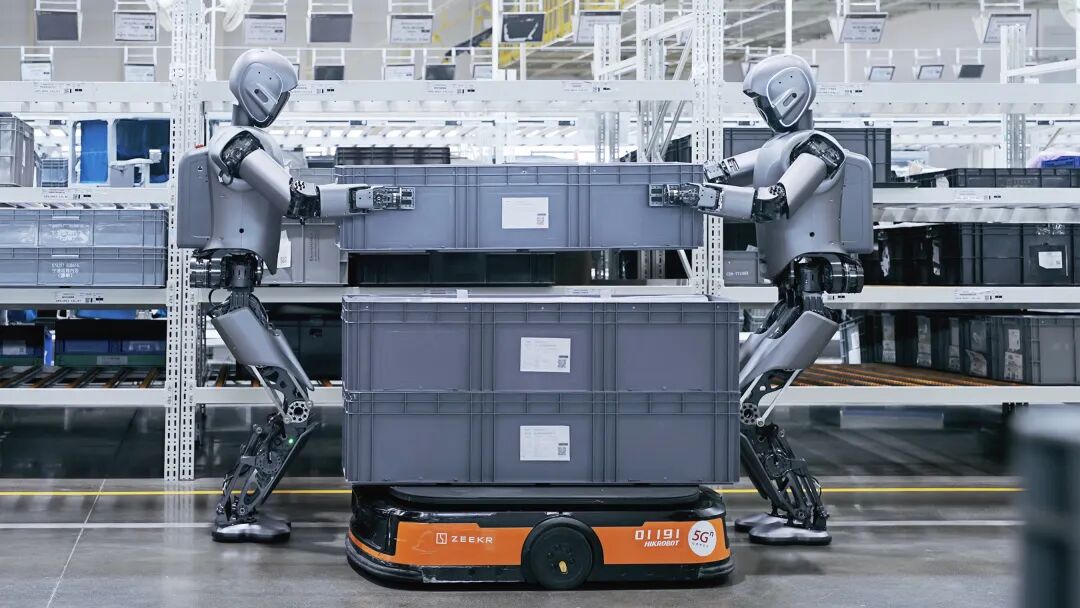
Multiple UBTECH humanoid robots, Walker S1, collaborate to handle large, heavy-duty containers
In collaborative handling, humanoid robots may face significant challenges, including uneven load distribution, complex trajectory planning, and dynamic environmental adaptation. To address these, UBTECH has developed a joint planning and control system, enabling multi-robot collaboration in trajectory planning, load identification, and compliant control. This ensures robots dynamically adjust their posture and force during handling, significantly enhancing stability and efficiency when transporting large, heavy workpieces.
In precision assembly process, Walker S1 robots demonstrate exceptional dexterous manipulation capabilities, particularly in handling deformable objects. When working with small and deformable film materials, Walker S1 utilizes high-precision sensing and adaptive control technologies to dynamically adjust its grasping force and posture. This ensures film objects remain undamaged and properly aligned throughout the assembly process. This innovation highlights the flexibility and reliability of UBTECH's humanoid robot, which is equipped with dexterous robotic hands with tactile sensing for complex industrial applications.
Additionally, Walker S1 integrates vision-based global initial positioning with force-based secondary positioning via reinforcement learning to execute precision operation-based quality inspection tasks with unmatched accuracy and adaptability.
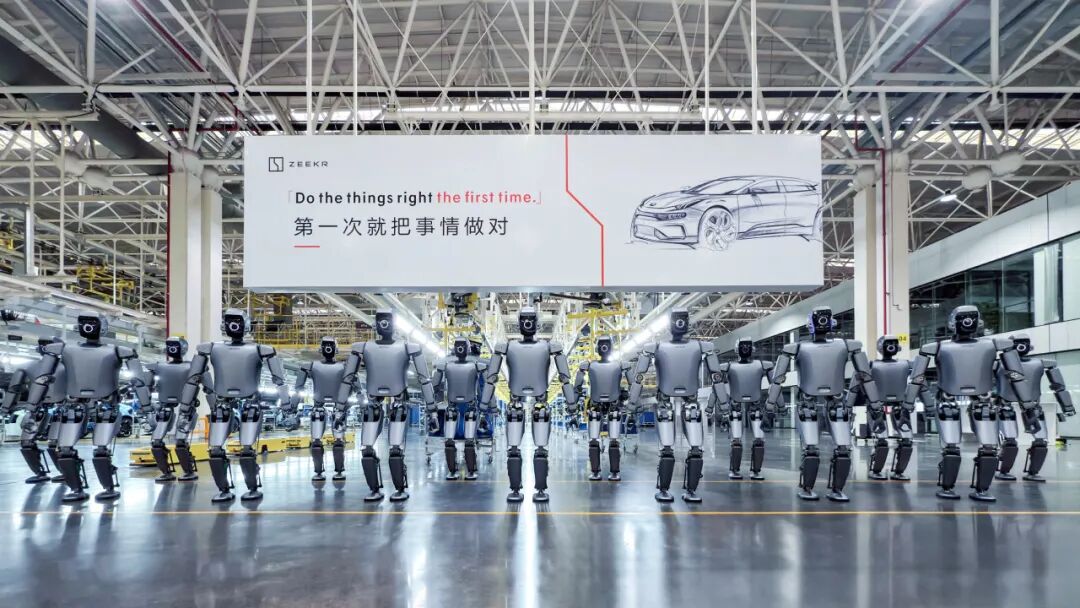
UBTECH's swarm-intelligent humanoid robots conduct practical training at ZEEKR's 5G Intelligent Factory
UBTECH collaborates with leading industry players, including Dongfeng Liuzhou Motor, Geely Auto, FAW-Volkswagen Qingdao, Audi FAW, BYD, BAIC New Energy, Foxconn, and SF Express. The company's Walker S series humanoid robots are now deployed in more automotive factories worldwide than any other humanoid robot, having successfully completed the first phase of single-agent autonomous intelligence training. With the launch of Practical Training 2.0, UBTECH is accelerating its multi-humanoid robot collaborative training and AI model development to drive product and technology innovation. Beyond Geely Auto, UBTECH is expanding deployment to additional partner factories, further reinforcing the scalable adoption of humanoid robots in industrial applications.
Previously
Qiming Star | Global First! UBTECH-Led Humanoid Robot "Tiangong" Achieves Stable Running at 6 km/h
The World Is Embracing Chinese Technology

Founded in 2006, Qiming Venture Partners currently manages 11 USD funds and 7 RMB funds, with total assets under management reaching $9.5 billion. Since its inception, the firm has focused on investing in outstanding early- and growth-stage companies in the Technology and Consumer (T&C) and Healthcare sectors.
To date, Qiming Venture Partners has invested in over 580 high-growth innovative companies. More than 210 of these have gone public on the New York Stock Exchange, NASDAQ, Hong Kong Exchanges and Clearing Limited, Shanghai Stock Exchange, and Shenzhen Stock Exchange, or exited through M&A and other means. Over 80 portfolio companies have become recognized unicorns or super-unicorns.
Many of Qiming Venture Partners' portfolio companies have grown into the most influential players in their respective fields, including Xiaomi (01810.HK), Meituan (03690.HK), Bilibili (NASDAQ: BILI, 09626.HK), Zhihu (NYSE: ZH, 02390.HK), Roborock (688169.SH), UBTECH (09880.HK), WeRide (NASDAQ: WRD), Gan & Lee Pharmaceuticals (603087.SH), Tigermed (300347.SZ, 03347.HK), Zai Lab (NASDAQ: ZLAB, 09688.HK), CanSino Biologics (688185.SH, 06185.HK), Schrödinger (NASDAQ: SDGR), MicroPort EP MedTech (688617.SH), New Horizon Health (06606.HK), Sanyou Medical (688085.SH), Amoy Diagnostics (300685.SZ), Berry Genomics (000710.SZ), SinoCellTech (688520.SH), Yuanxin Technology, ClinChoice, Belief BioMed, Biren Technology, and others.