Qiming Star | Tashi Zhihang CEO Yilun Chen Makes GTC Debut: Globally Unveils AWE 3.0, the First General-Purpose Embodied Large Model That Can Actually Work, Establishing New Path for Physical AI

AWE 3.0's design goals are clear and pragmatic — to get robots truly "out of the greenhouse, onto the job site, and capable of generalizing across tasks."

Recently, at NVIDIA GTC 2026, top global experts from NVIDIA, Stanford University, OpenAI, and other institutions gathered. Yilun Chen, founder and CEO of Tashi Zhihang — a Qiming Venture Partners portfolio company — was invited to attend.
Tashi Zhihang (TARS), founded on February 5, 2025, is uniquely positioned in the industry as a company simultaneously possessing embodied intelligence large model capabilities, hardware R&D capabilities, and mass production capacity for integrated software-hardware products. It pioneered the Human Centric embodied data engine, achieving a leapfrog breakthrough in real-world embodied data acquisition, and previously set a domestic record for large angel-round funding in the embodied intelligence sector.
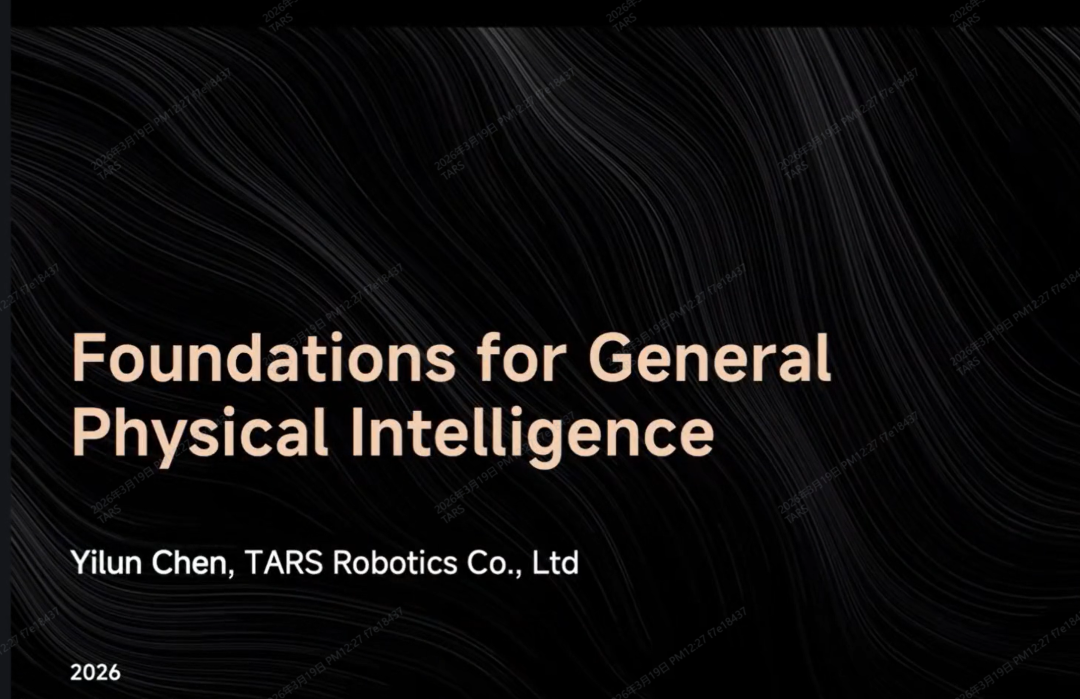
At this grand event, groundbreaking embodied intelligence technology made its debut. Dr. Chen delivered a speech titled "Foundations for General Physical Intelligence," becoming the first to systematically disclose the complete technical architecture and real-world results of the general-purpose embodied large model AWE 3.0 — using verifiable world records and industrial-grade applications to chart a clear path toward general physical intelligence for the entire industry.
01/ Ending the Industry's Route Debate: Answering Hypotheses with Facts
At NVIDIA GTC 2026, global technology giants including Tesla and Physical Intelligence participated in a roundtable discussion. Technical leaders engaged in fierce debate around core propositions in embodied intelligence, delving into data collection approaches, simulation strategy feasibility, and brain architecture design. The fundamental disagreements on these issues reflected the industry's ongoing confusion in route exploration.
Dr. Chen's presentation, through real data and AWE 3.0 — the world's first truly "working" general-purpose embodied large model — put an end to the industry's route debate with verifiable technical achievements and world record-level application performance.
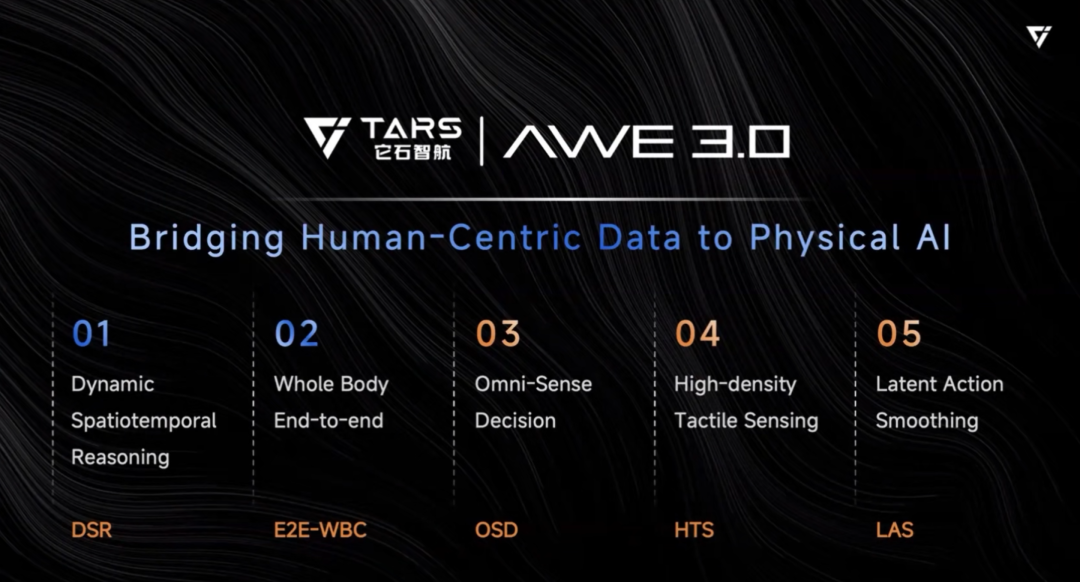
At the conference, Dr. Chen focused on explaining AWE 3.0's core architecture. This model takes vision, language, touch, and motion as unified inputs, building an intelligent system that can truly understand and manipulate the physical world. Unlike the "demo-level" models prevalent in the industry, AWE 3.0's design goal is clear and pragmatic — to get robots truly "out of the greenhouse, into real work, with generalizable capabilities."
In terms of technical breakthroughs, AWE 3.0 builds upon existing advantages in whole-body end-to-end learning and dynamic spatiotemporal reasoning, achieving three key innovations: Omni-Spatial Decision-making (OSD), High-density Tactile Sensing (HTS), and Latent-space Action Smoothing (LAS) — each directly addressing core pain points in current embodied intelligence development.
Enabled by AWE 3.0's high-precision manipulation, soft perception, and long-horizon task execution capabilities, on March 10, 2026, Tashi Zhihang successfully earned the Guinness World Records™ title for "most sub-millimeter wire harness assemblies completed by a robot in one hour." This marks the first Guinness record for a Chinese embodied intelligence enterprise in the field of industrial precision operations.
02/ A Data Paradigm Revolution: The Passive Collection Philosophy of "You Work, I Record"
Addressing the biggest bottleneck in embodied intelligence development — the data problem — Dr. Chen proposed a fundamentally different solution from mainstream approaches. He noted that AI development needs to progress through three stages: data scaling, compute scaling, and inference scaling, while embodied intelligence remains in the most basic yet critical "data starvation period." Compared to autonomous driving, embodied intelligence requires at least an order of magnitude more data.
How to obtain high-quality data became another heated debate at this conference, with industry mainstream routes showing clear divergence: some emphasize filtering high-value data, others insist on massive real robot data, and still others rely on combining simulation with human videos. Dr. Chen offered Tashi Zhihang's unique approach: the Human Centric data collection paradigm. "The good data paradigm is: you work, you live, and I record you."
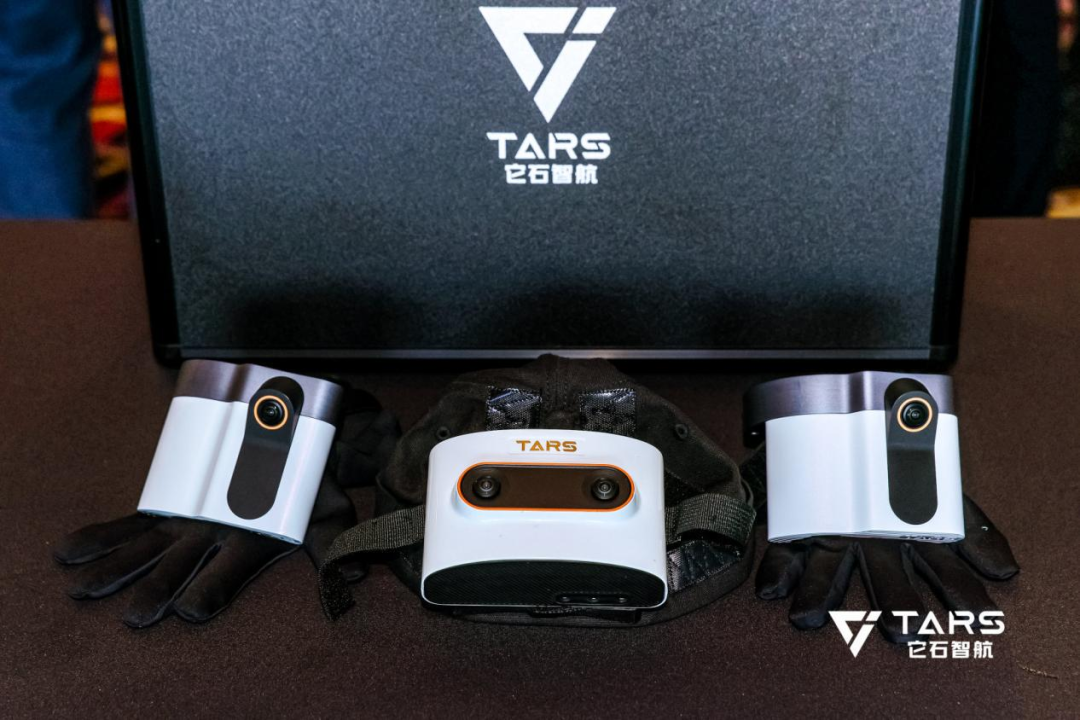
The core of this concept is that building general physical intelligence requires models to learn human natural behavior in real environments, rather than using teleoperation or simulation data to obtain a top-heavy VLA model that cannot function in real complex environments. To this end, Tashi Zhihang independently developed the SenseHub data collection suite, circumventing the scalability bottleneck of teleoperation while bridging the gap between simulation data and reality.
This also serves as a rigorous response to the industry's "chicken or egg" dilemma — before robots achieve mass adoption, how do you obtain sufficient data to make robots smarter? The answer is: let humans work first, machines record, then transfer. The global unveiling of AWE 3.0 at GTC represents China's historic shift from following to leading in the critical track of physical AI.
P A S T C O V E R A G E
Qiming Stars | Tashi Zhihang Raises $120 Million in Angel Round, Qiming Venture Partners Co-Leads

Founded in 2006, Qiming Venture Partners currently manages 11 USD funds and 7 RMB funds, with total assets under management reaching $9.5 billion. Since its inception, the firm has focused on investing in early and growth-stage outstanding enterprises in Technology and Healthcare.
To date, Qiming Venture Partners has invested in over 580 high-growth innovative companies, of which more than 210 have gone public on the New York Stock Exchange, NASDAQ, Hong Kong Exchanges and Clearing Limited, Shanghai Stock Exchange, and Shenzhen Stock Exchange, or exited through M&A and other means. Over 80 portfolio companies have become recognized unicorns or super-unicorns.
Many Qiming Venture Partners portfolio companies have grown into the most influential companies in their respective fields, including Xiaomi (01810.HK), Meituan (03690.HK), Bilibili (NASDAQ:BILI, 09626.HK), Zhihu (NYSE:ZH, 02390.HK), Roborock (688169.SH), Hesai Technology (NASDAQ:HSAI, 02525.HK), UBTECH (09880.HK), WeRide (NASDAQ:WRD, 0800.HK), HyperStrong (688411.SH), Insta360 (688775.SH), Unisound (09678.HK), Biren Technology (06082.HK), Zhipu (02513.HK), Gan & Lee Pharmaceuticals (603087.SH), Tigermed (300347.SZ, 03347.HK), Zai Lab (NASDAQ:ZLAB, 09688.HK), CanSino Biologics (688185.SH, 06185.HK), Schrödinger (NASDAQ:SDGR), MicroPort EP MedTech (688617.SH), Sanyou Medical (688085.SH), Amoy Diagnostics (300685.SZ), GenScript ProBio (688520.SH), Insilico Medicine (03696.HK), Hope Medicine, Yuanxin Technology, MediLink Therapeutics, LaNova Medicines, StepFun, and others.