Morning Star | DeepWay: The New Energy Heavy-Duty Truck of the Future Is Essentially an Industrial Robot
Staying committed to in-house R&D and production of core components, pursuing an internationalization strategy, and maintaining investment and iteration in intelligent technologies.

Editor's Note: Recently, Qiming Venture Partners portfolio company DeepWay held its spring product launch. IPO Zaozhidao interviewed DeepWay, where Chairman and CEO Wan Jun and CTO Tian Shan shared that the company's original aspiration was to achieve autonomous driving through vehicle manufacturing, with the ultimate goal of becoming an intelligent driving company and an industrial robotics company.
Wan Jun analyzed development trends in new energy heavy-duty trucks, the company's thinking on technology routes, and its three directions: insisting on self-developed and self-produced core components, globalization, and intelligentization. Tian Shan noted that only after building a solid hardware foundation can autonomous driving achieve better development, and that every autonomous driving product they develop must create value for users.
This article is republished with authorization from the Qiming Venture Partners WeChat official account.
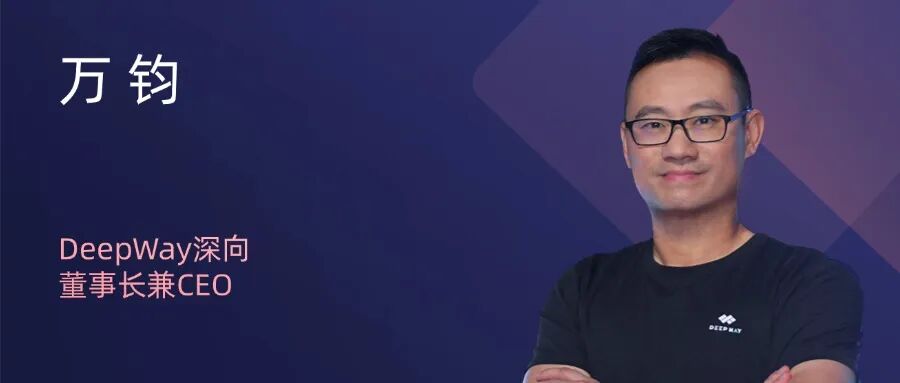
DeepWay Chairman and CEO Wan Jun
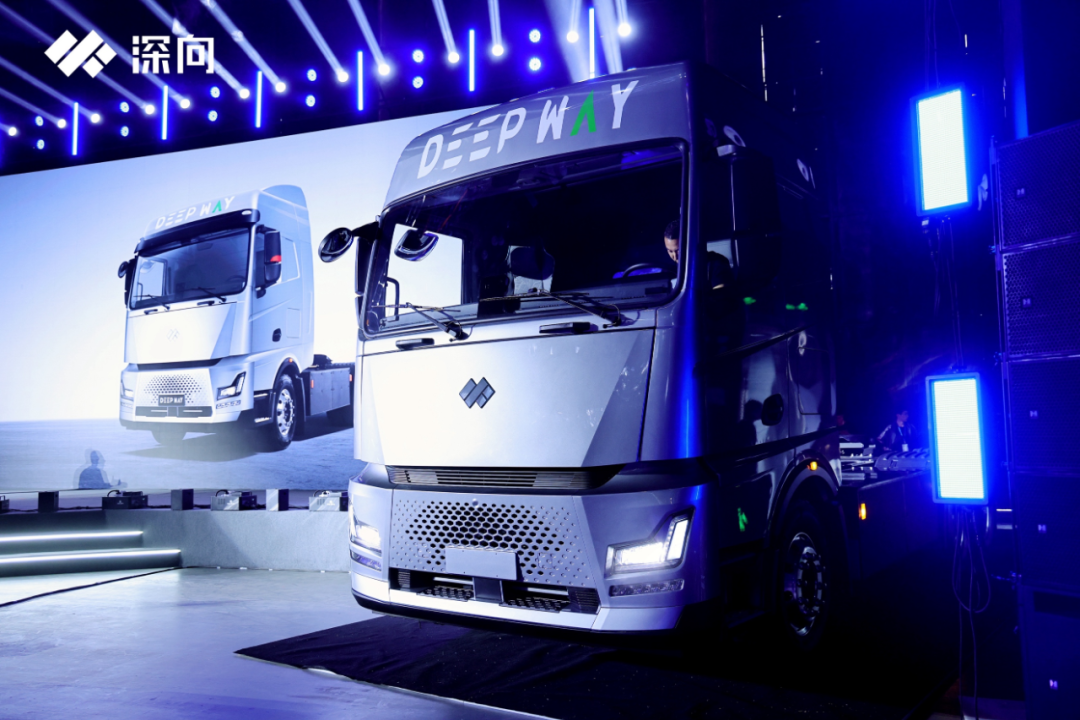
Recently, DeepWay officially launched two new energy heavy-duty truck models: the Xingchen II and the Xingtu.
According to compulsory traffic insurance sales data, since August 2024, new energy penetration in the heavy-duty truck market has exceeded 15% for eight consecutive months. In March this year, domestic new energy heavy-duty truck sales reached 15,000 units, accounting for 20.93% of total heavy-duty truck terminal sales — once again surpassing the 20% threshold.
In other words, the new energy heavy-duty truck sector is in a stage of rapid development.
And in the view of DeepWay Chairman and CEO Wan Jun, with sufficient charging infrastructure, plus the fact that commercial vehicles serve as production tools, the subsequent penetration rate increase for commercial vehicles may even outpace what passenger vehicles achieved over the past decade-plus.
Wan Jun further pointed out that for DeepWay, the company has consistently adhered to three directions: insisting on self-developed and self-produced core components, insisting on an internationalization strategy, and insisting on investment and iteration in intelligentization. "If we can do all three of these well, I believe we can win in this market."
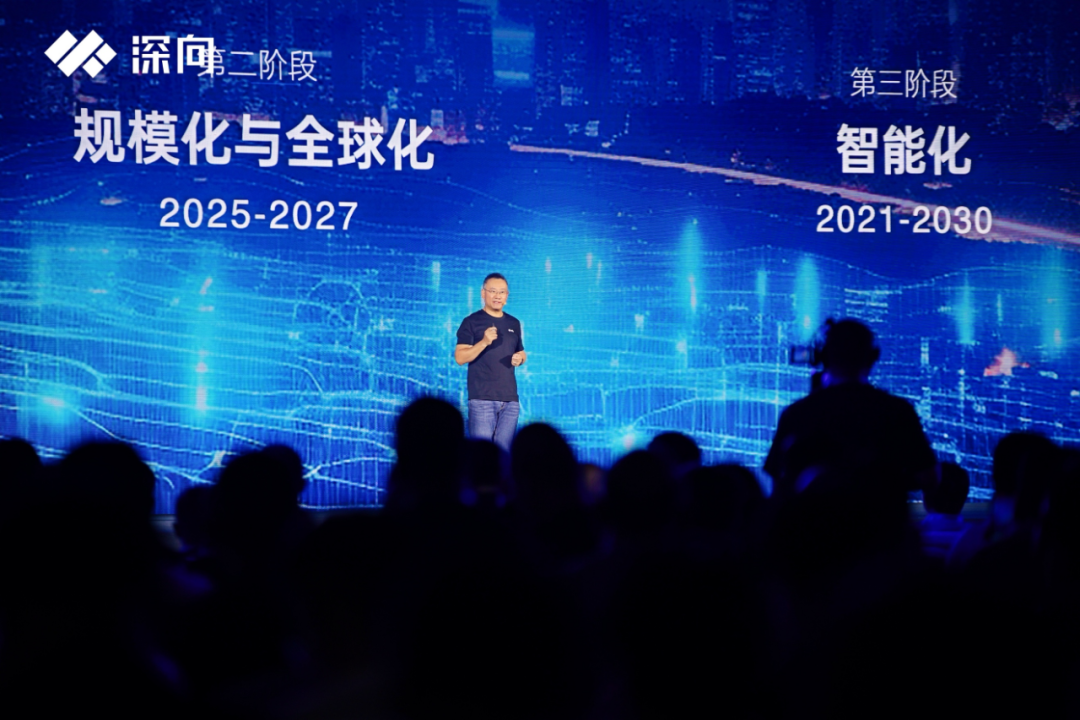
Specifically, regarding self-development: DeepWay has now achieved independent R&D of the three-electric system (battery, motor, and electronic control), which has not only effectively reduced overall vehicle costs but also significantly improved product adaptability to complex operating conditions and diverse transportation scenarios, ultimately achieving an efficient integration of lightweight design, low cost, and low energy consumption. Regarding globalization: through a team of fewer than 10 people using traditional dealer models, DeepWay has accumulated 870 orders as of May this year. Regarding intelligentization: DeepWay's new energy heavy-duty trucks now come standard with the Tianji·Suixing L2 combined assisted driving system. In system testing, Tianji·Suixing achieved a record of over 1.6 million kilometers driven with zero accidents — compared to the industry benchmark of 10 accidents per million kilometers in typical bulk transportation scenarios, this represents a substantial improvement in transportation safety.
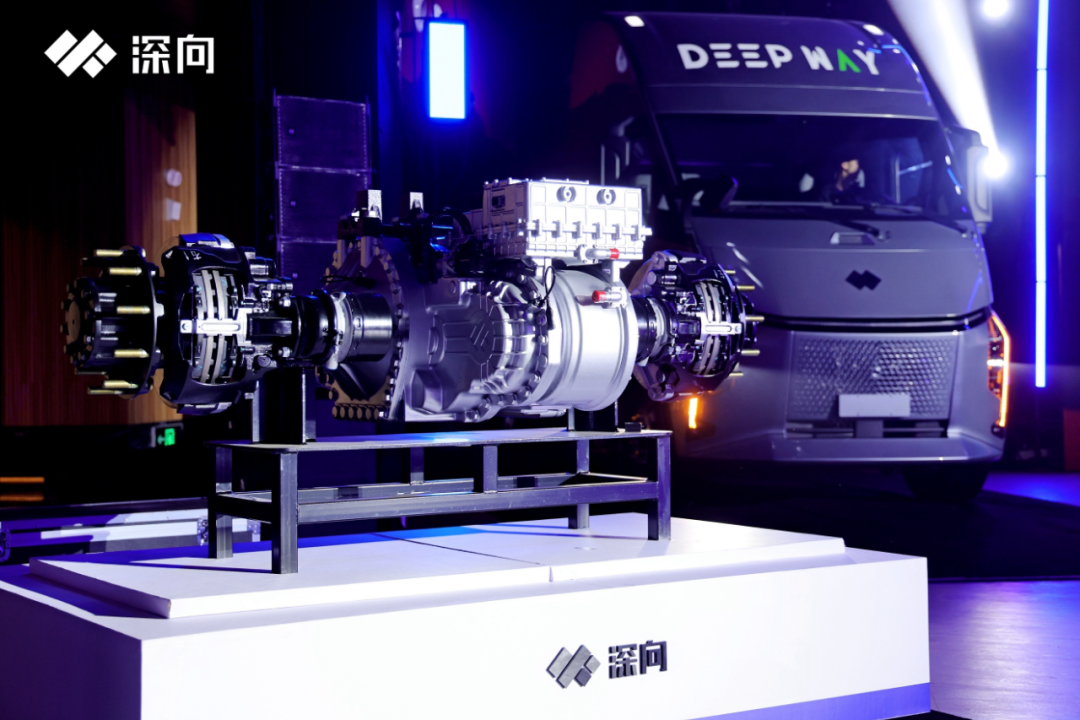
DeepWay's self-developed three-electric system
At the product launch, DeepWay signed purchase agreements with multiple domestic and international companies, accumulating 2,273 new energy heavy-duty truck orders.
Notably, Wan Jun also put forward a perspective at this launch: the new energy heavy-duty truck of the future is essentially an industrial robot.
"The core definition of a robot is to replace humans in performing a specific task, and to do so in a more environmentally friendly, safer, and more economical way. For passenger vehicles, people are already sitting in the car; for commercial vehicles, in the past humans managed the transportation of goods, but in the future when full unmanned operation is achieved, goods can be automatically transported from one city to another without any human physical labor in between. From this perspective, the new energy heavy-duty truck of the future is essentially an industrial robot — this is determined by the nature of trucks as production tools, not consumer products," Wan Jun added.
It is precisely based on this thinking that DeepWay has become more firm in its ultimate goal — not to be a truck company, but to be an intelligent driving company, an industrial robotics company. "Selling trucks" is merely a necessary transitional stage to achieve this ultimate goal.
On the occasion of the new product launch, DeepWay Chairman and CEO Wan Jun and DeepWay CTO Tian Shan shared their understanding and reflections on the new energy heavy-duty truck industry with IPO Zaozhidao and others, and elaborated on DeepWay's positioning and value.
The following is an edited transcript of the conversation.
01/
The New Energy Heavy-Duty Truck of the Future Is Essentially an Industrial Robot
DeepWay's Ultimate Goal Is Not to Be a Truck Company
IPO Zaozhidao: This time you proposed the view that "the new energy heavy-duty truck of the future is essentially an industrial robot." How should we understand this?
Wan Jun: The core definition of a robot is to replace humans in performing a specific task, and to do so in a more environmentally friendly, safer, and more economical way. For passenger vehicles, people are already sitting in the car; for commercial vehicles, in the past humans managed the transportation of goods, but in the future when full unmanned operation is achieved, goods can be automatically transported from one city to another without any human physical labor in between. From this perspective, the new energy heavy-duty truck of the future is essentially an industrial robot — this is determined by the nature of trucks as production tools, not consumer products. This is a recent reflection of mine.
IPO Zaozhidao: After this concept was proposed, what changes will it bring to future commercial vehicle usage scenarios and development directions?
Wan Jun: The core is that it has strengthened our conviction that the industry will develop toward full unmanned operation.
Actually, people have some doubts about full unmanned operation, always feeling that this may not be fully achievable. But our core team firmly believes that while this path will indeed be relatively long, this future will definitely come — this is something very certain. We just need to be more patient and invest more.
When we proposed this concept, it somewhat brought DeepWay back to our original aspiration — we once expressed an idea that DeepWay wanted to achieve autonomous driving through vehicle manufacturing, and the vehicle itself was merely a process or carrier for us. Our ultimate goal is not to be a truck company, but to be an intelligent driving company, an industrial robotics company.
However, although we have poetry and distant horizons, we still see the immediate realities. In other words, we have been somewhat more pragmatic for a period of time, spending considerable time and energy on the "vehicle" itself, and sometimes perhaps neglecting our original purpose of achieving fully unmanned driving.
So when we proposed this concept, it made the entire team return more to our original aspiration, to examine our starting point and the ultimate goal we want to achieve.
02/
More Focused on Creating Value for Customers
"Selling Trucks Well" Enables Better Development of Autonomous Driving
IPO Zaozhidao: Compared to other "new forces" in trucks, DeepWay doesn't seem to emphasize those "high-end" technologies as much.
Tian Shan: Our original aspiration has always been to achieve autonomous driving through vehicle manufacturing. Since we want to achieve autonomous driving through vehicle manufacturing, we first need to build good vehicles, and from the logic and strategic development path, "selling trucks" is a prerequisite. Only by building good vehicles and selling them can we support our autonomous driving dream — this is why we have always emphasized the diesel-electric cost differential, three-electric advantages, and so on. Essentially, it's all to help us sell more vehicles.
If we can deliver 8,000 vehicles, and all 8,000 are equipped with L2 assisted driving capabilities, our entire data scale will undergo a qualitative change. In the past, the entire industry might not have sold a few hundred vehicles with L2 assisted driving capabilities in a year. With this foundation, our autonomous driving can develop better.
So outsiders may feel that we haven't talked much about autonomous driving in recent years, but our view is that only after building a solid hardware foundation can autonomous driving achieve better development — this is a stage we must go through.
On the other hand, autonomous driving for commercial vehicles must be premised on commercial viability — that is, every autonomous driving product we develop must create value for users. Commercial vehicles are production tools; no matter how flashy or fancy something is, it's useless — users definitely won't pay for it.
Under this thinking, the reason we don't mention end-to-end or large models isn't that we don't use these technologies, but that we believe the value of these technologies themselves lies in whether the final product really has users willing to pay for it. In fact, we have end-to-end large models for passenger vehicles too — we just won't sell these products to everyone until they can truly create value for users.
Wan Jun: Often, companies without products are the ones that tend to conflate the tools they use with their products: because they have no products to show, they can only talk about concepts that nobody understands. We focus more on what kind of product we can ultimately deliver, because we have products. As for what technologies are used behind the product, we don't think that matters at all. As long as we can meet customer needs and create the value they require, even if we use the most primitive technology but the functionality is still stronger than others and the cost is lower — this is not a "shame." It doesn't mean we need some particularly "high-end" concept.
03/
New Energy Heavy-Duty Truck Penetration Will Definitely Keep Rising
The Biggest Constraint Is Still Insufficient Charging Infrastructure
IPO Zaozhidao: How do you view the development trend of new energy heavy-duty trucks?
Wan Jun: New energy penetration will definitely keep rising — this is my overall judgment. The future will definitely be a structure dominated by new energy, with the proportion of fuel vehicles decreasing. Of course, compared to passenger vehicles, commercial vehicle penetration is indeed relatively low for now. For the first four months this year, it should be slightly above 20%.
But I think looking at trends matters more than looking at absolute numbers — in 2020, new energy penetration for commercial vehicles was only a few tenths of a percent, and by 2023 it had already reached over 5%. That is, it went from a few tenths of a percent to over 5% in just about two years, while this process took passenger vehicles nearly 10 years. After passenger vehicles (new energy penetration) reached 5%, subsequent growth was explosive — today it's already around 50%. I think commercial vehicle growth may be even faster, because commercial trucks are production tools.
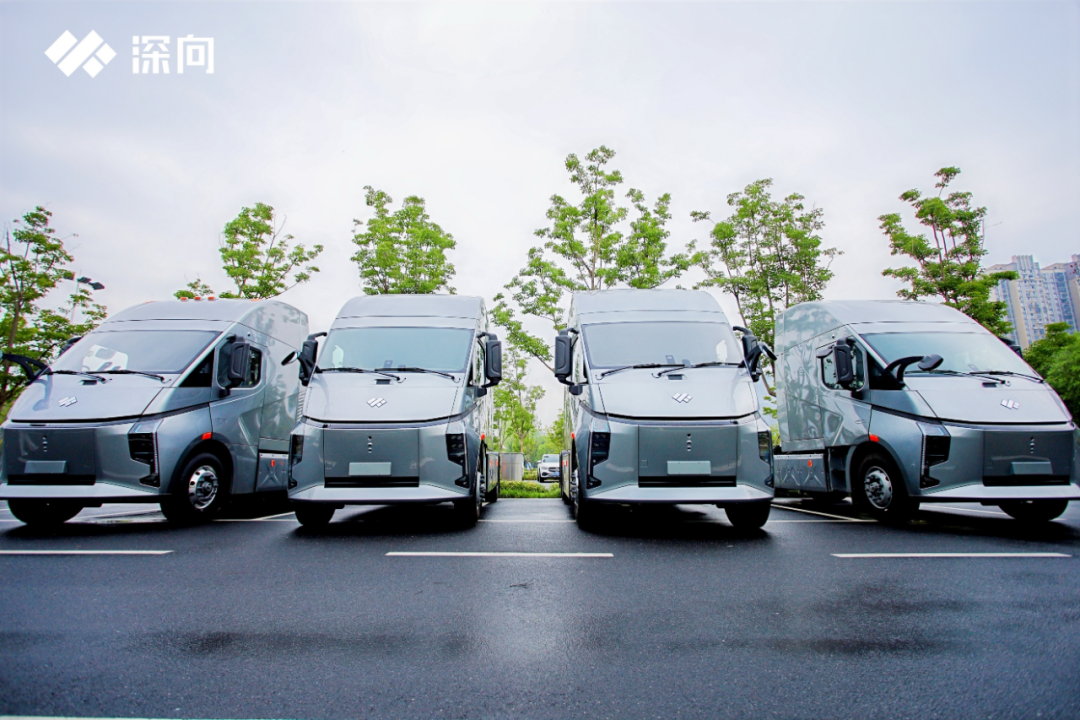
For example, in Changzhi, Shanxi, starting from mid-2024, 100% electrification was already achieved. Because that's a major coal-producing city, and the main logistics is coal transport. Once supporting charging facilities sprang up, people found that using these new energy (commercial) vehicles had no limitations whatsoever, costs were much lower than the original diesel vehicles, and profit margins were larger than before — so people stopped buying diesel (commercial) vehicles. Similarly, we've observed the same logic playing out in other regions: as long as charging keeps up, electrification happens very quickly.
Today the biggest factor constraining commercial vehicle new energyization may still be the lack of suitable charging infrastructure, but I believe this trend is changing, because I always hold a belief that in China, supply is never a problem — as long as there is demand, there will be supply. In my view, charging is relatively easy to solve, so I'm fully confident that China's truck electrification will reach 50% by 2030.
04/
Insisting on Self-Development, Globalization, and Intelligentization
Confident of Winning in the Market
IPO Zaozhidao: Do you have any preference for technology routes? Today DeepWay has chosen electric.
Wan Jun: From a technology route perspective, we have always firmly believed that the ultimate purpose of the vehicle itself is to complete transportation tasks — in a more economical, more environmentally friendly, and safer manner. So we don't oppose any technology routes; we make choices based on the maturity of the technology route itself. We have also maintained exploration of hydrogen and hybrid technologies, but at least for now, whether from the perspective of industry maturity or commercial prospects, electric is the most reasonable choice.
IPO Zaozhidao: How do you view industry competition?
Wan Jun: In any industry today, things are very "intense." But I always believe that competition ultimately brings tremendous benefits to the market — consumers can obtain lower costs, forcing manufacturers to continuously improve their technology and optimize their products, and ultimately everyone is creating customer value. So I don't find competition frightening; this is a natural process. We welcome this competition, and we are also one of the companies that have benefited from competition.
For DeepWay, we have consistently adhered to three directions: First, insisting on self-developed and self-produced core components: this can significantly help us control costs and thereby increase our competitiveness. Second, insisting on an internationalization strategy: we hope that by 2030, over 60% of sales will come from overseas. Third, insisting on investment and iteration in intelligentization.
If we can do all three of these directions — self-development, globalization, and intelligentization — well, I believe we can win in this market.
Source | IPO Zaozhidao
Past Reviews
Qiming Stars | DeepWay's Wan Jun: Designing Products from the User Perspective, Truck Electrification Will See Significant Development in the Coming Two Years Qiming Perspectives | Qiming Venture Partners' Alex Zhou: Four Key Investment Directions in Technology and Consumer for 2025 Qiming Stars | Nearly 20 Qiming Venture Partners Portfolio Companies Selected for "Future Stars" 2024 Annual Lists

Founded in 2006, Qiming Venture Partners currently manages 11 USD funds and 7 RMB funds, with total assets under management reaching $9.5 billion. Since its establishment, the firm has focused on investing in outstanding early and growth-stage companies in the Technology and Consumer (T&C) and Healthcare sectors.
To date, Qiming Venture Partners has invested in over 580 high-growth innovative companies, of which more than 210 have gone public on the New York Stock Exchange, NASDAQ, Hong Kong Exchanges and Clearing Limited, Shanghai Stock Exchange, and Shenzhen Stock Exchange, or exited through M&A and other means. Over 80 companies have become recognized unicorns or super-unicorns in their industries.
Among Qiming Venture Partners' portfolio companies, many have grown into the most influential companies in their respective fields, including Xiaomi (01810.HK), Meituan (03690.HK), Bilibili (NASDAQ:BILI, 09626.HK), Zhihu (NYSE:ZH, 02390.HK), Roborock (688169.SH), UBTECH (09880.HK), WeRide (NASDAQ:WRD), Gan & Lee Pharmaceuticals (603087.SH), Tigermed (300347.SZ, 03347.HK), Zai Lab (NASDAQ:ZLAB, 09688.HK), CanSino Biologics (688185.SH, 06185.HK), Schrödinger (NASDAQ:SDGR), MicroPort EP MedTech (688617.SH), Sanyou Medical (688085.SH), Amoy Diagnostics (300685.SZ), Berry Genomics (000710.SZ), SinocellTech (688520.SH), Yuanxin Technology, ClinChoice, Belief BioMed, Biren Technology, and others.