Interview | 'AI + Hardware': Insta360's JK on Keeping the Originality Flywheel Spinning
Companies need to solve users' genuinely unmet needs through continuous technological innovation, then reinvest profits into the next round of R&D — creating a virtuous cycle where innovation drives growth.

Recently, Qiming Venture Partners portfolio company and global leading smart imaging brand Insta360 (688775.SH) successfully listed on the STAR Market. With pioneering panoramic imaging technology, Insta360 rapidly became one of the world's most popular smart imaging brands within a decade, driven by precise execution on technology and market trends.
Qiming Venture Partners Partner Gary Ye and Insta360 Founder and Chairman JK previously held in-depth discussions at two internal Qiming meetings, systematically covering product line growth value assessment, reasons new products gain market traction, challenges and opportunities in the AI + smart era, and overseas expansion experience for consumer electronics innovators.
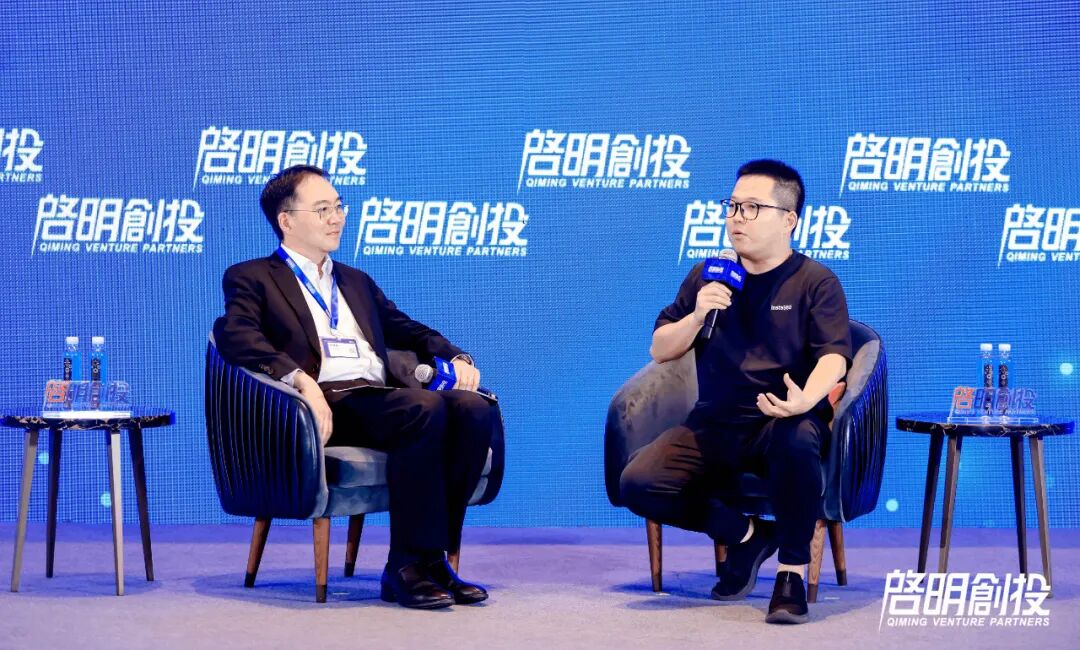
Qiming Venture Partners Partner Gary Ye (left) and Insta360 Founder and Chairman JK (right)
JK emphasized that companies need to solve users' truly unmet needs through continuous technological innovation, reinvesting profits into R&D to form a virtuous cycle of innovation-driven development. He also shared Insta360's product development experience — selecting domains with existing market demand but persistent pain points, with particular focus on technology breakthrough opportunities in high-margin markets. JK advised overseas-bound startups to maintain premium product positioning, ensure products are fully mature before market launch, and highlighted the importance of operational efficiency and patents.
Gary Ye shared his observations on the smart imaging industry's development. He noted that as early as ten years ago, when most industry players were still in the follow-and-imitate stage, Insta360 chose the path of original product R&D. He stressed that companies should focus on innovative R&D, continuously refining products to ensure they genuinely meet user needs.
01/
Developing Quality Technology and Products That Truly Meet Needs
Keeping the Originality Flywheel Spinning
Gary Ye: Hello everyone! I'm very glad to have this opportunity to meet with JK. Let's start with originality. I remember we first met ten years ago — you had just started your company, perhaps before even graduating. Insta360's initial products were highly original. Around 2015, the industry was still largely in fast-follow mode, yet you chose to do original products from the start. Where do you think this originality gene came from? Is there a connection between this originality gene and the company's development into a global leader?
JK: Thank you, Gary. We were deeply honored to receive Qiming Venture Partners' investment ten years ago, right after graduation. At that time, we came to Qiming with an original panoramic camera, meeting with Duane and Gary to discuss funding. Originality has indeed run through our company's past decade of development. Rather than originality, innovation might be more accurate, and there are several reasons behind it:
The first reason is our team composition itself. Both the founder and co-founders came from technical backgrounds. In university, we researched all kinds of new, fun products, such as building dating facilitation websites. The company has maintained this style from founding to present — we've recently developed some applications facilitating romantic connections as well. This is part of our company culture. Behind this is another very important reason: our business choices. Because we asked ourselves one question: if a company wants to develop, what does it need? It needs money. Where does money come from? It can come from investment or from operations. Investors may accompany you for a period, but not forever — you can't still be seeking investors thirty years later. So ultimately it must come from operating income.
To address this, we needed to solve one problem: why would customers buy our products rather than others'? We arrived at a very simple answer: you can solve problems others haven't solved, while having no other shortcomings, and then customers will choose your product. We carefully considered how to solve problems others hadn't solved. There are two elements here: we need to understand customer needs, and identify which customer needs others haven't properly addressed — even needs customers themselves aren't aware of. So we spent considerable time researching this, while building up a very long technology and engineering chain that would enable us to make good products meeting these needs. Internally, we define innovation as uncovering customer needs and developing quality technology and products to meet them.
Of course there are other business choices — not solving problems others haven't solved, but being more efficient than others and thus offering lower prices in the market. Good value is also a choice; Insta360 simply chose the former. Why the former? Because as university students starting a business, we had no real foundation. We weren't launching from a large resource platform, so we could only consider how to do better on customer choice, making customers choose us over other companies.
We believe product innovation and originality are very important paths. This has helped Insta360 achieve continuous development over the past decade. This continuous development means that over the past ten years, we have indeed sold products, maintained good gross margins, and the company has emphasized operational efficiency, allowing us to earn money that we then reinvested in R&D and product development. This gave us stronger capabilities to uncover customer needs in other industries, or deeper customer needs in existing industries, and create increasingly complex, innovative technology or product solutions — keeping this originality flywheel spinning, maintaining an innovative state. Here I want to emphasize one point: innovation requires money, requires capital support, and the best source of funds is the money earned solving the previous customer's problem, invested into the next cycle.
02/
Continuously Optimizing Products
Achieving Gradual Expansion of Target Customers and Application Scenarios
Gary Ye: So originality represents higher brand premium, gross margin, and the money earned can be reinvested in R&D — this is a good flywheel. Speaking of products, how do you judge whether a product line has growth value?
JK: We operate a company and develop a product, and we certainly pursue commercialization. The premise of commercialization is that customers are willing to pay for your solution or service. So finding what customers truly need, and need badly enough to pay for, is critical.
Because we didn't do market education for our first product, the Nano, after many tech enthusiasts bought it, there was no follow-on. Our major shift in thinking was to not develop products requiring market education. Instead, we directly look at which categories already exist, which markets are already mature; we also look at markets where leading companies have higher gross margins — even if a market is mature, if leading companies have relatively high gross margins, it means this market has barriers.
Third, we study consumers in the market, exploring whether they're full of dissatisfaction with existing solutions, whether many pain points remain unmet.
Basically meeting these three conditions, we believe this market presents opportunities for penetration or even disruption through new technology and products.
Insta360's current main businesses are action cameras and panoramic cameras; the company also has video conferencing and smartphone gimbal product lines, plus other products in development. Why have we launched increasingly more product lines, with many achieving very good revenue right upon launch? This relates to our solving real, validated customer needs. We can develop better solutions to replace existing products in the market.
We also hope to open entirely new markets. Because every validated market had a day when it didn't exist — each was validated and educated by one company. Beyond our existing seven product lines, we have other businesses where, based on customer needs, we attempt to develop and validate solutions, then educate and expand the market. Compared to the previous approach, this carries greater risk. But compared to when we first started, we have more accumulation and more mature methods. So we're also very confident about original categories born from Insta360.
Gary Ye: I saw that the flagship new product X5 released this April is the latest 360-degree camera. This product made waves globally — news reports showed many young people in New York lining up at dawn to buy it. Why do you think this product made such a splash? Was it due to certain market-igniting characteristics? Or was this the natural result of long-term accumulation?
JK: The fact that we're on our fifth generation and still getting good response or growth is related to the first four generations not being good enough — this is a fact. I'll make a bold guess: if Apple today released a watch that only needed charging once every two weeks, I believe not only young people would want to buy it, but probably all the seniors here would line up too. This is a very important reason. Although our product is on its fifth generation, many past pain points hadn't been solved.
For example, previously panoramic camera lenses were easily broken, and when broken had to be sent for repair at relatively high cost. In this generation, we used new materials and optical design, greatly improving hardness and making them replaceable. Previously we were limited by size, restricting the product's light sensitivity and computing power; but with the development of AI and many new technologies, this generation integrates three extremely low-power AI chips, enabling excellent low-light and dynamic performance even with very small lenses and sensors. Previously, after shooting with a panoramic camera, editing was more complex than with ordinary cameras; but now AI makes the product more intelligent and automatic in editing. All of these solved accumulated past pain points. So I believe this is a very important reason, related to our previous generations not being good enough.
Second, panoramic cameras still have relatively clear target customers and scenarios, but we believe there's still large penetration space among these target customers and scenarios. For example, many of the scenes just shown were shot in sports scenarios, even extreme sports. But as many problems and pain points of panoramic cameras are gradually solved, it's also increasingly suitable for ordinary people — ordinary people can use it to record children's growth, to record scenery seen during family trips and share with family and friends. We believe that as the product iterates, the population it adapts to while solving problems will gradually expand. Internally we have a term called PMF, Product Market Fit. For example, ten years ago when we sought funding from Qiming Venture Partners, we developed the Nano, a panoramic camera that plugged into phones. It had obvious advantages — it could shoot panoramas — and obvious disadvantages: image quality wasn't clear enough, and it had serious overheating. There would be a group in the market who could accept its advantages and not mind its disadvantages, but products with obvious pros and cons limit their ceiling, because users who care about the disadvantages won't buy. But as we gradually solved past disadvantages, the population, scenarios, and range the product suits will gradually expand — this is also a very important reason.
03/
Integrating Complex Industry Chains
Achieving Fully Automatic Shooting and Editing Goals
Gary Ye: Could you discuss what opportunities and challenges you think our products will face in the AI + smart era?
JK: When Insta360 was founded ten years ago, our mission was "helping people better record and share life," with the vision of "becoming a world-class smart imaging brand." Over the past decade, our business choices have tightly revolved around this mission. For example, we absolutely have not ventured into industries or businesses outside imaging. The technical capabilities and tech stacks we've built up — whether for products released this year or products to be released three years from now — are all planned around this mission. We realized six years ago that, for example, if we could condense Sony mirrorless-level camera performance into an iPhone-sized device, this would become the "ceiling" of the phone industry, because no phone manufacturer could achieve this breakthrough within five years.
We made this assumption, but suddenly realized a very important problem: even if we achieved this, it seemed we were still far from our mission. Because even if we made a camera with excellent performance, image quality, battery life, and portability, it still couldn't solve a very simple problem — most men here probably don't know how to photograph their wives or girlfriends well. When going out, you might take many photos, but users don't know how to edit videos or retouch images. We realized then that people's motivation for buying a camera actually comes from producing good photos and videos, but a good camera alone isn't enough to solve this, because users still need to master composition, editing techniques — all requiring substantial time to learn, but most users won't spend time studying this.
So starting six years ago, we considered how to solve this through AI. We started from pure data processing — for example, we began researching automatic editing six years ago, but the approach then was relatively crude, implemented through traditional CNN detection models and code rules. Currently, many end-to-end models developed by companies here are very effective; we directly have editors train these models, and the results are much better — this is pure data processing. However, this only solves the back-end editing problem: whether after shooting, it can automatically edit and retouch. There's another important problem: to take a good photo, the camera needs to be positioned at the right angle, so the camera needs to move. Insta360 doesn't develop robots, but we develop many products related to gimbals and motors, enabling our cameras to automatically track people — for example, when playing basketball, the camera can automatically follow the ball, shooting the entire game, and automatically edit highlight reels. So in this scenario, we can achieve fully automatic "robot" services for shooting and editing. These are some of our practices at the AI level.
We'll also long-term focus in this direction, using AI combined with cameras and mechanical capabilities to enable products to automatically record, shoot, and share in many scenarios. But the engineering difficulty is extremely high, because achieving this goal requires integrating many complex chains well — just as Mr. Zhou (Editor's note: UBTECH Founder, Chairman and CEO Zhou Jian) introduced the difficulty of developing robots. To reiterate, we're not developing robots, but the difficulty is comparable to developing robots — requiring integration of the entire chain. And our buyers are end consumers, so we also need to control costs, using consumer-grade sensors, yet achieving very robust performance — this is very challenging.
Persisting in Developing Premium Products
Emphasizing Operational Efficiency and Patent Registration
Gary Ye: Thank you! I'd like to ask you to share some advice for entrepreneurs at Qiming Venture Partners portfolio companies and for us, as we plan to invest in companies with "consumer + electronics + AI" products that may all consider globalization. So please share what should especially be done, and what especially should not be done.
JK: Building on the points just made, I especially recommend persisting in developing premium products, particularly for consumer electronics companies planning to go overseas. Only by developing premium products, with pricing benchmarked against market leaders, will this force companies to thoroughly research customer needs and force them to refine technology and products to an extreme state, thereby winning market recognition for the price. Currently, many categories have large amounts of unmet customer needs and pain points. Chinese companies have first-class engineers and supply chain resources. I believe many companies have the capability to create the best products in a category, and by persisting in this positioning, companies can become profitable; profitability enables continued investment in next-round iteration, R&D, and development. But if you immediately get caught in price wars, the company cannot profit, and subsequent development has no foundation — this is very practical. The low-price route is the easy choice, but I suggest first choosing the hard path.
Something especially not to do is also related to this: don't rush to announce a concept or idea, such as holding a product launch where news is already released but the product isn't ready, users can't buy your product, or the product has quality defects or design issues. We paid very heavy prices for early mistakes like this, and ultimately found that being first to announce actually didn't help business development much. On the contrary, if a company prepares well before launching, it creates positive feedback in the user community, forming a positive cycle where users promote to more potential users. So don't rush — make the product good before bringing it to market.
Other common challenges include company operational efficiency. I believe doing the math is very important — pricing, gross margin, marketing efficiency, etc. For example, whether customer acquisition is through agencies, or whether you carefully study advertising effectiveness and create, manage ads and KOL placements yourself, directly determines marketing efficiency and sales expenses. Regarding product R&D budgets, when initiating projects you need to control project duration — you can't push only very short-term projects, as then products won't have leading-edge qualities; but don't over-invest in products that fundamentally can't monetize in the short term, making costs too high. We've always believed making money is important, but making money isn't the tool for testing efficiency. If a product is profitable, it proves the project initiation, R&D investment, and marketing were all good. So profitability can force the entire company to achieve high operational efficiency. If a company's business can take root in various countries and regions, efficiency is extremely important.
Additionally, patent registration is very important. I believe this should become many companies' first lesson in going overseas — they need to learn basic patent knowledge and find quality law firms or teams to assist with patent registration.
Gary Ye: Excellent advice — still focus on making innovation happen, then refining products to ensure they truly meet user needs.
JK: Yes.
Investing in Promising
Yet Unvalidated and Uncommercialized "Non-Consensus" Technology
Gary Ye: Thank you! One last question — could you also share what your collaboration with Qiming Venture Partners has been like?
JK: I'm very grateful that Qiming Venture Partners invested in us for two consecutive rounds back then, and has given us support and companionship throughout. I'll share two details. First, when we presented to the investment committee, our demo was very crude with poor experience, and team members were all fresh graduates. Despite this, Gary and Duane still invested approximately $5 million, which at the exchange rate then gave us a valuation of over $20 million. If it were me, I definitely wouldn't have pulled the trigger. So I believe Qiming Venture Partners demonstrated extraordinary insight and vision regarding future technology.
Another detail before the investment: we took Gary to our then-office, at a supplier's place.
Gary Ye: In a residential building.
JK: We initially worked out of a supplier's office, but I rarely went there, so I pressed the wrong floor in the elevator. I worried Gary would have thoughts about this, but it didn't prevent Qiming Venture Partners from choosing to invest in us, for which I'm deeply grateful. So we believe Qiming Venture Partners is an institution that can see the key points and filter out noise. Qiming Venture Partners has deep insight and firm belief in "technology changing the world." Qiming Venture Partners is willing to invest in promising technology that has not yet been proven by the market or commercialized — "non-consensus" technology.
I'd also like to share a rather special observation. Qiming Venture Partners has given our company tremendous help, including when we first started and faced resource shortages in the supply chain — Gary connected us with many resources. Qiming Venture Partners is responsible not only to entrepreneurs but also to LPs. Qiming Venture Partners both continues to invest when the company needs it, and when the company has ample cash flow and reasonable valuation, appropriately manages exit timing to maintain balance. To this day, Qiming Venture Partners remains our company's second-largest institutional shareholder. Qiming Venture Partners also introduces us to new LPs and investors. In our view, Qiming Venture Partners is a very professional institution, and we're very grateful for Qiming Venture Partners' support over the past ten years.
We very much look forward to expanding cooperation with Qiming Venture Partners. The company is currently incubating multiple new technology projects internally, hoping these innovations can become the starting point for our next decade of collaboration. In the smart hardware overseas expansion space, perhaps in the future we can also jointly inspire and help more overseas-bound entrepreneurs.
Gary Ye: Thank you! And wishing you even better achievements in the future.
Previous Reviews
Qiming Stars | Global Smart Imaging Leader Insta360 Successfully Lists on STAR Market

Founded in 2006, Qiming Venture Partners currently manages 11 USD funds and 7 RMB funds, with total assets under management reaching $9.5 billion. Since its establishment, it has focused on investing in outstanding early and growth-stage companies in Technology and Healthcare industries.
To date, Qiming Venture Partners has invested in over 580 high-growth innovative companies, of which more than 210 have listed on the New York Stock Exchange, NASDAQ, Hong Kong Exchanges and Clearing Limited, Shanghai Stock Exchange, and Shenzhen Stock Exchange, or exited through mergers and acquisitions. Over 80 companies have become recognized unicorns or super-unicorns in their industries.
Among Qiming Venture Partners' portfolio companies, many have grown into the most influential companies in their respective fields, including Xiaomi (01810.HK), Meituan (03690.HK), Bilibili (NASDAQ:BILI, 09626.HK), Zhihu (NYSE:ZH, 02390.HK), Roborock (688169.SH), UBTECH (09880.HK), WeRide (NASDAQ:WRD), Insta360 (688775.SH), Gan & Lee Pharmaceuticals (603087.SH), Tigermed (300347.SZ, 03347.HK), Zai Lab (NASDAQ:ZLAB, 09688.HK), CanSino Biologics (688185.SH, 06185.HK), Schrödinger (NASDAQ:SDGR), MicroPort EP MedTech (688617.SH), Sanyou Medical (688085.SH), Amoy Diagnostics (300685.SZ), Berry Genomics (000710.SZ), Genor Biopharma (688520.SH), Yuanxin Technology, Insilico Medicine, MediLink Therapeutics, LaNova Medicines, Zhipu AI, StepFun, Biren Technology, and others.