Morning Star | WeRide's Han Xu: As Long as the Game Isn't Over, I'll Always Give My All
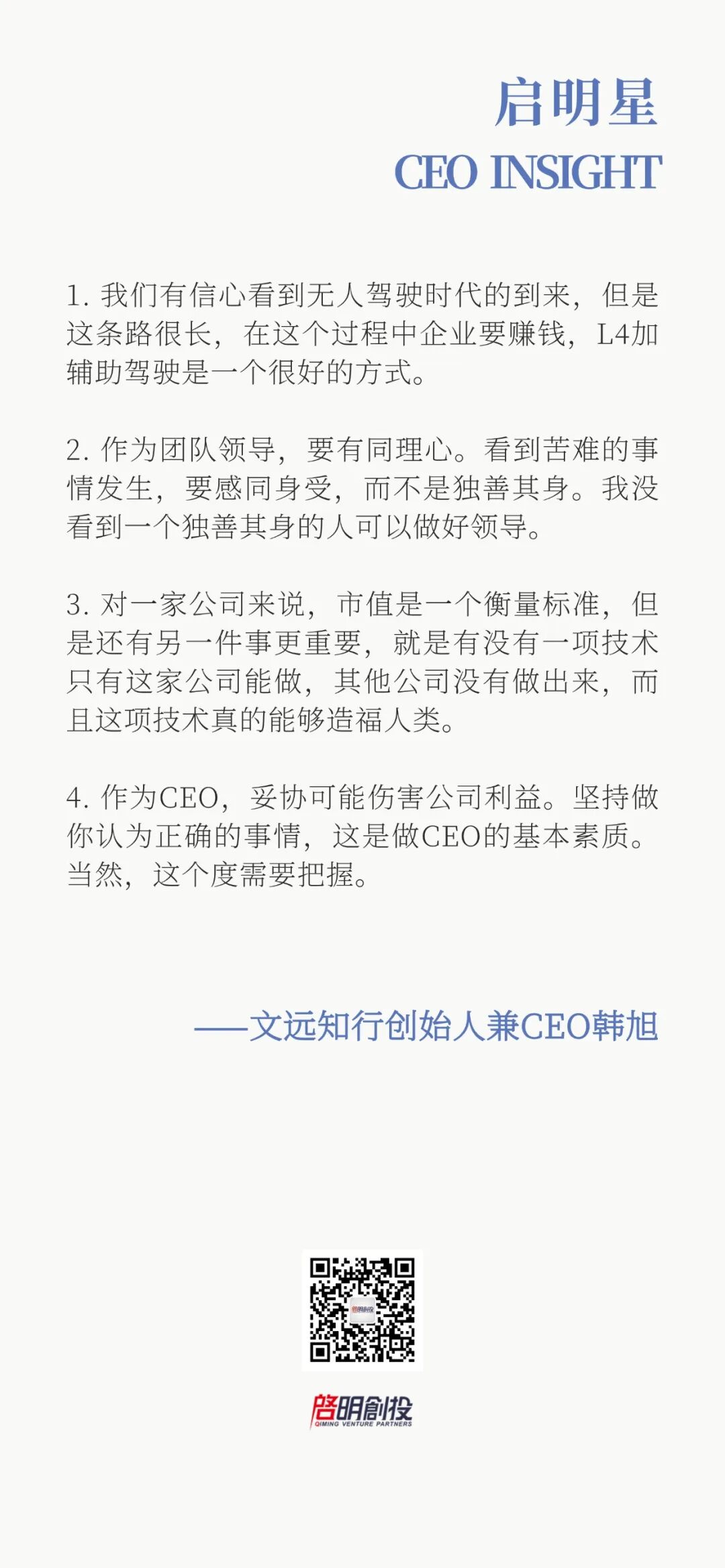
The most important thing for a company is to create value and generate profit through technology.

Editor's Note: Following its expanded partnership with Uber to deploy Robotaxi in 15 additional cities over the next five years, Qiming Venture Partners portfolio company WeRide (NASDAQ: WRD) recently signed a cooperation agreement with Dubai's Roads and Transport Authority (RTA) and Uber. The three parties will collaborate to launch commercial Robotaxi services in Dubai, bringing the convenience of autonomous driving to more users.
WeRide founder and CEO Tony Han recently sat down with China Entrepreneur magazine to share the company's commercialization model, the challenges encountered on its path to commercialization, and how it addressed them. On the decision to expand overseas, he expressed a desire to bring the benefits of autonomous driving technology to international users, much as the light bulb brought illumination everywhere. He also emphasized that when entering overseas markets, competitive advantage always comes down to solid technology, reliable products, and quality service — most importantly, delivering tangible positive returns for local customers and creating economic and social value for local communities. Looking ahead, Han noted that the era of driverless vehicles is approaching, but many challenges remain. He stressed the need to focus on the future, thinking about how to learn quickly and continuously evolve to adapt to a rapidly changing and intensely competitive environment.
This article is republished with permission from the Qiming Venture Partners WeChat official account, with edits and abridgments.
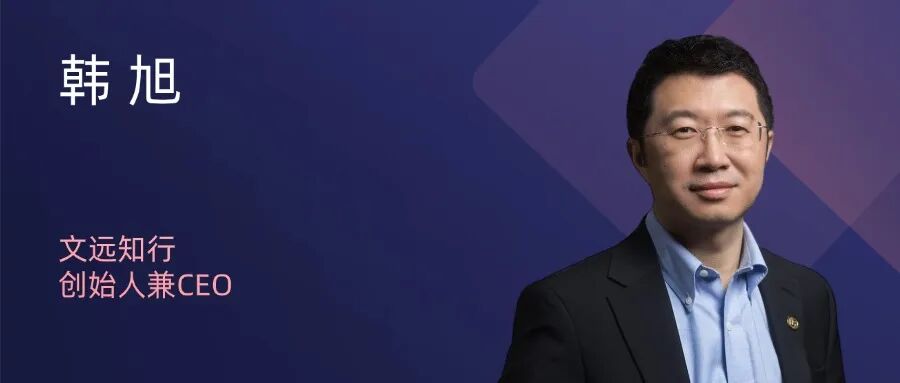
Tony Han, Founder and CEO of WeRide
As founder and CEO of WeRide, Tony Han has a hobby: sharing good books he's recently read with those around him. One book he recently recommended was Outlive: The Science and Art of Longevity. It's a book about how to take care of yourself and live healthily.
For a company, staying healthy and alive is equally important.
Six months after its U.S. IPO, autonomous driving technology company WeRide has been accelerating its commercialization and international business expansion. On May 6, WeRide and Uber announced an expanded partnership, planning to add Robotaxi operations in 15 new international cities over the next five years, covering Europe, the Middle East, and other regions.
"Past achievements are behind us. We should be thinking about what to do in the future, how to learn quickly, and how to adapt to this ever-changing, brutally competitive landscape," Han said.
In his view, the "AlphaGo moment" for autonomous driving could arrive in about three years. This will require both policy support and more application scenarios, as well as organizational upgrades within the company to select, motivate, and evaluate more talented people.
WeRide was founded in 2017, at the height of the autonomous driving industry boom, initially focusing on Robotaxi. In 2018, Han transitioned from CTO to CEO. After the company's CFO departed in 2019, he also took on fundraising responsibilities. At the most difficult point, the company had only eight months of cash left in its accounts.
From 2019 to 2020, as the autonomous driving industry entered a "winter," WeRide's survival hung in the balance.
When some senior executives wanted to exit, Han used nearly all his personal savings to buy back their shares. To raise funds, he adopted a "bull-rush tactic," meeting with wave after wave of investors, eventually securing investment from Yutong Bus and others. "More delightful still, the Min Mountains' snow in miles — After the three armies pass, all break into smiles." Han wrote in a WeChat Moments post at the time.
After catching its breath, WeRide immediately began developing new businesses like Robobus and expanding into overseas markets. In international markets, WeRide now operates in 30 cities across 10 countries, making it the only technology company simultaneously holding autonomous driving permits in China, the UAE, Singapore, France, and the United States.
Currently, WeRide has established one platform — the WeRide One autonomous driving general technology platform — and five product lines: Robotaxi, Robobus, Robosweeper (autonomous sanitation vehicles), Robovan (autonomous freight vehicles), and L2 advanced driver-assistance solutions.
Its next-generation mass-produced Robotaxi model, the GXR, received approval on February 24 to commence commercial autonomous ride-hailing services in Beijing's core Economic-Technological Development Area, the city's high-speed rail stations, and Daxing International Airport. Starting April 16, users can access Robotaxi services through WeRide's mobility app "WeRide Go" and check real-time Robobus operations.
Recently, China Entrepreneur sat down with Han for an in-depth conversation. He shared the ups and downs of the company's eight-year journey, his mindset as an entrepreneur, and his reflections on the autonomous driving industry.
The following is an edited transcript of the conversation.
01/ On Commercialization
WeRide Can't Burn Cash Forever
China Entrepreneur: What are WeRide's goals for 2025?
Han: The most important goal is scaled commercial deployment across all five product lines. We'll also continue expanding our international footprint — for example, in Q2 2025, we'll launch Robotaxi and Robobus operations in Switzerland. I believe WeRide is far ahead in internationalization, though maintaining this lead requires us to keep running, because others are catching up fast.
Additionally, we must ensure safety. The foundation of safety is technology. We need to work harder to integrate the latest large language models and world models into L4, because new algorithms can elevate safety and comfort to another level. WeRide is a pragmatic company. We don't adopt technology because it's cool or trendy, but because it improves our cost-effectiveness, safety, and comfort.
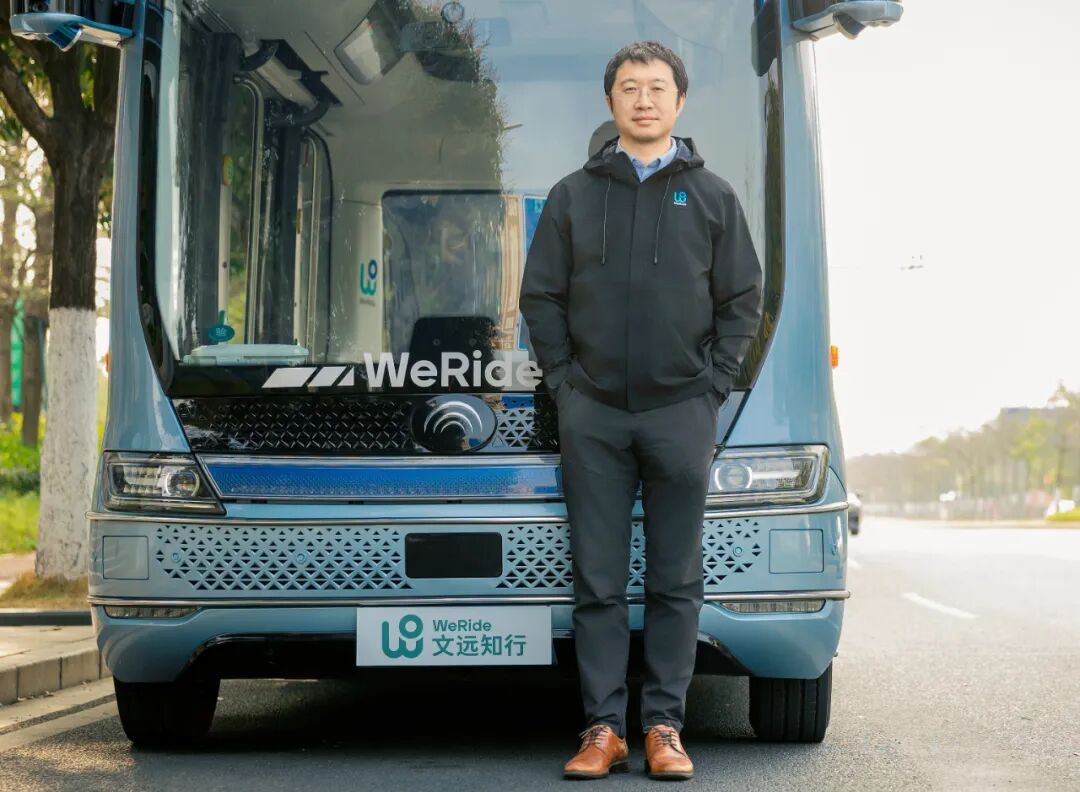
Photo | Deng Pan
China Entrepreneur: What new initiatives has WeRide undertaken in intelligent driving safety?
Han: WeRide has always treated safety as our top priority and highest priority. We've done extensive work on the technology side.
For example, our L4 autonomous driving solution employs multi-modal sensor fusion perception technology combining millimeter-wave radar, ultrasonic radar, cameras, and LiDAR, enabling 360° blind-spot-free perception. Our L2 advanced driver-assistance solution uses the QNX operating system, renowned for safety, at the underlying software level, offering industry-leading reliability, safety, and real-time performance. It also features defensive driving capabilities and 360° all-around obstacle avoidance — the former enabling human-like defensive driving to handle close-range cut-ins, sudden lane changes at small angles, and anticipating adjacent vehicles' intentions.
China Entrepreneur: It's already difficult for a company to excel at one product line. Why is WeRide doing five simultaneously? Is this choosing the hardest possible commercialization path?
Han: Yes. I believe there are difficult but correct things with significant returns that are worth doing.
Robotaxi can generate revenue, but volume has a long ramp-up period. Products like Robosweeper and Robobus, if done well, can see volume increase quickly.
The most important thing for a company is to create value and generate profit through technology. WeRide can't burn cash forever.
Are our products sufficiently focused? My answer is yes. Because we're not building five separate technologies. We're focused on one technology — essentially one fish, five ways to eat it. One technology applied to five product lines.
China Entrepreneur: How do you achieve this focus on one technology?
Han: We use the WeRide One autonomous driving general technology platform to build our product lines. This platform has three advantages: generality — highly generalizable software, hardware, and cloud architecture enabling rapid replication of standard autonomous driving capabilities across different vehicle models and scenarios; fully redundant ultimate safety — both software and hardware are fully redundant, ensuring ultimate safety in all scenarios; and self-training — using the platform to collect data from different urban traffic scenarios for continuous self-training and optimization, creating a flywheel effect for WeRide's technology.
China Entrepreneur: Were there differing opinions internally about pursuing five product lines?
Han: I see the five product lines as branches gradually growing from a tree.
Initially we only had Robotaxi. In 2020, I started thinking about Robobus. This product generated considerable debate. People asked if we were deviating from our main path. I said no, because application opportunities were already emerging, and we had Yutong Bus's support. I consider Yutong Bus the world's number one commercial vehicle company. Together we built the world's first Robobus without a steering wheel or pedals, now being tested or operated in 30 cities across 10 countries. This was an epoch-making product, completed in 2021, and still remarkably advanced four years later.
The second branch was Robovan. The thinking was: if we can build large vehicles, we can deliver goods. This was developed in partnership with ZTO Express and JMC.
The third branch was Robosweeper, which further split into two lines: a large 6-ton vehicle and a 1-ton compact vehicle.
Next came the L2 advanced driver-assistance solution in partnership with Bosch China. We've always used one set of algorithms. We didn't start with five separate things, but rather an organic, gradually growing process.
China Entrepreneur: Did you envision this many product lines when you founded the company, or did you figure it out as you found suitable partners?
Han: At the start there were just small buds. When branches grow depends on specific conditions. We may have other products to develop, but we'll only grow another branch when we encounter excellent partners. The trunk is our autonomous driving technology, because I believe we have the world's best autonomous driving technology.
China Entrepreneur: Which branch growth sparked the most intense debate?
Han: I think it was when we branched into L2, the partnership with Bosch China. That product started in 2022. People asked: could there be problems with an L4 company starting to do L2? There was a popular saying at the time about "laying eggs along the way," but from what I see now, WeRide is the only company that has truly delivered on this.
China Entrepreneur: How did you reach consensus on these differing opinions?
Han: Once we fully discuss and decide on something, everyone moves forward with one heart.
One book I read constantly is High Output Management. I call it the management "bible" and keep it in my bag, pulling it out whenever I have a moment.
Chapter 4 is about how to manage, and it's one of my favorites. It says that management must let everyone fully express their opinions. Why does a company have a CEO? Because after thorough discussion, there needs to be a very clear conclusion that everyone buys into and executes together — the CEO is the person who makes that call.
The book also mentions: meeting and decision. You can certainly make unilateral decisions, but execution becomes a major problem. Down where you can't see, people do things their own way, and the execution diverges.
We place enormous weight on discussion. When we take on something, our employees' first reaction is to ask why we're doing it and whether we should, rather than just going and doing it. After discussion, we reach a conclusion and execute.
Everyone has blind spots in their thinking — you can't manage everything. That's why many CEOs' ideas don't match their落地 results: because they haven't gone through sufficient discussion to form unified understanding.
We hold strategy meetings twice a year with our core dozen-plus executives. Our strategy sessions involve very deep discussion — we leave世俗 work aside, leave hierarchy aside, and everyone just asks whether something is right or wrong. Once we've discussed things through, the entire team's execution becomes extremely strong.
02/ On Industry Landscape
Only after full competition can a model be validated
China Entrepreneur: In 2022, why was the discussion around L2-level assisted driving the most intense?
Han Xu: The分歧 over whether to do L2 or L4 has always existed.
One分歧 was why do it now? Because sensors underwent massive change. Previously, L2 vehicles only used cameras — you couldn't use lidar because it was too expensive. A rotating mechanical lidar, even at $30,000, cost about as much as a car. But then solid-state lidar emerged, which I consider a milestone breakthrough — for the first time, lidar prices dropped to around RMB 2,000. Additionally, NVIDIA launched the Orin chip, with one chip at 254 TOPS; two chips could meet L2 requirements.
These two conditions combined made us feel we could do L2. Of course it would be difficult — beyond slimming down L4 to L2, we'd also be competing against companies that had already been at it for three or four years. But at that time, we still had confidence we could reach the top tier.
We spent 18 months working with Bosch China to develop the L2 assisted driving solution for Chery Automobile's Exeed brand. To my knowledge, we're the only company running the QNX operating system on NVIDIA chips, because Bosch China has extremely high safety requirements.
What people discussed then was why we couldn't just be a pure L4 company like our competitors — why do so much? The reason is that many pure L4 companies have gone through peaks and valleys. At peaks, everyone said autonomous driving would succeed tomorrow; at valleys, people wondered if it would ever succeed. We have confidence we can see the era of autonomous driving arrive, but we know this road is long, and during this process a company needs to make money. L4 plus assisted driving is a very good way to do that.
China Entrepreneur: Is it actually making money?
Han Xu: I think it's still in a gestation period.
China Entrepreneur: Is this cycle longer than you originally envisioned?
Han Xu: Yes, it is indeed longer than we envisioned.
China Entrepreneur: Why is it longer than envisioned?
Han Xu: Mainly changes in the competitive landscape. For example, Huawei entering as a giant, automakers insisting on in-house development, and many competitors — basically everyone's product pricing is relatively low. Of course market competition is normal; no one can predict the market 100%. I think this direction is still very correct.
China Entrepreneur: Some autonomous driving entrepreneurs believe the assisted driving business model doesn't work — suppliers either get疯狂 squeezed on price by OEMs or face enormous financial pressure. Do you agree?
Han Xu: Whether a model works or not is still hard to conclude now.
Take ride-hailing and bike-sharing — during the DiDi-Kuaidi war, some people also thought that model wouldn't work; same during the bike-sharing war. But once it reaches the finals and only a few players remain, it definitely works.
If today only 1-2 assisted driving solution providers remained, the model would work — but the precondition is that their systems are significantly ahead of most automakers' in-house efforts and other competitors' technology.
Another example: computers. Initially there were no general operating systems; every computer manufacturer made proprietary operating systems. Then UNIX emerged, with借鉴 and variants across many machines, and later Linux appeared — the general operating system model also worked.
So I think we too must go through full competition, with a few survivors remaining, and automakers willing to pay — then the model works.
China Entrepreneur: What's the revenue breakdown across your five major product lines now?
Han Xu: I think it's relatively balanced. The breakdown is often a dependent variable that changes with the market. We definitely prioritize whichever has the best input-output ratio.
China Entrepreneur: Which scenarios do you think need more deployment? Which should be deployable but currently aren't?
Han Xu: I think Robosweeper deployment should be faster. China is entering an aging society, and many young people don't want to be sanitation workers. But currently some places'考核 isn't based on ground cleaning effectiveness but on how much labor was deployed — so autonomous driving doesn't meet that standard. As labor aging deepens, many situations will gradually change.
China Entrepreneur: Any other scenarios?
Han Xu: For example, L3 should accelerate urban pilots, allowing companies with more advanced technology like ours to achieve deployment more easily.
China Entrepreneur: Has the company ever cut a product line?
Han Xu: Of course. For example, with our autonomous sanitation vehicles, we originally had a 3-ton vehicle alongside the 1-ton and 6-ton ones. But we felt engineering resources were very limited — doing the 1-ton and 6-ton vehicles well was already quite good — so we pushed the 3-ton vehicle back. We may do it in the future.
China Entrepreneur: Why prioritize holding back on the 3-ton vehicle?
Han Xu: The market decided. Main roads are swept by 6-ton vehicles, small roads by 1-ton vehicles. For functionality, the 6-ton and 1-ton vehicles can both cover what the 3-ton vehicle would do.
China Entrepreneur: For WeRide, what's the biggest challenge on the commercialization path, and how is it being addressed?
Han Xu: There are three challenges. First, the stability and reliability of integrated hardware-software solutions. Second, whether ROI meets market needs and expectations financially. Third, varying local准入 permits, operating scopes, and so on.
For the first, we need to start multi-party collaborative cooperation from the vehicle's early design stage. For example, we partnered with Geely's Farizon to develop the mass-produced Robotaxi model GXR, and with Yutong Bus to achieve front-loaded mass production for Robobus and Robosweeper — these are very major breakthroughs.
For the second, WeRide One, as a general autonomous driving technology platform, can not only be applied to different L4 autonomous vehicles but also enable efficient定向 development for mass-produced L2 assisted driving solutions,适配 different vehicle models and achieving different autonomous driving levels at minimum R&D cost, greatly reducing R&D expenses and achieving software cost reduction. For reducing labor costs, WeRide's Robotaxi, Robobus, and Robosweeper operations in many locations have already achieved fully unmanned operation. Where policy permits, we're pushing all our products in this direction. Additionally, through front-loaded mass production and supply chain management, we've also achieved hardware cost reduction.
For the third, one example: WeRide entered the Middle East market in 2021, launching publicly operated Robotaxi services in Abu Dhabi, the UAE capital, and has maintained active communication and engagement with local government departments including the Abu Dhabi Department of Transport. After more than two years of safe operation, we received the Middle East's first autonomous driving license, personally issued by the UAE Prime Minister — also the world's first license covering all domains and all vehicle types.
On the Darkest Hour: Final Victory Often Lies in Persisting Just a Little Longer
China Entrepreneur: In 2024, was going public WeRide's most important development?
Han Xu: Yes.
China Entrepreneur: I heard you were quite insistent about listing in the United States — some investors suggested Hong Kong, but you didn't waver?
Han Xu: Which market to choose relates to the political and economic environment at the time, the company's specific sector, and various other factors. Under the premise of legality and compliance, choosing a capital market with better liquidity is a very natural choice.
China Entrepreneur: When the company was founded, did you have a clear goal of definitely listing in the United States?
Han Xu: No. Our vision remains to use autonomous driving technology to transform human mobility, making it safer, more economical, more convenient, and more comfortable. I feel that if a person's purpose in studying is just to get into a top university, find a good job, and then marry and have children, that's not meaningful enough — I can't accept that purpose. It's also a waste of one's own intelligence and social resources. The purpose of learning is to master the ability to acquire knowledge and create knowledge.
China Entrepreneur: When the company went public, there wasn't a major valuation-to-market-cap倒挂. Was there less resistance from investors?
Han Xu: Yes. We often say at WeRide: "Proceed steadily to go far." This has much to do with our consistently steady development. It also means that during the capital boom, we didn't crazily inflate our valuation. And in the eight years since our founding, even during the most difficult times, we never laid off employees due to funding shortages. This is something we're very proud of.
When employees join us, unless their performance is consistently inadequate, I won't let them go. I believe that as a team leader, a good general, you must love your soldiers as your own children and have empathy. When you see suffering occur, you must feel it as your own, not remain detached. I've never seen a detached person become a good leader.
China Entrepreneur: Was 2020 your most difficult time?
Han Xu: Yes. The capital winter began at the end of 2019. In 2020, when cash was lowest, we could only sustain ourselves for 8 months. Every time we raised new funding, it would extend the runway a bit — this state of having only 8 months of money lasted a year. During that period, we were constantly raising money, buying time, until institutions like Yutong Bus invested in us.
China Entrepreneur: Was there internal discussion about selling the company?
Han Xu: There definitely was. If a business can't continue operating, selling is better than shutting down and dissolving.
China Entrepreneur: Did you approach potential buyers? Did you waver?
Han Xu: We didn't reach out in any systematic way, but some people came to us. I wasn't really struggling with it at the time. I figured I'd wrestle with that when the time came — it wasn't that moment yet. If you lose the match, then you think about how to apologize to the audience. But while the match is still going, you give it everything you've got. There's a line from On Protracted War that I love: "Final victory often lies in the effort of holding on just a little longer."
China Entrepreneur: In 2020, I heard some executives wanted to exit. If no investors were willing to buy their shares, would you have bought them yourself?
Han Xu: I had already put basically all my savings into buying those shares, leaving just a little for living expenses.
But I actually wouldn't recommend this. The world has too many stories of tragic heroes going all-in and turning the tide against impossible odds — that's really a last resort when there are no other options. I didn't imagine the company would grow to its current scale back then. I was just doing everything possible to keep myself and the company from sinking.
China Entrepreneur: Was that crisis the toughest test the company has faced?
Han Xu: I just hope there won't be so many tests in the future. No one knows what difficulties lie ahead.
We still have many goals we haven't achieved. For example, WeRide isn't profitable yet, and the complexity of problems we deal with daily keeps increasing. When a company has 40 or 50 people, you can manage through personal bonds. At 400 or 500, you need organizational management. At 4,000 or 5,000, it's not just organizational culture anymore. Every tenfold increase in scale brings fundamentally different challenges, so it's hard to say whether that was the most difficult time.
On Going Global: We Experienced the "First-Mover Disadvantage"
China Entrepreneur: In 2021, right after the company raised funding, you started expanding overseas. What were you thinking?
Han Xu: In 2021, the term "going global" didn't even exist yet. There was internal debate. Some people said, we just caught our breath and now we're going out? Expanding overseas is complex — we haven't even fully conquered China, why do this?
I felt the overseas market was substantial, the math worked, and we needed to push forward with an enterprising spirit. So we did it.
China Entrepreneur: What challenges did you anticipate?
Han Xu: Economic conditions, laws, policies — every place is different. But we wanted to bring autonomous driving technology to different overseas markets. I like this saying: Edison invented the light bulb, and it didn't just illuminate America — it illuminated the whole world.
We wanted to bring light everywhere, just like the light bulb. There are only a handful of companies in the world that can do true driverless operations. If we could bring our technology overseas and let international users enjoy the convenience of technology, why wouldn't we?
We've benefited enormously from modern civilization in China, especially medical advances. If a wonder drug were developed, wouldn't we use it? Of course we would.
China Entrepreneur: What pitfalls has the company hit overseas?
Han Xu: I can share one experience. When you're doing well overseas, Chinese competitors will come poach your people and simply copy your model. That's probably what you'd call the "first-mover disadvantage."
China Entrepreneur: How did you eventually solve this?
Han Xu: You need sufficient talent reserves, and you need to move fast enough. Talent reserves are crucial — that's why we're reluctant to lay off employees over money concerns.
China Entrepreneur: What do you think WeRide has done right in its overseas business?
Han Xu: When expanding overseas, competitive advantage always comes down to solid technology, reliable products, and quality service. Most importantly, you need to deliver tangible positive returns for local clients and create economic and social value for local communities.
We've accumulated some experience in this area. For example, maintain proactive engagement with local governments to ensure fully legal and compliant operations, while pushing for new policies and regulations that benefit the autonomous driving industry's development. Maintain partnerships with local upstream and downstream players — investors, automakers, transportation groups — so autonomous driving becomes part of the local intelligent transportation upgrade rather than an outside competitor, reducing cultural unfamiliarity and resistance. Products need localized adaptation to maximize functional, regulatory, and environmental adaptability overseas.
China Entrepreneur: What problem were you hoping to solve through the partnership with Uber?
Han Xu: Uber is probably the world's largest ride-hailing platform. Their decision to partner with WeRide first demonstrates the leading position of our technology. Plugging into Uber provides a shortcut for our overseas expansion, making it easier to be recommended to more users. This benefits both sides.
China Entrepreneur: What concrete help has this partnership brought?
Han Xu: We established our strategic partnership with Uber in September 2024. By December, we had launched the Middle East's largest commercial Robotaxi fleet in Abu Dhabi, capital of the UAE. This is also the largest publicly operating Robotaxi fleet outside the Chinese and US markets to date. In April this year, we expanded the partnership to Dubai, opening our second Middle Eastern city.
On May 6, we upgraded our cooperation again, with plans to expand to 15 additional cities over the next five years, including European and Middle Eastern markets. As you can see, the WeRide-Uber partnership is the most concrete and deep-going one out there.
05/
On Stock Price: "Many of My Decisions Have Nothing to Do with Wealth"
China Entrepreneur: The company's stock price surged dramatically on February 14 this year. What did you make of it?
Han Xu: I'm more concerned with how to build the company well. I once told our strategy team that our goal was to make WeRide a $10–20 billion company within three or four years. Later I reflected on this and felt I was being very utilitarian, lacking idealism — I wasn't thinking about creating social value or building WeRide into a great company.
China Entrepreneur: When did you have this reflection?
Han Xu: Around 2022. The industry was hot then, and everyone was claiming they'd reach $10 billion market cap. Later I felt that while market cap is one metric for evaluating a company, there's something more important: whether there's a technology that only WeRide can do, that other companies haven't developed, and that can truly benefit humanity. I'm more concerned with how to make these technologies better and generate greater commercial value.
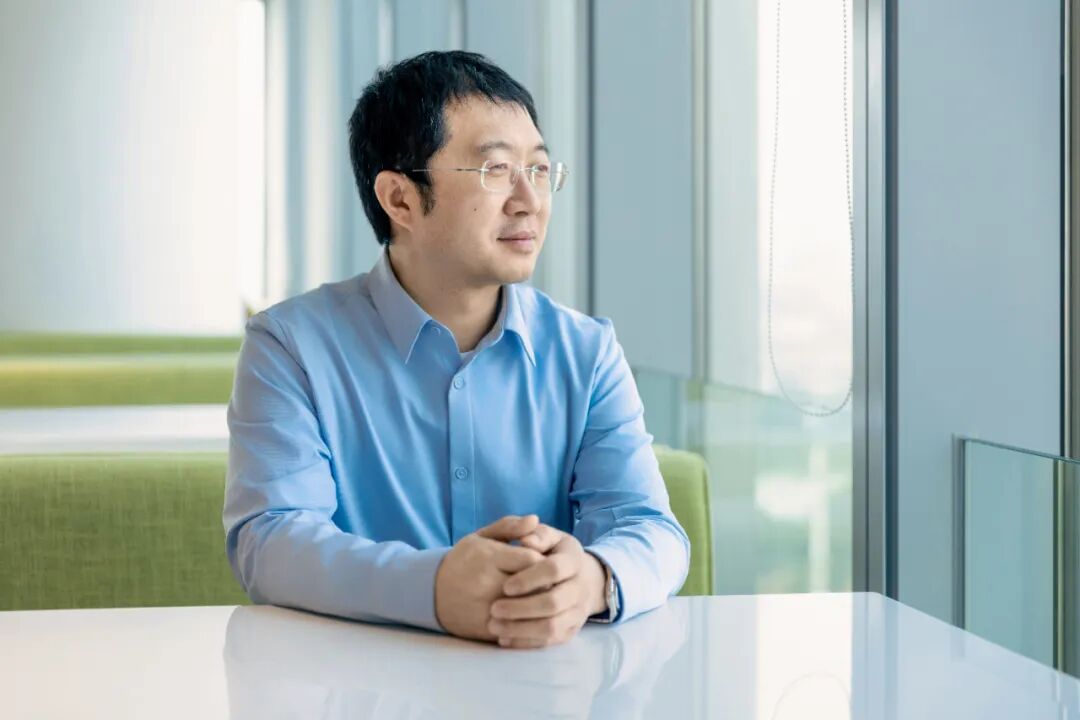
Photo | Deng Pan
China Entrepreneur: What technology specifically?
Han Xu: Some technologies we're currently developing. Watching stock prices is actually putting the cart before the horse — stock price is the result, or a manifestation of the result, and it's mixed with noise. We should focus more on the cause, on how to make the company greater. Everything else will come in due time.
China Entrepreneur: So you don't check the stock price every day now?
Han Xu: I still check it every day, but I'm much more at peace about it. I definitely need to know what the stock price is, but for me it's just one indicator.
China Entrepreneur: On the day of the surge, did you get a lot of messages? How did you feel?
Han Xu: First, pretty happy. Second, I was also wondering why it surged. Third, I immediately reminded myself: don't get carried away. Stock prices can fluctuate wildly — stay focused on the problems in front of you.
China Entrepreneur: You're the founder of WeRide, but in terms of equity, you're not the largest shareholder. Was this an adjustment made as the company developed?
Han Xu: I think it was a matter of circumstance. When Steve Jobs passed away, would he have regretted that Apple's market cap wasn't 10 times higher? I don't think so.
Especially for founders, a company really is like your own child. I certainly hope to raise it into what I envision, so I still need a certain amount of equity. But wealth has never been my goal — many of my decisions have nothing to do with wealth.
On Personal Growth: Persist in What You Believe Is Right
China Entrepreneur: I heard you met with a great many investors around 2020, and you still maintain a habit of deep weekly conversations with several of them?
Han Xu: In 2018, I transitioned from CTO to CEO. People thought it would take at least two years to make that transition well. Then in 2019, the company started having problems, and our original CFO left. I had to be both CEO and fundraiser — and fundraising was something I'd been particularly unskilled at.
At the time, used what I called the "bull charge tactic" — I met with any investor in China willing to see me, sometimes multiple investors in a day, presenting nonstop. Because I believed that even if I failed, it would be a failure after exhausting every possible effort. Fortunately, with support from institutions like Yutong Bus, we pulled through.
I'm also deeply grateful for a few people who stayed by my side, constantly helping me think through solutions — like our board member Duane Kuang (Editor's note: founding managing partner of Qiming Venture Partners), who was also an early investor in us.
China Entrepreneur: What advice did they give you?
Han Xu: For example, Duane Kuang taught me that as CEO, you cannot ignore conflicts. Duane Kuang told me that as CEO, compromise can harm the company's interests. Persisting in what you believe is right is a fundamental quality of being CEO. Of course, this balance is very difficult to strike. If you go too far, people may say you're authoritarian and stubborn. But if you don't make any decisions, the company doesn't need a CEO. A good CEO always strikes this balance very well.
China Entrepreneur: Of the advice you've received from the outside, what have you acted on and what haven't you?
Han Xu: For example, self-cultivation — I feel my cultivation is still insufficient. Under heavy pressure, my emotional control may still not be good enough. As for what I've done well, it's still too early to say.
China Entrepreneur: Have you had moments of poor judgment or strategic misjudgment?
Han Xu: I think the brutality of the assisted driving competition exceeded my expectations. But if I had known how brutal it would be, would I still have done it? Probably yes.
WeRide has a resilient spirit — we rise to the challenge. You thought the enemy had 1,000 troops, so you brought 3,000, planning to encircle and annihilate them. Then you discover the enemy has 10,000. You still have to fight, never retreating even unto death. You'll still win in the end — just with greater casualties, fighting harder. We have the spirit of "though thousands stand against me, I shall go."
China Entrepreneur: After partnering with Bosch China, is dealing with competition still very difficult?
Han Xu: Many Chinese autonomous driving companies have exited. Everyone is still competing — it's still a brutal scramble upward.
Markets change in an instant. No one is right forever. If someone tells you every strategic call they've made was correct, I think they're full of it — getting 90% right is already pretty good. What matters is having the courage, confidence, and resilience to adjust after that 10% you got wrong.
China Entrepreneur: If WeRide hadn't gotten into the ADAS business, would your losses be smaller?
Han Xu: That question doesn't even register for me. It's like casualties in war — if you lose the war, fewer casualties along the way mean nothing; if you win, even heavy losses at some point were a necessary price. In war, you focus on the outcome. If you only think about casualties, you're guaranteed to lose.
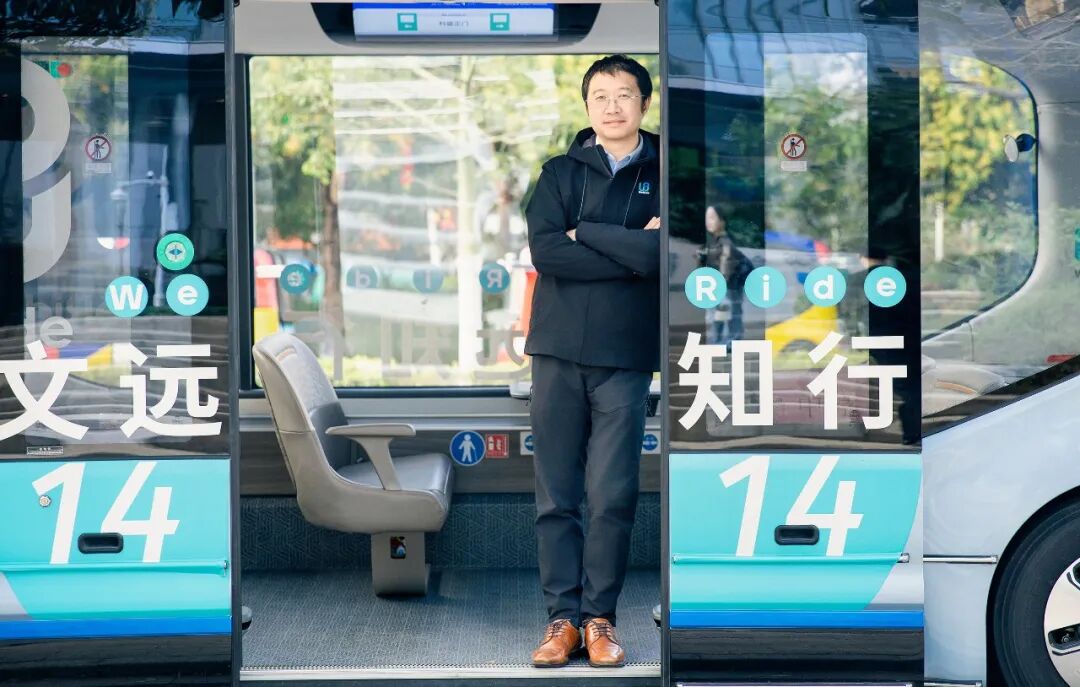
Photo | Deng Pan
China Entrepreneur: "One general's triumph, ten thousand soldiers' bones" — do you agree with that?
Han Xu: I actually really dislike that saying. What we're doing is about succeeding, paying a price, everyone working hard, and sharing the rewards together. The better metaphor is "sweat now, gold medal later." You can't just lie around expecting to win gold — talent alone won't cut it. Maybe we're not the most naturally gifted, but we're definitely the hardest working.
Rather than dwelling on the past, I want to talk about the future. We're approaching the era of driverless mobility, but there are still many hurdles to clear. Past achievements are behind us — what matters more is figuring out what comes next, how to learn fast, and how to adapt to this ever-shifting, brutally competitive landscape.
China Entrepreneur: How do we accelerate the arrival of the driverless era?
Han Xu: First, policy support. Right now we need more large-scale application scenarios for autonomous driving.
Second, from an internal company perspective, organizational upgrading and management matter enormously. How do you select, motivate, and evaluate top talent? These are all difficult challenges, because the more exceptional the talent, the harder they are to assess.
China Entrepreneur: Has WeRide introduced any innovative approaches to talent evaluation?
Han Xu: We're results-oriented, but results have a time dimension. Someone spends ten years forging one sword — that means no results for the first nine. Can you stomach that? Many companies struggle with this. You can't have it both ways. If you want short-term results, you may have to sacrifice some long-term goals. These trade-offs require constant adjustment.
China Entrepreneur: Any examples of this results-oriented approach?
Han Xu: Take our Robosweeper. From a results perspective, is it a successful product? We've already sold several hundred units. If sales break ten thousand, I'll consider it a resounding success. Another example: WeRide has operated Robotaxi for over 2,000 days without a single at-fault safety incident — that's a very clear, results-oriented demonstration on the safety front.
Source | China Entrepreneur
Author | Wang Wentong
Interviewers | Wang Wentong, Ren Yafei
Editor | Ma Jiying
Past Coverage
Qiming Stars | WeRide's Han Xu: The Ultimate Winner Will Prevail on Service Quality | Bilingual

Founded in 2006, Qiming Venture Partners currently manages 11 USD funds and 7 RMB funds, with total assets under management reaching $9.5 billion. Since its inception, the firm has focused on investing in outstanding early- and growth-stage companies in the Technology and Consumer (T&C) and Healthcare sectors.
To date, Qiming Venture Partners has invested in over 580 high-growth innovative companies, of which more than 210 have gone public on the NYSE, NASDAQ, Hong Kong Exchanges and Clearing Limited, Shanghai Stock Exchange, and Shenzhen Stock Exchange, or exited through M&A and other means. Over 80 portfolio companies have become recognized unicorns or super-unicorns.
Many Qiming Venture Partners portfolio companies have grown into the most influential players in their respective fields, including Xiaomi (01810.HK), Meituan (03690.HK), Bilibili (NASDAQ:BILI, 09626.HK), Zhihu (NYSE:ZH, 02390.HK), Roborock (688169.SH), UBTECH (09880.HK), WeRide (NASDAQ:WRD), Insta360 (688775.SH), Gan & Lee Pharmaceuticals (603087.SH), Tigermed (300347.SZ, 03347.HK), Zai Lab (NASDAQ:ZLAB, 09688.HK), CanSino Biologics (688185.SH, 06185.HK), Schrödinger (NASDAQ:SDGR), MicroPort EP MedTech (688617.SH), Sanyou Medical (688085.SH), Amoy Diagnostics (300685.SZ), Berry Genomics (000710.SZ), GenScript ProBio (688520.SH), Yuanxin Technology, Insilico Medicine, MediLink Therapeutics, LaNova Medicines, Zhipu AI, StepFun, Biren Technology, and others.