Morning Star | Cornerstone Robotics' Guowei Ou: Committed to Full-Stack Self-Development, Aiming to Transform the Global Surgical Robotics Landscape

To succeed as a founder, you need to balance two roles: the architect and the farmer. The architect takes the high-level view, designing efficient systems and setting strategic direction for the company. The farmer puts in the steady, unglamorous work — tilling the soil day after day, staying ready for bigger opportunities when they arrive.

Editor's Note: Recently, Qiming Venture Partners portfolio company Cornerstone Robotics collaborated closely with a research team at The Chinese University of Hong Kong to develop the world's first multifunctional automated embodied intelligence platform for surgical robots, successfully completing the world's first autonomous surgical verification in a clinical setting on Cornerstone's self-developed Sentire laparoscopic surgical robot. This marks a critical step forward in validating the versatility and practicality of China's autonomous surgical robot technology.
In an interview with China Entrepreneur magazine, Guowei Ou, founder and CEO of Cornerstone Robotics, shared his reasons for choosing to develop laparoscopic surgical robots. Regarding the decision to pursue full-stack in-house development of surgical robot components, Ou explained that creating qualified components is essential to ensuring the safety, efficacy, and stability of surgical robots, while also enabling cost control across the entire supply chain. He also described the measures Cornerstone has taken to expand clinical adoption of surgical robots in more hospitals.
William Hu, Managing Partner at Qiming Venture Partners, noted in the interview that Cornerstone Robotics maintains rigorous processes and highly efficient iteration mechanisms in its technology development. On the market strategy front, the company has a clear positioning: leveraging China's supply chain advantages to reduce costs and produce safe, effective, and affordably priced products that address unmet market needs. He added that as industry-academia-research-medicine collaboration grows increasingly tight, technological breakthroughs from universities and research institutions will accelerate their transfer to enterprises, helping Cornerstone continuously enhance its product competitiveness.
This article is republished with authorization from the Qiming Venture Partners WeChat official account.

Guowei Ou, Founder and CEO of Cornerstone Robotics
In the sci-fi blockbuster Prometheus, the scene where protagonist Elizabeth Shaw lies down in a fully automated surgical pod and mechanical arms complete a cesarean section without human intervention remains vividly memorable.
Thirteen years after the film's release, science fiction is steadily becoming reality.
In 2019, Guowei Ou, a professor at The Chinese University of Hong Kong who had spent over two decades in the surgical robotics field, founded "Cornerstone Robotics" alongside a group of top surgical robot experts, focusing on the development of high-end surgical robots.
In August 2022, Ou led his team to complete the first clinical application of the self-developed Sentire laparoscopic surgical robot at Hong Kong's Prince of Wales Hospital, performing a radical prostatectomy for urological prostate cancer.
To date, the Sentire laparoscopic surgical robot has completed clinical trials across multiple major specialties, and in September 2024 received formal approval from the National Medical Products Administration for market launch in China. It is simultaneously applying for medical device certification globally.
As early as his doctoral studies at MIT's Department of Mechanical Engineering, Ou collaborated with other professors to develop the world's first robotic ankle prosthesis. This invention was named one of Time magazine's Best Inventions of the Year in 2007, and was subsequently commercialized.
Ou still remembers the smile of the patient who received that robotic ankle prosthesis — a moment that largely determined his future path.
After completing his doctorate, Ou joined Intuitive Surgical, a world-leading surgical robotics company. Founded in 1995, Intuitive Surgical pioneered global surgical robot technology, with its flagship product being the renowned DaVinci surgical robot. At Intuitive Surgical, Ou led development of the Da Vinci Single-Site system and the Da Vinci ION lung biopsy surgical robot platform.
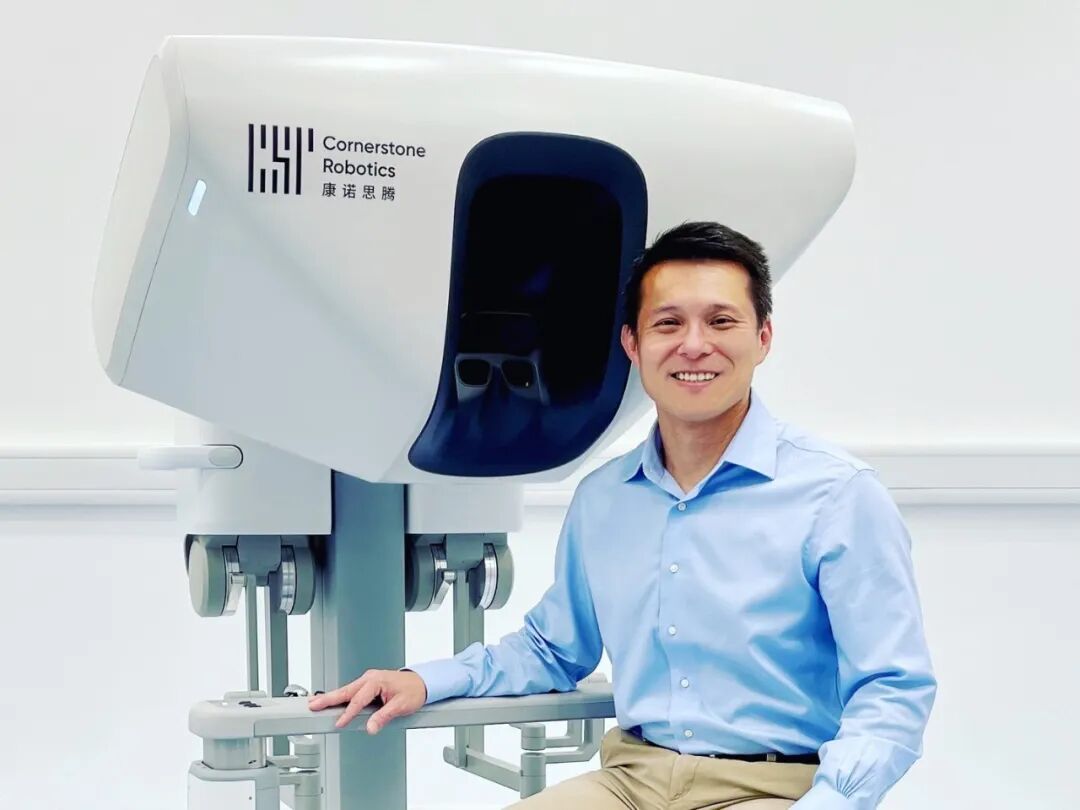
In 2016, Ou returned from the United States to teach at The Chinese University of Hong Kong, carrying entrepreneurial ambitions to build Chinese surgical robots. He hoped to leverage the Greater Bay Area's supply chain advantages and China's vast domestic market to translate research into broader commercial applications. He has long held a wish: "To give patients better treatment and doctors better assistive tools — I want every hospital to have a surgical robot."
Since its founding, Cornerstone Robotics has raised four rounds of investment totaling over 1.8 billion yuan, with investors including Qiming Venture Partners and other prominent institutions.
William Hu, Managing Partner at Qiming Venture Partners, was among the earliest investors in Cornerstone Robotics. During the 2020 COVID-19 pandemic, the two were unable to meet in person and could only communicate by phone. Yet in that first call, Ou made a strong first impression on Hu. Ou shared his understanding of the surgical robotics field and declared his ambition to reshape the global surgical robot landscape through Cornerstone Robotics. Since then, Qiming Venture Partners has invested in all four rounds of Cornerstone's funding.

William Hu, Managing Partner at Qiming Venture Partners
"Professor Ou not only had a clear technology roadmap — such as self-developed core technologies to ensure excellent product performance with controllable costs — but also assembled a top-tier cross-disciplinary team spanning mechanical engineering, electronics, software, medicine, and other fields. This comprehensive layout from underlying technology to clinical application showed me tremendous potential for the project's success," Hu told China Entrepreneur.
Cornerstone Robotics' core founding team comprises top surgical robot experts with deep industry experience and talented professionals from various disciplines, bringing extensive backgrounds in medical robotics research, technology development, clinical translation, and industrialization. Beyond Ou, CTO Zerui Wang was previously a research assistant professor at The Chinese University of Hong Kong, and the team includes engineers from Imperial College London and other prestigious institutions.
To achieve the goal of "changing the global surgical robot landscape," Ou established a global organizational footprint from day one, setting up four R&D centers in Shenzhen and Hong Kong, China; Boston, United States; and Portsmouth, United Kingdom. Additionally, leveraging the Greater Bay Area's supply chain advantages, Cornerstone built a mass production factory exceeding 10,000 square meters in Shenzhen.
01/ China's Surgical Robot Penetration Below 1%
The first product Ou led his team to develop independently was a laparoscopic surgical robot — the same domain targeted by the DaVinci robot, acclaimed as the "hand of God."
"The reason we chose this category is that over 45 million laparoscopic surgeries are performed globally each year, far exceeding other surgical types, meaning surgical robots have greater future application potential in this field and can help more patients. Currently, domestic surgical robot penetration in this area is extremely low, below 1%, and global penetration is also under 5%. Only the United States exceeds 15%," Ou told China Entrepreneur.
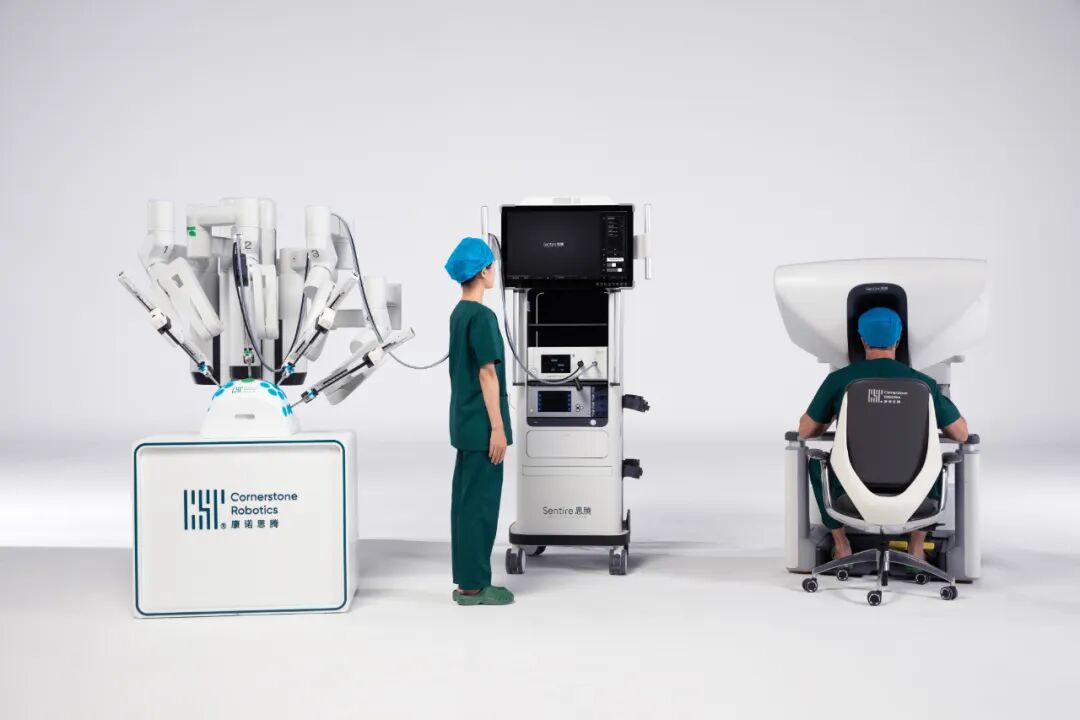
Currently, laparoscopic surgical robots can be applied in thoracic surgery, hepatobiliary surgery, gastrointestinal surgery, urology, gynecology, and other fields. These surgeries are often complex and precise, requiring highly experienced physicians.
However, robot-assisted laparoscopic surgery remains fundamentally a procedure performed by professional surgeons, with the entire operation overseen by a specialized medical team that has undergone rigorous foundational and clinical training.
Regarding how surgical robots work: just as doctors use ultrasound to gain "X-ray vision" to see organs, and endoscopes to extend their eyes into the gastrointestinal tract, surgical robots enable doctors to simultaneously extend both their hands and eyes, performing surgery on patients through very small incisions.
The benefits of robot-assisted laparoscopic surgery include smaller incisions, reduced bleeding, infection, and complications. Meanwhile, surgical trauma and postoperative pain are also diminished, facilitating faster return to normal life for patients. Additionally, it can improve surgical success rates.
In Ou's view, robot-assisted laparoscopic surgery benefits not only patients and doctors, but entire families. From his life experience, he has seen too many people whose lives and work are disrupted when family members fall ill, with the whole family's time consumed by the patient and everyone's burden increased. Robot-assisted laparoscopic surgery allows patients to return to daily life more quickly.
02/ 13,000 Components, Fully Self-Developed
"Many people habitually evaluate surgical robots using industrial robot standards. Generally, industrial robots have fewer than 1,000 components, but surgical robots have 13,000," Ou emphasized to China Entrepreneur.
Surgical robots are acclaimed as the pinnacle of medical technology products. Technically, they involve core technologies including mechanical architecture, power modules, electrical architecture, software architecture, complex algorithms, and visual imaging control — with enormous development difficulty. Beyond the sheer number of core technologies involved, the crucial point is that surgical robots are integrated systems with extremely high requirements in every domain.
Yet from day one of entrepreneurship, Ou decided on full-stack self-development. This became the question he was asked most frequently by investors during the entrepreneurial process: with so many fragmented components, why develop and design everything in-house?
"Surgical robots are a matter of life and death. The foremost standard is safety, efficacy, and stability. We cannot afford any harm to patients' lives that might result from substandard components," Ou told China Entrepreneur.
Cornerstone Robotics' English name is Cornerstone, meaning foundational stone. In Ou's view, to excel in surgical robots, one must build the technological cornerstone rather than simply buying components and assembling them.
When William Hu first engaged with Ou and Cornerstone Robotics, he also had concerns, mainly around technology development risks and competitive market pressures.
"Surgical robot technology is extremely complex, involving interdisciplinary integration, so technical risks may emerge during R&D. On the market side, the DaVinci surgical robot has already established first-mover advantage, with significant market share and brand recognition globally and domestically. As a latecomer, how Cornerstone could rapidly open markets and gain recognition from doctors and patients was a challenge," Hu analyzed to China Entrepreneur.
As Hu gained deeper understanding of the Cornerstone team, his concerns were quickly allayed.
He found that Cornerstone Robotics maintains rigorous processes and highly efficient iteration mechanisms in technology development. For example, in developing the mechanical master hand, they continuously invited doctors for testing, iterating the design approximately every two weeks, and after over a year of refinement produced a product meeting surgical usability requirements.
Furthermore, on market strategy, Cornerstone has clear positioning: leveraging China's supply chain advantages to reduce costs and produce safe, effective, and reasonably priced products that satisfy unmet market needs.
Over the past six years, Cornerstone's Sentire laparoscopic surgical robot has undergone nearly a hundred iterations. Each generation of product required continuous debugging and iteration in collaboration with specialist physicians. "Even for one interface, over 500 design drawings were made," a Cornerstone employee recalled to China Entrepreneur.
Currently, the Sentire laparoscopic surgical robot, with its highly dexterous articulating multi-functional instruments and immersive glasses-free 3D high-definition imaging, can extend surgeons' hands and eyes wherever needed. Its manipulable range far exceeds human hand limits, enabling free movement and operation even in confined spaces.
Additionally, through micro-damping calibration mechanisms and technologies including tremor filtration and motion correction, the Sentire laparoscopic surgical robot can effectively suppress inertial drift during operation, precisely replicating master hand movements for stable, accurate control without "floating, shaking, or sticking" issues.
03/ Achieving Broader Clinical Applications
For surgical robots to enter more hospitals and achieve clinical application, numerous obstacles remain, including pricing, hospital approval processes, and physician training cycles.
Regarding pricing, Ou told China Entrepreneur that Cornerstone's commitment to full-stack self-development from day one serves two purposes: ensuring technological control over surgical robots, and achieving cost control across the entire supply chain — ultimately enabling competitive pricing.
To address physician training, Cornerstone has developed and built its own surgical robot remote network. Through Cornerstone's dedicated remote surgery network and surgical robot system, surgical experts can perform remote surgeries and remote supervision, while younger, less experienced physicians can undergo remote training online.
In this way, remote surgery enables top surgeons' medical expertise and capabilities to be digitally extended, promoting global sharing and redistribution of medical resources; remote supervision allows senior experts to serve as "digital mentors" providing real-time guidance for clinical teaching or surgical operations, helping rapidly popularize surgical robot technology.
Additionally, Cornerstone has established its own experimental animal center, which for hospitals serves as core research infrastructure supporting medical research and translational medicine — a critical hub connecting basic research, clinical treatment, and technological innovation. However, establishing an experimental animal center involves high qualification requirements, strict biological control standards, and prevention of zoonotic disease transmission, among other criteria. Thus, not all hospitals have the capacity or willingness to build such facilities.
But in Cornerstone's philosophy, animal experiments create an efficient communication platform between clinical physician teams and Cornerstone's engineering teams, enabling rapid documentation and continuous iteration of various surgical robot issues identified by clinicians during testing.
For doctors and hospitals, the traditional training model for young surgeons has primarily been surgical observation, with scarce opportunities for hands-on operation and experience. Now, they can develop surgical skills through animal experiments, without adding training burdens to hospitals.
Currently, Cornerstone is collaborating with Beijing Shijitan Hospital and other institutions to cultivate new generations of young surgeons.
As domestic healthcare standards improve, patient demand for minimally invasive surgery increases, and medical insurance policies gradually tilt toward innovative medical technologies, the surgical robot market will grow rapidly.
Frost & Sullivan assessments show that the global surgical robot market will experience rapid development in coming years, with market size potentially reaching 399.4 billion yuan by 2030, representing a compound annual growth rate of 21.3%. China's surgical robot market is projected to reach 70.952 billion yuan, with a compound annual growth rate as high as 36.9%.
In Hu's view, domestic surgical robots will gradually capture market share and achieve independent innovation through supply chain advantages, cost-performance benefits, and R&D approaches more closely attuned to domestic clinical needs. Furthermore, he believes industry-academia-research-medicine integration will grow increasingly tight, with technological achievements from universities and research institutions accelerating their transfer to enterprises — helping Cornerstone continuously enhance product competitiveness.
In Ou's view, entrepreneurship requires balancing the roles of "architect" and "farmer." The architect takes a commanding view, managing the company and strategic direction scientifically and efficiently; the farmer works diligently and persistently, continuously cultivating and always preparing for greater opportunities to come.
Source | China Entrepreneur Magazine
Authors | Dongshan Zhao, Xiaodi Zhang
Editor | Xiaodi Zhang
Previous Articles
Dialogue | Building the "Pinnacle" of Surgical Robots

Founded in 2006, Qiming Venture Partners currently manages 11 USD funds and 7 RMB funds, with total assets under management reaching $9.5 billion. Since its establishment, the firm has focused on investing in outstanding early and growth-stage companies in Technology and Healthcare innovation.
To date, Qiming Venture Partners has invested in over 580 high-growth innovative enterprises, of which more than 210 have listed on the New York Stock Exchange, NASDAQ, Hong Kong Exchanges and Clearing Limited, Shanghai Stock Exchange, and Shenzhen Stock Exchange, or exited through mergers and acquisitions. Over 80 portfolio companies have become recognized unicorns or super-unicorns in their industries.
Many Qiming Venture Partners portfolio companies have grown into the most influential companies in their respective fields, including Xiaomi (01810.HK), Meituan (03690.HK), Bilibili (NASDAQ:BILI, 09626.HK), Zhihu (NYSE:ZH, 02390.HK), Roborock (688169.SH), UBTECH (09880.HK), WeRide (NASDAQ:WRD), Insta360 (688775.SH), Gan & Lee Pharmaceuticals (603087.SH), Tigermed (300347.SZ, 03347.HK), Zai Lab (NASDAQ:ZLAB, 09688.HK), CanSino Biologics (688185.SH, 06185.HK), Schrödinger (NASDAQ:SDGR), MicroPort EP MedTech (688617.SH), Sanyou Medical (688085.SH), Amoy Diagnostics (300685.SZ), Berry Genomics (000710.SZ), SinoCellTech (688520.SH), Yuanxin Technology, Insilico Medicine, MediLink Therapeutics, LaNova Medicines, Zhipu AI, StepFun, Biren Technology, and others.