Qiming Venture Partners' Duane Kuang: China's new quality productive forces are going global, and the venture capital industry can play an important role
Venture capital firms' tolerance for high risk and focus on long-term value inherently make them adventurous, willing to back technological innovation. By building a closed innovation loop that moves from "blood transfusion" to "blood creation," they can deeply embed themselves in company growth. And they have the ability to identify the most promising entrepreneurs and the most compelling directions for innovation.

On May 19, the Shenzhen Stock Exchange 2025 Global Investor Conference was held in Shenzhen under the theme "New Quality Productive Forces: New Opportunities for Investing in China — An Open and Innovative Shenzhen Market." Duane Kuang, Founding Managing Partner of Qiming Venture Partners, was invited to deliver a keynote speech titled Venture Capital and the Development of New Quality Productive Forces. Kuang stated that China's "new quality productive forces" are going global, with enormous investment potential. Global recognition of Chinese tech products and tech companies is rising, and the conditions and opportunities for China to build world-class tech enterprises are already in place — making this a space very much worth watching.
In this process, China's venture capital industry will play an important role. Specifically, venture capital firms' tolerance for high risk and focus on long-term value give them an adventurous spirit and a willingness to back technological innovation. By building an innovation loop that moves from blood transfusion to blood creation, VC firms can deeply participate in company development. And VC firms are able to identify the most promising entrepreneurs and innovation directions.
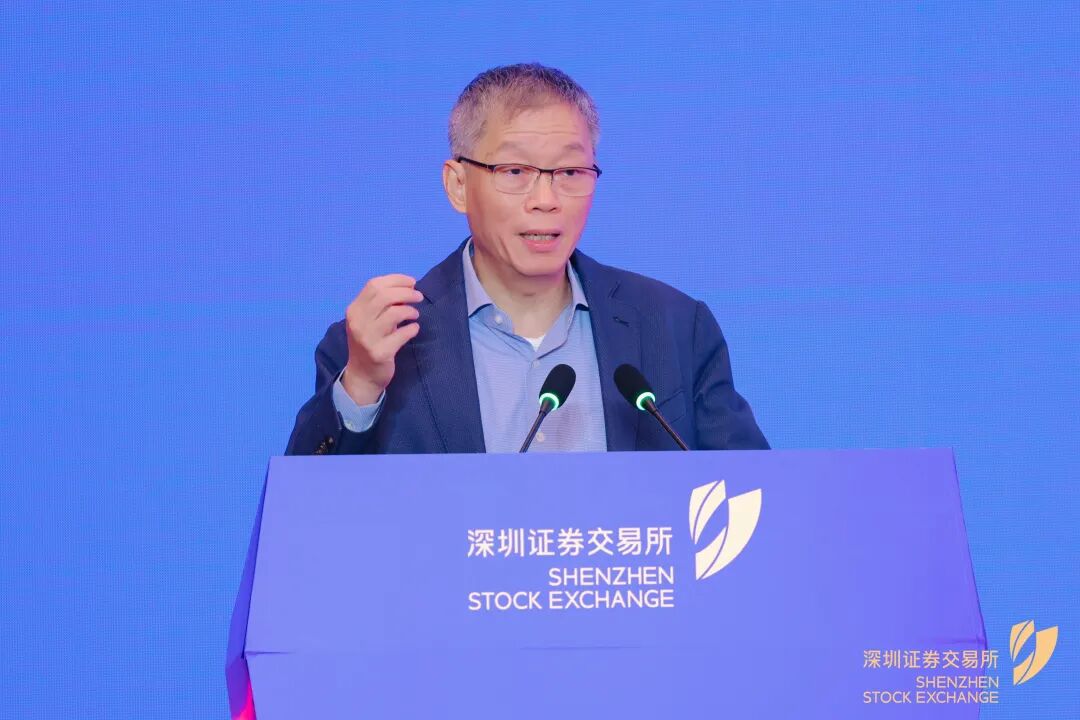
Duane Kuang, Founding Managing Partner of Qiming Venture Partners
The following is a transcript of the speech:
Distinguished leaders, guests, and colleagues, good morning. I'm very glad to have this opportunity to share my views on China's new quality productive forces and the investment opportunities around them. I have two main points: first, China's new quality productive forces are going global, with tremendous investment potential; second, in this process, China's venture capital industry can play a very important role. Let me expand on these two points.
01
China's Next-Generation AI Capability Ranks in the Global First Tier
When we talk about Chinese technology and China's new quality productive forces, we can't avoid a very hot topic recently — DeepSeek's "breakout" at the end of last year and beginning of this year. Let's review what happened: On December 26 last year, DeepSeek open-sourced its flagship model V3; on January 20 this year, DeepSeek further open-sourced its reasoning model R1. Through DeepSeek's own published papers and open-sourced algorithms, many major international computing centers and AI infrastructure providers, in a very short time, used DeepSeek's models to build inference and training models, and the results were indeed stunning. There were two aspects to this: first, its reasoning performance was very close to OpenAI's o1, comparable to o1. But more importantly, its cost was one-thirtieth that of OpenAI and the other well-known large models, including some American ones. This sent massive shockwaves through the global tech community, especially in AI. For some time before this, people believed China had AI capabilities, but still lagged about two years behind the international advanced level. After DeepSeek emerged, people realized the gap between China and the world's most advanced level was just two or three months — mainstream American business media were all reporting on it.
Not long after DeepSeek's emergence, MIT Technology Review published an article titled "Four Chinese AI Startups to Watch Beyond DeepSeek," listing StepFun, ModelBest, Zhipu AI, and Infinigence AI (editor's note: all portfolio companies of Qiming Venture Partners' investment team). This article illustrates one point: DeepSeek is just one representative company of Chinese AI capabilities "breaking out" — it's not the only competitive enterprise in China's AI field. DeepSeek's breakout showed the world that China has sufficient AI capabilities and stands at the global forefront in the current generative AI wave. The perspective I hope to bring is that after DeepSeek's breakout, the mindset people should have is this: there's no need to suddenly think Chinese AI is extraordinarily amazing, and even less need for self-deprecation thinking Chinese AI isn't up to par.
Just now I mentioned DeepSeek's R1 and OpenAI's o1, roughly a two- or three-month gap. Perhaps after some time, it becomes a six-month gap, a one-year gap, but it's also possible that certain Chinese AI models could even surpass currently most advanced international models. The most critical factor here is still confidence. DeepSeek's emergence allows us to very confidently believe that China's next-generation artificial intelligence capabilities rank in the world's first tier.
02
China's New Quality Productive Forces Are Going Global
On February 7, The Wall Street Journal published a report with the headline "China's Drug Industry Has Its Own DeepSeek Moment." This means it's not just in artificial intelligence — China's biopharmaceutical sector is experiencing the same thing, creating the world's most advanced next-generation biopharmaceutical products at faster speeds and lower costs. Let's look at the data from China's biopharmaceutical field in recent years. In fact, another chart I didn't show in my presentation is even more telling — in 2024, 30% of global major pharmaceutical companies' license-in deals came from outstanding Chinese biopharmaceutical startups. By comparison, in 2019, that number was zero. Some context here: the world's largest multinational pharmaceutical companies obtain some new drugs through internal R&D, but a very large portion through external collaboration, including purchasing patents from small and medium biotech R&D institutions and enterprises. China used to be a license-in country, a major recipient of overseas advanced medicines; now China has become a major source of license-out deals.
These two phenomena didn't suddenly occur in 2024. If we look back, China's exports over the past 20 years have shifted from traditional top categories like textiles to machinery, mechanical and electrical equipment, consumer electronics and components now being the largest category, accounting for 42% of total annual exports. And the fastest-growing categories are vehicles, aviation, and marine transport — particularly China's new energy electric vehicles demonstrating strong global competitiveness.
Why do I emphasize so much the internationalization of China's new quality productive forces and Chinese tech companies, Chinese companies going global, when talking about China's new quality productive forces and investment opportunities today? Let's look at America's largest tech companies, the Magnificent Seven. For these seven companies, overseas revenue accounts for more than 50% for most of them. Even Amazon, with its main battlefield in US e-commerce, derives 37% of its revenue from international markets. That is to say, a great tech company is necessarily a global tech company.
Let's look at China's large tech companies. In recent years, their internationalization and global acceptance have also been gradually improving. Among representative outstanding Chinese tech companies, none so far has overseas revenue exceeding 50%. However, these companies' growth momentum is very strong. From Shenzhen's BYD to CATL, ByteDance, Alibaba, and the newer tech giant Xiaomi (editor's note: a Qiming Venture Partners portfolio company), their overseas business proportions are rising year by year, and the proportions are already quite high.
This phenomenon isn't just happening at China's large tech companies — it's also happening at smaller ones. Here are several emerging Chinese tech companies: Roborock (editor's note: a Qiming Venture Partners portfolio company), which uses LiDAR and AI algorithms to make robot vacuums that dominate globally, becoming the world's leading company with number one global sales; Shenzhen-based Insta360 (editor's note: a Qiming Venture Partners portfolio company), which grew from a university student startup to today being far ahead globally in action cameras, especially panoramic cameras, with overseas business already at 80%, covering over 60 countries and regions; Hesai Technology (editor's note: a Qiming Venture Partners portfolio company), whose main products are LiDAR. In recent years, LiDAR has also shifted from American companies being the main suppliers to Chinese companies having very high global market share, with Hesai Technology being one very representative company; Mech-Mind Robotics (editor's note: a Qiming Venture Partners portfolio company), which uses AI vision paired with robotic arms to provide AI solutions for production lines.
Companies large and small are going global. To summarize: in the early years of reform and opening up, over ten to twenty years, we proved to the world China's manufacturing capability and quality; through step-by-step efforts in recent years, China's tech companies have also proven to the world their strong competitiveness. And the time and capability required for global recognition of a country's tech products and tech companies far exceeds what it takes for a country's manufacturing capabilities to gain acceptance. Through more than a decade of effort, China's tech companies and the capabilities of China's new quality productive forces have already forged this path. We believe the potential and opportunities for building world-class tech enterprises in China are already in place, and very much worth anticipating.
03
China's Venture Capital Industry Can Play a Major Role
The second point I want to make today: in this process, China's venture capital industry can play a very important role, and there are many investment opportunities.
Venture capital and technological development have a very natural relationship. VC's characteristics of high risk tolerance and long-term value anchoring determine that venture capital is most willing to take risks to support technological innovation. VC's mechanism of action is the innovation loop from blood transfusion to blood creation — that is, very different from other financial products, venture capital can not only invest but also participate in much of the work during a company's process of creating its own blood. VC can identify the most promising entrepreneurs and innovation directions. The vast majority of Chinese venture capital investment goes into technological innovation, including AI, advanced manufacturing, healthcare, new energy, and so on.
After more than a decade of rapid advancement, in recent years China's venture capital industry has faced considerable challenges. Recently, when talking with international investors and USD LPs about opportunities and challenges in China, I always share this view: from a global perspective, if you want to do venture capital, where should you put your money? Look at this chart and the answer is clear. This shows companies founded since 1990 that received venture capital investment and later reached maximum market caps exceeding $100 billion. If we only look at companies that received VC funding and were founded after 2010, as of April 25 this year, there are 7 such companies globally, 6 of which are from China. This is the reason to invest in China. This is the opportunity in China. I believe China's new quality productive forces and technological innovation will continue to generate more enormous investment opportunities and create more companies with investment potential and huge returns.
Where do these opportunities come from? I've listed some areas we focus on, including artificial intelligence, biopharmaceuticals, renewable energy, embodied intelligence/robotics, and so on. For AI, from investing in AI foundations and infrastructure in recent years, in the coming years AI will shift from "usable" to "actually good to use," and usable quite freely, conveniently, and cheaply. This major inflection point will happen in the next few years. I believe starting from 2025, AI empowering all industries will bring enormous investment opportunities. For biopharmaceuticals, population aging and increasingly focused attention on ever-smaller disease categories are all excellent opportunities for next-generation innovation. For renewable energy, historically energy powers were countries with natural resource endowments. In the next fifty years, I believe energy powers will be manufacturing powers, tech powers — whoever can do better R&D on new materials and better design of new energy equipment will be the energy power.
Today we're at the Shenzhen Stock Exchange's home court for the Global Investor Conference. As a venture capital institution, we also hope to play an active role in improving the quality of China's listed companies: whether continuously supplying quality pre-IPO companies to the exchange, or participating in companies' development processes as directors, shareholders, and so on to improve corporate governance standards... Additionally, in M&A and other directions, we're also making some new attempts.
Through deeper and further cooperation with the Shenzhen Stock Exchange and peers in China's capital markets, we hope to help more of China's new quality productive forces enterprises grow better.
Past Articles
Qiming View | Duane Kuang: The Time Is Right for China's Technology to Go Global
Qiming Honors | Qiming Venture Partners Ranks 5th in Zero2IPO 2024 China VC Rankings Among 5 Awards

Qiming Venture Partners was founded in 2006. Currently, Qiming Venture Partners manages 11 USD funds and 7 RMB funds, with total assets under management reaching $9.5 billion. Since its founding, it has focused on investing in early and growth-stage outstanding enterprises in Technology and Consumer (T&C), Healthcare, and other industries.
To date, Qiming Venture Partners has invested in over 580 high-growth innovative companies, of which more than 210 have listed on the New York Stock Exchange, NASDAQ, Hong Kong Exchanges and Clearing Limited, Shanghai Stock Exchange, and Shenzhen Stock Exchange, or exited through M&A and other means. More than 80 companies have become recognized unicorns or super-unicorns.
Among Qiming Venture Partners' portfolio companies, many have grown into the most influential companies in their respective fields, including Xiaomi (01810.HK), Meituan (03690.HK), Bilibili (NASDAQ:BILI, 09626.HK), Zhihu (NYSE:ZH, 02390.HK), Roborock (688169.SH), UBTECH (09880.HK), WeRide (NASDAQ:WRD), Gan & Lee Pharmaceuticals (603087.SH), Tigermed (300347.SZ, 03347.HK), Zai Lab (NASDAQ:ZLAB, 09688.HK), CanSino Biologics (688185.SH, 06185.HK), Schrödinger (NASDAQ:SDGR), MicroPort EP MedTech (688617.SH), Sanyou Medical (688085.SH), Amoy Diagnostics (300685.SZ), Berry Genomics (000710.SZ), GenScript ProBio (688520.SH), Yuanxin Technology, ClinChoice, Belief BioMed, Biren Technology, and others.